The Future of Flight: How VTOL Drones Are Changing Aviation
+
Table of Contents
- 1 What are VTOL Drones?
- 2 Benefits of VTOL Drones
- 2.1 1. No Need for a Runway
- 2.2 2. More Endurance
- 2.3 3. Better Reachability
- 2.4 4. Operational Efficiency
- 2.5 5. Less Infrastructure Dependence
- 3 Uses of VTOL Drones
- 3.1 Agriculture
- 3.2 Delivery
- 3.3 Emergency and Rehabilitation Missions
- 3.4 Military and Defense
- 3.5 Infrastructure Monitoring
- 3.6 Mapping and Monitoring
- 4 VTOL Drones vs Conventional Drones
- 4.1 AI and VTOL Drones
- 4.2 Issues Encountered with VTOL Drones
- 4.3 Limitations of Batteries
- 4.4 Regulatory Frameworks and Managing Air Traffic
- 4.5 Sensitivity to the Elements
- 4.6 High Initial Costs
- 4.7 Risks to Cybersecurity
- 5 Looking Ahead to VTOL Drones
- 5.1 Air Travel Right in Your City
- 5.2 Enhanced Battery Tech
- 5.3 Autonomous Operations
- 5.4 Smart City Integration of Drones
- 5.5 Increased Adoption in Commerce
- 6 The VTOL Drone’s Eco-Friendly Contribution to Aviation
- 7 Conclusion
- 7.1 FAQs
- 7.1.1 1. What does VTOL stand for?
- 7.1.2 2. What is the difference between VTOL and regular drones?
- 7.1.3 3. Which industries utilize VTOL drones?
- 7.1.4 4. Are VTOL drones sustainable?
- 7.1.5 5. Can VTOL drones be used for manned flight?
- 7.1.6 6. What are the problems with VTOL drones?
- 7.1.7 7. Where do VTOL drones go from here?
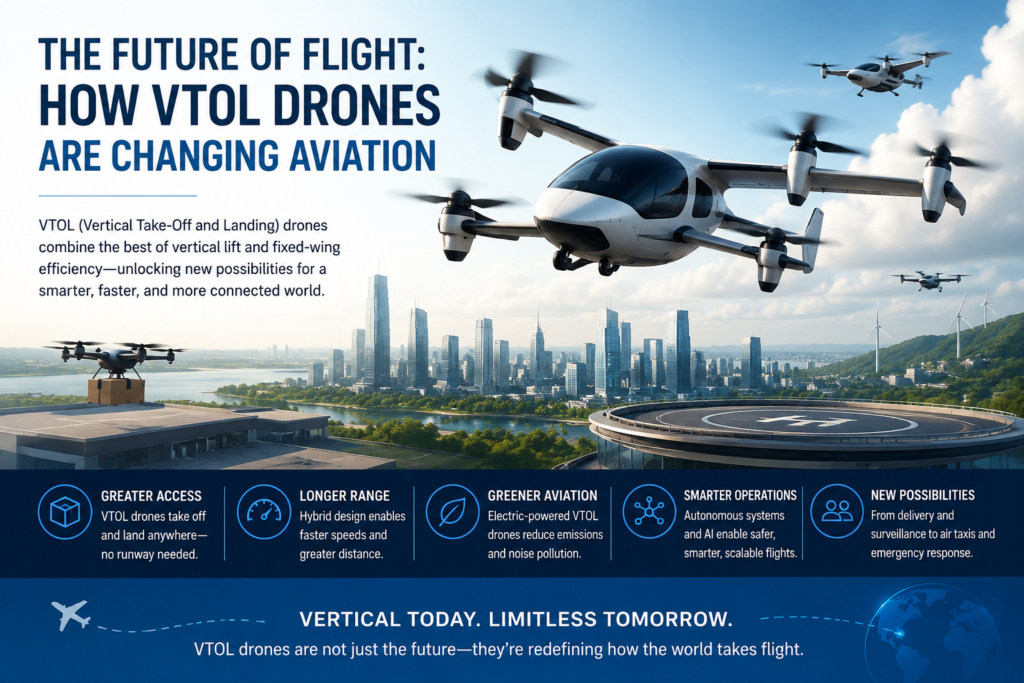
VTOL drones are transforming the future of the aviation industry. VTOL (Vertical Take-Off and Landing) technology enables drones to take off and land vertically, hover in mid-air, and land without the need for a runway. These modern-day flying machines combine the efficiency of fixed-wing aircraft with the flexibility of helicopters. As a result, VTOL drones are revolutionary in modern aviation.
There’s no industry that VTOL Drones can’t easily integrate into, including agriculture, the supply chain and logistics, the military, and emergency services. Technology that is improving at this pace means VTOL drones will transform urban transportation and mobility in the not-so-distant future.
What are VTOL Drones?
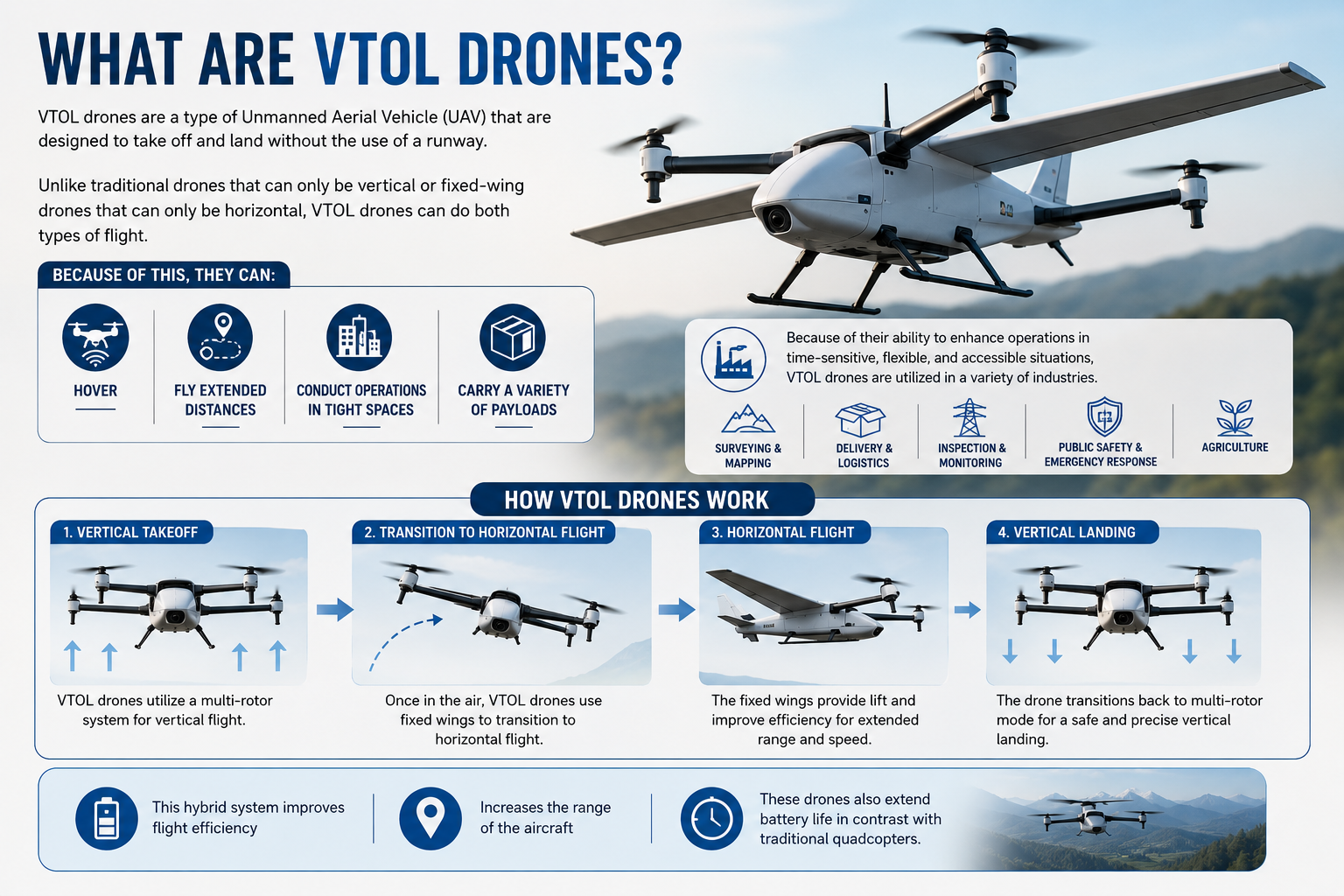
VTOL drones are a type of Unmanned Aerial Vehicle (UAV) that are designed to take off and land without the use of a runway. Unlike traditional drones that can only be vertical or fixed-wing drones that can only be horizontal, VTOL drones can do both types of flight.
Because of this, they can:
- Hover
- Fly extended distances
- Conduct operations in tight spaces
- Carry a variety of payloads
Because of their ability to enhance operations in time-sensitive, flexible, and accessible situations, VTOL drones are utilized in a variety of industries.
How VTOL Drones Work
VTOL drones utilize a multi-rotor system for vertical flight. Once in the air, VTOL drones use fixed wings to transition to horizontal flight. This hybrid system improves flight efficiency and increases the range of the aircraft. These drones also extend battery life in contrast with traditional quadcopters.
Key Features of VTOL Drones
| Component | Function |
|---|---|
| Rotors | Vertical takeoff and landing |
| Fixed Wings | Flight range and efficiency |
| Flight Controller | Control and stability of flight |
| GPS System | Positioning and autonomous flight |
| Batteries/Fuel System | Power supply |
| Sensors and Cameras | Mapping, surveillance, and monitoring |
Benefits of VTOL Drones
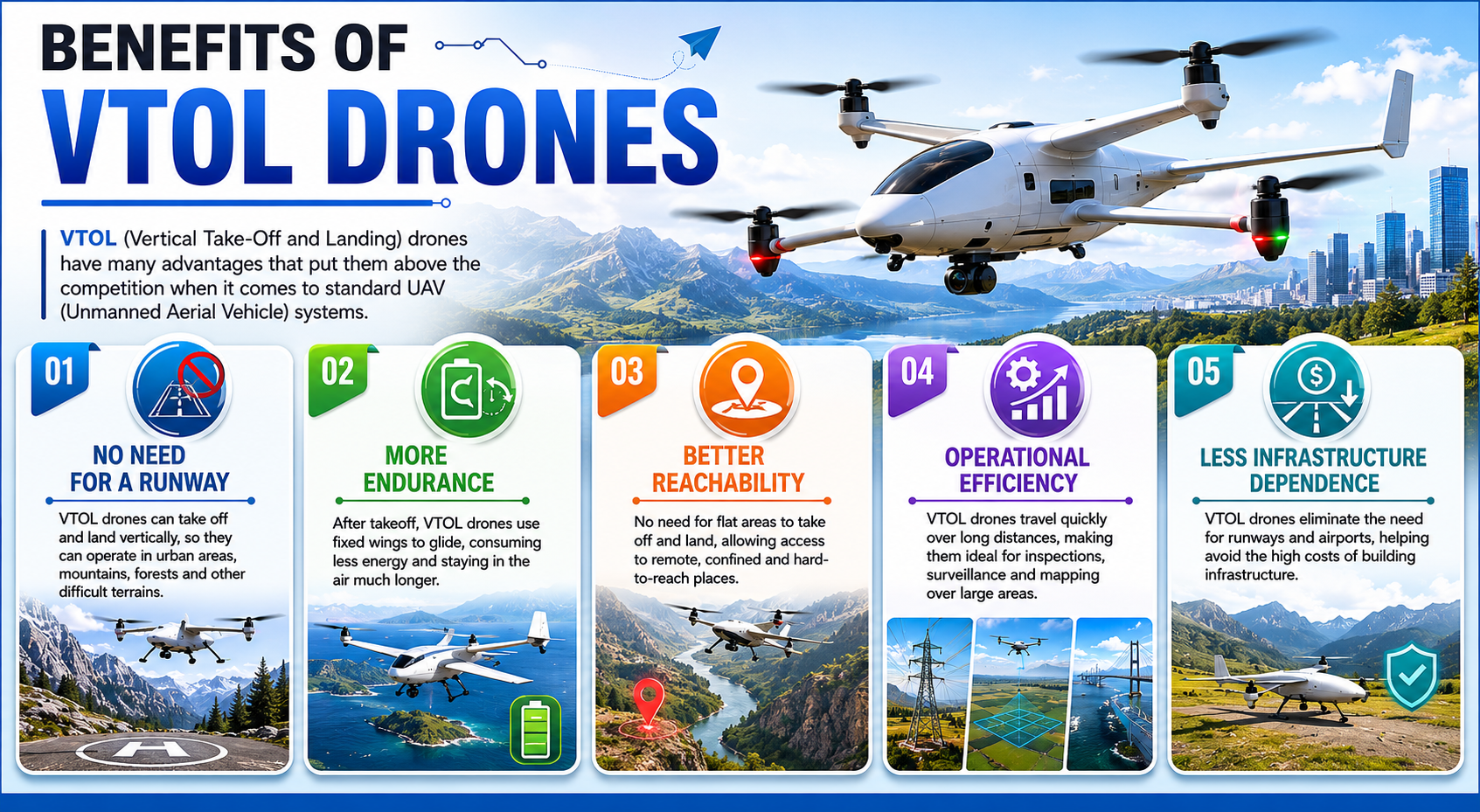
VTOL (Vertical Take-Off and Landing) drones have many advantages that put them above the competition when it comes to standard UAV (Unmanned Aerial Vehicle) systems.
1. No Need for a Runway
Traditional drones need a long, flat area to take off and land. VTOL drones can do both vertical and horizontal flight and thus can work in areas that most drones (especially helicopters) can’t reach, like urban areas and mountainous or forested areas.
2. More Endurance
Traditional multi-rotor systems have to work against gravity by constantly using power to stay in the air, but VTOL drones can use a fixed wing to glide after takeoff. Because of this, VTOL drones have smaller energy expenditures and can stay in the air longer.
3. Better Reachability
Because VTOL drones have no need for flat areas to take off and land, they can reach places other traditional vehicles and aircraft can’t.
4. Operational Efficiency
Because VTOL drones can travel quickly over long distances, they work well for systems that need inspections, surveillance, and mapping over large areas.
5. Less Infrastructure Dependence
VTOL drones take away the need for runways and airports, enabling clients to avoid the expenses associated with building runways and other infrastructure.
Uses of VTOL Drones
Because of both automation and superior aerial systems, VTOL drones have opened up countless applications in numerous industries.
Agriculture
VTOL drones are helping farmers by:
- Monitoring crops
- Spraying pesticides
- Analyzing soil
- Managing irrigation
This technology can lead to both an increase in productivity and a reduction in the cost of agricultural labor.
Delivery
Multiple businesses are exploring vertical take-off and landing (VTOL) drones to deliver products more efficiently. This can be particularly useful to deliver medicine, food, or supplies in hard-to-reach areas.
Emergency and Rehabilitation Missions
VTOL drones can be invaluable in crises. They can assist rescue teams in locating missing people, transporting supplies, and evaluating the destruction and injuries caused in the aftermath of a disaster.
Military and Defense
VTOL drones are used in the military to perform:
- Surveillance
- Border patrol
- Recon missions
- Tactical operations
VTOL drones are most particularly used in difficult terrains.
Infrastructure Monitoring
VTOL drones can be used by power and construction companies to monitor:
- Power Lines
- Wind Turbines
- Bridges
- Pipelines
- Railways
This technology reduces the danger to workers and increases the efficiency of the maintenance.
Mapping and Monitoring
VTOL drones that are outfitted with the latest sensors and cameras can create detailed and precise maps, and even 3D models of the areas for construction and planning of future urban development.
VTOL Drones vs Conventional Drones
VTOL Drones (Vertical take-off and landing Drones) can be compared to conventional drones in the following ways.
| Feature | VTOL Drones | Conventional Drones |
|---|---|---|
| Take-off and Landing | Vertical | Vertical |
| Distance | Long | Short |
| Speed | Fast | Moderate |
| Battery Usage | Efficient | Less Efficient |
| Hover Capability | Yes | Yes |
| Best Purpose | Mapping, delivery, and long-range missions | Short-range photography, inspections |
AI and VTOL Drones
Artificial Intelligence (AI) is a growing technology that is gaining traction in the field of VTOL drones. There are currently drones that have been outfitted with AI, which allow the drone to perform:
- autonomous travel
- avoidance of impediments in their flight path
- analysis of data during flight
- optimization of flight path
- Recognition of objects
AI technology allows drones to safely and effectively carry out complex tasks without the need for an operator. This makes the technology more applicable to more commercial operations.
Issues Encountered with VTOL Drones
VTOL drones may have their fair share of advantages, but they also come with a fair number of disadvantages.
Limitations of Batteries
One of the biggest drawbacks is battery technology. Capacities must be large enough to sustain power for long-distance travel.
Regulatory Frameworks and Managing Air Traffic
Principles for safely integrating drones with the existing air traffic systems are still in development. For a variety of reasons, including fear of the drone system’s impact on personal privacy, a number of social and economic obstacles remain, limiting broader consumer adoption of air travel services.
Sensitivity to the Elements
Drones, like any other technology, have a number of inherent shortcomings, including the impact of high winds and heavy precipitation.
High Initial Costs
VTOLs come with a high price tag. This is largely due to the expense of the sophisticated engineering, the sensors, and the autonomous systems.
Risks to Cybersecurity
Drones are particularly vulnerable to a wide variety of cyberattack techniques, including denial of service attacks, as well as signal jamming and other forms of interference.
Looking Ahead to VTOL Drones
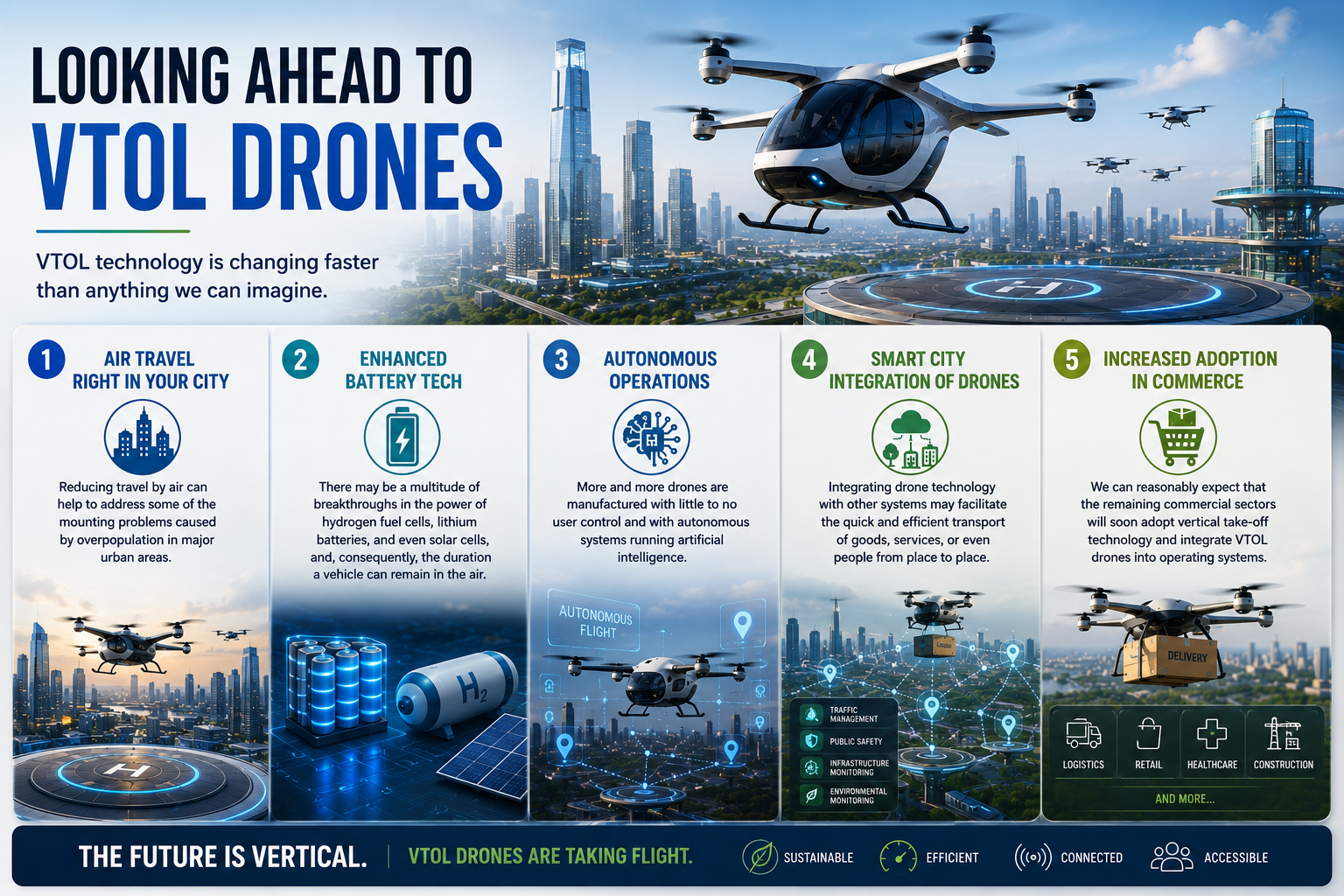
VTOL technology is changing faster than anything we can imagine.
Air Travel Right in Your City
Reducing travel by air can help to address some of the mounting problems caused by overpopulation in major urban areas.
Enhanced Battery Tech
There may be a multitude of breakthroughs in the power of hydrogen fuel cells, lithium batteries, and even solar cells, and, consequently, the duration a vehicle can remain in the air.
Autonomous Operations
More and more drones are manufactured with little to no user control and with autonomous systems running artificial intelligence.
Smart City Integration of Drones
Integrating drone technology with other systems may facilitate the quick and efficient transport of goods, services, or even people from place to place.
Increased Adoption in Commerce
We can reasonably expect that the remaining commercial sectors will soon adopt vertical take-off technology and integrate VTOL drones into operating systems.
The VTOL Drone’s Eco-Friendly Contribution to Aviation
Drones can make a little bit of a difference in the world to make a more sustainable aviation system. The fuel consumption of traditional aircraft is far greater than that of VTOL drones. With VTOL drones, aviation can be done more sustainably.
Benefits include:
- Less fuel consumption
- Decreased carbon emissions
- Reduced traffic congestion
- An energy-efficient transportation system
Greener energy technologies may utilize VTOL drones to provide a more eco-friendly option for short-distance travel and logistics.
Why VTOL Drones are Important to the Future of Flight
VTOL drones are an important part of a huge change to how we travel by air. It is a key part of aviation history that will provide safe, flexible, efficient, and autonomous travel for everyone.
VTOL drones are expected to be a normal part of our daily lives soon, as governments, start-up companies, and big tech firms are investing billions into this area of research. Large investments into research and development are expected to yield returns when laws and regulations adapt to this technology.
With this technology comes the potential to improve life all over the world by facilitating the delivery of critical medicine and helping to build smart cities and complex integrated transportation systems.
Conclusion
VTOL drones will shape the future of aviation with the ability to take off and land vertically, as well as travel a great distance rapidly. Within many fields such as agriculture, logistics, the military and security, urban mobility, defense, and emergency response, the role of VTOL technology will become a great part of everyday life.
Although there will be challenges with regulation, batteries, and cybersecurity, technology is advancing quickly. VTOL technology, coupled with the right sustainable energy, artificial intelligence, and smart technology, will be an important part of the future of aviation.
In a world that is advancing every day, VTOL technology is expected to play an important role in transforming the way businesses operate and the way we travel by providing a new method that is safe, flexible, efficient, and autonomous.
FAQs
1. What does VTOL stand for?
VTOL stands for Vertical Take Off and Landing. VTOL drones require no runway to take off or land.
2. What is the difference between VTOL and regular drones?
VTOL drones combine vertical lift with fixed-wing flight. This allows VTOL drones an extended flight range and offers significantly more efficiency than typical multi-rotor drones.
3. Which industries utilize VTOL drones?
Agriculture, logistics, defense, mapping, infrastructure inspection, and emergency response industries utilize VTOL drones.
4. Are VTOL drones sustainable?
Most VTOL drones employ electric power systems which result in less fuel and carbon emissions compared to conventional aircraft.
5. Can VTOL drones be used for manned flight?
Yes, a number of companies are developing VTOL manned air taxis and are intended to be used for urban transport.
6. What are the problems with VTOL drones?
The main problems of VTOL drones are limited batteries, regulations on the use of airspace, weather, cyber security, and high development costs.
7. Where do VTOL drones go from here?
The future holds for VTOL drones the possibility of full autonomy, urban air mobility, artificial intelligence, smart cities, and advanced delivery systems.