BTQ QCIM: The Revolutionary Fix for Modern Cyber Threats
+
Table of Contents
- 1 What is BTQ QCIM?
- 2 Key Features of BTQ QCIM
- 2.1 1. Processing-in-Memory Architecture
- 2.1.1 Advantages include:
- 2.2 2. High-Speed Cryptographic Operations
- 2.2.1 QCIM accelerates:
- 2.3 3. Quantum-Ready Security Support
- 2.4 4. Reduced Power Consumption
- 2.5 5. Enhanced Security Architecture
- 2.5.1 Benefits include:
- 2.6 6. Scalability
- 2.7 Benefits of BTQ QCIM
- 2.7.1 Faster Security Operations
- 2.7.2 Cyber Defense Improvements
- 2.7.3 Reduced Operating Costs
- 2.7.4 Improved Security in the Cloud
- 2.8 Being Ready for Quantum Threats
- 2.9 Potential Applications of BTQ QCIM
- 2.9.1 Financial Services
- 2.9.2 Government Agencies
- 2.9.3 Healthcare
- 2.9.4 Cloud Computing
- 2.9.5 Defense and Military
- 2.10 The Future of QCIM Technology
- 2.11 Conclusion:
- 2.12 Frequently Asked Questions
- 2.12.1 1. What does QCIM mean?
- 2.12.2 2. In what manner does QCIM deviate from conventional computing?
- 2.12.3 3. Why should I care about QCIM and encryption?
- 2.12.4 4. Will QCIM help defend me from threats based on quantum computing?
- 2.12.5 5. What are some of the industries that may benefit from QCIM?
- 2.12.6 6. What is QCIM’s biggest benefit?
Cyber threats are more disruptive than ever in our rapidly evolving digital landscape. Organizations, governments, and businesses all face an onslaught of sophisticated attacks that attempt to breach and exploit sensitive data, financial resources, and critical infrastructure. The traditional cybersecurity model fails to provide the necessary countermeasures. Innovative technologies are being developed to advance digital defenses. An example of one of these innovations is BTQ QCIM (Quantum Compute-In-Memory).
BTQ Technologies has provided a breakthrough with QCIM, which incorporates an entirely new way of looking at cryptographic computing. BTQ QCIM integrates advanced processing and memory architecture to provide a secure, efficient, and powerful environment for encryption and cybersecurity. Organizations would no longer move data within the system so frequently and would be able to expedite the processing of cryptographic tasks.
This article will provide an overview of BTQ QCIM, including its operational methodology, key features, advantages, and the significance of this new technology in countering the modern wave of cyber threats.
What is BTQ QCIM?
BTQ Technologies has developed QCIM (Quantum Compute-In-Memory) and provides a completely new computing architecture to elevate the performance of cryptography and the resilience of cybersecurity.
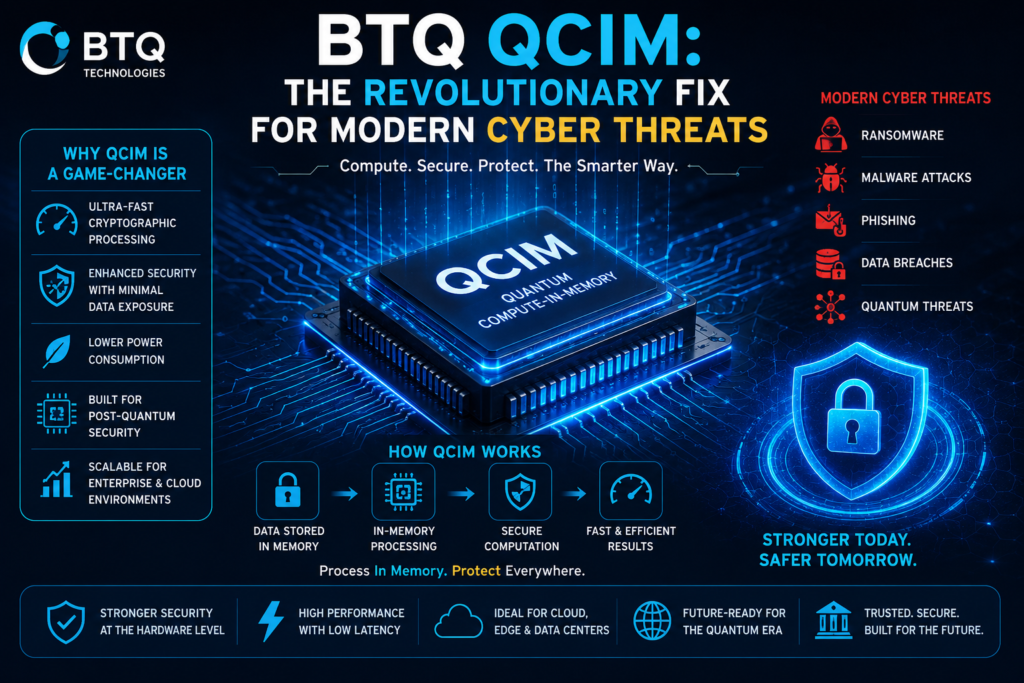
In every computer architecture, data is moved from memory to processing components to perform some computation and is then transferred back to memory. This creates bottlenecks in performance and consumes a lot of energy, as well as opens new attack vectors for cyber threats. QCIM does not have this architecture. With QCIM, computational tasks are carried out within the memory.
This new architecture provides faster cryptographic operations with low latency and low energy consumption, while also providing stronger defenses against cyber attacks, especially those that are launched by quantum computing.
As cyber attacks become more sophisticated and disruptive, cyber technologies such as QCIM provide a more secure digital infrastructure.
Modern Cybersecurity Challenges
Addressing problems such as the following has become paramount to cybersecurity:
- Ransomware
- Advanced persistent threats (APT)
- Data breaches
- Supply chain attacks
- Cloud security issues
- Quantum computing
Traditional architectures were not designed to accommodate advanced modern cryptography. Because of this, there is a need for hardware solutions to support high-demand cryptographic workloads for organizations in a way that does not compromise high-performance standards.
BTQ QCIM takes a new approach to solve this problem by innovating how hardware implements cryptographic processing.
How BTQ QCIM Works
The main innovation BTQ QCIM brings to the market is the use of Processing in Memory (PIM).
Unlike the traditional approach of moving data across the computer’s memory and processor, computations are made where data resides.
Step 1: Data Storage
Secure memory components store sensitive data and cryptographic keys.
Step 2: In-Memory Processing
Data does not leave memory to be processed, so PIM architectures execute the cryptographic functions in memory.
Step 3: Data Movement
With PIM, unnecessary data transfers are avoided, therefore eliminating the performance bottlenecks that are typically caused when data is moved across the memory and processor.
Step 4: Fast Security Operations
PIM architectures execute cryptographic functions and security operations (encryption, decryption, hashing, etc.) in memory faster than traditional processor-centric architectures.
Step 5: Security by Design
With a reduced surface area of data, the memory component instills a higher level of security during processing.
Key Features of BTQ QCIM
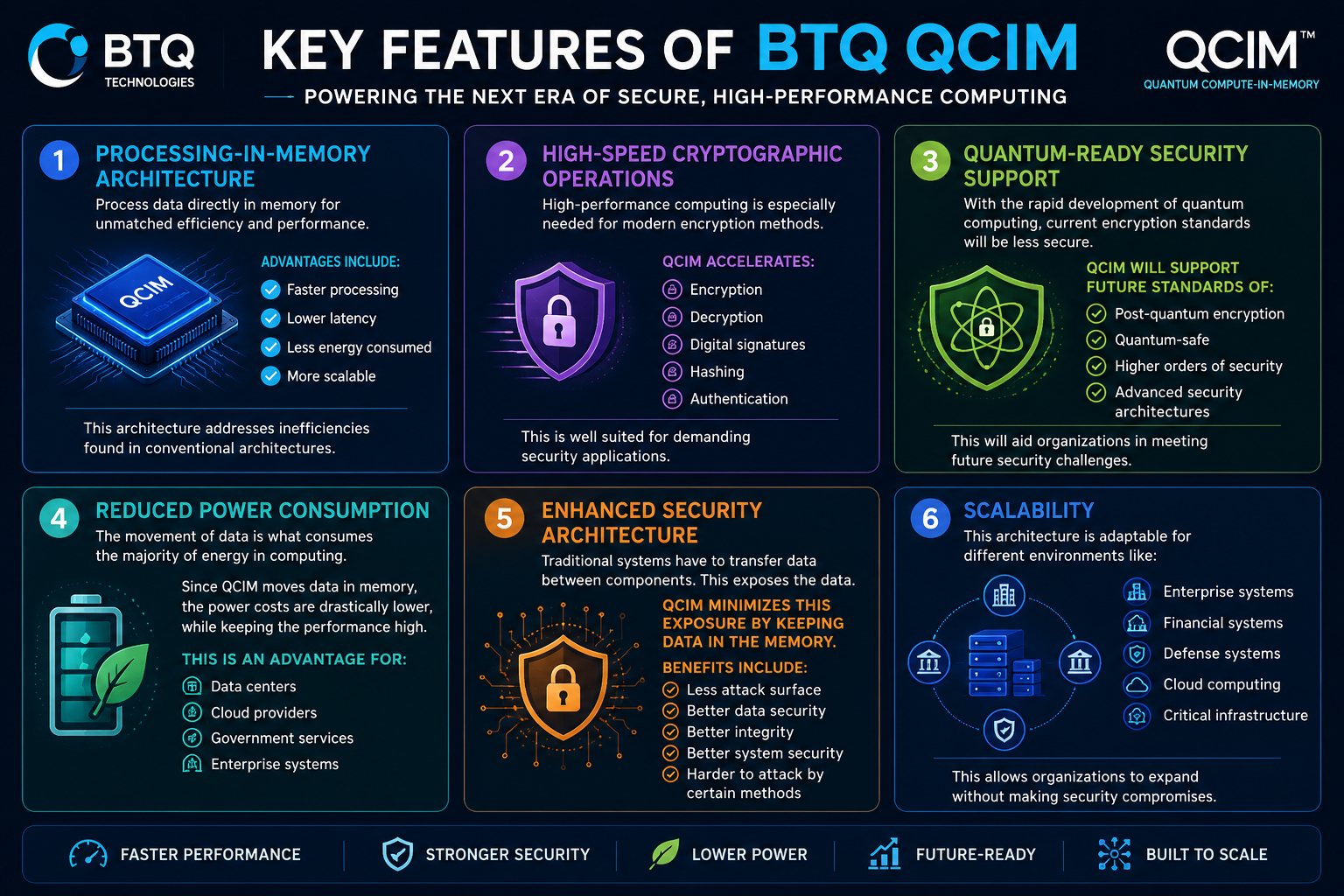
BTQ QCIM has incorporated several features that further strengthen its position as a leading security product.
1. Processing-in-Memory Architecture
The distinguishing aspect of this architecture is the incorporation of the ability to process data directly in the memory.
Advantages include:
- Faster processing
- Lower latency
- Less energy consumed
- More scalable
This architecture addresses inefficiencies found in conventional architectures.
2. High-Speed Cryptographic Operations
High-performance computing is especially needed for modern encryption methods.
QCIM accelerates:
- Encryption
- Decryption
- Digital signatures
- Hashing
- Authentication
This is well suited for demanding security applications.
3. Quantum-Ready Security Support
With the rapid development of quantum computing, current encryption standards will be less secure.
QCIM will support future standards of:
- Post-quantum encryption
- Quantum-safe
- Higher orders of security
- Advanced security architectures
This will aid organizations in meeting future security challenges.
4. Reduced Power Consumption
The movement of data is what consumes the majority of energy in computing.
Since QCIM moves data in memory, the power costs are drastically lower, while keeping the performance high.
This is an advantage for:
- Data centers
- Cloud providers
- Government services
- Enterprise systems
5. Enhanced Security Architecture
Traditional systems have to transfer data between components. This exposes the data.
QCIM minimizes this exposure by keeping data in the memory.
Benefits include:
- Less attack surface
- Better data security
- Better integrity
- Better system security
Harder to attack by certain methods
6. Scalability
This architecture is adaptable for different environments like:
- Enterprise systems
- Financial systems
- Defense systems
- Cloud computing
- Critical infrastructure
This allows organizations to expand without making security compromises.
Benefits of BTQ QCIM
The benefits of QCIM go beyond performance improvement.
Faster Security Operations
Organizations that deal with large amounts of encrypted data need to have processing be fast.
QCIM speeds up:
- Safe communications
- Encryption of data
- Verification of identity
- Secure transactions
This gives better performance to the system.
Cyber Defense Improvements
QCIM provides better defense through:
- Less data exposure
- Higher protections with complex encryption
QCIM also provides better defense with more layered hardware protections.
Reduced Operating Costs
With lower power consumption across systems, QCIM helps lower infrastructure costs with:
– Less need for energy
– Less need for cooling systems
– Better use of systems
– Quicker processes
Improved Security in the Cloud
Cloud systems handle lots of sensitive data every day.
QCIM offers:
- Quicker encryption
- Secure processing of data
- Less latency
- More scalability
This helps the security of cloud systems, especially the cloud service and enterprise customers.
Being Ready for Quantum Threats
Being able to forecast the future is a big advantage.
One big issue with Quantum Computing is that it will break many encryption systems.
Since QCIM works with the new post-quantum ways of encryption, it allows businesses to be ready when security changes.
Also Read- From Flight to Dive: Inside the Aalborg University Hybrid Drone
Potential Applications of BTQ QCIM
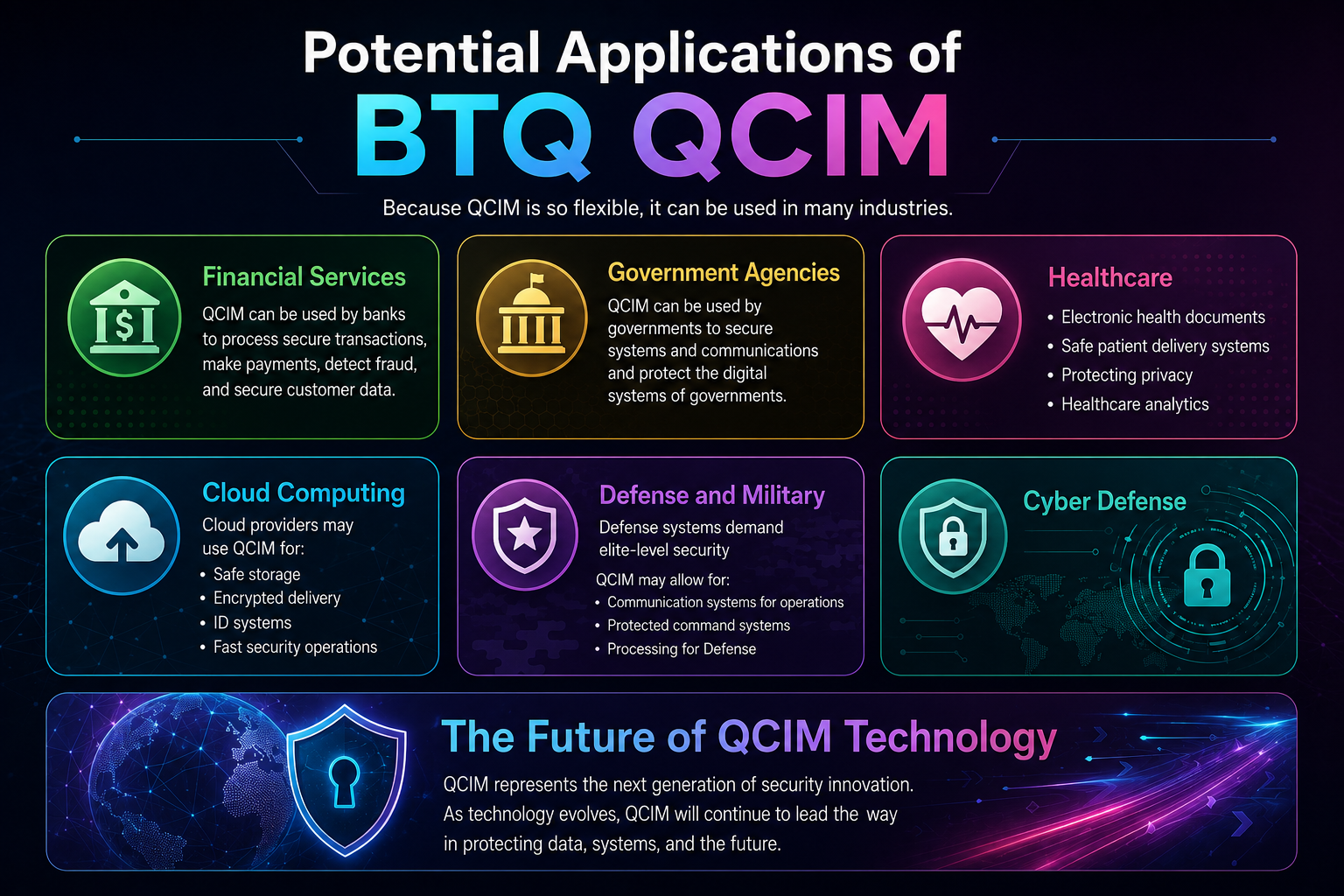
Because QCIM is so flexible, it can be used in many industries.
Financial Services
QCIM can be used by banks to process secure transactions, make payments, detect fraud, and secure customer data.
Government Agencies
QCIM can be used by governments to secure systems and communications and protect the digital systems of governments.
Healthcare
Electronic health documents:
- Safe patient delivery systems
- Protecting privacy
- Healthcare analytics
- Cloud Computing
Cloud Computing
Cloud providers may use QCIM for:
- Safe storage
- Encrypted delivery
- ID systems
- Fast security operations
- Cloud Computing
- Defense and Military
- Defense systems demand elite-level security
Defense and Military
QCIM may allow for:
- Communication systems for operations
- Protected command systems
- Processing for Defense
- Cyber Defense
- The Future of QCIM Technology
The Future of QCIM Technology
The speed and variety of changes in the security threats and defenses continue to be of concern.
Artificial Intelligence, Machine Learning, and Quantum Computing bring new ways to organize and to be threatened.
BTQ QCIM is a hardware improvement of security threats and defenses in quantum computing.
In-memory processing may also change the face of security in the future.
Even within its ecosystem, QCIM is mature when compared to the rest of the developing tech in areas of encryption and security.
Conclusion:
Cyber attacks continue to become more complex as quantum computing nears its practical applications. Organizations need to implement systems to protect their critical resources and information. QCIM is one system that improves security now, while allowing organizations to prepare for the threats of the future.
For organizations looking to enhance their protection systems, BTQ QCIM may become one of the most critical cybersecurity systems of the next ten years.
Frequently Asked Questions
1. What does QCIM mean?
QCIM stands for Quantum Compute-In-Memory. It is a computing architecture that BTQ Technologies has developed to speed up the processing of cryptography and better safeguard against cyberattacks.
2. In what manner does QCIM deviate from conventional computing?
Moving data between the memory and the processor is a function of traditional systems. In this architecture, that movement is eliminated because QCIM performs computations directly in memory, resulting in faster and more efficient systems.
3. Why should I care about QCIM and encryption?
By performing encryption faster, QCIM reduces the chances of data being exposed. Additionally, QCIM supports advanced cryptography that results in more robust security.
4. Will QCIM help defend me from threats based on quantum computing?
Yes. QCIM offers support for post-quantum cryptographic algorithms and, as a result, may safeguard against quantum-based attacks.
5. What are some of the industries that may benefit from QCIM?
QCIM technology may benefit the finance, healthcare, governmental, defense, cloud computing, and other industries that provide services to critical infrastructure.
6. What is QCIM’s biggest benefit?
The biggest benefit of QCIM is that it functions faster, more efficiently, and more securely while reducing energy costs and eliminating bottlenecks by performing computations directly in memory.