IdeaForge ALE: Unleashing Next-Gen Air Power
+
Table of Contents
- 1 What Is IdeaForge ALE?
- 2 Key Features of IdeaForge ALE?
- 2.1 1. UAV-to-UAV Deployment
- 2.2 2. Extended Operational Reach
- 2.3 3. Mission Agility
- 2.4 4. Autonomy
- 2.5 5. Rapid Payload Adaptability
- 3 Comparison Table of IdeaForge ALE
- 3.1 Benefits of Air-Launched Drones
- 3.1.1 Flexibility of Missions
- 3.1.2 Extended Range Capabilities
- 3.1.3 Less Exposure to Risk
- 3.1.4 Increased Coverage with Real-time Data
- 3.1.5 Improved Efficiency
- 3.1.6 Encouragement of Swarm Systems
- 3.2 Potential Applications of IdeaForge ALE
- 3.2.1 Border Security
- 3.2.2 Intelligence
- 3.2.3 Communications
- 3.2.4 Search and Rescue
- 3.2.5 Maritime Missions
- 3.2.6 Tactical Use of Drones
- 3.3 How the System Works
- 3.4 Importance for Future Defense Technologies
- 3.5 Challenges and Considerations
- 3.5.1 Technical Complexity
- 3.5.2 Communication Issues
- 3.5.3 Payload Limits
- 3.5.4 Regulatory Requirements
- 3.5.5 Cybersecurity
- 4 Conclusion
- 4.1 Frequently Asked Questions (FAQs)
- 4.1.1 1. What does ALE stand for?
- 4.1.2 2. What is the main objective of IdeaForge ALE?
- 4.1.3 3. What missions can the system accomplish?
- 4.1.4 4. Why is UAV-to-UAV deployment significant?
- 4.1.5 5. Can several drones be sent from a single carrier?
- 4.1.6 The design of the concept allows the sending of one or more smaller drones from a carrier platform.
- 4.1.7 6. Is the concept dependent on autonomous technology?
- 4.1.8 7. Is the technology concept restricted to the military?
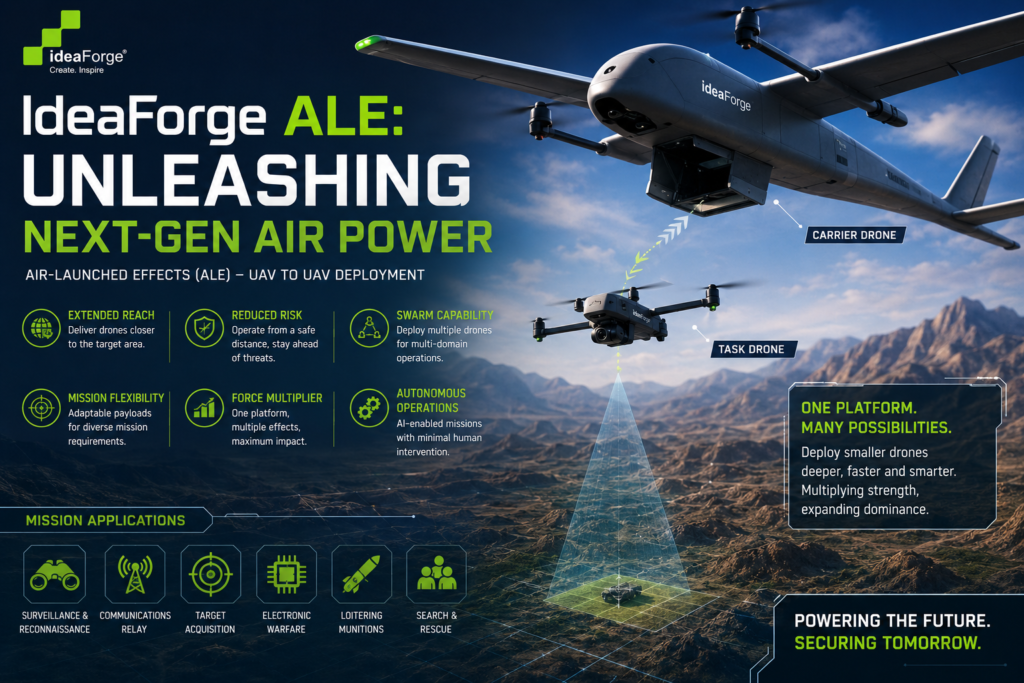
Unmanned aerial systems continue to alter the defense industry by increasing situational awareness, precision, and flexibility during operations. One of the recent developments in this arena is IdeaForge ALE. This concept includes UAV-to-UAV capabilities to autonomously launch drones mid-air. This concept aims to further increase the adaptiveness, reach, and efficacy of unmanned operations.
As defense agencies around the globe continue to invest in self-sufficient systems, mid-air autonomous drone deployment is a critical capability. Being able to launch smaller drones from a bigger aerial platform introduces the capability to conduct a wider range of operations, including surveillance and reconnaissance, as well as communication and support missions. This concept illustrates the direction in which drone systems and self-sufficiency are headed: toward seamless interconnectedness.
What Is IdeaForge ALE?
Air-Launched Effects (ALE) is a concept whereby a larger unmanned aerial system acts as a launch platform for smaller drones. Unlike traditional systems where the smaller drone is launched from the ground, the smaller drone is deployed from the aerial system mid-air.
This concept aims to establish a networked drone system, where multiple aerial resources can be used in concert to achieve a goal.
This concept moves us closer to a self-sufficient networked battlefield, where autonomous systems partner to achieve a common purpose.
Key Features of IdeaForge ALE?
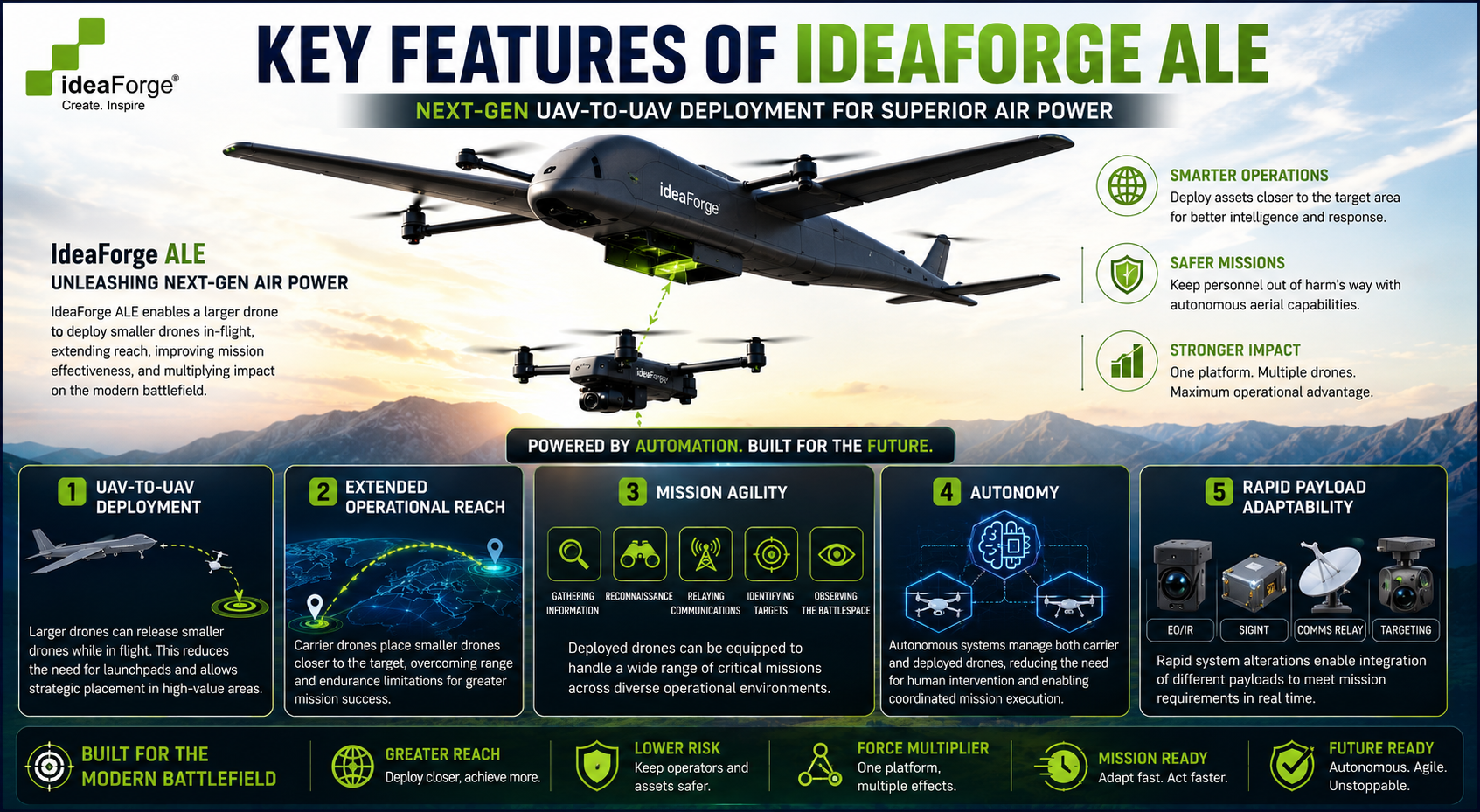
This idea became a remarkable concept in drone technology due to the incorporation of multiple leading-edge capabilities.
1. UAV-to-UAV Deployment
Larger drones can release smaller drones while in flight. This reduces the need for launchpads for smaller drones and allows larger drones to place smaller drones in strategic locations.
2. Extended Operational Reach
Typically, the range of smaller drones is limited, and so is their endurance. The carrier platform places smaller drones nearer to the target, increasing the range of smaller operational drones.
3. Mission Agility
Deployed drones can be equipped to complete different tasks, such as:
– Gathering information
– Reconnaissance
– Relaying communications
– Identifying targets
– Observing the battle space
4. Autonomy
More and more drone systems are using autonomous operations for both the carrier and the deployed drones. This reduces the need for a human operator to be present for the coordination of tasks.
5. Rapid Payload Adaptability
Rapid system alterations can be made to the platform, depending on the operational need, to integrate different payloads.
Comparison Table of IdeaForge ALE
The main features of the system are summarized in the following table:
| Features | Descriptions |
|---|---|
| Deployment Mechanism | Airborne UAV-to-UAV launch |
| Main Objective | Extend operational range |
| Launch System | Carrier drone |
| Secondary System | Smaller task-driven drone |
| Mission Types | Surveillance, reconnaissance, and communication |
| Operational Edge | Enhanced range and flexibility |
| Human Engagement | Lessened by automation |
| Battlefield Function | Force multiplier |
Benefits of Air-Launched Drones
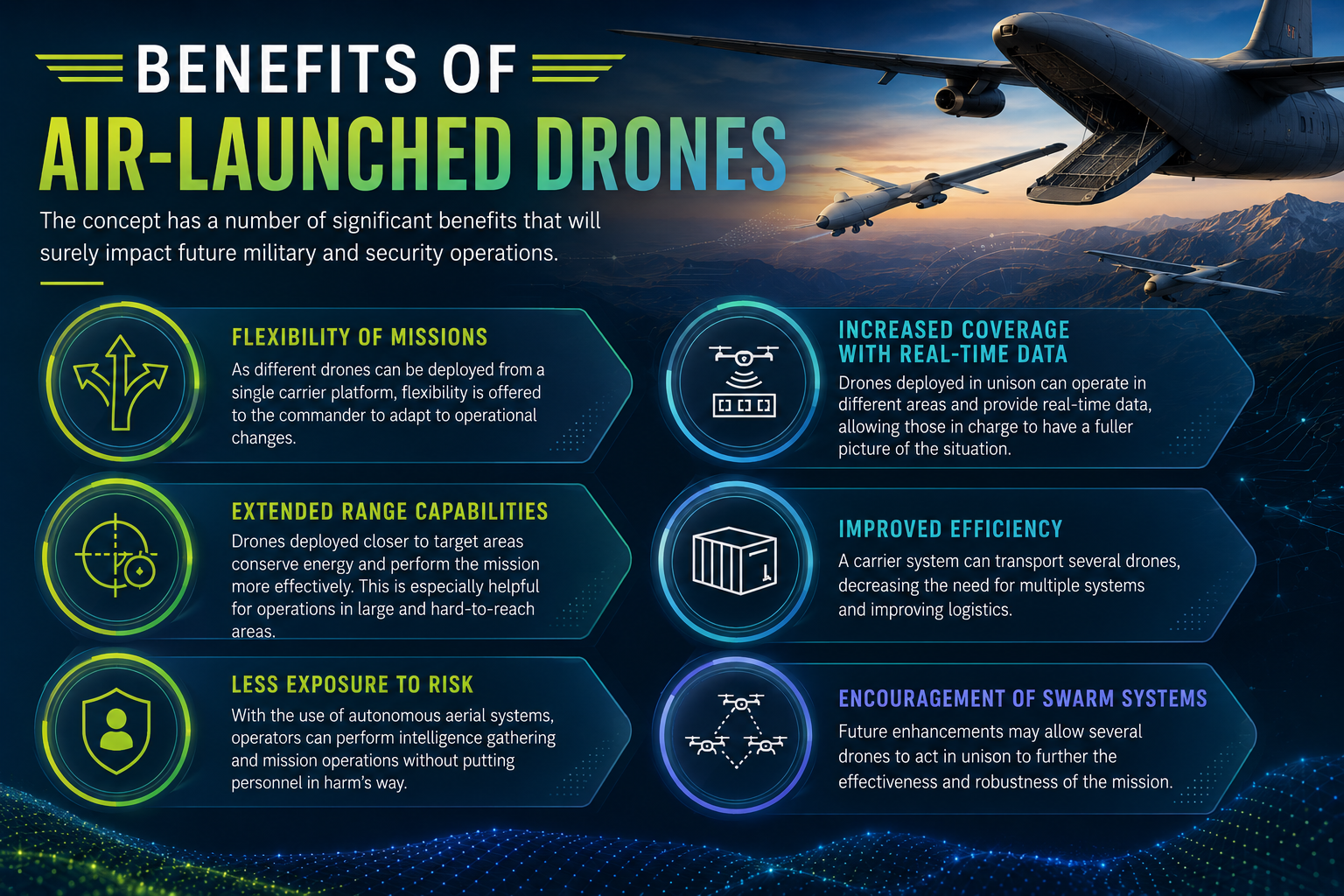
The concept has a number of significant benefits that will surely impact future military and security operations.
Flexibility of Missions
As different drones can be deployed from a single carrier platform, flexibility is offered to the commander to adapt to operational changes.
Extended Range Capabilities
Drones deployed closer to target areas conserve energy and perform the mission more effectively. This is especially helpful for operations in large and hard-to-reach areas.
Less Exposure to Risk
With the use of autonomous aerial systems, operators can perform intelligence gathering and mission operations without putting personnel in harm’s way.
Increased Coverage with Real-time Data
Drones deployed in unison can operate in different areas and provide real-time data, allowing those in charge to have a fuller picture of the situation.
Improved Efficiency
A carrier system can transport several drones, decreasing the need for multiple systems and improving logistics.
Encouragement of Swarm Systems
Future enhancements may allow several drones to act in unison to further the effectiveness and robustness of the mission.
Potential Applications of IdeaForge ALE
The technology can be applied in several military and security situations, including the following:
Border Security
Monitoring extensive border regions requires an aerial presence. Air-launched drones can perform observation in hard-to-reach areas.
Intelligence
Aerial drones that are closer to areas of interest can perform the necessary data gathering for the real-time intelligence that is vital to defense operations.
Communications
In scenarios where terrestrial communications are unavailable, aerial drones can provide a means of communication by acting as relays.
Search and Rescue
Drones deployed in an emergency can greatly reduce the time to locate missing persons and provide an overview of the response to the emergency.
Maritime Missions
Drone carriers can be tasked with support missions while deploying observation drones.
Tactical Use of Drones
Drones can be used to gather intelligence on the fighting and troop disposition of the enemy on the battlefield.
How the System Works
This system deploys in a few simple steps.
- A carrier drone takes off with one or many smaller drones onboard.
- The carrier then navigates toward the mission area.
- The smaller drones are released at the carrier’s deployment point.
- The released drones turn on and start their mission.
- The drones send mission updates to either a remote operator or a command center.
- The drones then either return, continue their mission, or complete their objective.
This system deploys within a much shorter time frame compared to traditional methods of launching drones.
Also Read- Future Unlocked: TRV-150 Combines Logistics and Lethal Precision
Importance for Future Defense Technologies
Today’s battles rely on autonomous systems that act independently even in the most chaotic situations. Drones that are air-launchable are a leap forward in unmanned systems tech. They allow for operations to be layered by utilizing multiple drone platforms.
In the future, air-launchable systems may operate even more effectively. They may possess coordination and communication systems that allow for real-time changes to the mission and other dynamically adjustable components.
Among the array of changes to modern warfare is a larger focus on drone systems and networking. The systems that launch drones and allow freedom of command enable militaries to expand their operational reach and versatility.
Challenges and Considerations
Although this system is innovative, it still faces several challenges.
Technical Complexity
Multiple drones require a high level of integrated hardware and advanced software, which is still not fully developed and proven.
Communication Issues
For a drone swarm to be effective, communications must be solid.
Payload Limits
Performance and endurance must be balanced by a carrier drone’s payload.
Regulatory Requirements
The use of sophisticated, fully automated remote aerial systems has regional regulatory and operational challenges.
Cybersecurity
Protecting communication links and control systems from sabotage remains critically important.
Advanced concepts for the deployment of drones in the face of persistent R&D challenges will continue to improve the feasibility and efficiency of advanced drone systems.
Conclusion
The airborne deployment of drones represents a new chapter in fully automated drone systems. The capability of a carrier drone to release mission-specific drones in the air offers defense organizations greater flexibility, greater reach, and greater effectiveness in the conduct of defense-related missions.
The further development of autonomous technologies will undoubtedly offer IdeaForge ALE the opportunity to further develop a fully integrated network of aerial services. The combination of mobility, flexibility, and the ability to multiply forces will take modern drone systems in an exciting direction. Whether for surveillance, reconnaissance, communication, or support operations, future autonomous missions will demonstrate the capability of advanced UAV systems to significantly change the operational environment.
Frequently Asked Questions (FAQs)
1. What does ALE stand for?
ALE stands for Air-Launched Effects. It refers to the concept of a larger aerial system launching smaller systems.
2. What is the main objective of IdeaForge ALE?
The goal of IdeaForge ALE is to enhance mission flexibility and operational reach through the airborne launch of smaller systems.
3. What missions can the system accomplish?
Surveillance, reconnaissance, communication, and support missions as well as intelligence and combat observation.
4. Why is UAV-to-UAV deployment significant?
Drones can be sent closer to the intended area of interest. This means more efficient use and fewer restrictions to engagement.
5. Can several drones be sent from a single carrier?
The design of the concept allows the sending of one or more smaller drones from a carrier platform.
6. Is the concept dependent on autonomous technology?
Yes, the modern, autonomous navigation, and mission management technology of today, are highly relevant to the deployment of the concept.
7. Is the technology concept restricted to the military?
Although a primary focus of the concept is for defense, other similar concepts may provide support to disaster response, search and rescue, and protection of people and facilities operations.