Future Unlocked: TRV-150 Combines Logistics and Lethal Precision
+
Table of Contents
- 1 What is TRV-150?
- 2 Capabilities of the TRV-150
- 2.1 1. Self-Controlled Flight
- 2.2 2. VTOL (Vertical Take-Off and Landing) Capability
- 2.3 3. Large Load Capacity
- 2.4 4. Role Versatility
- 2.5 5. Lower Operational Risk
- 2.6 6. Precision Strike Capability
- 3 Specifications of TRV-150
- 4 Benefits of the TRV-150
- 4.1 1. Improved Battlefield Logistics
- 4.2 2. Operational Flexibility
- 4.3 3. Lower Risk to Personnel
- 4.4 4. Cost Savings
- 4.5 5. Easy to Set Up
- 4.6 6. Precision Strike Potential
- 4.7 How the APKWS Integration Changes the Game
- 4.8 Potential Applications
- 4.8.1 Tactical Resupply
- 4.8.2 Emergency Medical Support
- 4.8.3 Border Security
- 4.8.4 Special Operations
- 4.8.5 Combat Support Missions
- 4.8.6 Disaster Response
- 4.9 Challenges and Considerations
- 4.9.1 Air Defense Threats
- 4.9.2 Regulatory Requirements
- 4.9.3 Payload Trade-Offs
- 4.9.4 Cybersecurity
- 4.10 The Future of Multi-Role Military Drones
- 5 Conclusion
Nowhere is the race for technological dominance clearer than in the evolution of warfare. Unmanned systems are becoming essential to militaries around the globe. Surveillance and reconnaissance are the least of the modern drone’s new and improved capabilities. Systems are now fully functional for the delivery of resupplies as well as precision strikes. The TRV-150 is a prime example of this paradigm shift, being an autonomous aerial systems platform originally intended for logistics missions.
Integration of a precision strike, guided rocket system into the TRV-150 demonstrates that a single unmanned platform can serve competing needs of supply and combat missions. This is a major advancement in the ability of multi-purpose unmanned systems and will likely have an effect on battle strategy.
What is TRV-150?
The primary purpose of the TRV-150 (Tactical Resupply Vehicle) unmanned aerial system is the delivery of supplies to unmanned personnel in hostile environments. The system was designed to eliminate the need for supply missions that expose pilots and potentially the entire ground convoy to the danger of enemy fire and provide personnel with the supplies they need.
The system can transport key supplies of virtually any type for sustaining personnel or a mission. It is fully capable of autonomous flight and can transport time-critical supplies such as:
– Ammunition
– Medical supplies
– Food and water
– Communication systems
– Emergency response and/or relief supplies.
The system is designed to operate in contested or remote areas, making it an ideal solution for modern military logistics.
TRV-150’s Metamorphosis from Logistic Drone to Precision Strike Drone
One of the more recent developments of the TRV-150 occurred in an exciting flight test where the TRV-150 launched an airborne 70mm APKWS rocket. This test showed that a platform originally developed to provide a logistical service could now perform an offensive task involving precision strikes.
The addition of a design element such as a lightweight launcher turned the system into a versatile battlefield tool. As a result, instead of having to rely on multiple systems to perform combat and transport tasks, militaries could rely on a single platform that could perform multiple roles based on the situation.
This capability has caused a lot of excitement among defense analysts and military planners.
Capabilities of the TRV-150
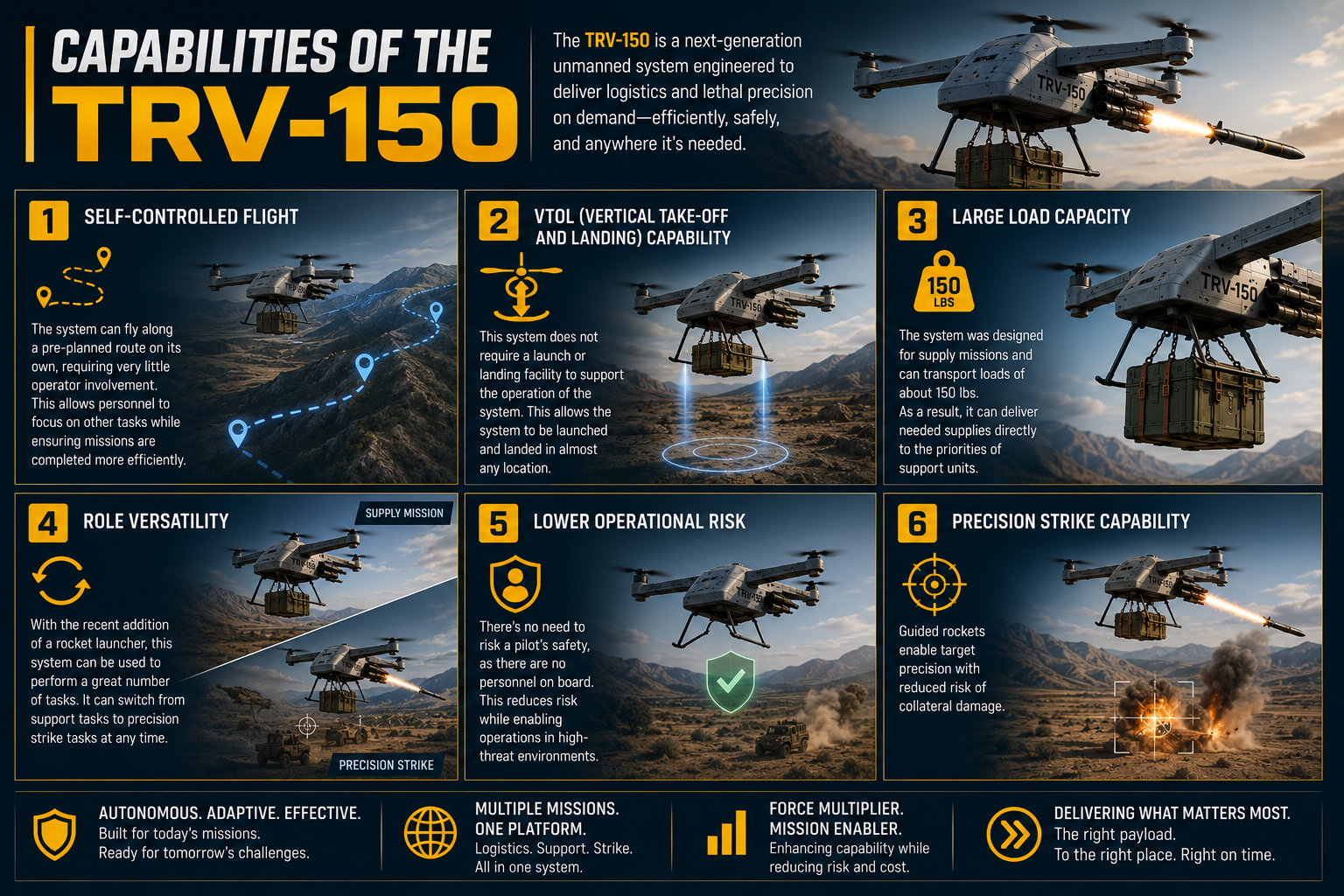
There are many aspects regarding this unmanned system that are advantageous.
1. Self-Controlled Flight
The system can fly along a pre-planned route on its own, requiring very little operator involvement. This allows personnel to focus on other tasks while ensuring missions are completed more efficiently.
2. VTOL (Vertical Take-Off and Landing) Capability
This system does not require a launch or landing facility to support the operation of the system. This allows the system to be launched and landed in almost any location.
3. Large Load Capacity
The system was designed for supply missions and can transport loads of about 150 lbs. And as a result, it can deliver needed supplies directly to the priorities of support units.
4. Role Versatility
With the recent addition of a rocket launcher, this system can be used to perform a great number of tasks. It can switch from support tasks to precision strike tasks at any time.
5. Lower Operational Risk
There’s no need to risk a pilot’s safety, as there are no personnel on board.
6. Precision Strike Capability
Guided rockets enable target precision with reduced risk of collateral damage.
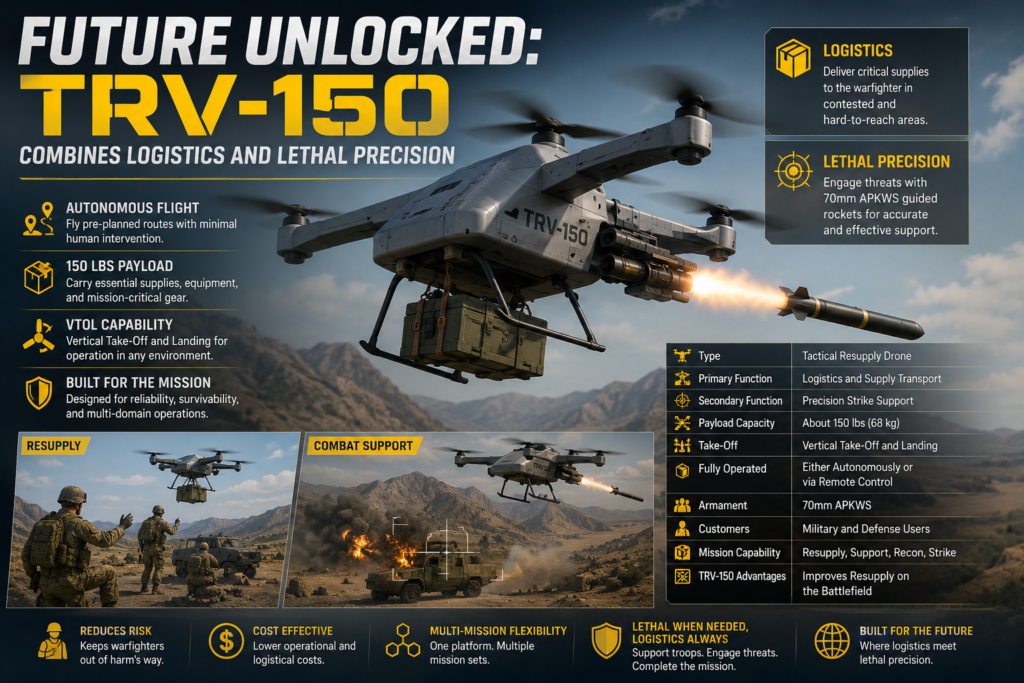
Specifications of TRV-150
| Feature | Description |
|---|---|
| Type | Tactical Resupply Drone |
| Primary Function | Logistics and Supply Transport |
| Secondary Function | Precision Strike Support |
| Payload Capacity | About 150 lbs (68 kg) |
| Take-Off | Vertical Take-Off and Landing (VTOL) |
| Operation Mode | Either Autonomously or via Remote Control |
| Armament | 70mm APKWS Rocket System |
| Customers | Military and Defense Users |
| Mission Capability | Resupply, Support, Reconnaissance, and Strike Missions |
| Key Advantage | Improves Resupply Operations on the Battlefield |
Benefits of the TRV-150
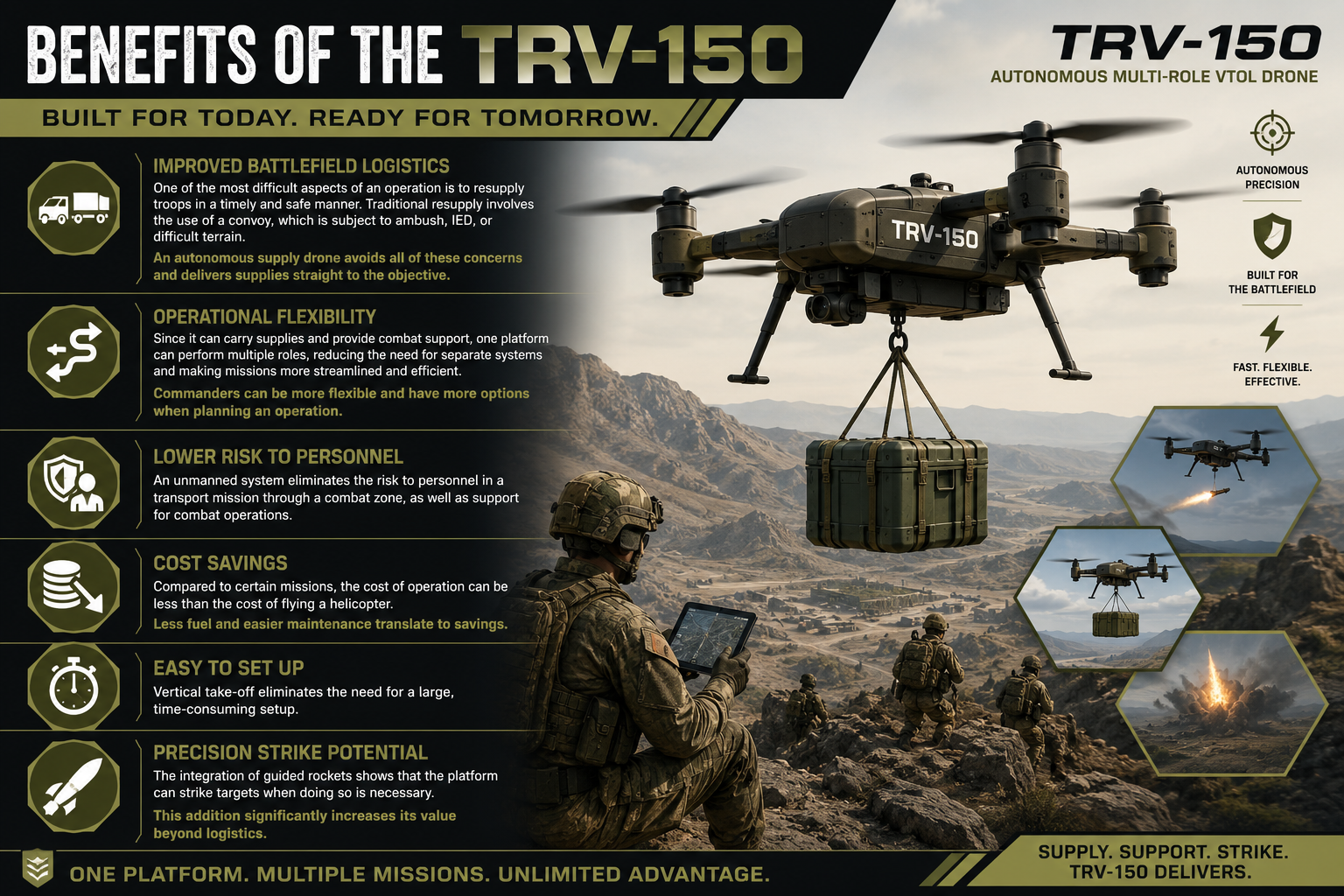
1. Improved Battlefield Logistics
One of the most difficult aspects of an operation is to resupply troops in a timely and safe manner. Traditional resupply involves the use of a convoy, which is subject to ambush, IED, or difficult terrain.
An autonomous supply drone avoids all of these concerns and delivers supplies straight to the objective.
2. Operational Flexibility
Since it can carry supplies and provide combat support, one platform can perform multiple roles, reducing the need for separate systems and making missions more streamlined and efficient. Commanders can be more flexible and have more options when planning an operation.
3. Lower Risk to Personnel
An unmanned system eliminates the risk to personnel in a transport mission through a combat zone, as well as support for combat operations.
4. Cost Savings
Compared to certain missions, the cost of operation can be less than the cost of flying a helicopter. Less fuel and easier maintenance translate to savings.
5. Easy to Set Up
Vertical take-off eliminates the need for a large, time-consuming setup.
6. Precision Strike Potential
The integration of guided rockets shows that the platform can strike targets when doing so is necessary. This addition significantly increases its value beyond logistics.
Also Read- BTQ QCIM: The Revolutionary Fix for Modern Cyber Threats
How the APKWS Integration Changes the Game
The Advanced Precision Kill Weapon System uses laser guidance to transform the 70mm rockets to which it is applied into precision-guided munitions. This has many benefits, including:
- Greater precision in targeting
- Less collateral damage
- Lower expense than larger missiles
- Greater lethality against light vehicles and tactical targets
With the addition of this weapon system, the drone is no longer simply a cargo truck. It has become a highly flexible system that can be used to target a wide variety of mission needs.
Systems that can be used to fulfill a wide variety of mission needs without requiring extensive changes to the system or a great deal of time to prepare are increasingly valued by military planners. The successful launch of the rockets shows that this system is capable of being used for a wide variety of missions.
Potential Applications
-
Tactical Resupply
The primary mission of the system is still to deliver critical supplies to troops in remote and/or hostile environments.
-
Emergency Medical Support
Medical supplies and even blood or other emergency medical treatments can now be rapidly delivered to areas that are beyond the immediate reach of other means of transportation.
-
Border Security
The logistics support the system can offer to border security forces can be used to deliver supplies and support in remote border areas.
-
Special Operations
Special operations often need covert logistical support. The platform can meet these requirements while operating with fewer resources and drawing less attention in the field.
-
Combat Support Missions
The addition of guided weapons makes the platform much more versatile, allowing it to support troops on the battlefield by accurately engaging targets when the situation demands it.
-
Disaster Response
Aside from its military capabilities, this system could be used to airlift supplies to victims in natural disasters when the roads are beyond repair.
Challenges and Considerations
Even with the potential the technology possesses, there are many factors to consider.
-
Air Defense Threats
Drones operating in combat zones or hostile areas often face serious threats, including electronic jamming, anti-drone technologies, and advanced air defense systems designed to detect, disrupt, or destroy them.
-
Regulatory Requirements
Military arms will be required to validate and ensure compliance with operational and safety measures before mass deployment.
-
Payload Trade-Offs
Adding weapons systems will likely limit the amount of trade and logistics cargo. Mission planners will need to design tradeoffs to determine the best balance between the operational logistics and combat tradeoffs.
-
Cybersecurity
Safeguarding systems from hacking and electronic warfare will be a continuing dominant focus.
The Future of Multi-Role Military Drones
The immediate future will likely see the convergence of the transportation, combat, and reconnaissance capabilities onto a singular unmanned platform.
The TRV-150 actively demonstrates that unmanned systems are expanding beyond the traditionally based systems brought to the battlefield.
Conclusion
The TRV-150 is a Prime Example of the Evolution of Military Drone Technology. Originally Designed as a Tactical Resupply Platform. It Has Now Been Proven to Conduct Precision Strikes with the Integration of Weapons Systems. Combining Both Combat and Logistics Capabilities Offers Defense Forces Enhanced Flexibility and Efficiency, while Also Reducing the Risk to Personnel.
As defense companies investigate multi-role unmanned systems, such platforms may be integral to future defense operations. TRV-150 offers supply delivery coupled with precision ammunition that demonstrates the capability of new technologies to reshape modern warfare and provide new levels of effectiveness on the battlefield.
FAQs
-
What is the TRV-150?
The TRV-150 is an unmanned, tactical, autonomous, resupply drone designed to traverse rough terrains and deliver supplies to aid in the support of military operations.
-
What is the TRV-150 designed to deliver?
The TRV-150 is designed to deliver munitions and supplies, such as food and medicine, to military personnel.
-
What was the first weapon tested on the system?
The system conducted a flight test in which the drone delivered and launched a 70mm Advanced Precision Kill Weapon System (APKWS) rocket.
-
What is the payload capacity of the system?
The system has a cargo capacity of 150 pounds (68 kilograms).
-
How autonomous is the TRV-150?
The system is fully autonomous and performs missions with little intervention by the operator.
-
Can the system be used in scenarios other than military operations?
The system can be used in military operations that focus on logistics, as well as emergency operations that deliver aid in hard to reach locations.