TUNGA-X: The Drone Hunter of the Future
+
Table of Contents
- 1 TUNGA-X Interceptor UAV is what?
- 2 Key features of the TUNGA-X
- 2.1 1. Vehicles that take off and land vertically
- 2.1.1 Benefits include:
- 2.2 2. High-Speed Interception
- 2.3 3. Artificial Intelligence-Based Tracking
- 2.3.1 Advantages include:
- 2.4 4. Day and Night Operations
- 2.5 5. Autonomous Mission Capability
- 2.6 6. Integrated Radar Support
- 3 TUNGA-X Technical Specifications
- 3.1 How the TUNGA-X Works
- 3.1.1 Detection
- 3.1.2 Target Assignment
- 3.1.3 Launch
- 3.1.4 Tracking
- 3.1.5 Interception
- 3.1.6 Mission Completion
- 3.2 Potential Applications of the TUNGA-X
- 3.2.1 Military Base Protection
- 3.2.2 Critical Infrastructure Security
- 3.2.3 Border Security
- 3.2.4 Airport Protection
- 3.2.5 Urban Defense Operations
- 3.2.6 Cost Effectiveness
- 3.2.7 Precision Targeting
- 3.2.8 Mobility
- 3.2.9 Scalability
- 3.2.10 Future Adaptability
- 3.3 The Future of Counter-Drone Warfare
- 4 Conclusion
The future of the drone hunter is here, and it’s called TUNGA-X.
Unmanned aerial vehicles (UAVs) have revolutionized modern warfare, surveillance, and security operations, and are expected to continue to play a significant role in the future. Drones have many uses, such as for reconnaissance, intelligence gathering and precision strikes, but they have also posed new challenges for security. Spying, attacking military bases, as well as disrupting critical infrastructure, is now possible by using small drones with a low cost. In response to these escalating dangers, defence enterprises across the globe are creating counter-drone systems designed to tackle the challenge of drones. Among the more innovative solutions in this area is the TUNGA-X Interceptor UAV, which is a next-generation drone that is specifically designed to be used to destroy hostile drones.
The TUNGA-X, designed by Turkish defence technology firm STM, is a major leap in counter-UAV technology. The TUNGA-X is a highly efficient way of neutralizing aerial threats at a low cost, unlike the traditional air defense systems, which use expensive missiles. Featuring artificial intelligence, autonomous targeting and quick interception, it is one of the most promising anti-drone systems of the future.
TUNGA-X Interceptor UAV is what?
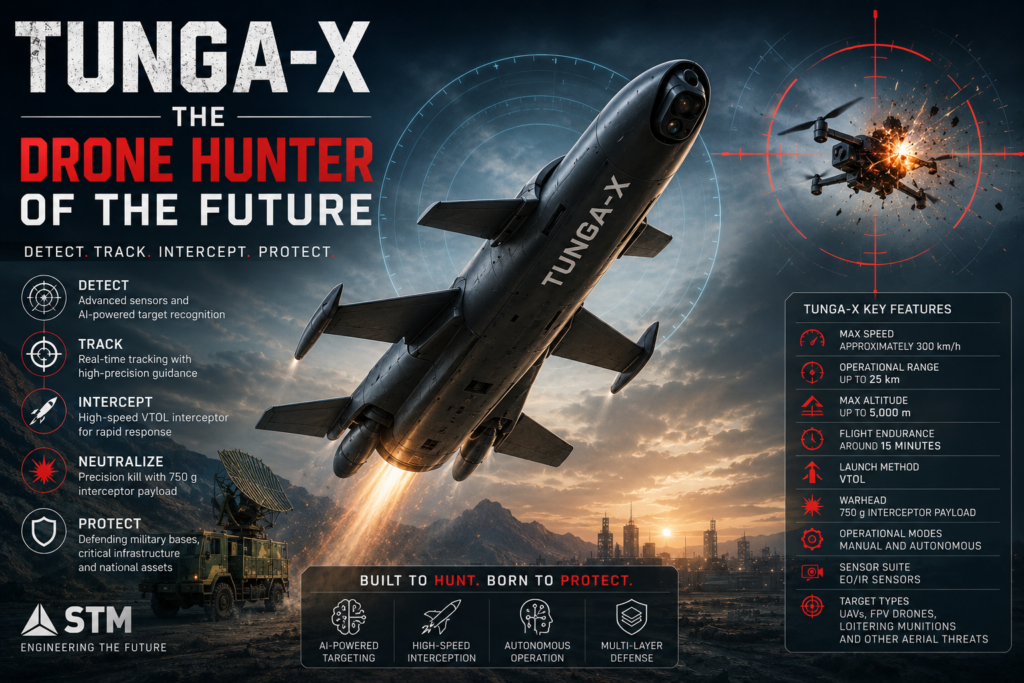
The TUNGA-X is an advanced interceptor drone designed to detect, track, and destroy the hostile UAV prior to its arrival at the target. Designed to specifically combat small drones, loitering munitions and other unmanned threats on the battlefield.
Unlike the traditional military drones used for surveillance or offence, the TUNGA-X is a defence weapon. It functions as a drone hunter, speeding up to attack enemy drones in mid-air and destroying them. The special role makes it a valuable asset in the protection of military bases, airports, government facilities and critical infrastructure.
The drone can be flown either remotely or remotely piloted. It has sophisticated on-board systems which enable it to detect, track and engage targets with a high degree of precision.
Why are Counter-Drone Systems important?
This has been proven in modern wars, as small drones are quite dangerous. Commercial drones are available which can easily be modified for military use, either with explosives or intelligence gathering capabilities. Today in the modern battlefield, loitering munitions are being used, and First-Person View (FPV) drones have arisen, which poses new challenges for defense forces.
These threats may not be best addressed by traditional air defense systems. It is not a wise financial use to expend scarce missiles on an inexpensive drone. In addition, some small UAVs are not easily detectable and targetable by conventional systems.
The TUNGA-X tackles these questions with:
- Lower interception costs
- Faster response times
- High operational flexibility
- Improved capability to hit small aerial targets.
- Strengthened security of key sites
The TUNGA-X will likely be part of the future of air defense, particularly with the ongoing advancements in drone technology.
Key features of the TUNGA-X
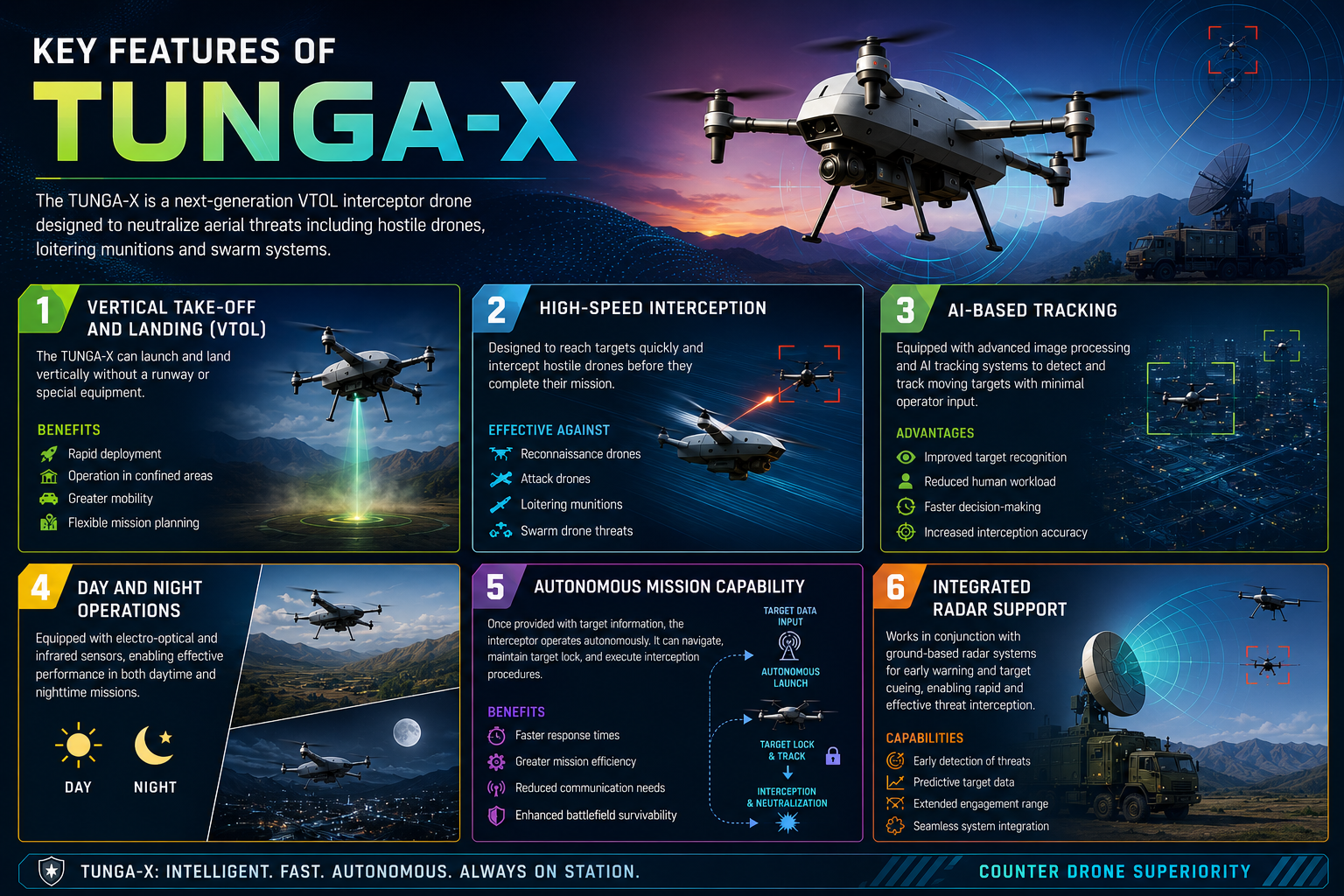
The TUNGA-X is particularly remarkable due to its state-of-the-art design and cutting-edge technologies. It is proving effective as a counter-drone platform due to a number of features.
1. Vehicles that take off and land vertically
The TUNGA-X’s features, its VTOL design, are one of the most significant. The drone is able to launch vertically without a launch pad or special launching equipment.
Benefits include:
- Rapid deployment
- Working in enclosed areas.
- Greater mobility
- Flexible mission planning
This feature enables the deployment of military units from different sites such as urban areas, temporary field bases, etc.
2. High-Speed Interception
The TUNGA-X is designed to reach targets quickly. It has the ability to fly at high speed and intercept hostile drones before they finish their tasks.
When the circumstances call for fast interception, they’re especially critical against:
- Reconnaissance drones
- Attack drones
- Loitering munitions
- Swarm drone threats
3. Artificial Intelligence-Based Tracking
The drone is equipped with advanced image processing technology and AI tracking systems. These systems can detect and track moving targets with little or no operator assistance.
Advantages include:
- Improved target recognition
- Reduced human workload
- Faster decision-making
- Increased interception accuracy
4. Day and Night Operations
Operating both day and night.Running a day and night business.
In the modern fashion of combat operations, they take place throughout the day. The TUNGA-X is equipped with electro-optical and infrared sensors, enabling it to operate effectively during both daytime and nighttime missions.
This ability makes it possible to remain protected from above without restriction of light.
5. Autonomous Mission Capability
Once it has been given the target information, the interceptor can operate on its own. Upon launch, it is capable of engaging towards threat, maintaining target lock and performing interception procedures.
Autonomous operation offers:
- Faster response times
- Greater mission efficiency
- Reduced communication requirements
- Enhanced battlefield survivability
6. Integrated Radar Support
The TUNGA-X can be used in conjunction with ground-based radar systems. These systems offer predictive data and early warning capabilities, enabling the interceptor to respond quickly to intercepting threats.
The radar and UAV interception are a perfect combination for a multi-layered defense system.
TUNGA-X Technical Specifications
The following table shows the following key specifications of the TUNGA-X Interceptor UAV:
| Specification | Details |
|---|---|
| Platform Type | Interceptor UAV |
| Primary Mission | Counter-Drone Operations |
| Launch Method | Vertical Take-Off and Landing (VTOL) |
| Maximum Speed | Approximately 300 km/h |
| Operational Range | Up to 25 km |
| Flight Endurance | Around 15 Minutes |
| Maximum Altitude | Up to 5,000 m |
| Guidance System | GNSS and Optical Guidance |
| Tracking Method | AI-Based Image Processing |
| Operational Modes | Manual and Autonomous |
| Sensor Suite | EO/IR Sensors |
| Warhead | 750 g Interceptor Payload |
| Target Types | UAVs, FPV Drones, Loitering Munitions, and Other Aerial Threats |
How the TUNGA-X Works
In the interception process, there are a number of steps:
Detection
A drone is sent to intercept an intruding drone – either using ground-based radar or surveillance systems.
Target Assignment
Target information is sent to the TUNGA-X control system. The interceptor is provided with information on the drone’s trajectory, speed and position.
Launch
The TUNGA-X is fired vertically and starts to move towards the target area.
Tracking
The drone detects and tracks the hostile UAV by relying on sensors on board and software enhanced with artificial intelligence.
Interception
Once the interceptor is within range, it launches an attack on the target. The hostile drone is destroyed by direct impact or by a special warhead which is designed to intercept the drone from the air.
Mission Completion
Mission data is then sent to operators for assessment and analysis after the engagement.
Also Read- Top AI Chatbot Apps Transforming Communication in 2026
Potential Applications of the TUNGA-X
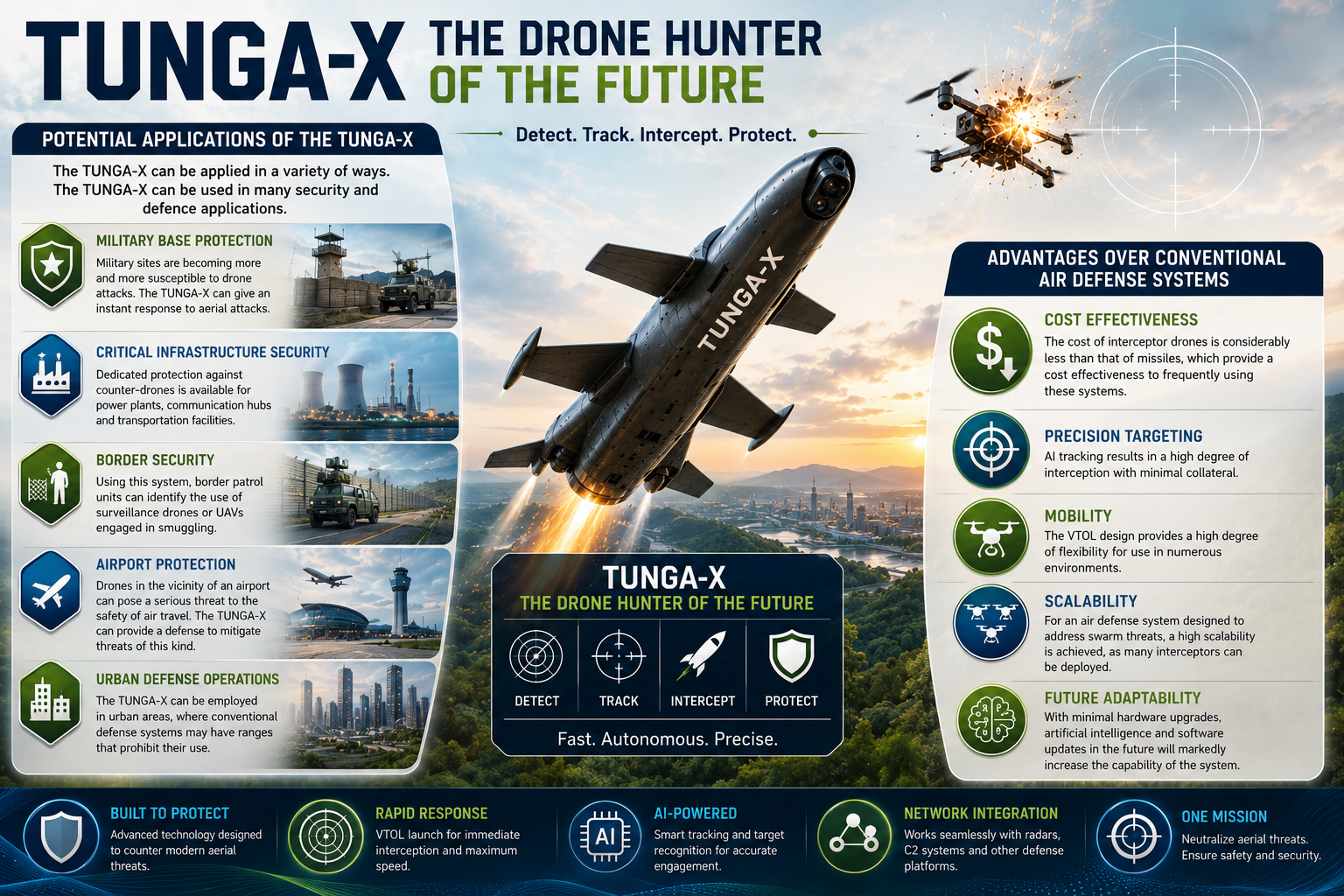
- The TUNGA-X can be applied in a variety of ways.
- The TUNGA-X can be used in many security and defence applications.
Military Base Protection
Military sites are becoming more and more susceptible to drone attacks. The TUNGA-X can give an instant response to aerial attacks.
Critical Infrastructure Security
Dedicated protection against counter-drones is available for power plants, communication hubs and transportation facilities.
Border Security
Using this system, border patrol units can identify the use of surveillance drones or UAVs engaged in smuggling.
Airport Protection
Drones in the vicinity of an airport can pose a serious threat to the safety of air travel. The TUNGA-X can provide a defense to mitigate threats of this kind.
Urban Defense Operations
The TUNGA-X can be employed in urban areas, where conventional defense systems may have ranges that prohibit their use.
This provides advantages over conventional air defense systems.
Cost Effectiveness
The cost of interceptor drones is considerably less than that of missiles, which provide a cost effectiveness to frequently using these systems.
Precision Targeting
AI tracking results in a high degree of interception with minimal collateral.
Mobility
The VTOL design provides a high degree of flexibility for use in numerous environments.
Scalability
For an air defense system designed to address swarm threats, a high scalability is achieved, as many interceptors can be deployed.
Future Adaptability
With minimal hardware upgrades, artificial intelligence and software updates in the future will markedly increase the capability of the system.
The Future of Counter-Drone Warfare
The TUNGA-X is a system that addresses developments in warfare that the military has undertaken. With faster, cheaper, and more sophisticated drone technology, a greater emphasis on defense will be required.
Some future models of interceptor UAVs may have:
- Extended flight time
- Enhanced autonomous features
- Swarm interception capabilities
- Advanced AI threat assessment capabilities.
- Improved radar/sensor collaboration
An example of autonomous drone-on-drone combat that may be incorporated in air defense systems of the future is the TUNGA-X.
Conclusion
The TUNGA-X Interceptor UAV represents a highly innovative solution for counter-drone defense, addressing a preeminent global security concern with a practical and cost-effective model that will seek, track, and destroy a wide range of hostile drones. The TUNGA-X with its VTOL launch, AI tracking, autonomous flight, and high-speed interception is likely to have great appeal for a wide range of nations and security organizations.
With the ever-evolving threats posed by drones, the TUNGA-X and other systems of this type will be essential to safeguard critical infrastructure, military establishments, and the general public. The TUNGA-X represents the beginning of a new class of sophisticated air defense systems that will be more easily integrated with contemporary military operations.
FAQs
-
What is the TUNGA-X Interceptor UAV?
The TUNGA-X is a counter-drone UAV system that can locate, track, and eliminate hostile UAVs.
-
Is the TUNGA-X autonomous?
Yes. This system can indeed be used as an autonomous system when integrated with AI-based tracking and targeting systems.
-
What form of threats can it block?
The TUNGA-X can engage with threats posed by reconnaissance drones, FPV drones, loitering munitions and small UAVs.
-
Discuss the significance of the TUNGA-X to the future of warfare.
Considering the rising threats of drones in the contemporary global warfare environment, the TUNGA-X provides a highly intelligent, flexible and affordable system to counter drone threats.