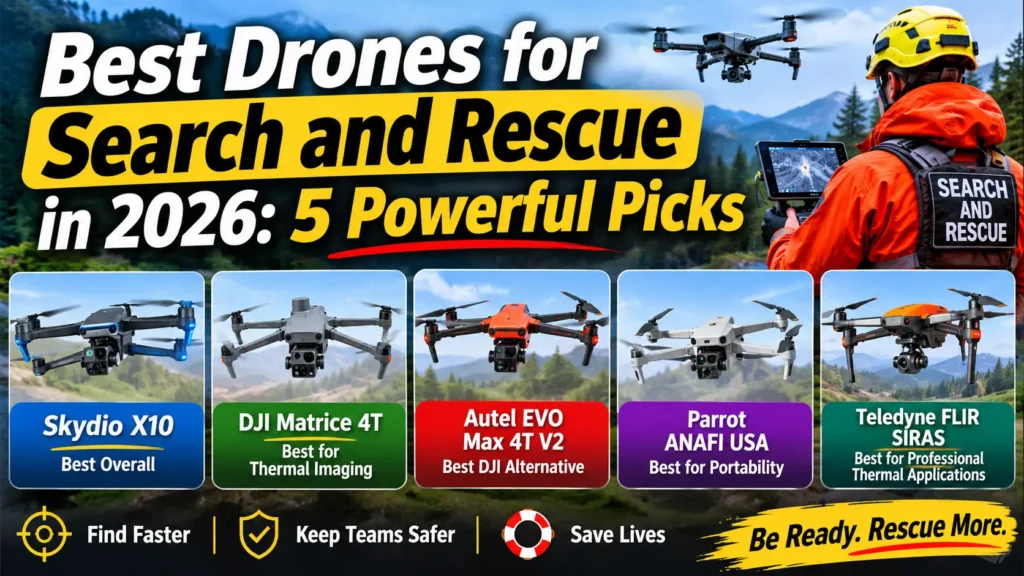
Best Drones for Search and Rescue in 2026: 5 Powerful Picks
+
Table of Contents
- 1 5 Best Drones for Search and Rescue 2026
- 1.1 1. Skydio X10 – Best Overall
- 1.1.1 Key features:
- 1.2 2. DJI Matrice 4T – Best for Thermal Imaging
- 1.3 3. Autel EVO Max 4T V2 – Best DJI Alternative
- 1.4 4. Parrot ANAFI USA – Best for Portability
- 1.4.1 Important Features
- 1.5 5. Teledyne FLIR SIRAS – Best for Professional Thermal Applications
- 1.5.1 Important Features
- 2 Comparison Table: Best Drones for Search and Rescue
- 3 Conclusion
Unpredictable weather, poor visibility, and difficult terrain create challenges for emergency personnel looking to find missing persons (i.e., hikers and accident victims), as well as to help those affected by natural disasters. Large, unmanned aerial vehicles (UAVs) allow emergency teams to cover large areas and access difficult terrain. UAVs can also give emergency teams up-to-date information regarding missing persons.
The best drones for search and rescue incorporate both thermal imaging and high-definition (HD) video cameras. These features help search and rescue (SAR) teams locate the missing and, at the same time, protect SAR teams from dangerous conditions and situations.
In this report, we review five drones that met our criteria for the best drones for SAR teams for 2026.
5 Best Drones for Search and Rescue 2026
1. Skydio X10 – Best Overall

The Skydio X10 is designed with cutting-edge hardware and software to serve the public safety and industrial markets. This UAV can access difficult terrain and buildings using its artificial intelligence (AI) technology. It is also equipped with visible light and thermal cameras, as well as intelligent obstacle avoidance technology.
Key features:
- 640 × 512 thermal imaging
- Advanced AI-powered obstacle avoidance
- Multiple high-resolution cameras
- Approximately 40 minutes of flight time
- IP55 weather protection.
Benefits: Thermal imaging and AI technology provide SAR teams the ability to find people in difficult, dangerous, and remote locations. This UAV is recommended for public safety agencies in the United States.
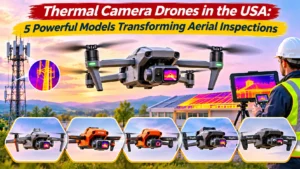
Also Read: Thermal Camera Drones in the USA: 5 Powerful Models Transforming Aerial Inspections
2. DJI Matrice 4T – Best for Thermal Imaging
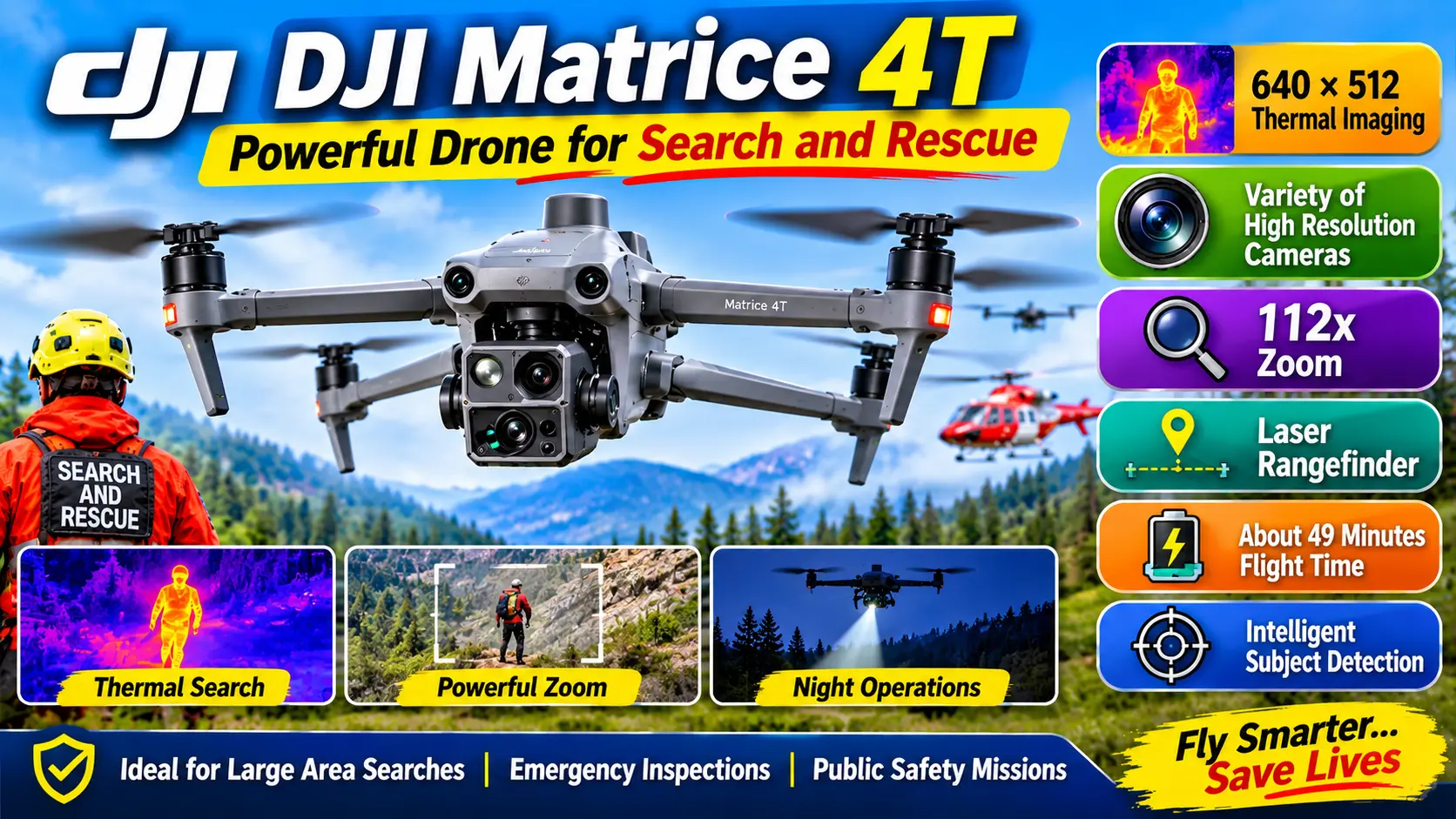
The DJI Matrice 4T contains intelligent flight systems as well as both visual and thermal cameras.
Rescue personnel can use the Matrice 4T’s thermal imaging to identify potential heat signatures. Operators can use the zoom functions to analyze subjects at greater distances. The unit is also equipped with a laser rangefinder.
Main features and benefits include:
- 640 x 512 thermal imaging
- Variety of high-resolution cameras
- 112x zoom
- Laser rangefinder
- About 49 minutes flight time
- Intelligent subject detection
Benefits: The Matrice 4T is designed for large area searches and nighttime operations. Additionally, it can be used for emergency inspections. Keep in mind, U.S. government entities should evaluate applicable procurement restrictions before buying any DJI products.
3. Autel EVO Max 4T V2 – Best DJI Alternative

The Autel EVO Max 4T V2 is designed for professional inspections, public safety, and emergency response.
It features thermal imaging and zoom cameras, laser ranging, and intelligent flight and navigation systems. The EVO Max 4T V2 is also equipped with A-Mesh networking technology. This technology is designed to enable wireless communication between other compatible devices and aircraft.
Main features and benefits include:
- 640 x 512 thermal imaging
- Wide-angle and zoom cameras
- Laser rangefinder
- 42 minutes flight time
- Advanced obstacle avoidance
- A-Mesh networking technology
Benefits: The EVO Max 4T V2 gives first responders a myriad of imaging capabilities. Its thermal camera can be used to locate heat signatures, while the zoom capabilities allow operators to analyze subjects from further distances.
4. Parrot ANAFI USA – Best for Portability
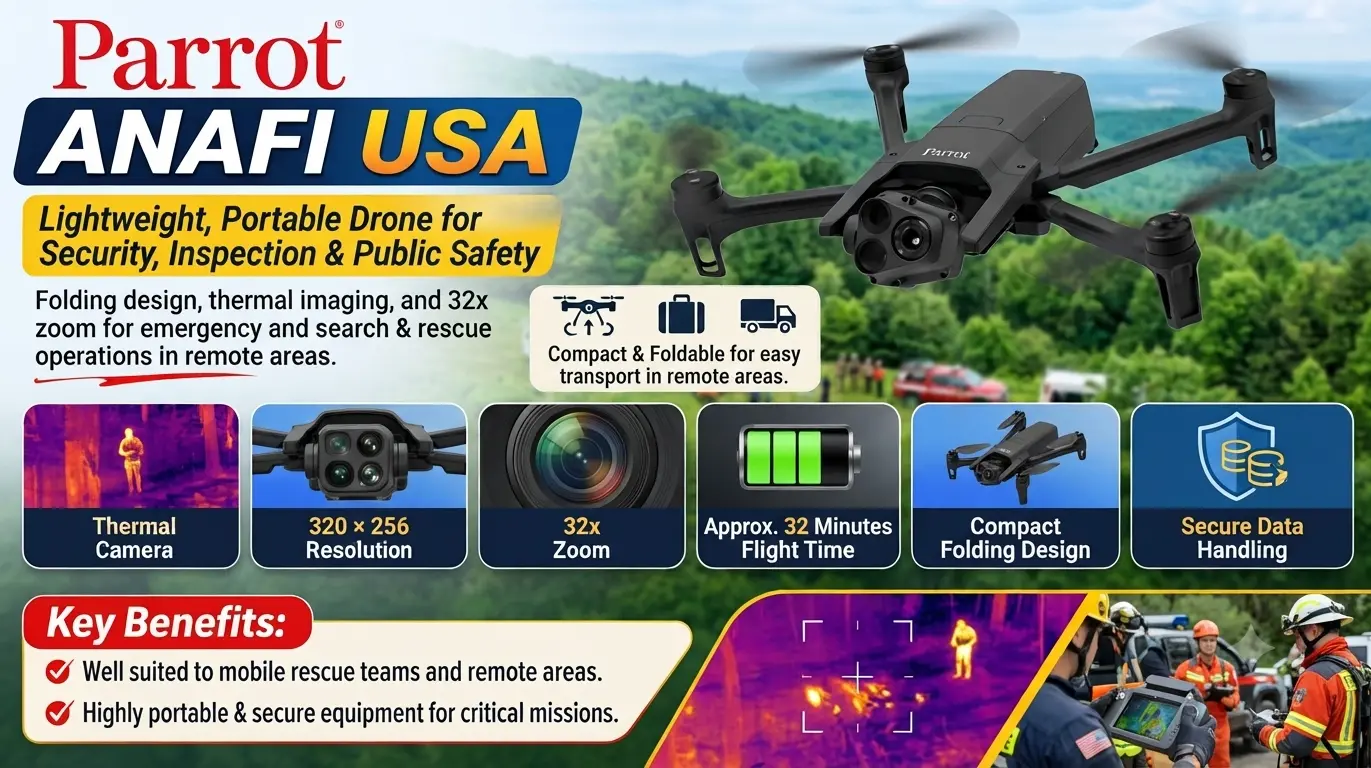
The Parrot ANAFI USA is a lightweight, portable drone for security, inspection, and public safety applications.
ITS folding design makes transportation easier for emergency personnel operating in remote areas. Additionally, its combination of thermal imaging with zoom provides the capacity to examine areas that are challenging to access.
Important Features
- FLIR Boson thermal camera
- 320 x 256 thermal resolution
- 32 x zoom
- Approximately 32 minutes of flight time
- Compact folding design
- Secure data handling features
Benefits: Because of its construction, it’s well suited to mobile rescue teams. It’s particularly well suited to situations where high portability and security of equipment are of primary importance.
5. Teledyne FLIR SIRAS – Best for Professional Thermal Applications
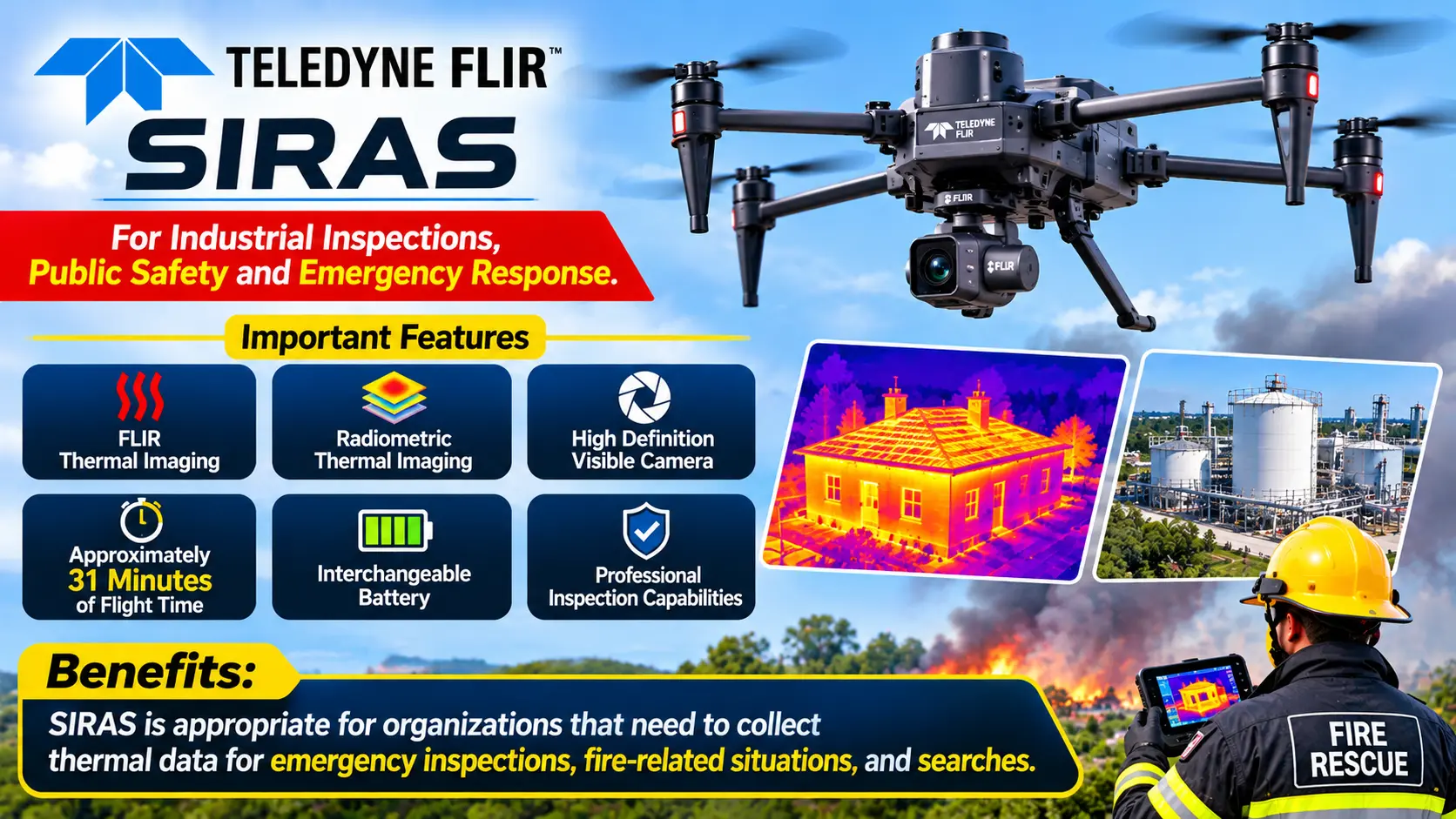
The Teledyne FLIR SIRAS is intended for industrial inspections, public safety, and emergency response.
Thermal imaging technology helps operators detect and evaluate temperature differences and identify heat sources. The drone is equipped with a visible-light camera and has an interchangeable battery.
Important Features
- FLIR thermal imaging
- Radiometric thermal imaging
- High-definition visible camera
- Approximately 31 minutes of flight time
- Interchangeable battery
- Professional inspection capabilities
Benefits: SIRAS is appropriate for organizations that need to collect thermal data for emergency inspections, fire-related situations, and searches.
Also Read: Best AI Sound Effects Generators in 2026: Powerful Tools for Custom Audio
Comparison Table: Best Drones for Search and Rescue
| Drone | Thermal Resolution | Flight Time | Best For |
|---|---|---|---|
| Skydio X10 | 640 × 512 | 40 minutes | Overall Performance |
| DJI Matrice 4T | 640 × 512 | 49 minutes | Thermal Imaging |
| Autel EVO Max 4T V2 | 640 × 512 | 42 minutes | DJI Alternative |
| Parrot ANAFI USA | 320 × 256 | 32 minutes | Portability |
| Teledyne FLIR SIRAS | 640 × 512 | 31 minutes | Thermal Applications |
Note: These are approximate maximum manufacturer-specified figures. Flight times can vary due to operating conditions, battery, and payload configuration. Specifications can also vary by configuration.
How to Select the Right Search and Rescue Drone
Here are some of the most important factors to consider when selecting a professional SAR drone.
Thermal Imaging: Resolution directly impacts a sensor’s ability to discern heat signatures and other details within thermal images.
Flight Endurance: Being able to fly longer not only increases the area a team is able to cover, but also reduces the number of interruptions and breaks to change batteries.
Obstacle Avoidance: Navigating drones around obstacles can help pilots make safer and more efficient flights around buildings, trees, and other obstacles.
Weather Resistance: Durability can be measured by wind resistance and temperature limitations as well as the IP rating.
Procurement Compliance: The latest NDAA requirements need to be considered, as well as the Blue UAS listing and other federal restrictions on drone procurement.
Conclusion
New technologies are continuously improving search and rescue operations. Emergency services can now quickly collect aerial data and assist with inspections of hard-to-reach and dangerous areas. Many new drones have the capability of identifying heat signatures. This aids rescue operations by providing details on survivors who may need assistance.
In 2026, the Skydio X10 is perhaps the best drone for autonomous operations, while the DJI Matrice 4T offers one of the best imaging systems. The Autel EVO Max 4T V2 and Parrot ANAFI USA are also worth consideration. Lastly, the Teledyne FLIR SIRAS is a professional drone for thermal applications.
Deciding on the best drone for search and rescue operations can depend on numerous factors such as the budget, flight endurance, camera requirements, and procurement policies. With properly trained operators, drones have the potential to be transformative for emergency response and search and rescue operations.
Frequently Asked Questions (FAQs)
1. What are the best drones for search and rescue in 2026?
The Skydio X10, DJI Matrice 4T, Autel EVO Max 4T V2, Parrot ANAFI USA, and Teledyne FLIR SIRAS are professional options worth consideration.
2. Can drones find missing persons at night?
Yes, in theory. Thermal-equipped drones can help operators spot human heat signatures at night, depending on surrounding conditions.
3. How much do search and rescue drones cost in the USA?
Professional thermal drones can cost several thousand dollars and higher for more capable enterprise configurations.
4. Are thermal cameras essential for rescue drones?
Yes, thermal cameras can help spot heat differences, especially for operations in low- or no-visibility conditions.
5. Are FAA licenses required for drone pilots in the USA?
For commercial operations, yes. For qualifying public aircraft operations, licenses may not always be required.