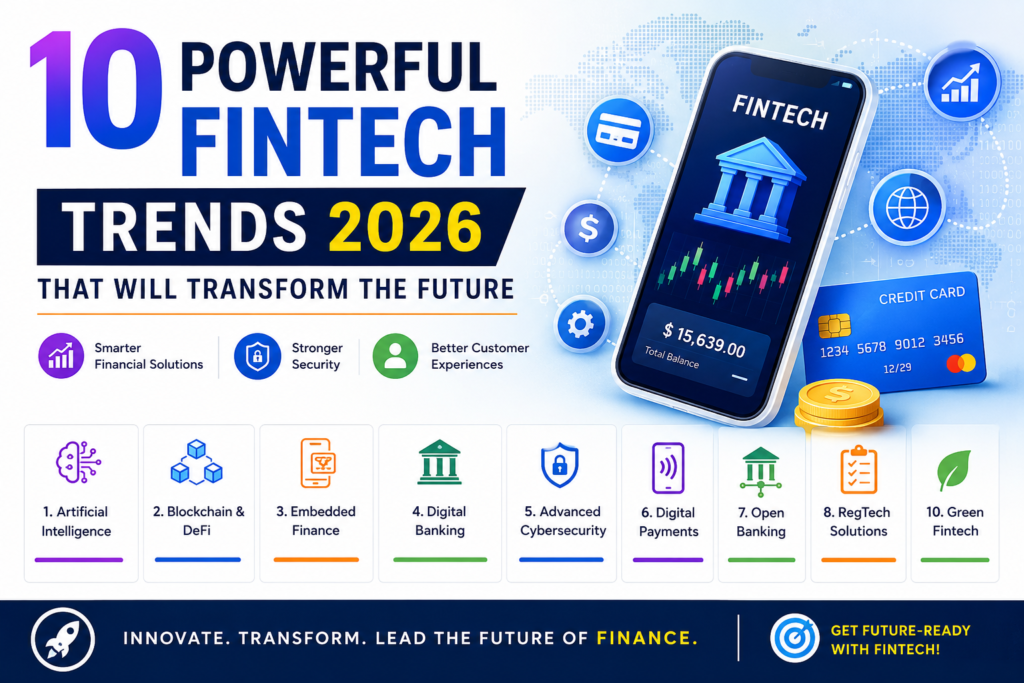
10 Powerful Fintech Trends 2026 That Will Transform the Future
+
Table of Contents
- 1 What Are Fintech Trends 2026?
- 2 The 10 Most Influential Fintech Trends in 2026
- 2.1 1. Finance and Artificial Intelligence
- 2.2 2. Blockchain and DeFi
- 2.2.1 Some benefits include:
- 2.3 3. Growth of Embedded Finance
- 2.4 4. Digital Banking Evolution
- 2.5 5. Advanced Cyber Security Solutions
- 2.6 6. Contactless and Digital Payments
- 2.7 7. Open Banking Technology
- 2.7.1 Benefits:
- 2.8 8. RegTech (Regulatory Technology)
- 2.8.1 Benefits:
- 2.9 9. Personalized Financial Services
- 2.9.1 Benefits:
- 2.10 10. Sustainable and Green Fintech
- 2.10.1 Benefits:
- 3 Fintech Trends 2026 Comparison Chart
- 4 Conclusion
- 4.1 Frequently Asked Questions About Fintech Trends 2026
- 4.1.1 1. What will the major fintech trends be in 2026?
- 4.1.2 2. How will AI transform fintech?
- 4.1.3 3. Will blockchain play an important role in the future of finance?
- 4.1.4 4. What is the reason behind the increase in digital payments?
- 4.1.5 5. What advantages will Fintech Trends 2026 bring to businesses?
The financial system is quickly evolving. Technology has a hand in everything from how people manage their finances to how they save and invest. Innovations like AI and blockchain have integrated technology with security and have completely revolutionized the digital finance space. Fintech Trends of 2026 will likely reshape how we think about banking, business, and finances by providing services that are easily accessible, highly automated, and focused on the customer.
Fintech services go far beyond just online payment solutions. Now, they include AI-based virtual financial assistants, a myriad of cybersecurity solutions and enhancements, embedded finance, decentralized solutions, and a plethora of advanced banking technologies. Early adopters will feel the effects of highly advanced, automated, secure, and convenient business processes.
What Are Fintech Trends 2026?
Fintech Trends 2026 are a myriad of the most recent innovations within technology and finance, and how they are intersecting. New innovations within this space are rapidly changing how digital transactions, virtual banking, and investing services are experienced by end-users.
The focus of fintech innovations is primarily on eliminating the friction and latency from legacy financial systems and offering services that are smart, highly automated, and personalized.
Modern Fintech Technologies
Some of the advanced features that modern fintech technologies have include:
- AI-based automation for speed in financial decisions
- Instant digital transactions
- Robust cybersecurity
- Custom banking
- Cloud-based finance
- Transparency through blockchain
- Mobile-first finance
- Advanced detection and prevention of fraudulent transactions
The innovations in this space are making financial technologies that serve a global audience both smart and secure.
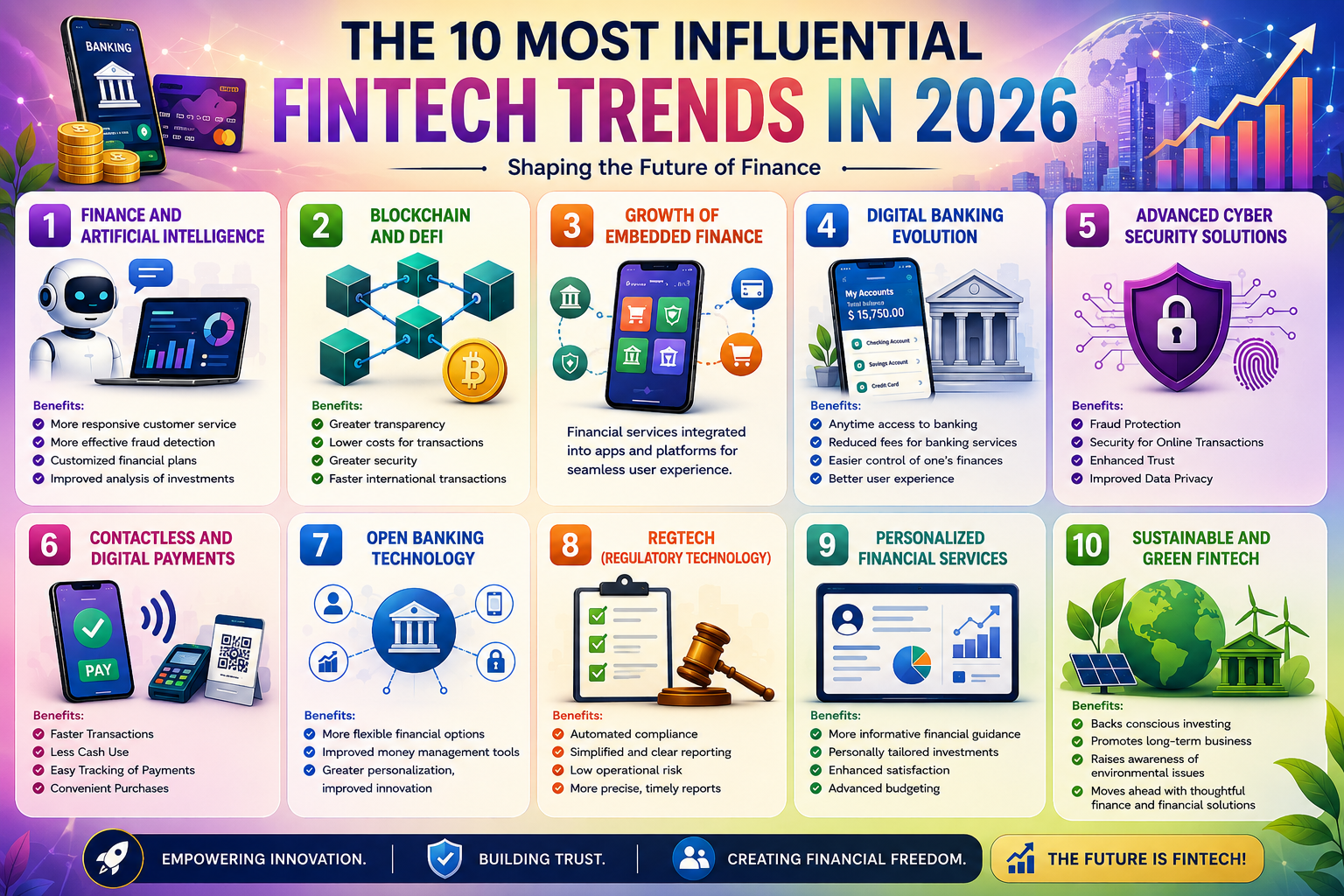
The 10 Most Influential Fintech Trends in 2026
1. Finance and Artificial Intelligence
Artificial Intelligence is predicted to be among the top Fintech Trends in 2026. This is because AI has the ability to transform financial operations. Banks and other financial platforms have started integrating AI in their customer support systems, as well as in systems for detecting and preventing fraud, evaluating and predicting the value of investments, and in the automation of financial guidance.
AI chatbots can be utilized to perform customer service tasks in real time, and AI-driven systems can analyze and evaluate financial behavior to develop and suggest appropriate recommendations.
Some of the advantages include:
- More responsive customer service
- More effective fraud detection
- Customized financial plans
- Improved analysis of investments
AI integration has the ability to develop and increase the efficiency of financial services.
2. Blockchain and DeFi
The use of Blockchain technology has the potential to develop greater levels of security and transparency among financial systems. DeFi enables individuals to utilize financial services without relying fully on traditional financial systems.
One of the dominant Fintech Trends in 2026 is the utilization of Blockchain technology to facilitate faster financial transactions and the transfer of verified digital identity and secure data.
Some benefits include:
- Greater transparency
- Lower costs for transactions
- Greater security
- Faster international transactions
The adoption of Blockchain technology and systems will continue to gain traction across the financial and commercial sectors.
3. Growth of Embedded Finance
Embedded finance refers to the integration of financial services into digital platforms, websites, and applications. Users have the ability to utilize payment services, insurance, loans, and banking directly in their preferred applications.
Organizations are adopting embedded finance for the betterment of their customers and to facilitate seamless digital operations.
4. Digital Banking Evolution
Digital Banking continues to shift the way customers engage with their banks. Customers prefer enhanced, flexible digital banking services and the ability to conduct banking transactions using their mobile devices. In an effort to retain their customer base, traditional banks have also invested in improving their online banking services.
One of the major FinTech trends for 2026 centers on the improvement of fully digital banking systems. These banks are able to quickly and easily deliver financial services.
Benefits of Digital Banking:
- Anytime access to banking
- Reduced fees for banking services
- Easier control of one’s finances
- Better user experience
Also Read- 10 Best VPN for USA: Unlock Faster & Safer Browsing
5. Advanced Cyber Security Solutions
As online finance continues to expand, the protection of customers and their finances continues to be a concern. Financial institutions have begun to heavily invest in the improvement of security technologies to safeguard their customers from online threats.
Modern security products rely on the use of Artificial Intelligence, Biometrics, and advanced surveillance systems to identify suspicious transactions.
Benefits of Advanced Cyber Security Solutions:
- Fraud Protection
- Security for Online Transactions
- Enhanced Trust
- Improved Data Privacy
Cybersecurity will continue to be a focal point for Financial Technologies.
6. Contactless and Digital Payments
At this point, digital payments are an everyday financial transaction. The use of digital wallets, QR Code payments, and contactless cards has replaced traditional payment systems.
The payment systems of the future are highly focused on the ease of use, safety, and, of course, rapid transactions.
Benefits of Digital Payments:
- Faster Transactions
- Less Cash Use
- Easy Tracking of Payments
- Convenient Purchases
7. Open Banking Technology
Open Banking makes it possible to safely share financial information between banks and approved service providers, giving users better control and more personalized financial services. This data is shared between banks and authorized Third Party Integrators. Access to this data allows the creation of more customized banking services and products.
Open banking empowers the user with more control over their financial data and is another of the rising FinTech trends for 2026.
Benefits:
- More flexible financial options
- Improved money management tools
- Greater personalization, improved innovation
8. RegTech (Regulatory Technology)
RegTech is a combination of different technologies aimed at helping financial services firms to comply with regulations. It offers a simpler approach to fulfil compliance obligations, while minimizing mistakes and difficulty in reporting. Financial services firms adopt RegTech to control and monitor their risks and adhere to regulations in an effective way.
Benefits:
- Automated compliance
- Simplified and Clear reporting Low operational risk
- More precise, timely reports
9. Personalized Financial Services
Nowadays, it is common for customers to expect financial services to address their unique requirements. Personalization is achieved with the help of Artificial Intelligence and Data Analytics to offer specialized guidance. Personalized finance is considered one of the pivotal fintech trends of 2026, as it provides users greater control over their finances.
Benefits:
- More informative financial guidance
- Personally tailored investments
- Enhanced satisfaction, Advanced budgeting
10. Sustainable and Green Fintech
As time passes, the financial services industry is beginning to incorporate sustainability. Green fintech focuses on the crossing of responsible investing and digital solutions that advance the sustainability agenda. Financial services firms have begun to offer methods to invest in an environmentally friendly way and tools to measure the effect on sustainability.
Benefits:
- Backs conscious investing
- Promotes long-term business
- Raises awareness of environmental issues
- Moves ahead with thoughtful finance and financial solutions
Also Read- 10 Powerful Team Collaboration Tools That Boost Success in 2026
Fintech Trends 2026 Comparison Chart
| Fintech Trend | Financing Feature | Key Advantage |
|---|---|---|
| Artificial Intelligence | Smart Automation | Quick Decisions |
| Blockchain | Safe Digital Storage | Greater Transparency |
| Embedded Finance | Integrated Systems | Convenience to the User |
| Digital Banking | Online Banking | Ease of Access |
| Cyber Security | Improved Protection | Safe Transactions |
| Digital Payments | Cashless | Easy Transactions |
| Open Banking | Data Availability | Financial Customization |
| RegTech | Automation of Compliance | Less Risk |
| Personalized Finance | AI | Better Planning |
| Green Fintech | Sustainable Financing | Conscious Financing |
Advantage of Fintech Innovations
Advancing Fintech Trends 2026 provides:
- Faster Financing
- Better Global Access
- Safety of Financing
- Lower Costs
- Greater Satisfaction and Improved Service
- Greater Customization of Financial Services
- Driving Technology of Finance
- Competitiveness of Business
- Greater Control of Money for Users
- Fintech Innovations
Greater Connectivity of Automation and Intelligence in Financial Solutions of the Future
Continued Advancement of AI, Blockchain, and Digital Banking
An investment for future business competitiveness and better solutions
Fintech Innovations 2026
Technology, Safety, and Customization are the priorities for the Future of Finance.
Conclusion
Financial Technology Innovations are creating a new era of banking and monetary transactions that are fast, easy, and safe. Innovations such as AI and sustainable Finance Solutions are altering the ways individuals and businesses deal with their money.
The Fintech Trends for 2026 suggest the future will be more automated, more transparent, more secure, and more convenient for the user. The businesses that integrate these changes will thrive in the next digital economy.
Frequently Asked Questions About Fintech Trends 2026
1. What will the major fintech trends be in 2026?
Major trends will include the use of artificial intelligence, blockchain, digital banking, enhanced cybersecurity, open banking, and the use of embedded finance technologies.
2. How will AI transform fintech?
AI will be used more in fintech to help automate tasks, recognize and prevent fraud, and add a more personalized touch to support that will be offered to customers, as a result of the support being more time-efficient.
3. Will blockchain play an important role in the future of finance?
Blockchain will continue to be a part of the future of finance because of the technology’s ability to add a level of security and trust to financial transactions and improve the overall efficiency of the transactions that will be a part of future finance.
4. What is the reason behind the increase in digital payments?
The payment options that are digital continue to grow in use because transactions are completed in an easier, faster, and safer way.
5. What advantages will Fintech Trends 2026 bring to businesses?
Modern fintech solutions will allow businesses to have more streamlined processes that will also save the business money, provide a more secure way to conduct business, and offer customers a better overall experience.