Future of Robotics: The Revolutionary Rise of Smart Machines
+
Table of Contents
- 1 What Is the Future of Robotics?
- 1.1 How AI is Changing Robotics
- 1.2 Key Features of Robotics
- 1.2.1 1. Manufacturing
- 1.2.2 2. Healthcare
- 1.2.3 3. Logistics and Warehousing
- 1.2.4 4. Agriculture
- 1.2.5 5. Domestic Assistance
- 2 Robotics Apps and Software Platforms
- 2.1 Key Features of Future Robots
- 2.2 Benefits of the Future of Robotics
- 2.2.1 Increased Efficiency
- 2.2.2 Greater Workplace Safety
- 2.2.3 Greater Precision
- 2.2.4 Robots May Reduce Staffing Shortages
- 2.2.5 New Opportunities for Workers
- 2.3 Limitations of Robotics
- 2.3.1 What’s Next
- 3 Conclusion
- 3.1 FAQs
Robotics is at an exciting juncture in its development. Once, robots could only perform repetitive, predictable movements. The current revolutions in artificial intelligence, computer vision, machine learning, natural-language processing, and sensing technology are fundamentally changing robotics. Robots are beginning to perceive and understand their environments, make decisions, learn from their environment, and ultimately operate and interact with humans.
Connected to “Physical AI” systems, robotics is predestined to collide with next-gen, real-world-capable intelligent technologies. In the next few years, up until 2026, researchers and companies will focus on embodied AI, humanoid robots, collaborative machines, healthcare robotics, and more capable robot foundation models.
What Is the Future of Robotics?
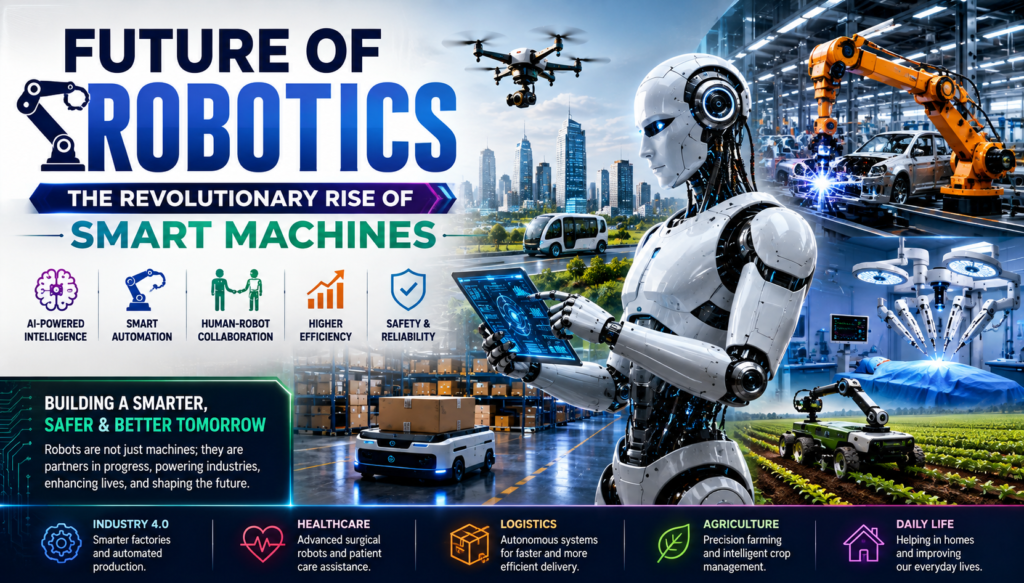
The future of robotics is intelligent, adaptable, and collaborative machines. Next-generation machines will not simply follow instructions. They will have a goal, and problem-solving will be the focus.
This evolution is already occurring in factories, warehouses, hospitals, and research labs. The NSF states robotics have the ability to increase productivity and efficiency while also dealing with hazardous and detailed tasks.
The next shift will be the integration of robotics with Generative AI. The integration of multiple modalities of AI will utilize natural language, vision, understanding of space, and physical ability. This will allow a user to instruct a robot to “move these boxes to the storage area.”
How AI is Changing Robotics
AI is fundamentally changing the nature of robots. Robots are becoming increasingly intelligent. Computer vision is enabling robots to read barcodes, understand and interact with their surrounding environment, and identify and report defects. Machine learning is enabling robots to predict and adapt to changing conditions and optimize their behavior. Natural-language processing is enabling speech and text-to-command interaction.
Another rapidly advancing field is that of foundation models for Robotics and Vision-Language-Action systems. The goal is to enable a robot to understand the world, interpret instructions, and execute tasks.
These advances are predicted to bring about a major shift from script-based robotics to goal based. Robots will be able to execute tasks after receiving objectives, rather than through manual programming.
Key Features of Robotics
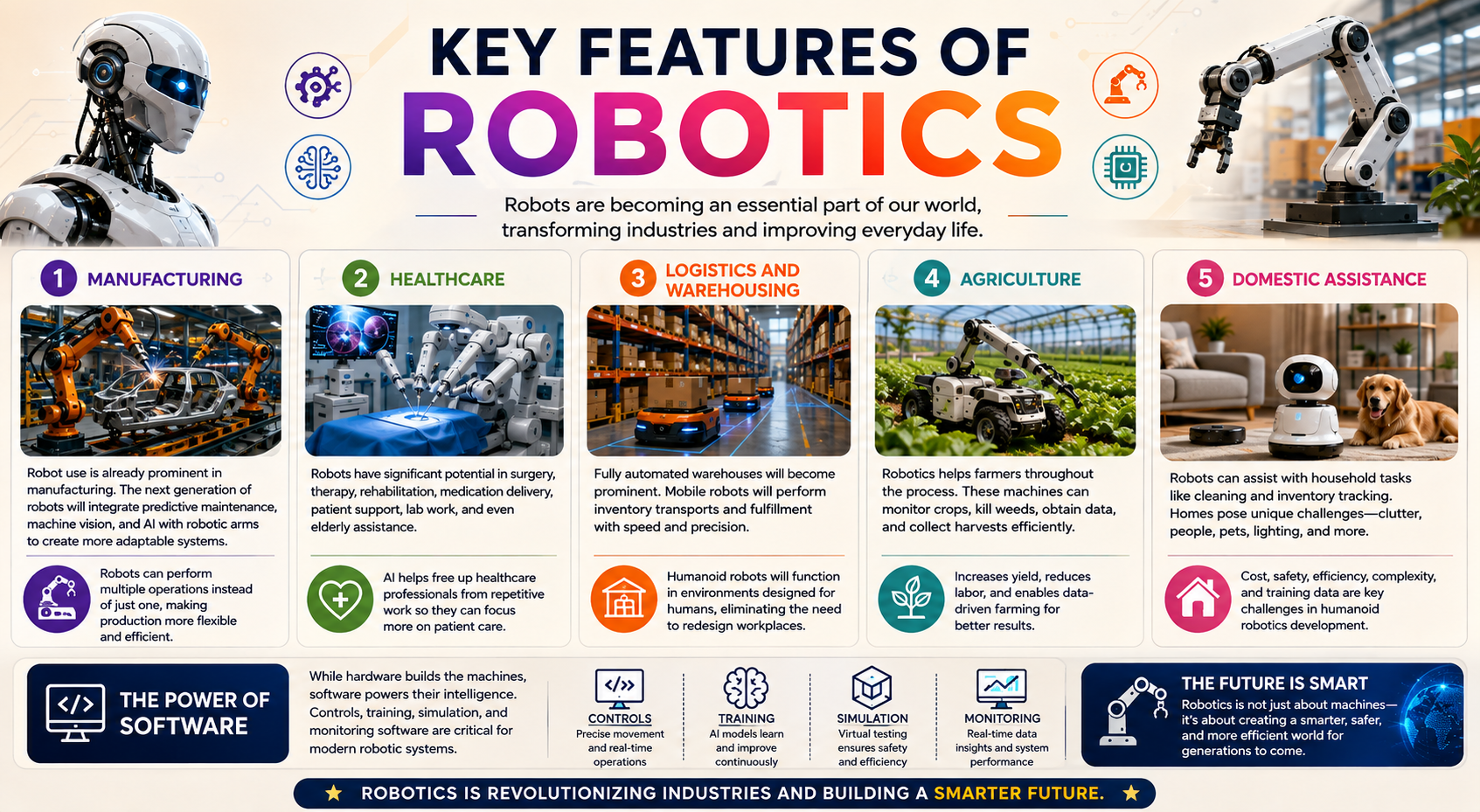
Robots are likely to become common outside of manufacturing. Robot use is expected to be prominent in many fields.
1. Manufacturing
Robot use is already prominent in manufacturing. The next generation of manufacturing robots will integrate factory predictive maintenance, machine vision, and AI models with robotic arms to create a manufacturing system that is more adaptable to changing customer demands.
Instead of only performing one operation, robots can become more flexible and perform multiple operations or tasks.
2. Healthcare
Robots have significant potential in all aspects of healthcare, from surgery to therapy and rehabilitation, to medication delivery and patient support, and even lab work and elderly assistance.
AI is also expected to help free up healthcare practitioners from repetitive work to allow them to focus on their profession.
3. Logistics and Warehousing
Fully automated warehouses will become prominent. Mobile robots will perform automated inventory transport and fulfillment.
The creation of humanoid robots will allow machines to function in environments designed for humans, eliminating the need to redesign working environments in light of specialized machinery.
4. Agriculture
Robotics has the advantage of producing machines that can aid farmers throughout the process. These machines can monitor crops, kill weeds, obtain data, and collect harvests.
5. Domestic Assistance
The most exciting challenge is the domestication of automation. With each passing year, we start seeing more machines that can assist with household duties like cleaning or even tracking inventory levels.
Although an orderly factory setting is more predictable, households have their own unique challenges. Robots have to learn to navigate clutter, members of a household, pets, and varying levels of lighting and many other uniquely human challenges. Stanford researchers have pointed to costs, safety, efficiency, complexity, and the training data as the largest challenges in the development of humanoid robotics.
While hardware has dominated the discussion of robotics, the development of software is just as important. For controls, training, simulation, and monitoring, software applications have become critical for robotic systems.
Also Read- Game-Changing Machine Learning Trends to Watch in 2026
Robotics Apps and Software Platforms
| Robotics App/Platform Type | Key Features | Main Benefit |
|---|---|---|
| Robot Programming Apps | Motion programming, task configuration, diagnostics | Faster deployment |
| Simulation Platforms | Virtual environments, digital twins, testing | Safer development |
| Robot Fleet Management | Monitoring, scheduling, analytics | Better fleet efficiency |
| Computer Vision Software | Object detection, tracking, inspection | Improved perception |
| AI Robot Assistants | Voice commands, reasoning, task planning | Easier human interaction |
| Remote Teleoperation Apps | Live control, video feeds, status monitoring | Human supervision |
| Predictive Maintenance Tools | Sensor analytics, fault detection | Reduced downtime |
Key Features of Future Robots
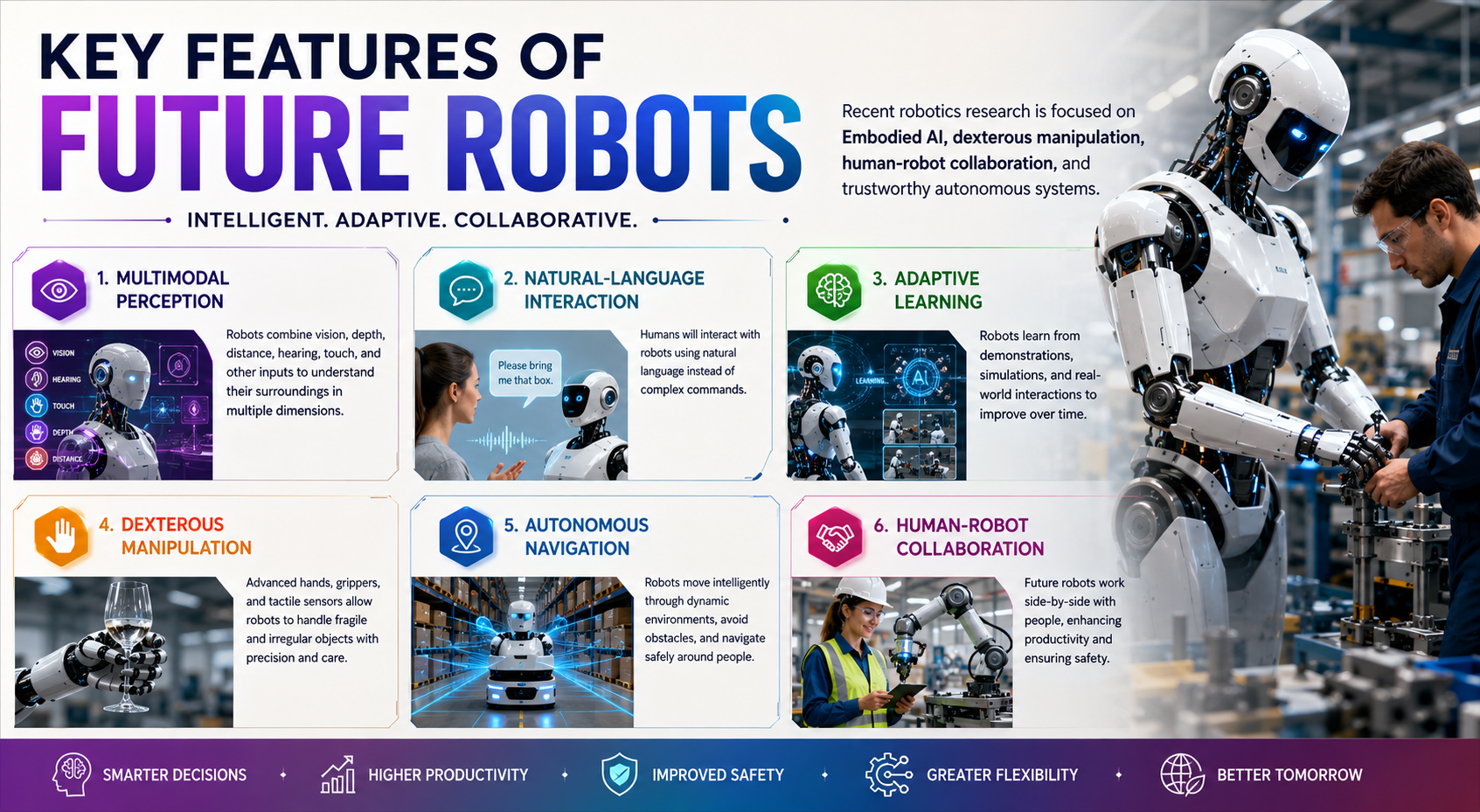
What follows are several defining elements of future robots.
- Multimodal perception: Future robots will have the ability to combine light, depth, and distance, hear, touch, and many other inputs, thus enabling them to “see” and multidimensionally “know” their surroundings.
- Natural-language interaction: Instead of command-line interface interaction, humans will interact with robots using natural language.
- Adaptive learning: Robots will be expected to learn through demonstrations, simulations, and physical world interactions.
- Dexterous manipulation: Further advancements in robotics will allow robots to handle fragile and irregular objects through the design and control of hands and grippers as well as the integration of tactile sensors.
- Autonomous navigation: Robots will be expected to traverse and avoid obstacles while avoiding collisions with humans.
- Human-robot collaboration: Future robots will work side-by-side with employees instead of working behind safety barriers.
Recent robotics research is focused on Embodied AI, dexterous manipulation, human-robot collaboration, and trustworthy autonomous systems.
Benefits of the Future of Robotics
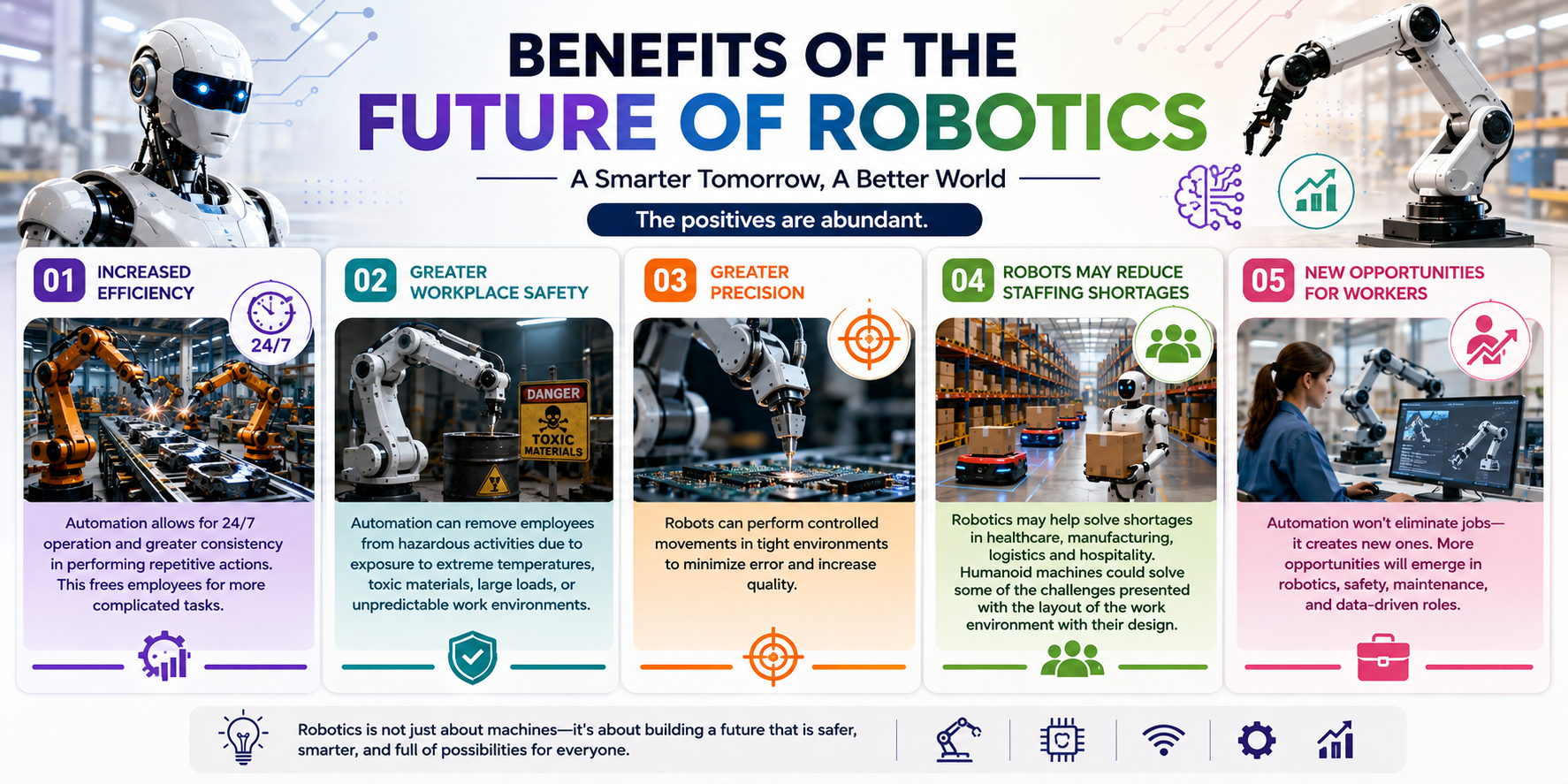
The positives are abundant.
Increased Efficiency
Automation allows for 24/7 operation and greater consistency in performing repetitive actions. This frees employees for more complicated tasks.
Greater Workplace Safety
Automation can remove employees from hazardous activities due to exposure to extreme temperatures, toxic materials, large loads, or unpredictable work environments.
Greater Precision
Robots can perform controlled movements in tight environments to minimize error and increase quality.
Robots May Reduce Staffing Shortages
Robotics may help solve shortages in healthcare, manufacturing, logistics, and hospitality. Humanoid machines could solve some of the challenges presented by the layout of the work environment with their design.
New Opportunities for Workers
We shouldn’t expect automation to lead to the elimination of all jobs. Machines may be better suited to take on more of the mundane and repetitive activities, allowing more job openings within robotics, safety, and data specializations.
Also Read- Top 10 Trending Wearable Tech Devices in the USA for 2026
Limitations of Robotics
Though there are many challenges, the future for robotics is bright. The operating environment for robots currently has poor lighting and is experienced within a lab of controlled chaos and unfamiliar objects. The robots also have poorly defined boundaries caused by unpredictable human interaction.
The training data for robots is much less sophisticated and extensive compared to the vast open arrays of data for natural language processing.
There are many challenges, of course: cost, battery life, reliability, cybersecurity, privacy, regulation, safety, and, of course, the liability of a robot making decisions for itself and being deployed without certainty.
What’s Next
We should expect robotics innovations that fulfill useful functions rather than focusing on impressive new forms. The convenience of automated tasks is the next value proposition.
More and more experts liken this change to the integration of physical AI. McKinsey reveals that rapid advances in AI, data, and hardware make robots usable outside of closed-off environments.
Of course, we must still establish reasonable boundaries. The current state of robots in the form of humanoid systems lacks dexterity, generalization, energy efficiency, and reliable operation. There is a belief that those breakthroughs will happen in a few years at most, while others envision that wider, more general AI capabilities will take longer.
It is not likely that we will see a future where robots dominate over humans. Rather, robotics technology will be another layer in the infrastructure of society as it complements the work of people and executes tasks that machines do best.
Conclusion
The world is shifting from rigid automated systems to intelligent, flexible, and social machines. AI is endowing robots with more advanced perception, reasoning, learning, and social skills; plus, the science of AI in combination with more advanced physical computing, sophisticated sensors, and cutting-edge actuators is bringing us more physically capable machines.
These technologies can change the way people work, live, and interact with the world, impacting not only the workplace but hospitals, warehouses, farms, and homes. The greatest potential may not be machines that can do more tasks. It will be machines that can understand goals and intent, operate safely with people, and adapt to different situations.
The coming years will tell if we move quickly from the foundation of modern smart machines to adopting safe and effective AI systems.
FAQs
1. What is the possible future of robotics?
We can see that the future of robotics will involve further integration with automation and artificial intelligence to create machines that are intelligent, self-adaptive, and able to collaborate with humans.
2. How will AI transform robotics?
Robots will be able to identify the semantics of what they see and also learn from and plan steps based on previous data through AI.
3. Where will robots be located in the future?
In the future, robots will be used in manufacturing, healthcare, farming, construction, and even in your own home.
4. Will robots put people out of work?
Being able to do a lot of jobs quickly and accurately will take a lot of jobs away, but programming the AI and keeping them safe to do that will also create many new jobs.
5. What are the important challenges of robotics?
There are many challenges that robotics may face, such as unreliable intelligence, safety, energy usage, and AI and hardware cost. Then there’s also challenges related to how versatile a robot can be and how secure it can be from being hacked as well as how well it can work on its own.
6. Are humanoid robots ready for everyday use?
Humanoid robots can be seen in the marketplace now, however they still need a lot of progress in order to be safe and reliable enough for everyday use.