AI Combat Drones: The Powerful Future of Modern Warfare
+
Table of Contents
- 1 What Are AI Combat Drones?
- 2 Applications of AI Combat Drones
- 2.1 Benefits of AI Combat Drones
- 2.1.1 Reduced Risk to Personnel
- 2.1.2 Faster Decision Support
- 2.1.3 Greater Operational Persistence
- 2.1.4 Improved Situational Awareness
- 2.1.5 Scalable Operations
- 2.2 AI Combat Drones and the Rise of Swarm Technology
- 2.3 Challenges and Ethical Concerns
- 2.4 The Future of AI Combat Drones
- 3 Conclusion
AI fundamentally reconfigures social systems in general and military systems in particular. AI systems create a fundamental dissonance in almost every military function, including planning, logistics, and operations.
AI systems push the boundaries of advanced surveillance equipment in production today. There is a progression in the design of military systems. This progression allows military systems to operate more independently, analyze more data, and rely on human input less.
After 2026, there was considerable R&D interest in the five elements of AI-embedded defense systems: the use of AI to control systems, the ability to detect and engage hostile systems, the ability for individual systems to operate independently, the ability for systems to operate as a cooperative group, and secure systems of communication.
What Are AI Combat Drones?
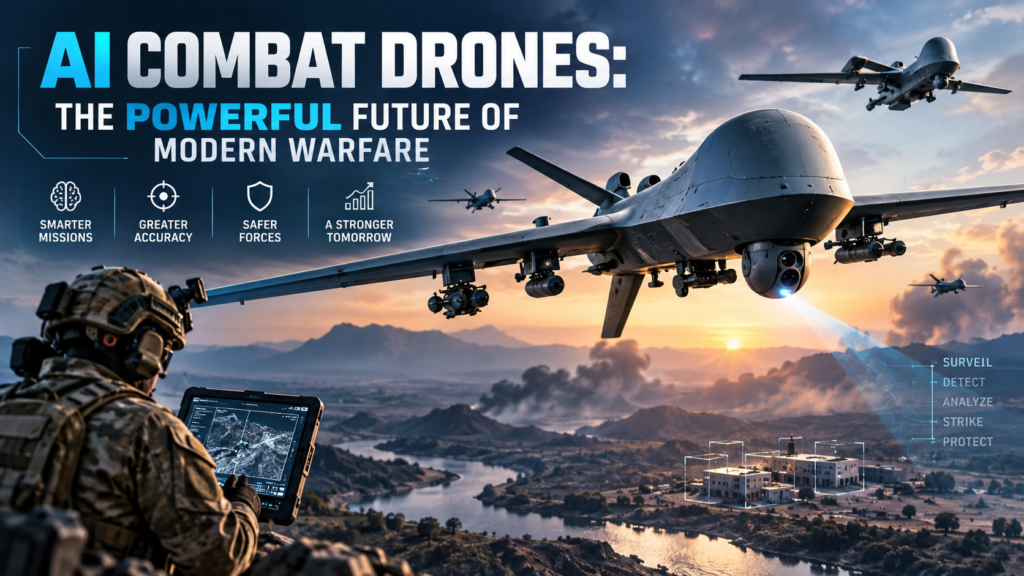
AI Combat Drones are military weapons systems that are designed to operate under AI systems for tasks that have traditionally required human on-site control. AI systems can be used to support functions of command, intelligence, and reconnaissance; coordination and communication; logistical support; observations and threat response.
Although the term AI Combat Drones implies systems that are capable of acting completely independently, this is a misleading assumption. The current paradigms of AI systems for military use are designed to be used under human control. AI systems perform processes of perception, navigation, data outputs, and other functions, leaving the control of operations to the human user.
AI drones – designed for military use – are becoming advanced. There are emerging technologies of AI integration that provide detection systems as well as the communication and control systems needed for various military missions. These systems are made to integrate with current defense systems to provide greater support for military missions.
Key Features of AI Combat Drones
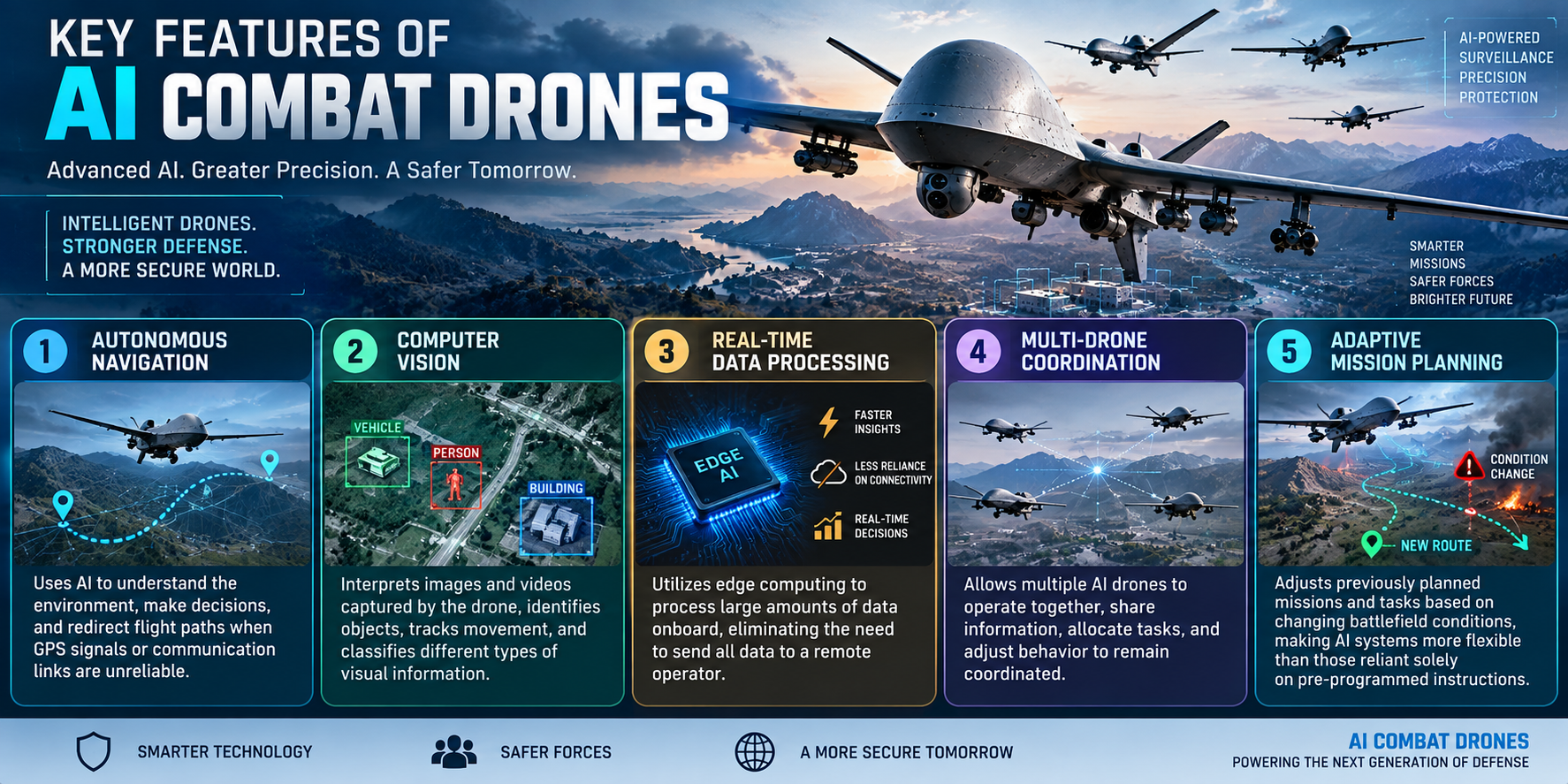
Modern AI combat drones can incorporate a broad range of advanced technologies.
1. Autonomous Navigation
If GPS signals and communication links are unreliable, drones can use AI technology to understand their environment, make decisions, and redirect their flight paths.
2. Computer Vision
Computer vision uses AI to interpret data from system images and videos captured by the drone and enhance the onboard system. Computer vision systems can identify objects and track movement, as well as classify various types of visual information.
3. Real-Time Data Processing
Traditionally, drones process large amounts of data by sending collected data to a remote operator. By utilizing edge computing, data can be processed on the drone, eliminating reliance on constant connectivity.
4. Multi-Drone Coordination
The most advanced systems allow many artificial intelligence (AI) systems/drones to operate together. They are able to share information, allocate tasks, and adjust behavior to remain coordinated.
Recent defense programs are increasingly exploring centralized control of autonomous aerial and ground systems at scale.
5. Adaptive Mission Planning
Because of the nature of warfare, battlefield conditions are rarely, if ever, static. For this reason, it is important for combat drones to be able to adjust previously planned missions and tasks. AI systems can be considered more flexible than systems reliant solely on instructions.
Also Read- VTOL Military Drones: The Future of Warfare
Applications of AI Combat Drones
AI combat drones have many applications beyond traditional warfare.
| Application | How AI Helps | Potential Benefit |
|---|---|---|
| Intelligence & Surveillance | AI organizes and analyzes imagery and data collected from multiple sensors. | Improves situational awareness and helps operators process large amounts of information efficiently. |
| Reconnaissance | AI enhances autonomous navigation and monitoring when drones are assigned reconnaissance tasks. | Enables more efficient observation of difficult or remote areas while reducing the need for constant manual control. |
| Threat Detection | AI processes sensor information to identify potential threats and provide operators with relevant battlefield information. | Supports faster threat assessment and improved battlefield awareness. |
| Search & Rescue | Drones can access areas that may be difficult or dangerous for humans while AI helps process collected information quickly. | Speeds up search operations and can reduce risks to personnel. |
| Logistics | Autonomous drones can assist with transporting supplies and optimizing supply operations. | Improves logistical efficiency and can support supply delivery in challenging environments. |
| Electronic Warfare | AI analyzes sensor data and changing battlefield conditions to help operators understand complex environments. | Provides enhanced situational awareness and supports more informed operational decisions. |
| Mine Detection | Drones use remote imagery and AI-assisted analysis to identify and assess potential explosive threats. | Helps improve operational safety while reducing personnel exposure to hazardous areas. |
| Swarm Operations | AI can coordinate multiple unmanned systems, allowing them to work together and adapt to changing conditions. | Creates greater operational capacity, flexibility, and adaptability when managing complex missions. |
In the United Kingdom, drones were used to help military personnel identify landmines and explosive ordnance, analyze threats in an area, and help military personnel do their jobs with less exposure to danger.
Benefits of AI Combat Drones
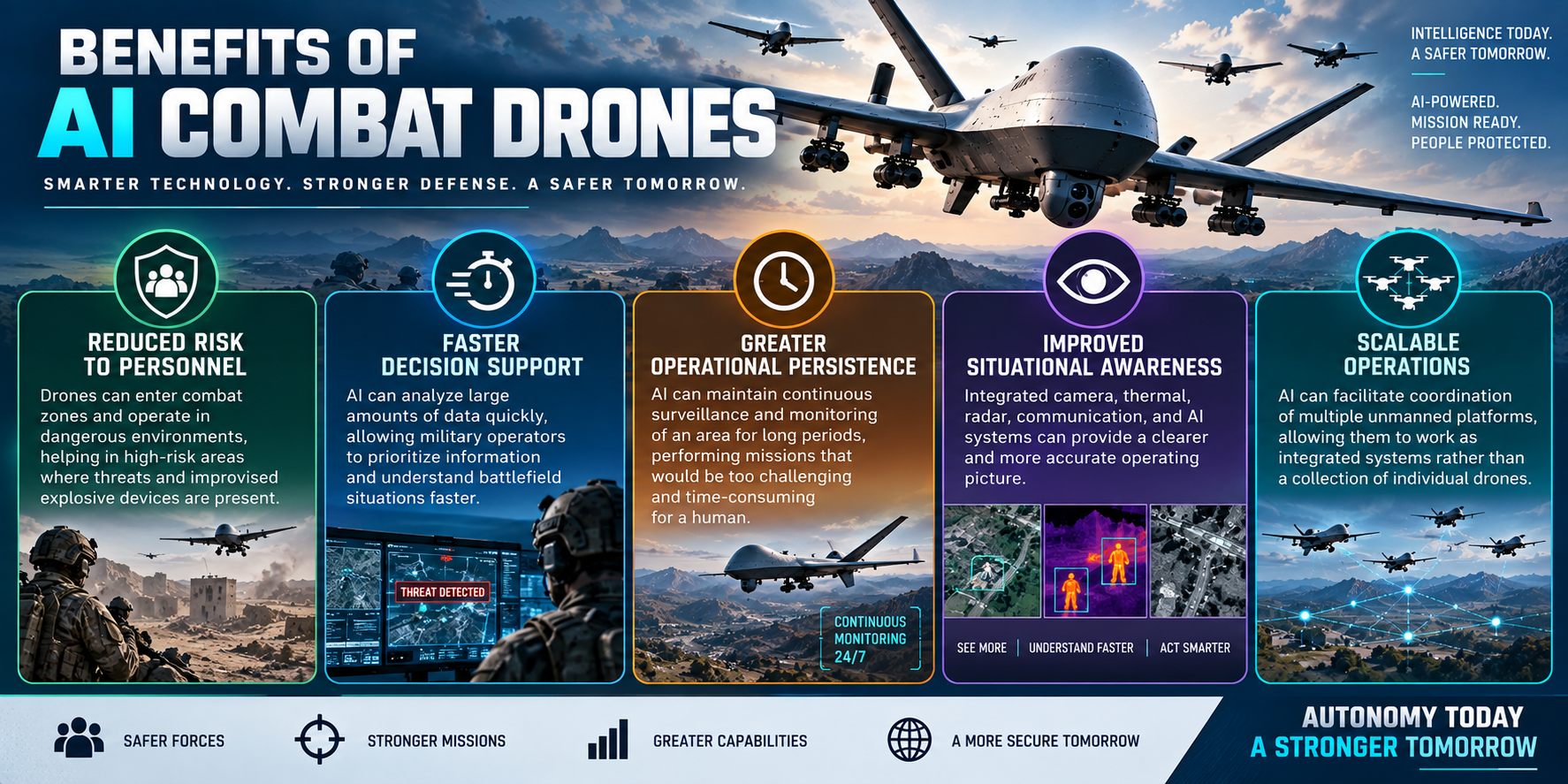
Reduced Risk to Personnel
Drones can enter combat zones and operate in dangerous environments. This also helps operations in areas where there is a high risk of encountering threats and improvised explosive devices.
Faster Decision Support
AI can analyze large amounts of data quickly, which allows military operators to prioritize and understand the situations on the battlefield.
Greater Operational Persistence
AI can maintain the perspective of the area for a long time, which would previously be too challenging and time-consuming for a human.
Improved Situational Awareness
Integrated camera, thermal, radar, communication, and AI systems can provide a clearer and more accurate operating picture.
Situational Awareness, Quick Decision Making, Longer Operational Capabilities, Resiliency, and Personnel Risk Reduction could be benefits derived from the employment of NATO’s 2026 Autonomous and Unmanned Systems.
Scalable Operations
AI could facilitate coordination of multiple unmanned platforms, perhaps addressing operations as integrated systems rather than a collection of individual drones.
AI Combat Drones and the Rise of Swarm Technology
Autonomous military technology has embraced swarm drone technology. Lacking reliance on a single drone, swarm technology uses multiple drones to fulfill a mission.
AI-driven UAV defense systems consider research focused on cooperative multi-UAV and swarm operations to be important.
Swarm drone technology also introduces significant challenges of command and control, cybersecurity, reliability, identification, and human control.
Challenges and Ethical Concerns
AI combat drones are controversial for several reasons.
First, moral concerns arise with autonomous AI systems when they make decisions regarding target identification or selection. There are also concerns regarding accountability, system reliability, proportionality, and compliance with international humanitarian law.
Another major concern is cybersecurity. Drone systems rely heavily on software and integration of multiple components. Compromising any of these components could result in loss of control of the drone or malicious system manipulation.
There is also the issue of operating in environments where the information is purposefully incomplete or misleading. DARPA mentions that tactical autonomy will need to be able to function with uncertain information and changing circumstances, as well as integrated sensors within an adversarial, deceptive environment.
Due to the above, it is highly unlikely that the military AI of the future will be dominated by how autonomous machines become. Designing and implementing AI systems within the military will require trust, testing, human oversight, cybersecurity, and responsible deployment.
Also Read- AI Email Writers: Supercharge Your Inbox
The Future of AI Combat Drones
Military systems are starting to move away from drones that are remotely controlled and more toward intelligent, networked, and autonomous systems.
The U.S. is one of the nations involved with DARPA’s AIR initiative to test the use of AI in controlled flight. Canada and other allied nations are working on similar programs to accelerate the creation and integration of autonomous and uncrewed defense systems.
It is likely that the following generations will utilize resilient and reliable communication and improved human-machine interfaces as well as collaborative autonomy and enhanced sensor systems.
Rather than having individual units of control, it is likely that militaries will command networks of intelligent systems.
Conclusion
AI combat drones represent a significant change in military doctrine and technology. When paired with artificial intelligence systems, these drones allow for greatly extended military operations and reduced exposure of military personnel. They can fulfill many of today’s military operational tasks while greatly reducing the military’s exposure and personnel burden.
Their greatest benefits will include rapid situational awareness, increased operational reach, real-time visualization and information processing, and flexible tasking in rapidly changing environments.
Along with the benefits, autonomous systems also present various challenges. The best and most effective systems of the future will balance autonomous systems with human control and oversight.
Artificial Intelligence has the ability to transform technological warfare in many ways, and one of those ways is with the use of combat drones. Although these drones are currently being tested, fully functioning counterparts are expected to play a large role soon in modern warfare. AI-powered combat drones are complex machines. These machines will make a large contribution to modern warfare based on their innovative design. This means that how they are designed will be of paramount importance.
FAQs
-
How do AI combat drones differ from other drones?
AI-powered systems provide automation for navigation, object identification, and mission-plan execution. AI-powered drones are unique in their ability to analyze collected sensor data to a greater degree.
-
What is the main purpose of AI combat drones?
AI combat drones are designed to minimize the risk to personnel, process data at a rapid pace, understand the threats that are present, and be able to effectively communicate with one another.
-
Can AI combat drones be used on their own?
Functionally, some can, but the level of automation is on a spectrum. The drones require a person for supervision.
-
What will AI combat drones be able to do in the future?
In the future, these drones will be able to operate and think for themselves to a higher extent than they currently do. The focus of their design will be to improve their cooperation among themselves and to continue prioritizing establishing defensive measures at the expense of a creatively autonomous design.