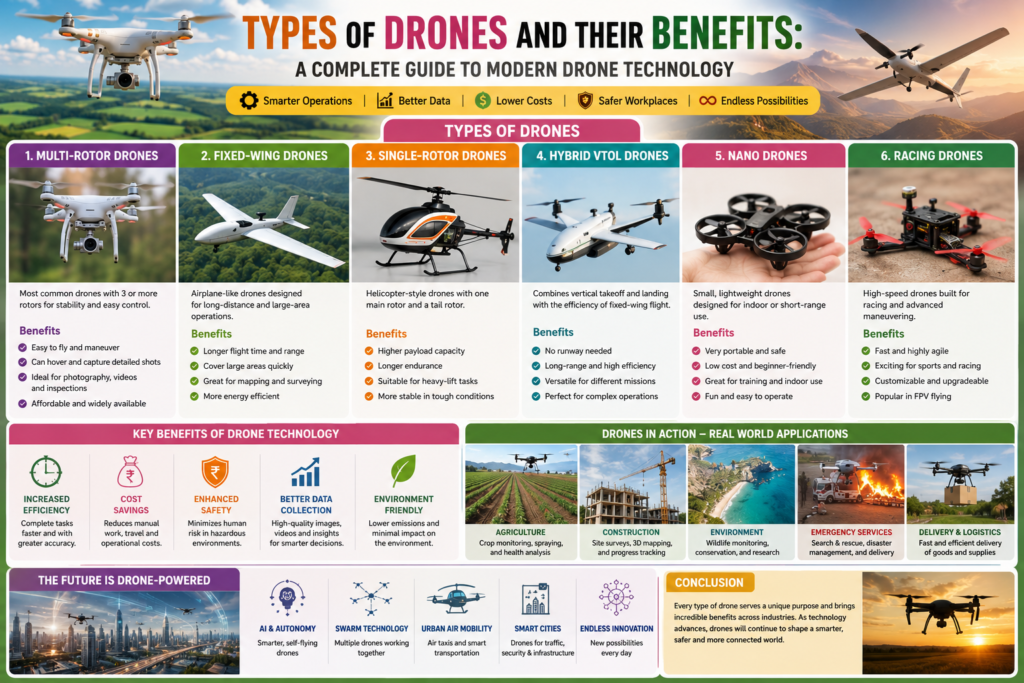
Types of Drones and Their Benefits: A Complete Guide to Modern Drone Technology
+
Table of Contents
- 1 What Are Drones?
- 2 Main Types of Drones
- 2.1 1. Multi-Rotor Drones
- 2.1.1 Easy to Operate
- 2.1.2 Perfect for Aerial Photography
- 2.1.3 Very Affordable
- 2.1.4 Compact Design
- 2.1.5 Common Applications
- 2.2 2. Fixed-Wing Drones
- 2.2.1 Long Flight Time
- 2.2.2 Greater Coverage Area
- 2.2.3 High Speed
- 2.2.4 Better Efficiency
- 2.2.5 Common Applications
- 2.3 3. Single-Rotor Helicopter Drones
- 2.3.1 Longer Flight Time
- 2.3.2 Heavy Payload Capacity
- 2.3.3 High Stability
- 2.3.4 Common Applications
- 2.4 4. Fixed Wing Hybrid VTOL Drones
- 2.4.1 No Runway Needed
- 2.4.2 Long-Distance Capability
- 2.4.3 Energy Efficient
- 2.4.4 Versatile Performance
- 2.4.5 Common Applications
- 2.5 5. Nano Drones
- 2.5.1 Portable and Lightweight
- 2.5.2 Safe for Indoor Flying
- 2.5.3 Beginner Friendly
- 2.5.4 Comparison of Price
- 2.5.5 Most Common Uses
- 2.6 6. Racing Drones
- 2.6.1 Supreme Speed
- 2.6.2 Responsive Controls
- 2.6.3 Exciting User Experience
- 2.6.4 Customizable Design
- 2.6.5 Most Common Uses
- 3 Benefits of Drone Technology
- 3.1 1. Access to Remote Locations
- 3.2 2. Cost Savings
- 3.2.1 Using drones can reduce:
- 3.3 3. Innovations in Safety
- 3.3.1 They are widely used in:
- 3.4 4. Better Data Collection
- 3.5 5. Environmental Benefits
- 3.5.1 This helps monitor:
- 4 Industries Using Drones
- 4.1 Agriculture
- 4.2 Construction
- 4.3 Healthcare
- 4.4 Media and Entertainment
- 4.5 Security and Defense
- 5 Future of Drone Technology
- 6 Conclusion
In just 10 years, the evolution of drone technology has been staggering. At first, drones were heavily integrated into military functions, but the world has witnessed tremendous growth in commercial applications like entertainment, agriculture, logistics, and personal use. Different types of drones provide unmatched flexibility, improved efficiency, and significant cost savings for autonomous operations across various industries.
With high-resolution cameras, a combination of GPS and advanced sensors, and A.I. assisted navigation coupled with automated flight, modern drones are more efficient and safer. The steady growth of technology means drones will continue to become more intelligent, with more applications available to consumers.
This article will provide the reader with the most basic types of drones, their functionality, and the benefits they offer.
What Are Drones?
Drones are unmanned aircraft. They can offer versatile applications and autonomous flight capabilities that are either controlled remotely or programmed, aided by onboard software and sensors.
They are utilized for:
- Aerial photography
- Mapping and survey
- Agricultural monitoring
- Delivery
- Search and rescue
- Security and surveillance
- Military
- Entertainment and Racing
Drones can reach faster and more remote locations, making them invaluable in tech-focused industries.
Also Read- Cymotive Innovates in Cybersecurity Solutions for Connected Vehicles
Main Types of Drones
Just as with airplanes, there are many different types of designs and applications within the world of drones. The most popular types of drones will be discussed below.
| Type of Drone | Main Features | Common Uses | Key Benefits |
|---|---|---|---|
| Multi-Rotor Drones | Use multiple propellers to hover | Used for photography and inspection | Affordable and simple |
| Fixed-Wing Drones | Use an airplane-like structure | Used for mapping and long-distance surveying | More energy efficient, longer range |
| Single-Rotor Helicopter Drones | Use one large propeller | Used for heavy industrial lifting | Better range and lifting capability |
| Fixed-Wing Hybrid VTOL Drones | Airplane structure with vertical takeoff capability | Used for delivery and surveillance | Flexible and efficient |
| Nano Drones | Very small airframe | Used for practice and indoor flying | Portable, flexible, and safe |
| Racing Drones | Very fast and competitive design | Used for drone racing | Extremely fast and agile |
1. Multi-Rotor Drones
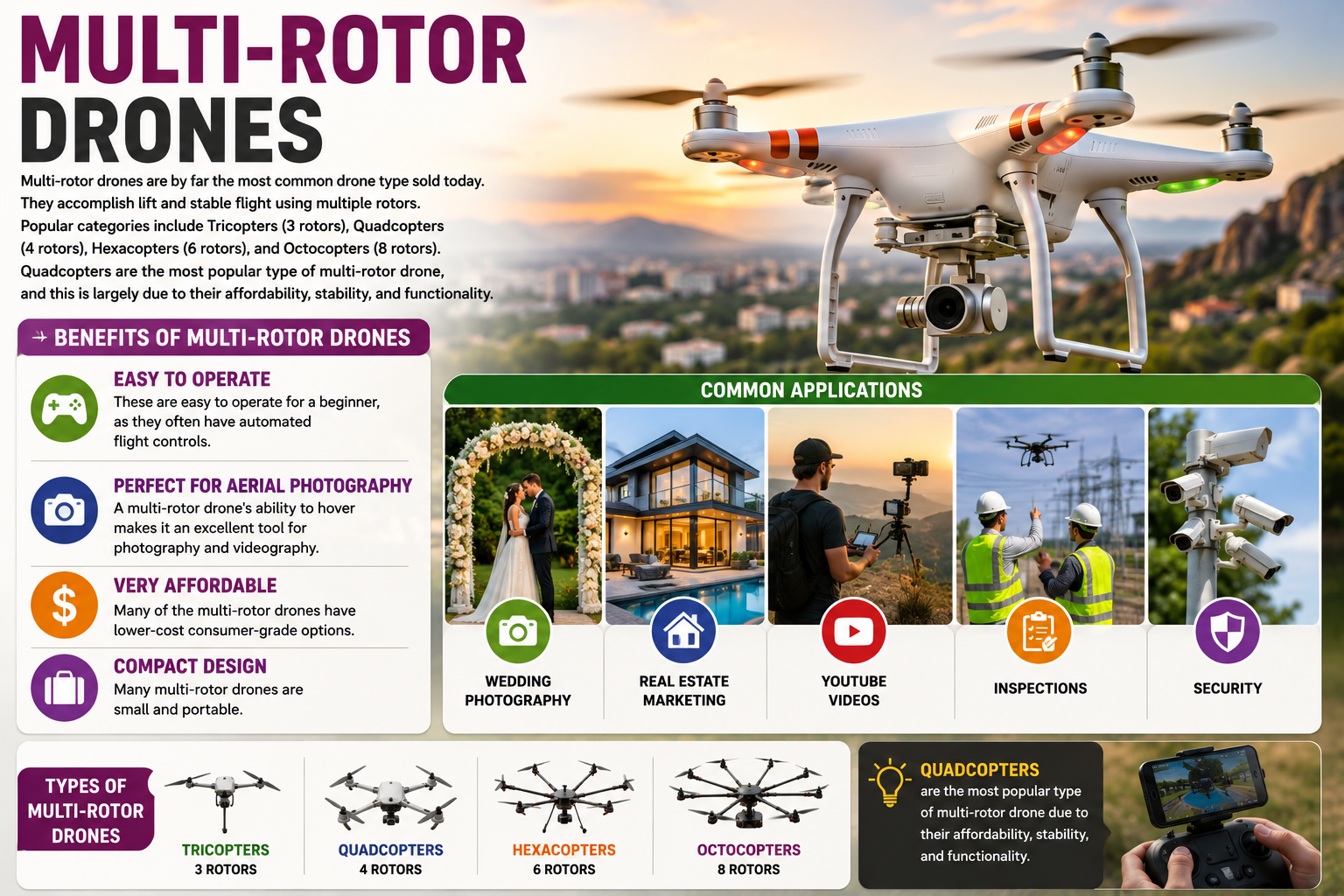
Multi-rotor drones are by far the most common drone type sold today. They accomplish lift and stable flight using multiple rotors. Popular categories include Tricopters (3 rotors), Quadcopters (4 rotors), Hexacopters (6 rotors), and Octocopters (8 rotors). Quadcopters are the most popular type of multi-rotor drone, and this is largely due to their affordability, stability, and functionality.
Benefits of Multi-Rotor Drones
Easy to Operate
These are easy to operate for a beginner, as they often have automated flight controls.
Perfect for Aerial Photography
A multi-rotor drone’s ability to hover makes it an excellent tool for photography and videography.
Very Affordable
Many of the multi-rotor drones have lower-cost consumer-grade options.
Compact Design
Many multi-rotor drones are small and portable.
Common Applications
- Wedding Photography
- Real Estate Marketing
- YouTube Videos
- Inspections
- Security
2. Fixed-Wing Drones
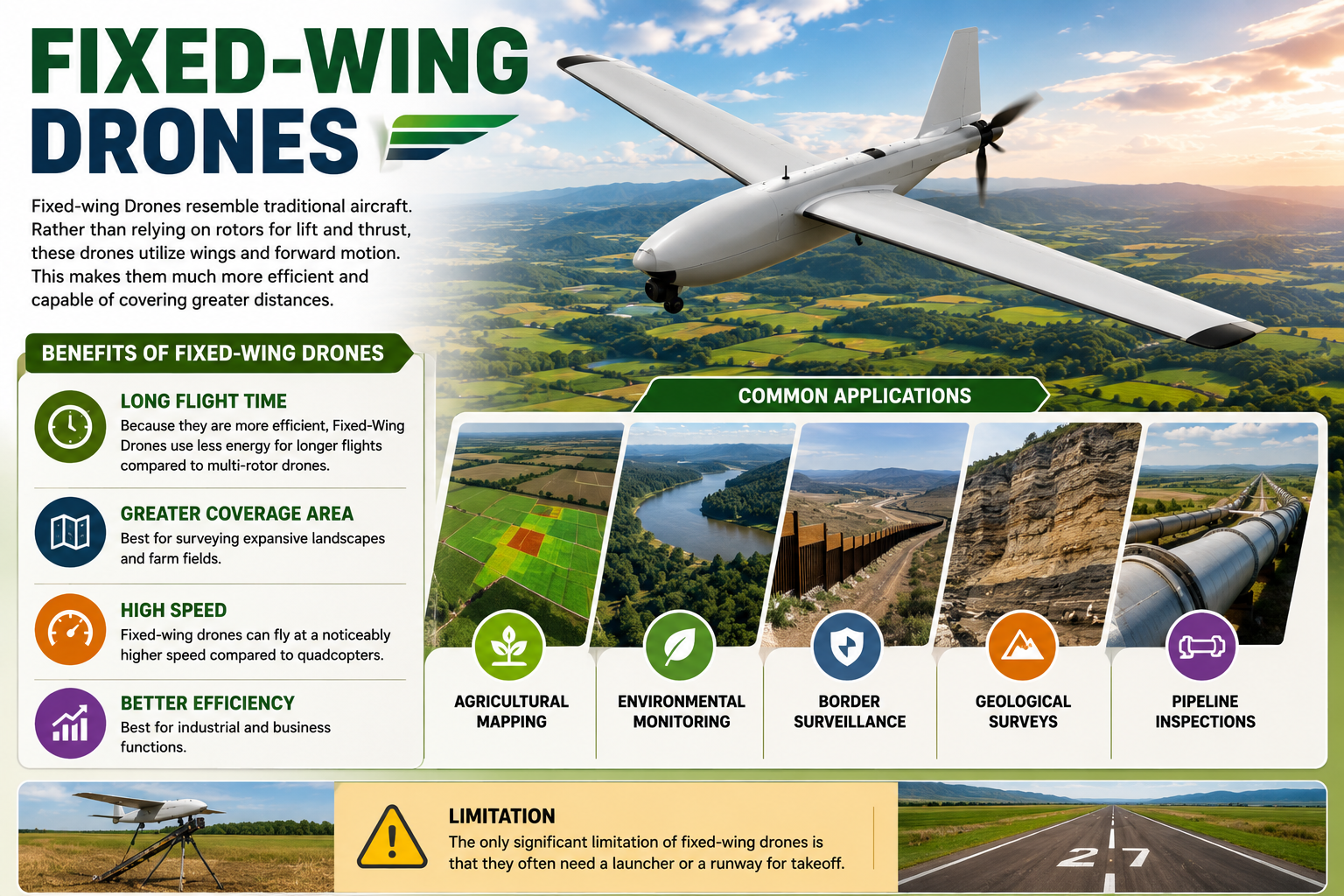
Fixed-wing Drones resemble traditional aircraft. Rather than relying on rotors for lift and thrust, these drones utilize wings and forward motion. This makes them much more efficient and capable of covering greater distances.
Benefits of Fixed-Wing Drones
Long Flight Time
Because they are more efficient, Fixed-Wing Drones use less energy for longer flights compared to multi-rotor drones.
Greater Coverage Area
Best for surveying expansive landscapes and farm fields.
High Speed
Fixed-wing drones can fly at a noticeably higher speed compared to quadcopters.
Better Efficiency
Best for industrial and business functions.
Common Applications
- Agricultural mapping
- Environmental monitoring
- Border surveillance
- Geological surveys
- Pipeline inspections
The only significant limitation of fixed-wing drones is that they often need a launcher or a runway for takeoff.
3. Single-Rotor Helicopter Drones
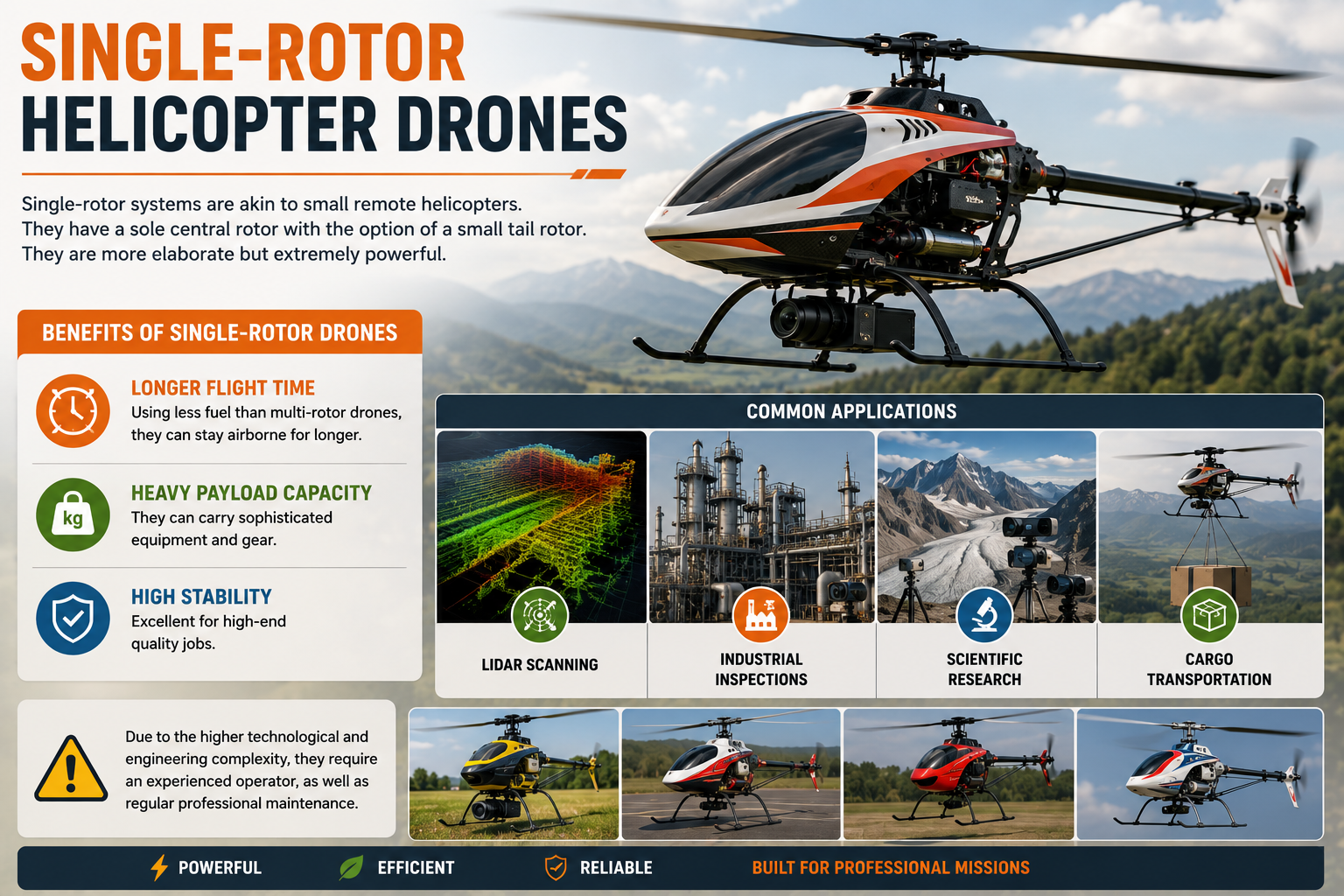
Single-rotor systems are akin to small remote helicopters. They have a sole central rotor with the option of a small tail rotor.
They are more elaborate but extremely powerful.
Benefits of Single-Rotor Drones
Longer Flight Time
Using less fuel than multi-rotor drones, they can stay airborne for longer.
Heavy Payload Capacity
They can carry sophisticated equipment and gear.
High Stability
Excellent for high-end quality jobs.
Common Applications
- Lidar scanning
- Industrial inspections
- Scientific research
- Cargo transportation
Due to the higher technological and engineering complexity, they require an experienced operator, as well as regular professional maintenance.
4. Fixed Wing Hybrid VTOL Drones
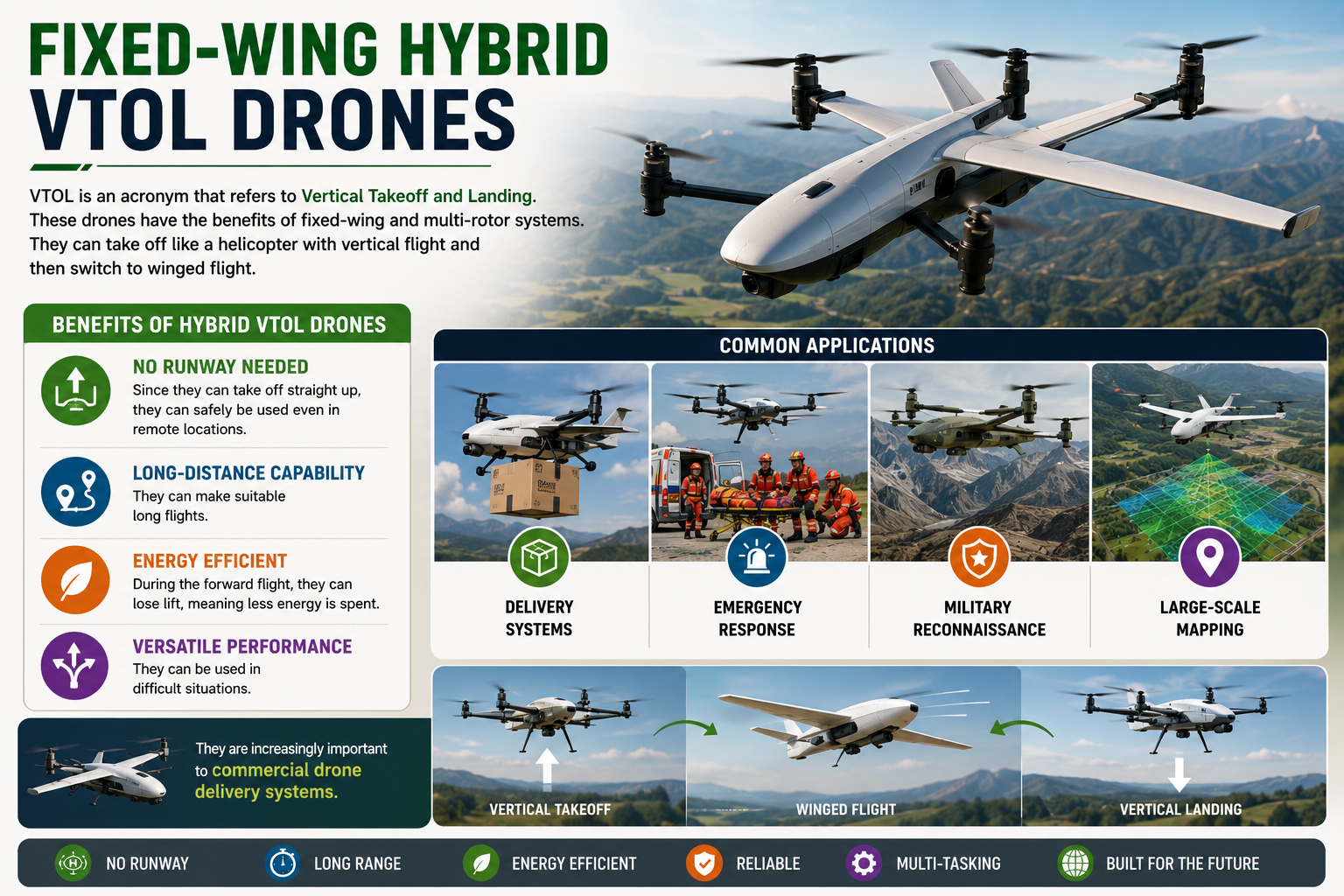
VTOL is an acronym that refers to Vertical Takeoff and Landing. These drones have the benefits of fixed-wing and multi-rotor systems.
They can take off like a helicopter with vertical flight and then switch to winged flight.
Benefits of Hybrid VTOL Drones
No Runway Needed
Since they can take off straight up, they can safely be used even in remote locations.
Long-Distance Capability
They can make suitable long flights.
Energy Efficient
During the forward flight, they can lose lift, meaning less energy is spent.
Versatile Performance
They can be used in difficult situations.
Common Applications
- Delivery systems
- Emergency response
- Military reconnaissance
- Large-scale mapping
They are increasingly important to commercial drone delivery systems.
5. Nano Drones
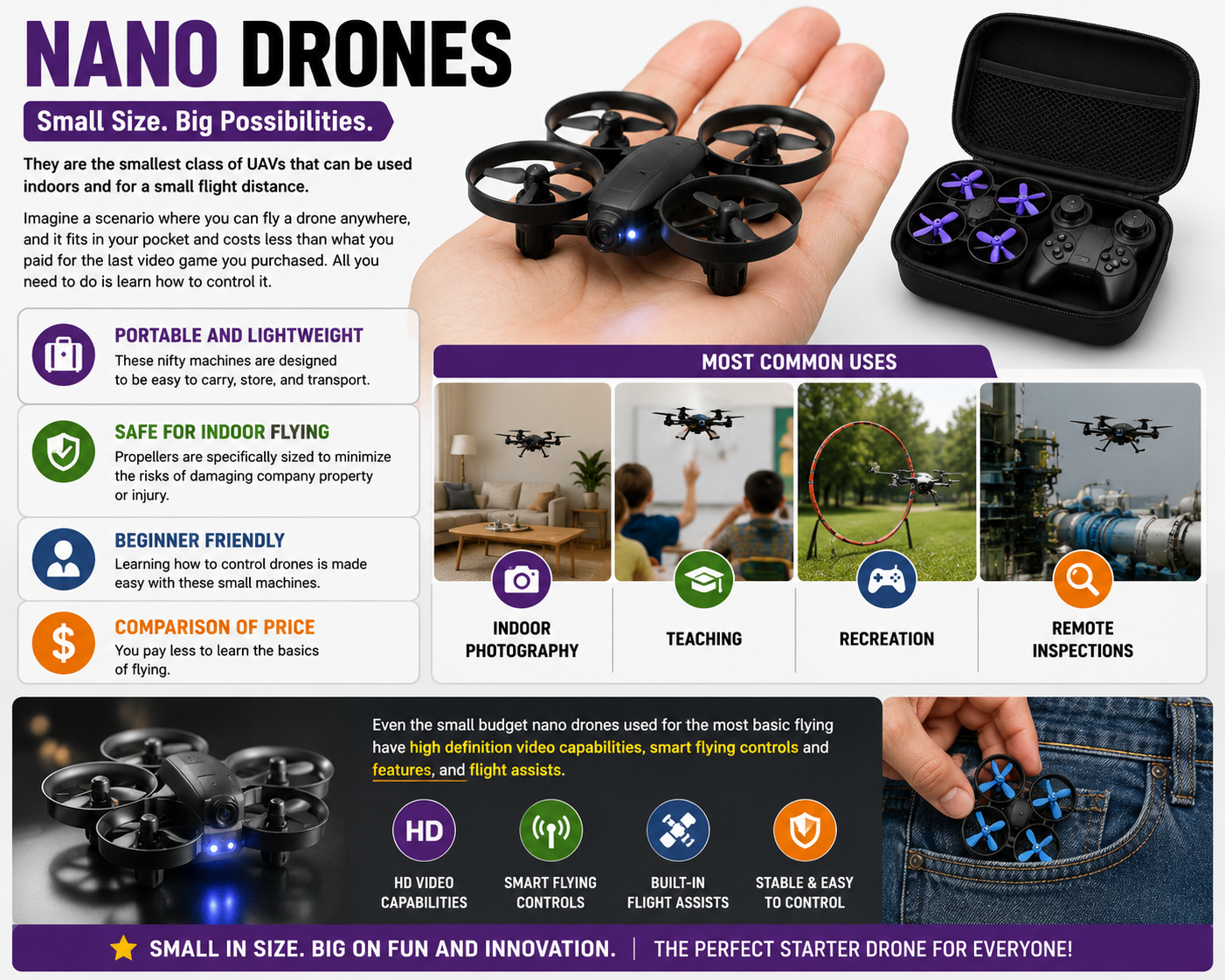
They are the smallest class of UAVs that can be used indoors and for a small flight distance.
Imagine a scenario where you can fly a drone anywhere, and it fits in your pocket and costs less than what you paid for the last video game you purchased. All you need to do is learn how to control it.
Portable and Lightweight
These nifty machines are designed to be easy to carry, store, and transport.
Safe for Indoor Flying
Propellers are specifically sized to minimize the risks of damaging company property or injury.
Beginner Friendly
Learning how to control drones is made easy with these small machines.
Comparison of Price
You pay less to learn the basics of flying.
Most Common Uses
- Indoor photography
- Teaching
- Recreation
- Remote inspections
Even the small budget nano drones used for the most basic flying have high definition video capabilities, smart flying controls and features, and flight assists.
6. Racing Drones
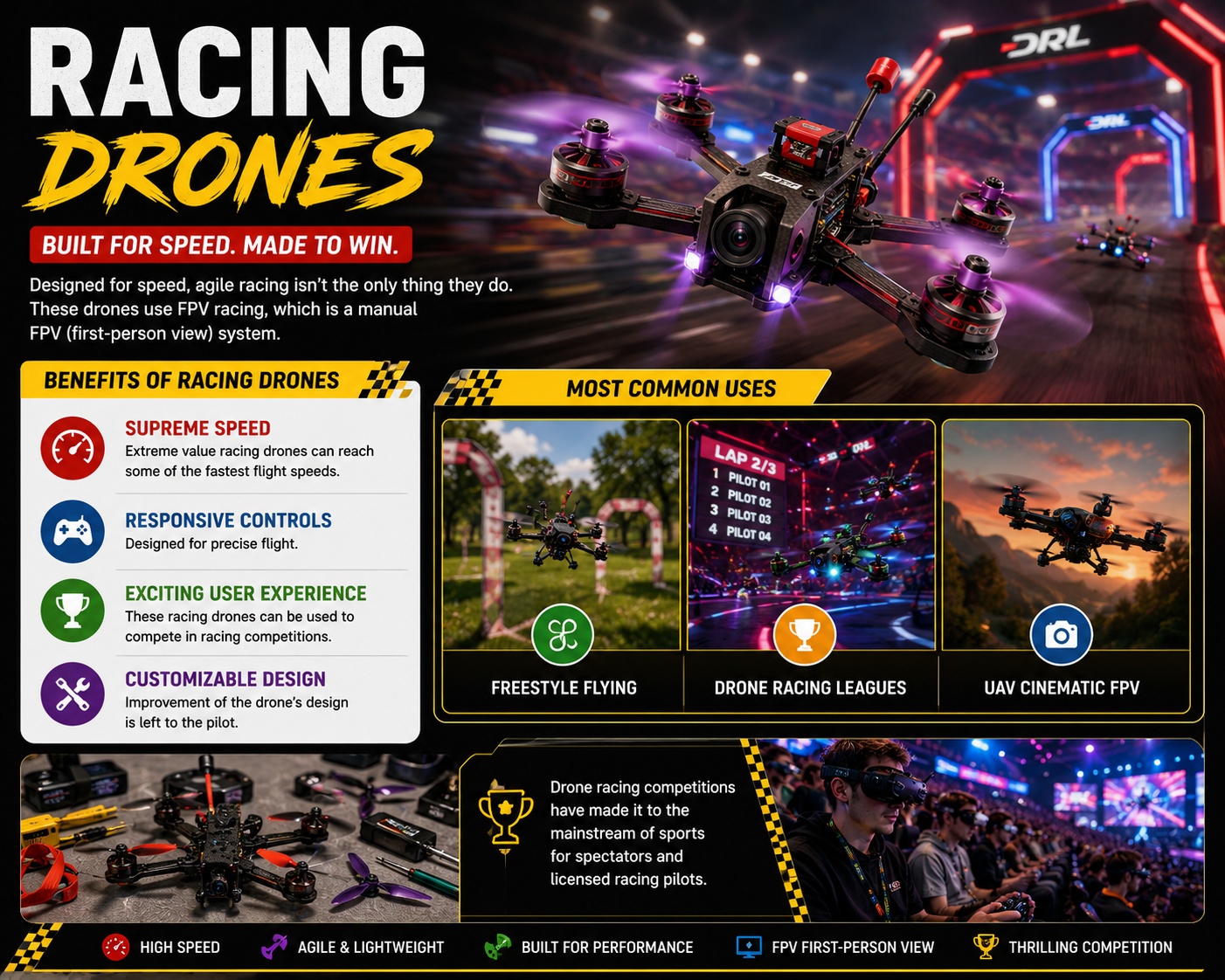
Designed for speed, agile racing isn’t the only thing they do.
These drones use FPV racing, which is a manual FPV (first-person view) system.
Benefits of Racing Drones
Supreme Speed
Extreme Value racing drones can reach some of the fastest flight speeds.
Responsive Controls
Designed for precise flight.
Exciting User Experience
These racing drones can be used to compete in racing competitions.
Customizable Design
Improvement of the drone’s design is left to the pilot.
Most Common Uses
- Freestyle flying
- Drone racing leagues
- UAV cinematic FPV
Drone racing competitions have made it to the mainstream of sports for spectators and licensed racing pilots.
Benefits of Drone Technology
Drone technology provides major advantages across industries.
1. Access to Remote Locations
One of the main problems with getting to the most remote, non-urban areas is the extreme lack of infrastructure. Drones can do what people can’t, so to gain access to the most remote areas where manned methods are inefficient, farming monitor drones or delivery drones, for example, make easy delivery through the use of non-traditional infrastructure.
2. Cost Savings
Businesses save money on labor, fuel, and equipment.
Using drones can reduce:
- Surveying costs
- Inspection expenses
- Security staffing needs
3. Innovations in Safety
Other than racing drones, using drones for farming, delivery, and selling makes the risks of deliveries and personal injuries obsolete. The same can be said of drones used in firefighting, which were once manned methods that required direct exposure to life-threatening situations.
They are widely used in:
- Disaster zones
- Firefighting operations
- Hazardous industrial sites
4. Better Data Collection
Drones have significantly improved the quality of data collection and have modernized the quality of the data collected used especially in the industrial world. High-quality videos, image collection, and the rich data and sensor information they produced are evidence of the advancements made in the field.
Industries use this data for:
- Mapping
- Analytics
- Infrastructure planning
- Crop health monitoring
5. Environmental Benefits
Electric drones emit fewer greenhouse gas emissions than many traditional vehicles.
This helps monitor:
- Wildlife
- Forests
- Climate conditions
- Water resources
Industries Using Drones
The extensive development of drone technology has aided various industries.
Agriculture
In Agriculture, drones are used for:
- Monitoring crops
- Spraying fertilizers
- Analyzing irrigation
Construction
In Construction, drones are used for:
- Building site inspections
- 3D modeling for mapping
- Monitoring progress
Healthcare
In Healthcare, drones are used for transporting:
- Medicines
- Vaccines
- Supplies
Media and Entertainment
Drones are used as a means of cinematic aerial coverage for:
- Movies
- Sports
- Travel Videos
Security and Defense
In the industrial aspect of Security and Defense, drones are used for:
- Surveillance
- Border controls
- Tactical operations
Future of Drone Technology
The future of drones is very promising. Some ideas that are yet to be fully realized are:
- Autonomous AI-based drones
- Drones as a means of aerial public transport
- Drones for the delivery of goods
- Integration of drones into smart cities
- Swarm-based drones
Due to the evolution of regulations and technology, drones are likely to reshape the ways we conduct transportation, logistics, and public services. Advances in batteries alone are likely to render drones far more useful.
Conclusion
The development of drones has the potential to be one of the most impactful innovations of modern times. The enhancement of the utility of drones across multiple sectors, such as defense, healthcare, agriculture, and cinematography, has added to this utility.
Different types of drones are useful for different purposes. Multi-rotor drones are best for cinematographic purposes, fixed-wing drones are best for long-range aerial coverage, and hybrid VTOLs are used for combining flexibility and efficiency. Nano drones and racing drones have also grown and enhanced recreational and educational purposes.
With ever-advancing technology, drones will increasingly dominate automation, transport, security, and data collection in the coming years.
FAQs
1. What are the different types of drones?
Main types of drones include multi-rotor, fixed-wing, single-rotor, hybrid VTOL, nano, and racing drones.
2. What drones are best for aerial photography?
Multi-rotor drones are best, with quadcopters preferred for their stable hovering, capturing photos without shaking, and for ease of smooth camera movement.
3. What industries benefit from drones?
Industries such as agriculture, construction, healthcare, media, logistics, and defense gain advantages through drone usage.
4. How much do drones cost?
Price ranges for drones vary based on use and capabilities. Entry-level drones are considerably priced, while industrial drones command much higher prices.
5. Where are drones headed?
The future will showcase drones with full autonomy, integrated into society for on-demand delivery and aerial taxi systems, and enhanced with the ability to navigate.
6. Are drones reliable?
Yes, the current generation of drones show numerous safety features like GPS to create no-fly zones, and the ability to avoid obstacles and return to their takeoff location without assistance. However, knowledge of the local laws and required safety protocols are essential.