Master the Sky: Essential Drone Videography Tips for Beginners
+
Table of Contents
- 1 The Impact of Drone Videography
- 2 Key Features Beginners Drones Should Have
- 2.1 1. Camera Quality
- 2.2 2. Gimbal Stabilization
- 2.3 3. GPS Positioning
- 2.4 4. Obstacle Avoidance
- 2.5 5. Intelligent Flight Modes
- 2.6 6. Battery Life
- 3 Comparing Different Drones
- 4 Beginner Drone Photography / Videography Tips
- 4.1 1. Learn How to Fly
- 4.2 2. Film during the golden hour
- 4.3 3. Slow and Steady
- 4.4 4. Employ the Rule of Three
- 4.5 5. Manually adjust camera settings
- 4.6 6. Use ND Filters
- 4.7 7. Don’t shoot without a plan
- 4.8 8. Monitor Weather Conditions
- 4.9 9. Play Various Camera Angles
- 4.10 10. Make Videos Professionally
- 4.11 Common Drone Videography Mistakes to Avoid
- 4.11.1 Flying Too Fast
- 4.11.2 Ignoring Safety Rules
- 4.11.3 Poor Battery Management
- 4.11.4 Overusing Effects
- 4.11.5 Forgetting to Calibrate
- 4.12 Drone Videography’s Impact on Content Creation
- 4.13 Best Locations for Drone Videography Practice
- 5 Drone Videography Potential
- 5.1 FAQs
- 5.1.1 What is a good way to break into the world of drone videography?
- 5.1.2 Is 4K a must in drone videography?
- 5.1.3 What are the tips to get better quality, professional looking drone footage?
- 5.1.4 Are modern Drones beginner-friendly?
- 5.1.5 What are the best filming weather conditions for flying a drone?
- 5.1.6 What does a gimbal do to maintain the quality of camera footage?
- 5.1.7 What is the recommended minimum time for beginners to spend flying?
Capture stunning visuals from above as drone videography debuts as another exciting creative opportunity today! Whether it be a travel video or cinematic footage, drone videography is a skill that can be mastered and can take your videos to the next level. As technology advances, it makes aerial filming even easier and more accessible. Although a beginner may find drone videography intimidating, it is not for a lack of accessibility. Although it is an art that should be practiced and involves safety, lighting, framing, and setting a camera as it develops a new skill, almost anyone, with the right guidelines, can shoot stunning aerial footage.
Look no further! We will cover some tips for drone videography as well as some basic techniques that will advance your drone videography to the next level. We will explain what drone features you should look for, what kind of camera you should use for drone videography, as well as video editing tips that will add polish to your videos, and common mistakes people make and how to avoid them.
The Impact of Drone Videography
Aerial videography once required cranes and helicopters. Now it’s as simple and inexpensive as a drone. With a flying camera that captures footage in high definition, the applications of drone videography are endless.
- Real Estate Videos
- YouTube and Vlogging
- Social Media Content
- Travel Cinematography
- Weddings
- Drone Nature Documentaries
- Outdoor Sports
Aerial videography has never been so easy and accessible for beginners, thanks to the advancements in drone technology.
Key Features Beginners Drones Should Have
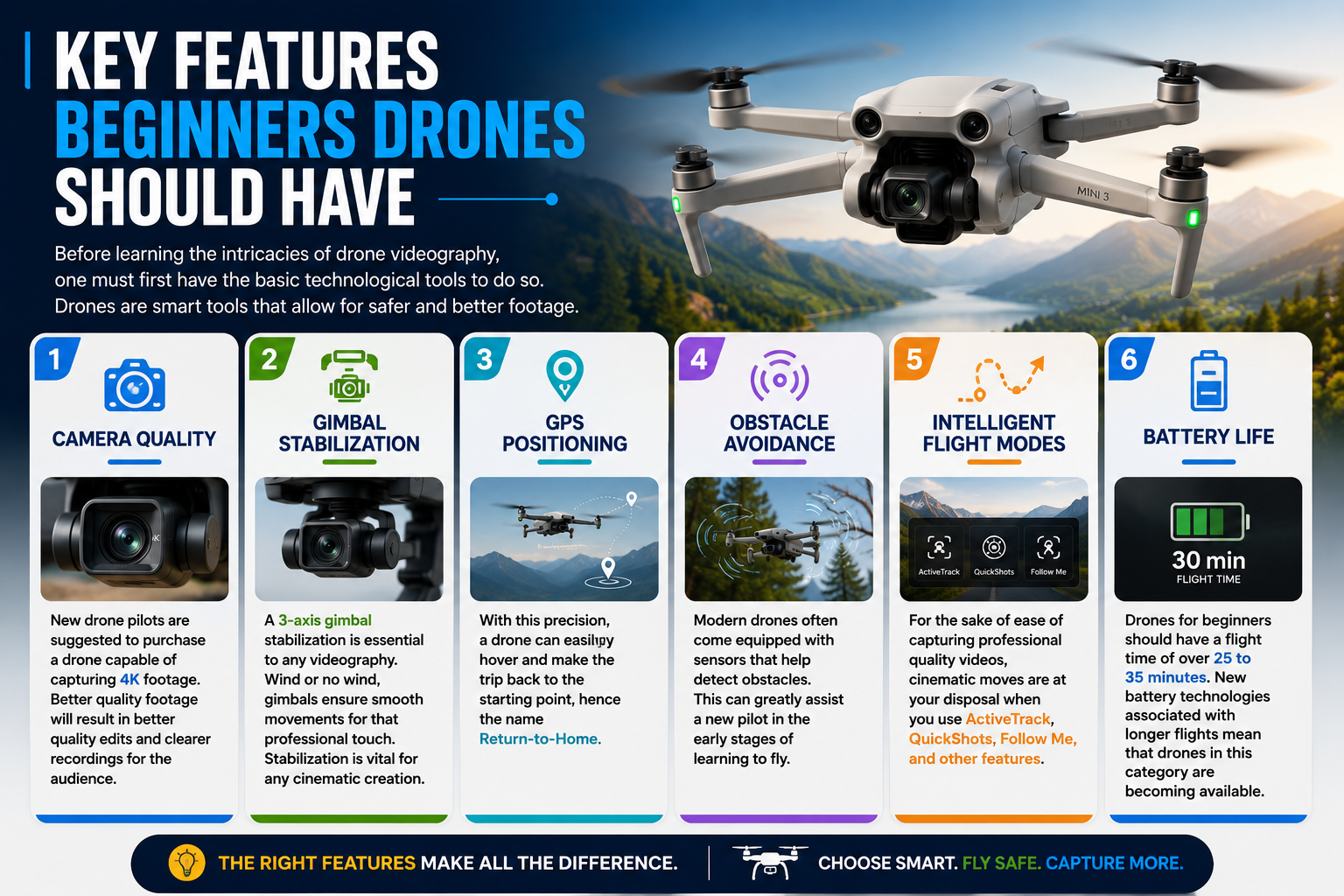
Before learning the intricacies of drone videography, one must first have the basic technological tools to do so. Drones are smart tools that allow for safer and better footage.
1. Camera Quality
New drone pilots are suggested to purchase a drone capable of capturing 4K footage. Better quality footage will result in better quality edits and clearer recordings for the audience.
2. Gimbal Stabilization
A 3-axis gimbal stabilization is essential to any videography. Wind or no wind, gimbals ensure smooth movements for that professional touch. Stabilization is vital for any cinematic creation.
3. GPS Positioning
With this precision, a drone can easily hover and make the trip back to the starting point, hence the name Return-to-Home.
4. Obstacle Avoidance
Modern drones often come equipped with sensors that help detect obstacles. This can greatly assist a new pilot in the early stages of learning to fly.
5. Intelligent Flight Modes
For the sake of ease of capturing professional-quality videos, cinematic moves are at your disposal when you use ActiveTrack, QuickShots, Follow Me, and other features.
6. Battery Life
Drones for beginners should have a flight time of over 25 to 35 minutes. New battery technologies associated with longer flights mean that drones in this category are becoming available.
Comparing Different Drones
| Drone Model | Camera Quality | Stabilization | Flight Time | Best Feature |
|---|---|---|---|---|
| DJI Mini 4K | 4K Video | 3-Axis Gimbal | 31 Minutes | Lightweight and beginner-friendly |
| DJI Mini 3 | 4K HDR | 3-Axis Gimbal | 38 Minutes | Excellent battery life |
| DJI Flip | 4K Smart Camera | Electronic Stabilization | 30 Minutes | AI-powered tracking |
| Potensic ATOM SE | 4K Video | GPS Stabilization | 31 Minutes | Affordable option |
| DJI Air 3 | Professional 4K | Advanced Gimbal | 46 Minutes | Obstacle avoidance system |
Beginner Drone Photography / Videography Tips
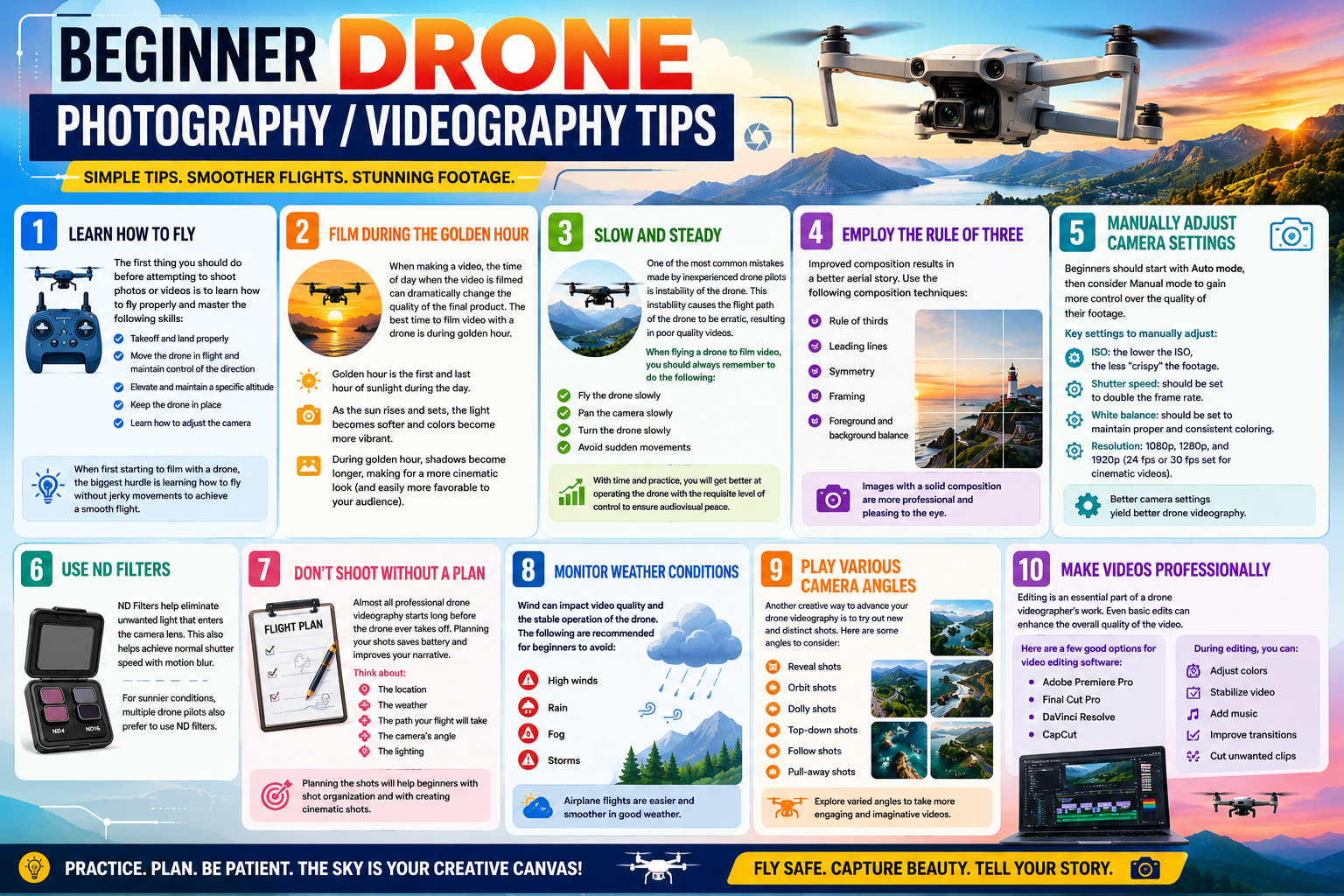
1. Learn How to Fly
The first thing you should do before attempting to shoot photos or videos is to learn how to fly properly and master the following skills:
- Take off and land properly
- Move the drone in flight and maintain control of the direction
- Elevate and maintain a specific altitude
- Keep the drone in place
- Learn how to adjust the camera
When first starting to film with a drone, the biggest hurdle is learning how to fly without jerky movements to achieve a smooth flight.
2. Film during the golden hour
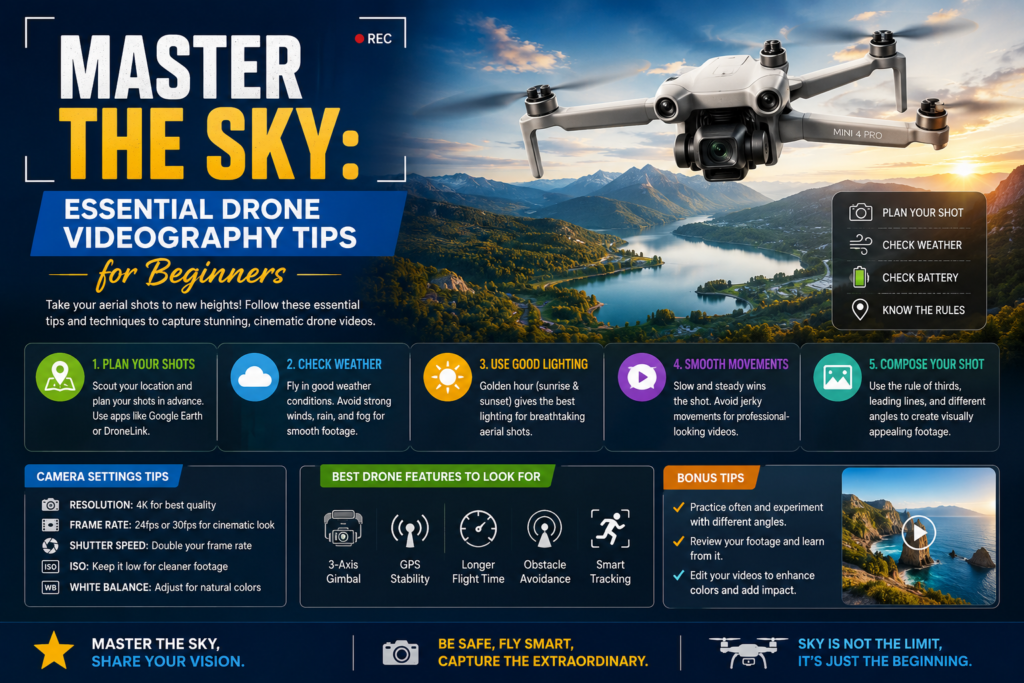
When making a video, the time of day when the video is filmed can dramatically change the quality of the final product. The best time to film a video with a drone is during golden hour.
- Golden hour is the first and last hour of sunlight during the day.
As the sun rises and sets, the light becomes softer and colors become more vibrant. During golden hour, shadows become longer, making for a more cinematic look (and easily more favorable to your audience).
3. Slow and Steady
One of the most common mistakes made by inexperienced drone pilots is the instability of the drone. This instability causes the flight path of the drone to be erratic, resulting in poor-quality videos.
When flying a drone to film a video, you should always remember to do the following:
- Fly the drone slowly
- Pan the camera slowly
- Turn the drone slowly
- Avoid sudden movements
With time and practice, you will get better at operating the drone with the requisite level of control to ensure audiovisual peace.
4. Employ the Rule of Three
Improved composition results in a better aerial story. Use the following composition techniques:
- Rule of thirds
- Leading lines
- Symmetry
- Framing
- Foreground and background balance
Images with a solid composition are more professional and pleasing to the eye.
5. Manually adjust camera settings
Beginners should start with Auto mode, then consider Manual mode to gain more control over the quality of their footage.
Key settings to manually adjust:
- ISO: the lower the ISO, the less “crispy” the footage.
- Shutter speed: should be set to double the frame rate.
- White balance: should be set to maintain proper and consistent coloring.
- Resolution: 1080p, 1280p, and 1920p (24 fps or 30 fps set for cinematic videos).
Better camera settings yield better drone videography.
6. Use ND Filters
ND Filters help eliminate unwanted light that enters the camera lens. This also helps achieve normal shutter speed with motion blur.
For sunnier conditions, multiple drone pilots also prefer to use ND filters.
7. Don’t shoot without a plan
Almost all professional drone videography starts long before the drone ever takes off. Planning your shots saves battery and improves your narrative.
Think about:
- The location
- The weather
- The path your flight will take
- The camera’s angle
- The lighting
Planning the shots will help beginners with shot organization and with creating cinematic shots.
8. Monitor Weather Conditions
Wind can impact video quality and the stable operation of the drone. The following are recommended for beginners to avoid:
- High winds
- Rain
- Fog
- Storms
Airplane flights are easier and smoother in good weather.
9. Play Various Camera Angles
Another creative way to advance your drone videography is to try out new and distinct shots. Here are some angles to consider:
- Reveal shots
- Orbit shots
- Dolly shots
- Top-down shots
- Follow shots
- Pull-away shots
Explore varied angles to take more engaging and imaginative videos.
10. Make Videos Professionally
Editing is an essential part of a drone videographer’s work. Even basic edits can enhance the overall quality of the video.
Here are a few good options for video editing software:
- Adobe Premiere Pro
- Final Cut Pro
- DaVinci Resolve
- CapCut
During editing, you can:
- Adjust colors
- Stabilize video
- Add music
- Improve transitions
- Cut unwanted clips
The software will work best to enhance your footage.
Also Read- Best Smart Drones for Beginners in 2026
Common Drone Videography Mistakes to Avoid
-
Flying Too Fast
Don’t fly the drone rapidly. It creates a bad cinematic experience and poor-quality videos.
-
Ignoring Safety Rules
Remain compliant with the rules of the area and be sure to keep the drone in your field of view.
-
Poor Battery Management
Batteries should not be fully discharged. Travel safely and come back early if the battery is low.
-
Overusing Effects
Don’t go crazy with transitions and effects as they clutter the video. Use effects moderately to prevent visual clutter.
-
Forgetting to Calibrate
Be certain to calibrate the gimbal and compass, which will help prevent navigation issues.
Drone Videography’s Impact on Content Creation
With a professional and cinematic appeal, drone videography enhances digital content. It helps creators:
- Showcase different viewpoints
- Augment audience interest
- Enhance narrative
- Design posts and create content for social media
- Generate marketing videos with a professional finish
Aerial drone visuals are becoming increasingly popular among travel bloggers, YouTubers, and film creators.
Best Locations for Drone Videography Practice
In the early stages of learning to fly, it is important to practice in big, open spaces that are free of obstructions.
Best practice areas are:
- Parks
- Beaches
- Open fields
- Countryside roads
- Lakesides
Avoid confined areas until the practice sessions boost your confidence and skill.
Drone Videography Potential
The rapid technology evolution will also have an impact on drones. Some of the technologies that could improve in the future include:
- AI filming
- Better sensors for avoiding obstacles
- More endurance on battery life
- Superior low-light capabilities
- Automated cinematic filming
- Best drones with advanced tracking capabilities
Not all technology in drone videography is for seasoned experts. With the right technology and techniques, anyone can create awe-inspiring footage.
Enjoyment of this creative skill is one of the best parts of becoming a drone videography master. Today’s drones are equipped with a variety of advanced stabilization, AI functions, intelligent flight modes, and pro-level cameras, making aerial filming a straightforward task.
Smooth flying, knowledge of camera settings, cinematic movements, and correct editing can take your drone videography to new cinematic boundaries. The key is to be patient and practice.
Regardless of what type of video you are setting out to do, travel, social, or movie, our tips and instructions should give you professional-quality videos.
FAQs
-
What is a good way to break into the world of drone videography?
When looking for a first drone to film and capture photos, the DJI Min is a good choice. It has reasonable camera quality and has decent automated smooth flying.
-
Is 4K a must in drone videography?
Resolution is important and should not be overlooked. 4k is a better option when compared to lower droplow and gives users more flexibility to edit videos and present quality content.
-
What are the tips to get better quality, professional looking drone footage?
Golden hour is the best time for shooting. Professional editing and making tweaks to your shots can create a better overall look and feel.
-
Are modern Drones beginner-friendly?
With the way automated flight and the GPS system for smoother flying, the modern day drone is much easier for normal users to fly.
-
What are the best filming weather conditions for flying a drone?
Calm winds and lighting can create a decent workflow.
-
What does a gimbal do to maintain the quality of camera footage?
Gimbals are used to create a level shot while mitigating shaky shots, enhancing the overall quality and look of the final video.
-
What is the recommended minimum time for beginners to spend flying?
Shorter practice sessions can be more beneficial than longer sessions of flying the drone. Consistent practice will lead to an easier time to manage the drone.