Best 4K and 8K Drones for Filmmaking in 2026
+
Table of Contents
- 1 Why 4K and 8K Drones Matter for Filmmaking
- 2 Best 4K and 8K Drones for Filmmaking in 2026
- 2.1 1. DJI Inspire 3
- 2.1.1 Key Features
- 2.1.2 Best For
- 2.1.3 Pros
- 2.1.4 Cons
- 2.2 2. DJI Mavic 4 Pro
- 2.2.1 Key Features
- 2.2.2 Best For
- 2.2.3 Pros
- 2.2.4 Cons
- 2.3 3. DJI Air 3S
- 2.3.1 Key Features
- 2.3.2 Best For
- 2.3.3 Pros
- 2.3.4 Cons
- 2.3.5 4. Autel EVO Lite+
- 2.3.6 Key Features
- 2.3.7 Best For
- 2.3.8 Pros
- 2.3.9 Cons
- 2.4 5. DJI Mini 5 Pro
- 2.4.1 Key Features
- 2.4.2 Best For
- 2.4.3 Pros
- 2.4.4 Cons
- 3 Comparison Table for Best 4K and 8K Drones
- 3.1 Key Features to Consider Before Buying
- 3.1.1 1. Camera Quality
- 3.1.2 2. Stabilization
- 3.1.3 3. Battery
- 3.1.4 4. Obstacle Avoidance
- 3.1.5 5. Portability
- 3.1.6 6. Intelligent Flight
- 4 Conclusion
- 4.1 FAQs
- 4.1.1 1. Is 2026 going to see a rise of wait for it… 8K drone filmmaking?
- 4.1.2 2. What drones make good beginners?
- 4.1.3 3. What is the best drone option for a professional shoot?
- 4.1.4 4. Do filmmaking drones have a high price tag?
- 4.1.5 5. What is the ideal drone for travel filmmaking?
- 4.1.6 6. Why is obstacle avoidance necessary?
- 4.1.7 7. Do drones perform well in low-light conditions?
- 4.1.8 8. What do drones shoot at to be considered cinematic?
Drones are at the core of capturing cinematic visuals for small and large productions alike. As of 2026, independent filmmakers and content creators have more options than ever available to them to capture stunning visuals when paired with the new generation of commercially available best 4K and 8K drones. These drones are equipped with advanced camera technology, obstacle detection, AI, and flight assist technology to offer highly stabilized and smooth aerial footage.
When comparing the latest drones, one thing stands out — filmmakers can now capture cinema-quality footage using drones that are compact, lightweight, and surprisingly easy to fly. This technology can be utilized to significantly improve the production quality of a range of video content, including travel vlogs, advertisements, weddings, real estate, and extreme sports.
In this guide, we will analyze the leading 4K and 8K filmmaking drones for 2026 and decide which available model will best suit your needs.
Why 4K and 8K Drones Matter for Filmmaking
There is an increasingly high demand for high-quality, high-definition videos with the proliferation of social media and the rise in digital video content. Here are some reasons 4K and 8K drones are the new gold standard:
- Drones produce videos that are sharper and much more detailed.
- Drones offer far more flexibility for cropping and editing than ever before.
- Drones perform much better with low-light photography.
- Drones offer the ability to produce highly professional videos with cinematic-grade color.
- Drones offer much more advanced stabilization systems than in the past.
- Drones have improved technology with respect to AI, flight assist, and obstacle detection.
- Drones have improved their dynamic range and the ability to capture videos in HDR.
Film and content creators are more interested than ever in using drones to assist in their projects. Standard videos are still produced and shot in 4K. For those wanting to shoot future videos, 8K drones offer more options in terms of flexibility.
Best 4K and 8K Drones for Filmmaking in 2026
1. DJI Inspire 3
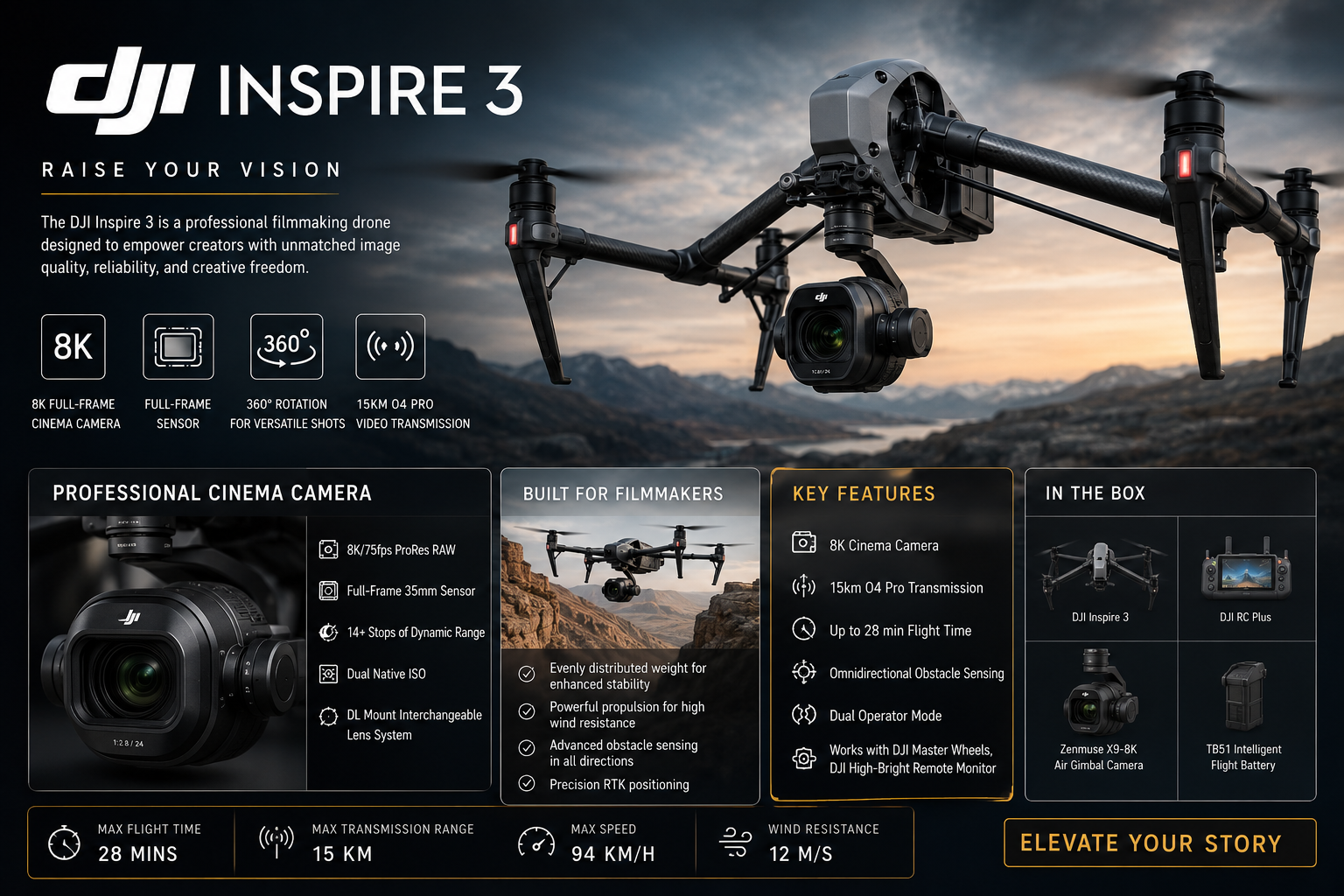
The DJI Inspire 3 is, without a doubt, the best drone option available for professional filming in 2026. Designed from the ground up to accommodate cinema production, the Inspire 3 has a full-frame camera with the ability to capture beautiful images and 8K RAW video.
Key Features
- 8K RAW video
- Full-frame image sensor
- Swappable professional camera lenses
- Dual operator option
- Advanced obstacle detection
- Improved performance during low-light settings
Best For
- Professional Filmmakers
- Commercial productions
- Documentaries
- Bigger budget cinemas
Pros
- Cinematic images with the best quality
- Professional dynamic range
- Professional stabilization
- Excellent control
Cons
- Very costly
- Not portable
- An advanced flying level is required
2. DJI Mavic 4 Pro
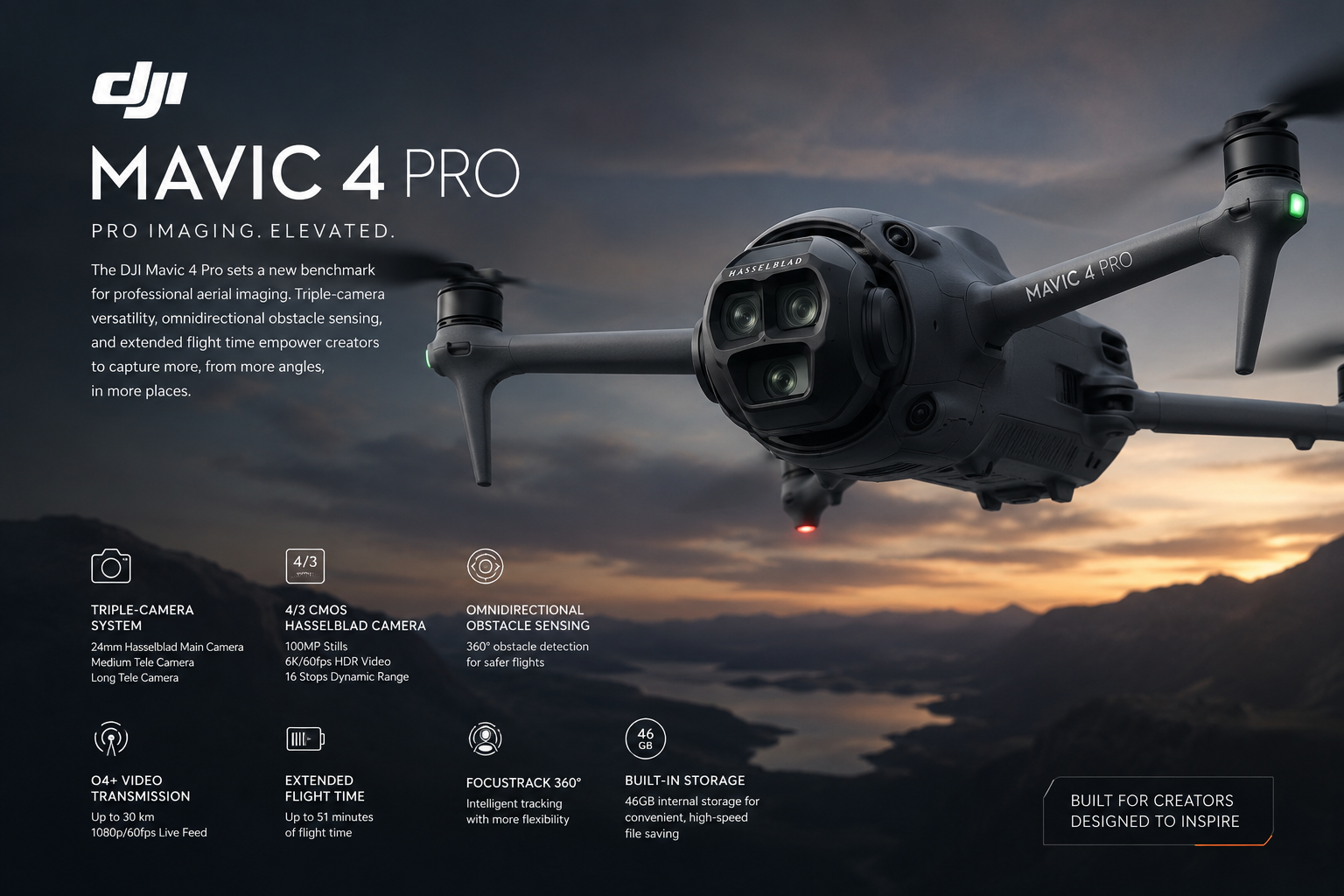
The DJI Mavic 4 Pro is the best choice of drone considering all options available to filmmakers in 2026. It provides probably the best balance of both portability and cinematic performance. Filmmakers can get professional-looking images and video without the large physical burden of cinema drones.
Key Features
- New advanced camera system
- 6K HDR video
- Full 3D
- More advanced with object detection
- More compact design
- Long battery
Best For
- Travel filmmakers
- YouTubers
- Freelance
- Commercial
Pros
- Truly portable
- More professional videos
- Good detection
- More battery time
Cons
- Expensive for newbies
- Less quality than cinema drones
3. DJI Air 3S
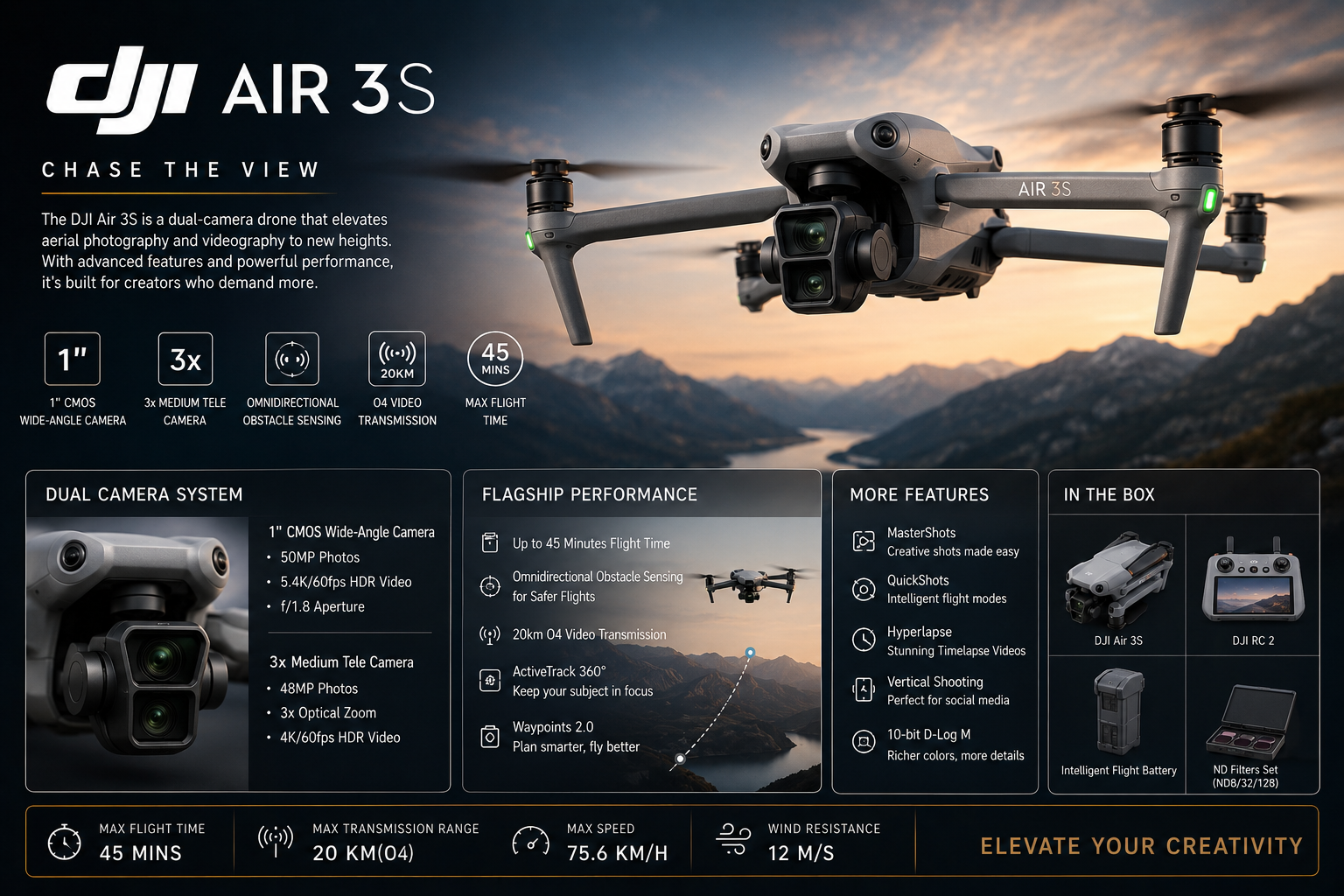
The DJI Air 3S is one of the best midrange drones to have in 2026. It has all the features of a good premium drone with the video quality you need. In addition, the price is reasonable.
Key Features
- Dual-camera System
- 4K HDR Recording
- Intelligent subject tracking
- Strong stabilization
- Compact Body
- Foldable
- Smart Flight Assistance
Best For
- Freelancers
- Creators
- Travel vloggers
- Wedding videographers
Pros
- Excellent price
- Lightweight
- Intuitive interface
- Great stabilization
Cons
- Not true 8K
- Small camera sensor
4. Autel EVO Lite+
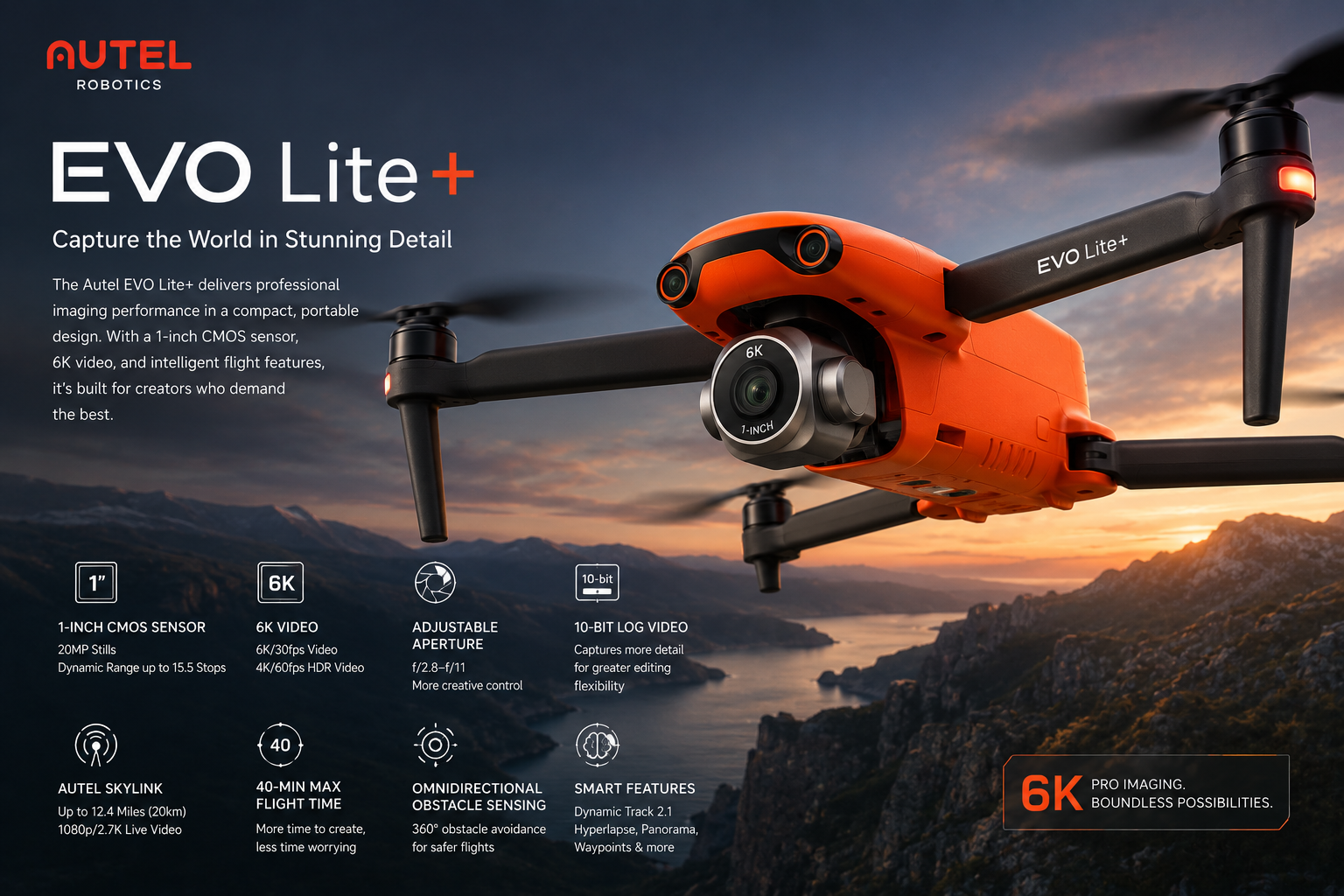
Drone filmmaking leads have moved towards the Autel EVO Lite+. For image quality coupled with flight performance, this drone is an excellent pick.
Key Features
- High resolution capability
- 1″ CMOS
- Adjustable aperture
- Long-lasting battery
- Wind resistance
- Advanced avoidance systems
Best For
- Independent filmmakers
- Outdoor cinematography
- Travel content
- Professional creators
Pros
- Excellent image quality
- Long-lasting battery
- Great performance
- Ultra-reliable flight
Cons
- Software systems are still developing
- Slightly heavier construction
5. DJI Mini 5 Pro
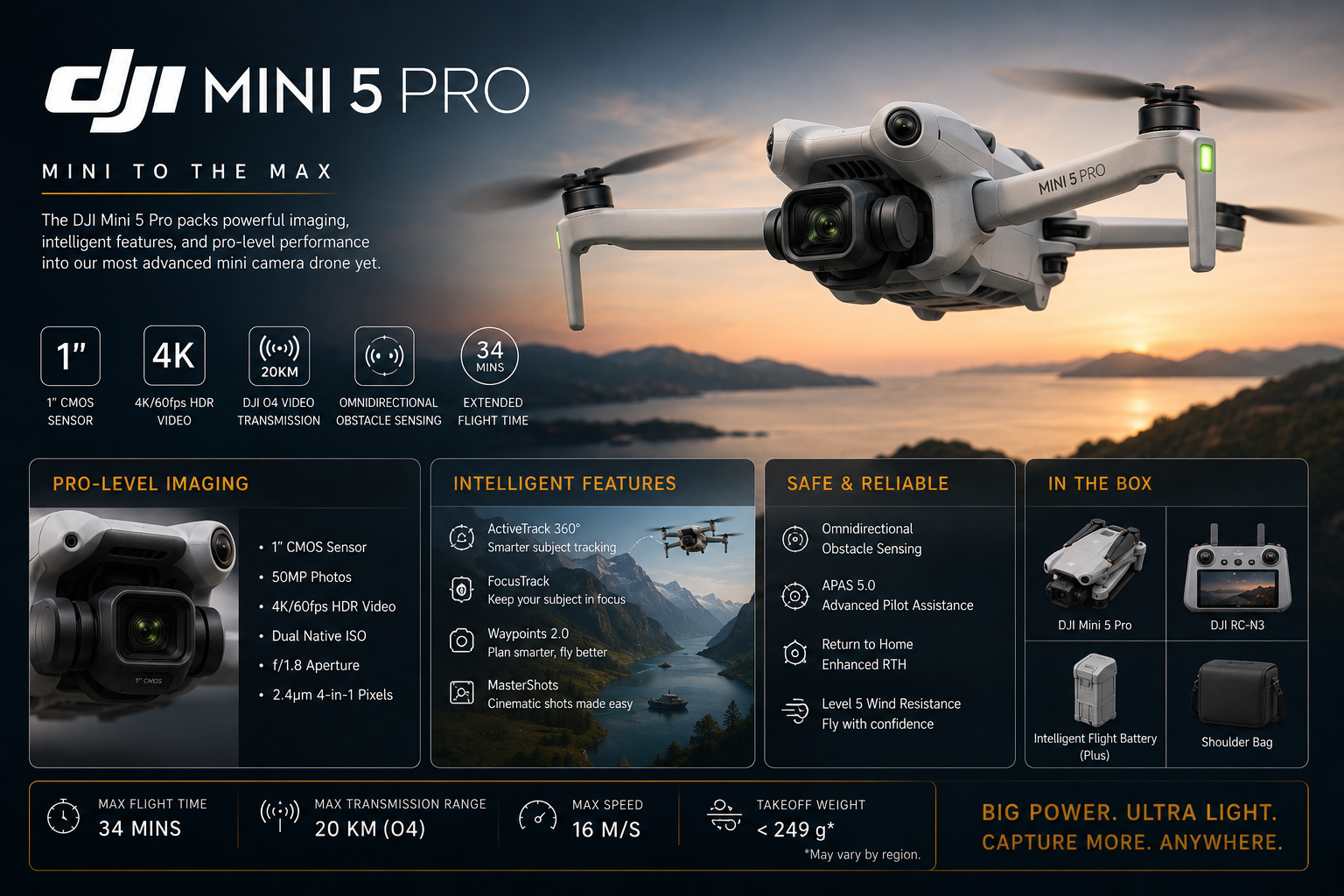
The DJI Mini 5 Pro is the pinnacle of 2026 compact cinema drones. DJI focuses on 4K film recording with compact construction.
Key Features
- 4K footage at 120fps
- AI tracking
- Lightweight and compact body
- Advanced stabilization
- Smart shooting modes
- Portable and foldable
Best For
- Beginners
- Travel vloggers
- Social media influencers
- Casual filmmakers
Pros
- Great portability
- Easy flying
- Amazing video quality
- Great battery life
Cons
- Smaller sensor
- Limited shooting capabilities compared to cinema drones
Also Read- Top FPV Drones for Racing in 2026: The Ultimate Speed, Power & Performance Guide
Comparison Table for Best 4K and 8K Drones
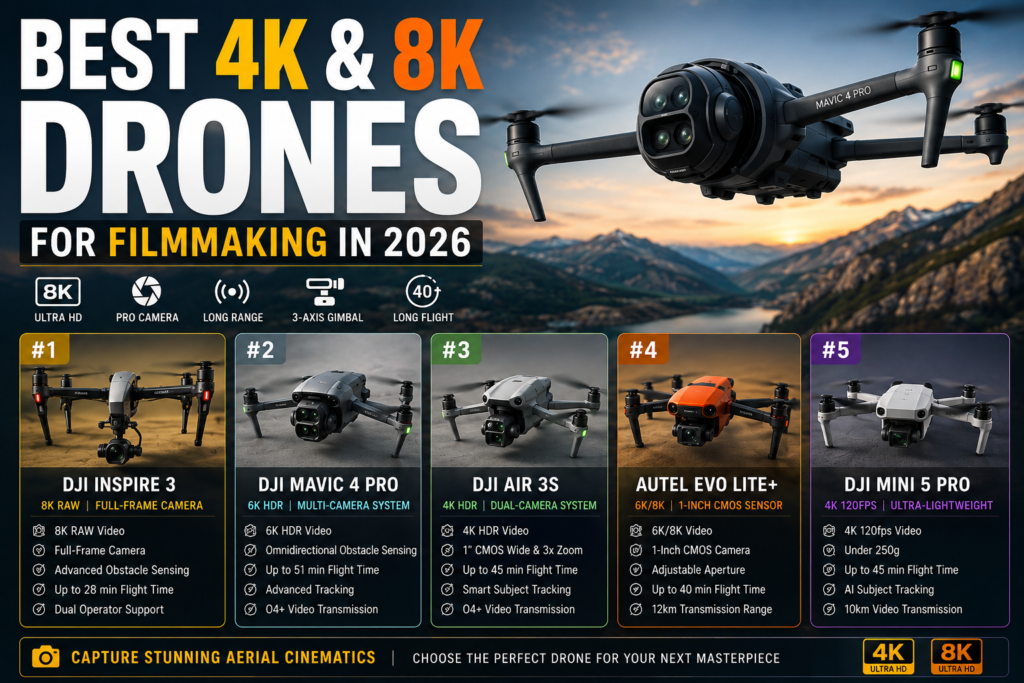
| Drone Model | Video Resolution | Best Feature | Flight Time | Best For | Skill Level |
|---|---|---|---|---|---|
| DJI Inspire 3 | 8K RAW | Full-frame cinema camera | 28 minutes | Professional filmmakers | Advanced |
| DJI Mavic 4 Pro | 6K HDR | Portable cinematic performance | 51 minutes | Travel and commercial producers | Intermediate |
| DJI Air 3S | 4K HDR | Affordable professional features | 45 minutes | Freelancers and vloggers | Intermediate |
| Autel EVO Lite+ | 6K/8K | Excellent low-light performance | 40 minutes | Independent filmmakers | Intermediate |
| DJI Mini 5 Pro | 4K 120fps | Ultra-portable design | 45 minutes | Beginners and travelers | Beginner |
Key Features to Consider Before Buying
1. Camera Quality
Film sensors come in all shapes and sizes. Some drones are bigger and can capture stunning footage in low light with impressive detail and dynamic range, while others simply can’t match that level of quality. Larger sensors produce more cinematic footage.
2. Stabilization
In order to capture smooth and stable wavy shots, a 3-axis gimbal is necessary.
3. Battery
Drones with longer flight times are preferred by filmmakers.
4. Obstacle Avoidance
A more advanced sensor with obstacle avoidance is recommended when trying to capture more cinematic shots with advanced flight movements.
5. Portability
A compact foldable design will benefit the filmmakers traveling to various remote shooting locations.
6. Intelligent Flight
AI tracking combined with automated cinematic flight paths helps filmmakers create content with ease and enhances the overall shooting experience.
Conclusion
The year 2026 will broaden opportunities across the board for drone filmmakers. From high-end cinema drones to versatile models that pack up nicely, the future has the perfect drone for every need.
The DJI Inspire 3 is the best example of a top-tier professional filmmaking drone with full 8K RAW capability and cinema-grade images. For more portability and less price, look to the DJI Mavic 4 Pro and the Air 3S drones, respectively. The Autel EVO Lite+ holds its own with great video as well. Beginners and travel filmmakers will prefer the portable DJI Mini 5 Pro.
Finding the ideal drone for your needs depends on your filmmaking goals and challenges, your fiscal situation, and experience. A great 4K or 8K drone will drive up the caliber of your cinematography and storytelling.
FAQs
1. Is 2026 going to see a rise of wait for it… 8K drone filmmaking?
Not necessarily. The majority of the videos shot today cover the typical 4K format. But, 8K opens more editing options and assures the content won’t be out of date for as long.
2. What drones make good beginners?
The best lightweight drones, for easy flight and even easier portability, are favorably compact, like the DJI Mini 5 Pro.
3. What is the best drone option for a professional shoot?
The king of pro level cinematography drones is the Inspire 3. It packs the 8K RAW format capability and a full-frame camera system.
4. Do filmmaking drones have a high price tag?
There is a considerable range in price depending on quality and level of filmmaking. On the low end, the entry-level filmmaking drones are relatively inexpensive. On the high end, professional cinema-grade drones can cost a pretty penny.
5. What is the ideal drone for travel filmmaking?
The two best options are the DJI Mavic 4 Pro and DJI Mini 5 Pro. Both options are small and portable for travel and also have excellent video quality.
6. Why is obstacle avoidance necessary?
When filming intricate/dramatic shots or maneuvers, it is difficult and risky to keep the drone in focus and avoid collisions. In these scenarios, the value of obstacle avoidance cannot be overstated when doing filmmaking with drones.
7. Do drones perform well in low-light conditions?
A higher quality drone with advanced features and a larger sensor will perform better in low light than drones with the same characteristics on a lesser scale.
8. What do drones shoot at to be considered cinematic?
For a cinematic quality in video all the shots should be filmed at a frame rate of either 24fps or 30fps. For the effects of slow motion, the frame rate should be at 60fps or higher.