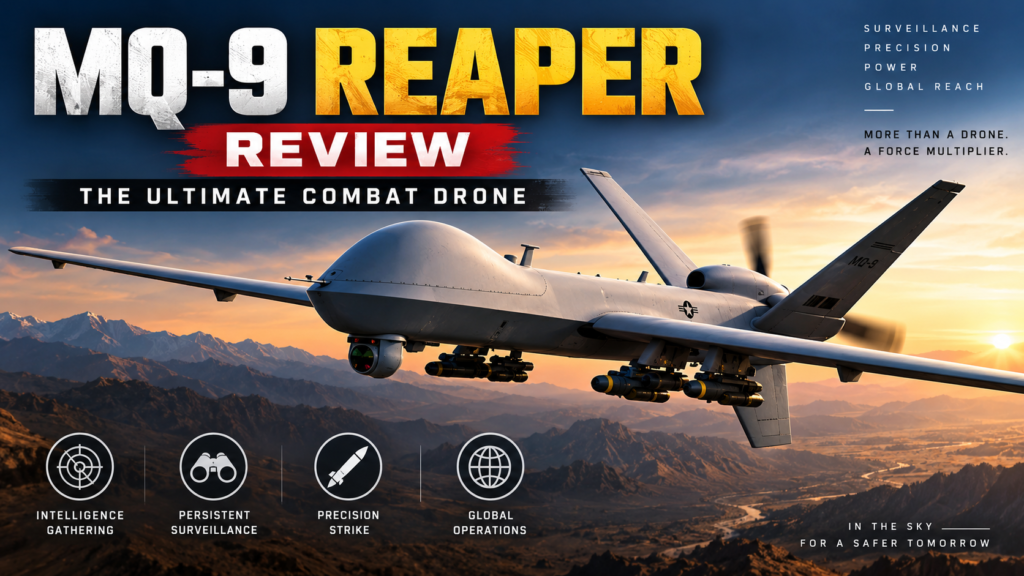
MQ-9 Reaper Review: The Ultimate Combat Drone
+
Table of Contents
- 1 What is the MQ-9 Reaper?
- 1.1 Key Features of MQ-9 Reaper Drones
- 1.1.1 Outstanding Endurance
- 1.1.2 Sensor Package
- 1.1.3 Long Range Communication
- 1.1.4 Flexible Mission Capability
- 1.1.5 Flexible Payloads
- 1.2 MQ-9 Reaper Apps and Control Systems
- 2 MQ-9 Reaper Specifications at a Glance
- 2.1 Advantages of the MQ-9 Reaper
- 2.1.1 Increased Safety for Operators
- 2.1.2 Multitasking
- 2.1.3 Safe Situational Awareness for Operators
- 2.1.4 Combat Operational Flexibility
- 2.2 Limitations of MQ-9 Reaper Drone
- 2.3 MQ-9 Reaper vs. Consumer Drones
- 2.4 Is the MQ-9 Reaper the Ultimate Combat Drone?
- 3 Final Verdict
- 3.1 FAQs about the MQ-9 Reaper
- 3.1.1 1. What is the primary function of the MQ-9 Reaper?
- 3.1.2 2. Is the MQ-9 Reaper a drone?
- 3.1.3 3. How many people staff a typical MQ-9 Reaper team?
- 3.1.4 4. What distinguishes an MQ-9 Reaper from regular drones?
- 3.1.5 5. Does the MQ-9 Reaper have sophisticated sensors?
- 3.1.6 6. Is the MQ-9 Reaper still important?
The MQ-9 Reaper is one of the most famous unmanned aerial vehicles used by modern military services. It has the capabilities of a combat drone. The MQ-9 Reaper integrates a system that combines a remotely piloted vehicle (RPV), an advanced sensor, communication equipment, mission control, and weapons systems.
Intelligence, Surveillance, and Reconnaissance (ISR) missions, as well as precision strike missions, are where the Reaper Drone Systems are best employed. The Reaper’s long loiter and endurance capabilities provide operators the capability to perform the Intelligence, Surveillance, and Reconnaissance missions, gather ISR, and collect intelligence on targets, all while remaining outside the high operational risk environment.
The Reaper Drone is a highly capable and sophisticated drone, and it is one of the best combat drone systems in the world. In this review, we will analyze the software and control systems, the limitations, some of the specifications, and the role the Reaper systems fill in today’s warfare.
What is the MQ-9 Reaper?
The MQ-9 Reaper is a larger and more advanced development of the MQ-1 Predator. It was created by General Atomics and is primarily used in military operations.
The MQ-9 performs similar functions to a small commercial drone, but on a much larger scale. It is designed for long-term missions and can carry a variety of mission equipment and sophisticated military sensors.
As with many systems, the Reaper Drone is operated by a military crew. The crew comprises a pilot and a sensor operator.
The Reaper can perform diverse missions, including reconnaissance, persistent surveillance, target observation, and strike operations.
Key Features of MQ-9 Reaper Drones
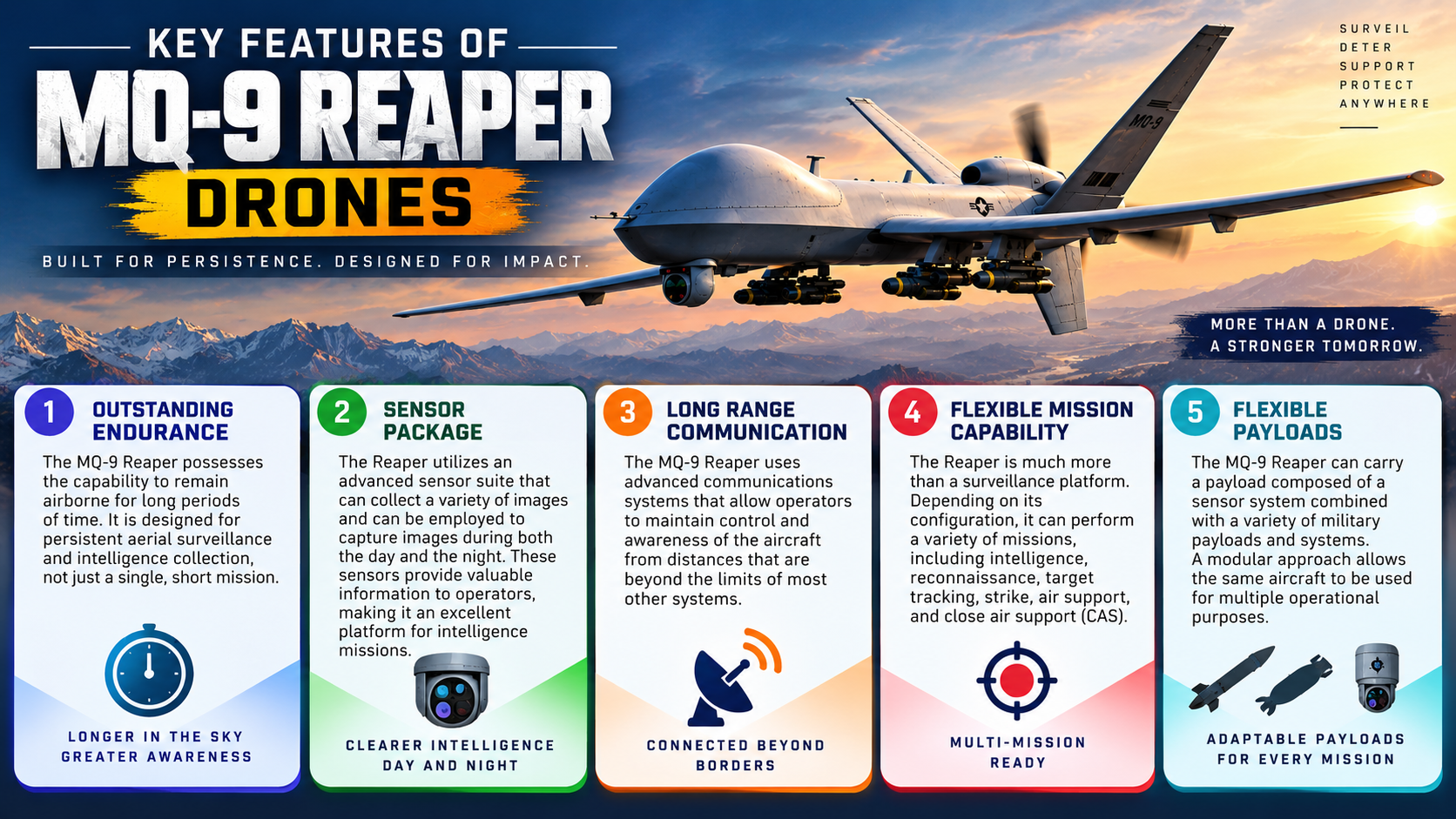
Outstanding Endurance
The Reaper Drone possesses the capability to remain airborne for long periods of time.
Persistent aerial surveillance and intelligence collection require aircraft that are not designed for a single, short mission. The Reaper Drone fills this requirement.
Sensor Package
The Reaper utilizes an advanced sensor suite that can collect an assortment of images and can be employed to capture images during both the day and the night.
The ground sensors provide a wealth of information to operators and therefore make the Reaper an excellent platform for intelligence missions.
Long Range Communication
The Reaper Drone makes use of advanced communications systems to allow operators to maintain control and an awareness of the status of the aircraft from distances that are, in the realm of almost all other systems, beyond the limit of control.
Flexible Mission Capability
The Reaper is so much more than a surveillance platform. The Reaper can perform a variety of missions.
According to its configurability, the Reaper Drone can undertake a myriad of missions: intel, stalker, recon, strike, air support, and CAS.
Flexible Payloads
The MQ-9 Reaper has the capability of carrying a payload composed of a sensor system combined with a variety of military payloads and systems.
A modular approach allows the same aircraft to be used for multiple operational purposes.
Also Read- Zipline: The Powerful Rise of Drone Delivery
MQ-9 Reaper Apps and Control Systems
The Reaper Drone uses other forms of “apps” rather than apps on a smartphone. Instead, the plane uses proprietary military applications and ground control systems.
The Ground Control Station is the control center of the system. The ground control systems include numerous mission control interfaces that give users all the tools to manage the aircraft and sensors, control communications, and manage missions.
The systems fulfill many mission functions, including:
- Aircraft control
- Missions planning
- Navigation
- Control of sensors
- Real-time imagery
- Communications
- Tracking of targets
- Management of data
- Control of payloads
- Awareness of situation
The MQ-9 system relies heavily on the software environment. Without the ground control system, the communications system, trained operators, and the supporting equipment, the aircraft cannot perform its missions.
MQ-9 Reaper Specifications at a Glance
| Specification | MQ-9 Reaper |
|---|---|
| Type of Aircraft | Remotely Piloted Aircraft |
| Primary Purpose of Aircraft | ISR and Precision Strike |
| Manufacturer | General Atomics |
| Type of Engine | Turboprop |
| Wingspan | Approximately 66 feet |
| Length | Approximately 36 feet |
| Maximum Takeoff Weight | Approximately 10,500 pounds |
| Payload | Approximately 3,750 pounds |
| Number of People It Can Carry | Pilot and Sensor Operator |
| Type of Communication | Line-of-Sight and Beyond-Line-of-Sight |
| Primary Advantage of Aircraft | Long Endurance |
| Type of Sensors | Multi-Spectral Surveillance |
Specifications can change based on the configuration, upgrades, and the mission.
Advantages of the MQ-9 Reaper
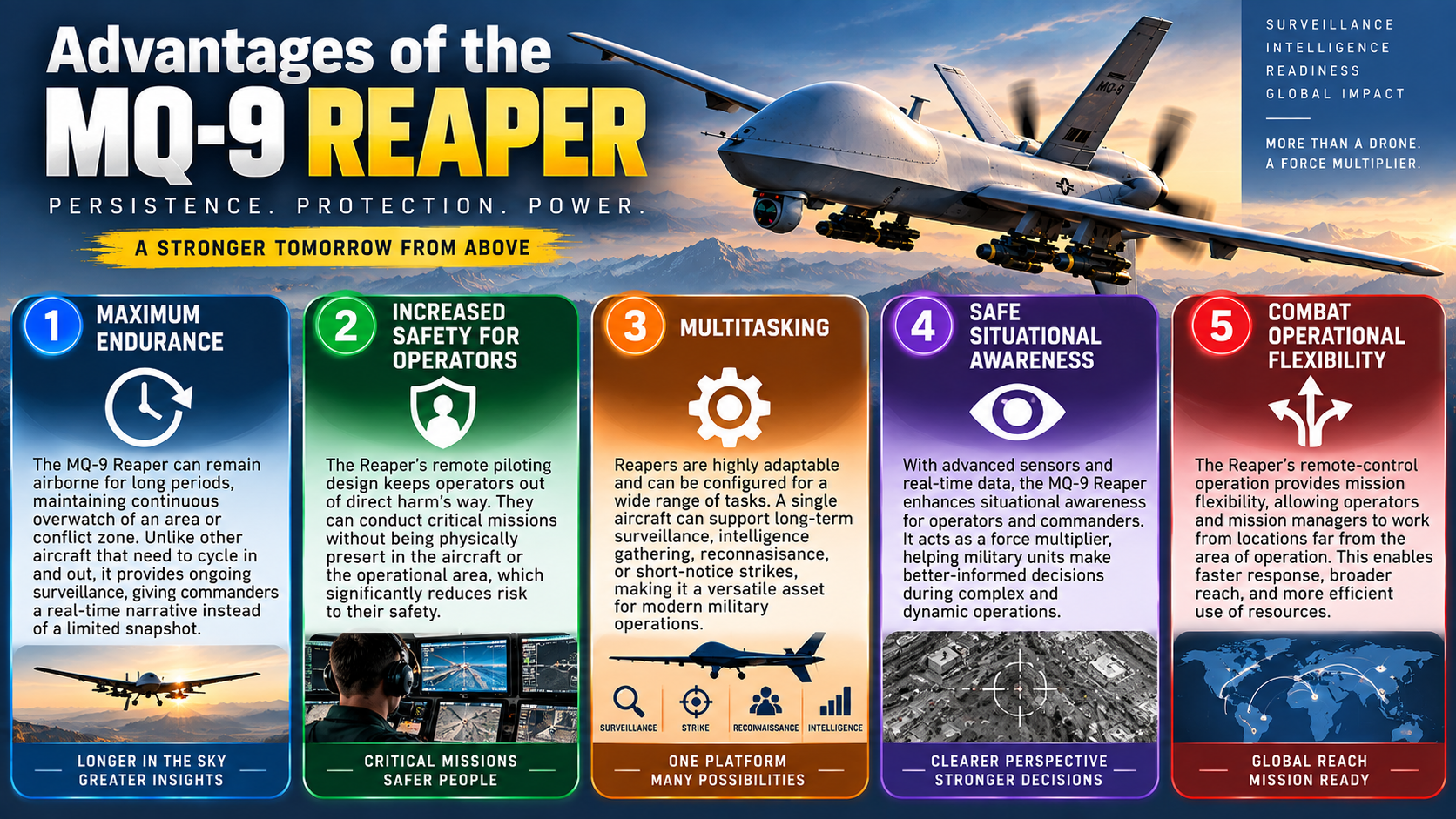
The Reaper Drone features maximum endurance, which is by far the most valuable capability that it brings to the table. Unlike other aircraft that need to cycle in and out, a Reaper can maintain an overwatch of an area and a conflict zone for long stretches of time.
This ultimately leads to operational situational awareness for the commanders being presented with a more ongoing narrative rather than a cryptic snapshot.
Increased Safety for Operators
The Reaper’s design incorporates remote piloting, meaning that the operators do not put themselves at risk by directly interfacing with the aircraft and the operations it is involved in.
Decreased risk to the operators themselves is a benefit of this design.
Multitasking
Reapers are highly adaptable in the tasks that they can be fitted to carry out. A single Reaper can be configured to assist with anything from long-term surveillance to short-notice strikes.
Safe Situational Awareness for Operators
Thanks to its unique design incorporating advanced situational awareness, the Reaper Drone is a force multiplier for military units engaged in going after high-complexity operations.
Combat Operational Flexibility
The Reaper’s remote control operation offers mission flexibility to operators, as mission managers do not necessarily have to be co-located with the area of operation.
Limitations of MQ-9 Reaper Drone
Due to the nature of its design, the MQ-9 is considerably constrained in its capability when compared to other designs. Among other things, speed is an issue. The MQ-9 was not designed to be a high-speed aircraft, but rather one that is optimized for endurance and surveillance.
Another issue is the full dependency on communications. Remote control tasks are communication-intensive, requiring a reliable command link. Losing connectivity will impact the mission.
The system needs a lot of trained staff and a lot of supporting structures. Running the ground station, booking flight time, planning and running communications, analyzing intelligence, and support operations all take a large amount of effort.
Because of that, the Reaper is not just a plane. It’s a whole system.
Also Read- Microsoft Copilot Review: A Powerful AI Assistant
MQ-9 Reaper vs. Consumer Drones
There is very little to relate between a consumer drone and a Reaper Drone.
Consumer drones are, by and large, small and easy-to-use flying systems designed to carry a camera and fly for recreational and commercial purposes.
The MQ-9 is designed to carry military-grade communications, embedded sensors, and mission payloads all while maintaining a high state of mission adaptability and persistence.
It draws its capabilities from its system of supporting assets.
Is the MQ-9 Reaper the Ultimate Combat Drone?
Once again, it depends.
With respect to persistent surveillance, long endurance, mission flexibility, and remote operations, it undoubtedly is one of the best. The MQ-9 is best not for carrying the most significant loads or the largest size, but for the adaptability of the system of sensors, aircraft, communications, and operators as a whole.
Although it has no plans to completely replace any military aircraft, there is a place for it for long-endurance, flexible mission, and sustained surveillance missions.
Final Verdict
The MQ-9 Reaper disrupts the status quo of military aviation with its persistent, advanced, remote tower system, and adaptable design. Its design has captured the imaginations of producers of contemporary warfare.
The greatest asset of the Reaper Drone is its persistence. Through its capacity to loiter, military operators are afforded intelligence-gathering opportunities and battlefield mission support.
While its persistence is strong, the Reaper Drone has its shortcomings. It is reliant on ground-based infrastructure, is not designed to be as fast as a fighter, and is more of a slower surveillance drone.
Given its design, the Reaper Drone has earned its place as a premier combat UAV system and even as a fully integrated aviation system, combined with software, sensors, and communication.
FAQs about the MQ-9 Reaper
1. What is the primary function of the MQ-9 Reaper?
The primary functions of the Reaper Drone are intelligence gathering, surveillance, reconnaissance, and target observation and destruction.
2. Is the MQ-9 Reaper a drone?
MQ-9s are remotely piloted aircraft systems, and as such are not autonomous like other systems.
3. How many people staff a typical MQ-9 Reaper team?
The normal staffing pattern is a pilot in the cockpit and a sensor operator. Other mission support staff may be employed to fulfill other mission tasks.
4. What distinguishes an MQ-9 Reaper from regular drones?
The Reaper Drone has a more sophisticated design intended for surveillance missions that carry communication and payload systems. Other drone models are built for less complicated purposes.
5. Does the MQ-9 Reaper have sophisticated sensors?
The Reaper Drone actually uses an advanced type of multi-spectral sensor that can support observations and surveillance in different environments and at different times of day.
6. Is the MQ-9 Reaper still important?
It is still important. The combination of systems and capabilities of the Reaper Drone, including endurance, surveillance, communication, flexibility and the ability to perform multiple missions, still allows it to perform well as an unmanned aircraft system (UAS).