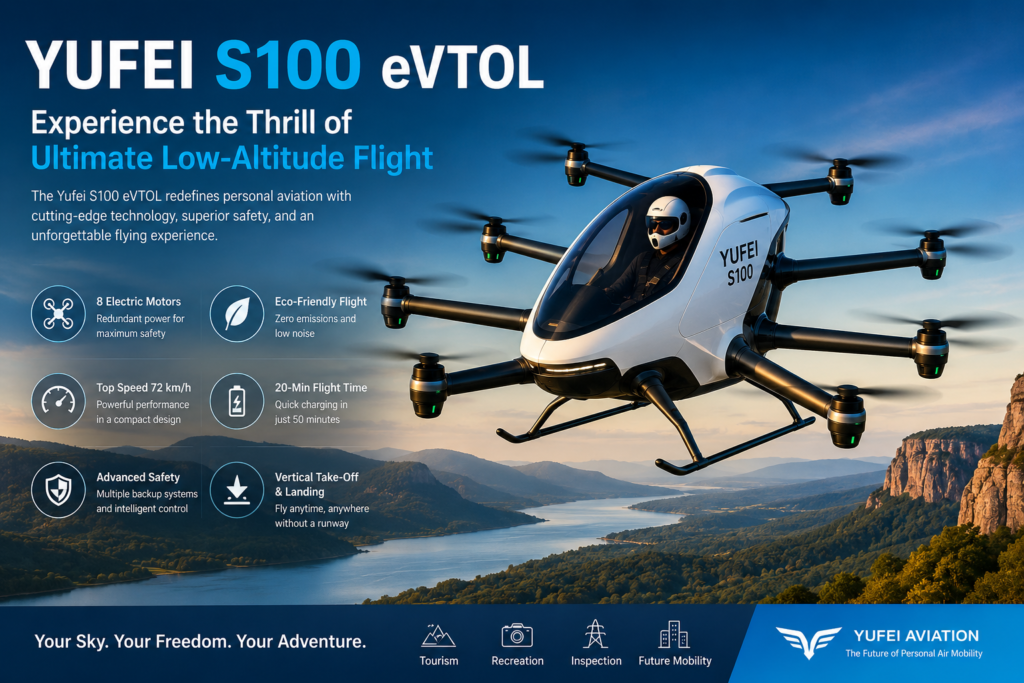
Yufei S100 eVTOL: Experience the Thrill of Ultimate Low-Altitude Flight
+
Table of Contents
- 1 What is the Yufei S100 eVTOL?
- 2 Key Specifications of the Yufei S100 eVTOL
- 2.1 Innovative Design and Engineering
- 2.2 Advanced Electric Propulsion System
- 2.3 Safety Features That Inspire Confidence
- 2.3.1 1. Motor Redundancy
- 2.3.2 2. Backup Power Systems
- 2.3.3 3. Durable Airframe
- 2.3.4 4. Intelligent Flight Control
- 2.4 The Excitement of Low-Altitude Flight
- 3 Yufei S100 Use Cases
- 4 Environmental Benefits of Electric Flight
- 4.1 Lower Carbon Footprint
- 4.2 Less Noise Pollution
- 4.3 Sustainability Meets Aviation
- 4.4 Regulatory Approval
- 4.5 Battery Technology
- 4.6 Infrastructure Development
- 4.7 Public Acceptance
- 4.8 The Yufei S100 and the Future of Personal Air Mobility
- 5 Conclusion
- 5.1 Frequently Asked Questions (FAQs)
- 5.1.1 1. What does eVTOL mean?
- 5.1.2 2. How many passengers can the Yufei S100 transport?
- 5.1.3 3. What is the Yufei S100’s maximum speed?
- 5.1.4 4. What is the maximum flight time of the Yufei S100?
- 5.1.5 5. Is the Yufei S100 good for the environment?
- 5.1.6 6. What will the Yufei S100 primarily be used for?
- 5.1.7 7. Does the Yufei S100 have any safety redundancies?
- 5.1.8 8. Are eVTOLs capable of completely replacing all transportation in the future?
The new electric Vertical Take-Off and Landing (eVTOL) vehicles are pioneering a new era in personal flight. Among these evolving forms of personal air mobility is the Yufei S100 eVTOL. This innovative low-altitude flight eVTOL makes personal flight exciting, accessible, and efficient. The future of personal aviation can be seen in the design of the Yufei S100, which utilizes an advanced electric propulsion system housed in a small and lightweight form.
As the population grows in the urban environment, so does the demand for efficient travel. eVTOLs are designed to provide a new and safer form of transport as an alternative to street-bound methods. The Yufei S100 offers an incredible flying experience and demonstrates the capabilities of modern engineering in aerial transport.
What is the Yufei S100 eVTOL?
As a single-seat eVTOL, the Yufei S100 is unlike conventional aircraft in that it does not need a long runway for takeoff. It can make vertical lift and landing. This makes the Yufei S100 a useful vehicle for use in constrained environments.
The S100 was designed to be intuitive and safe, yet provide a high-performance flight experience. Although made of advanced materials, the design lends itself to a lower operating cost. It is environmentally safe.
The aircraft is making personal air transportation available to a larger audience for the first time.
Key Specifications of the Yufei S100 eVTOL
The following table highlights some important specifications of the Yufei S100:
| Specification | Details |
|---|---|
| Aircraft Type | Single-Seat eVTOL |
| Passenger Capacity | 1 Person |
| Empty Weight | ~115 kg |
| Maximum Payload | ~110 kg |
| Propulsion | 8 Electric Motors |
| Maximum Airspeed | 72 km/h |
| Maximum Flight Time | 20 minutes |
| Recharge Time | 50 minutes |
| Aircraft Composition | Carbon Fiber with Aluminum Alloy |
| Flight Profile | VTOL (Vertical Take-off and Landing) |
| Focus Application | Recreational, Touristic, and Inspection Flights |
The specs highlight the Yufei S100 eVTOL’s emphasis on personal transportation and a rather quick flight experience.
Innovative Design and Engineering
The Yufei S100 is another example of modern innovative eVTOL design. The aircraft demonstrates the usage of lightweight yet strong carbon fiber and aluminum alloy.
The modern compact design allows the Yufei S100 to be more portable than other eVTOL designs, and some variants have foldable parts.
The eVTOL design and engineering reflect the positive change in aviation to a more efficient, safe, and user-oriented experience.
Advanced Electric Propulsion System
The Yufei S100 has developed an effective propulsion system based on eight independent electric motors. This system has multiple benefits:
- Stability when flying
- Improved safety due to redundancy
- A quieter aircraft
- Reduced service time
- A green way of transportation
Traditional aviation has been challenged from fossil fuel-based propulsion to a greener propulsion system. The Yufei S100 eVTOL leads the change to safe urban aviation, away from fossil fuel to electric propulsion.
The electric motors give the pilots a smoother and more stable power output throughout their journey.
Safety Features That Inspire Confidence
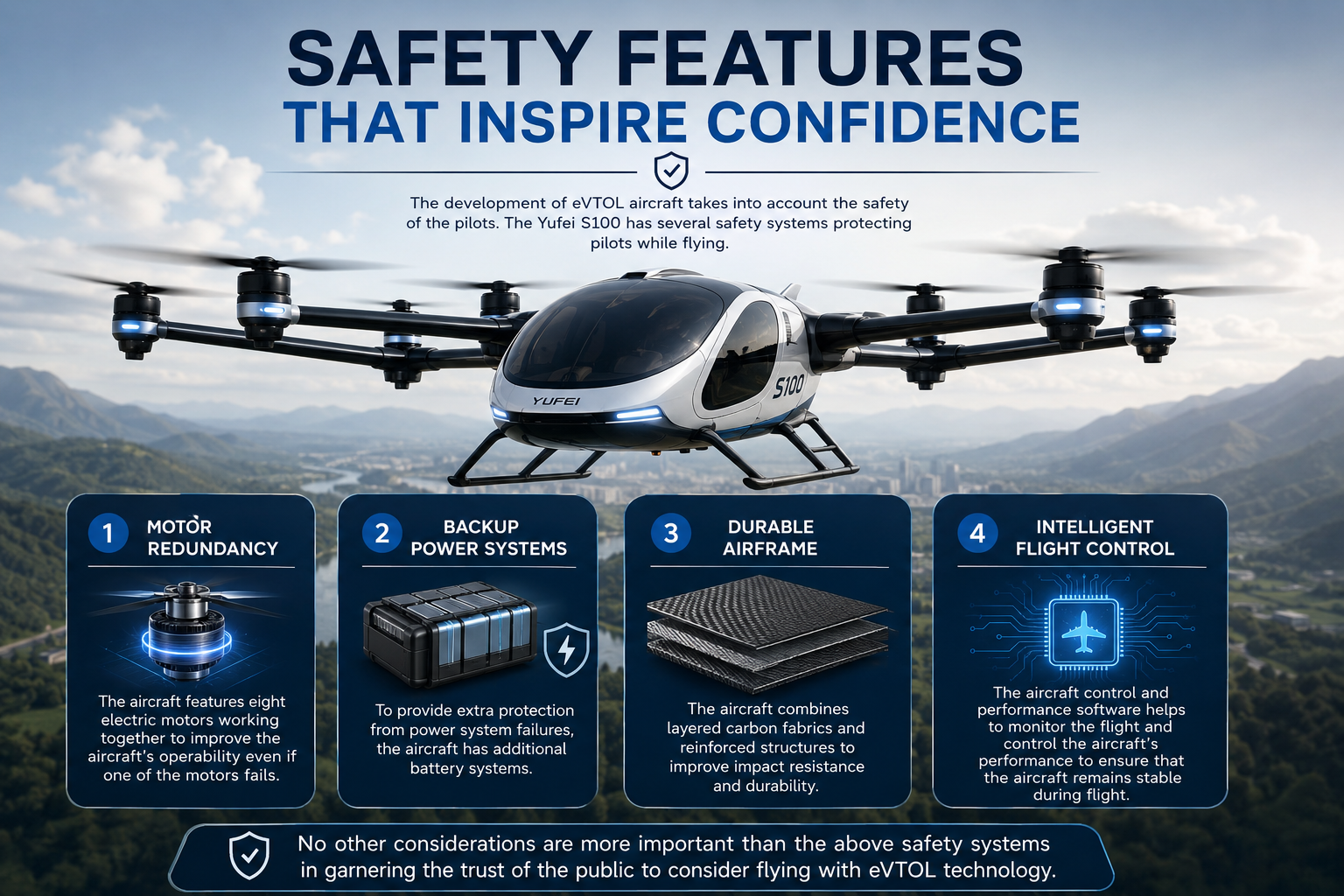
The development of eVTOL aircraft takes into account the safety of the pilots. The Yufei S100 has several safety systems protecting pilots while flying.
1. Motor Redundancy
The aircraft features eight electric motors working together to improve the aircraft’s operability even if one of the motors fails.
2. Backup Power Systems
To provide extra protection from power system failures, the aircraft has additional battery systems.
3. Durable Airframe
The aircraft combines layered carbon fabrics and reinforced structures to improve impact resistance and durability.
4. Intelligent Flight Control
The aircraft control and performance software helps to monitor the flight and control the aircraft’s performance to ensure that the aircraft remains stable during flight.
No other considerations are more important than the above safety systems in garnering the trust of the public to consider flying with eVTOL technology.
The Excitement of Low-Altitude Flight
The Yufei S100 is appealing because flying with it is a unique experience.
Unlike the lengthy processes that come with traditional air travel, involving large airplanes and lengthy airports, the Yufei S100 experience is personal and immersive.
The choice of flying at lower altitudes is a great idea. It produces:
- Panoramic views
- Great sightseeing
- Enhanced interactivity and excitement
- Greater sensory visual perception reaching beyond the cabin
It is so much more fun seeing the countryside and coastlines through the S100 windows. No other traditional means of transportation can come close to what the Yufei S100 offers.
Yufei S100 Use Cases
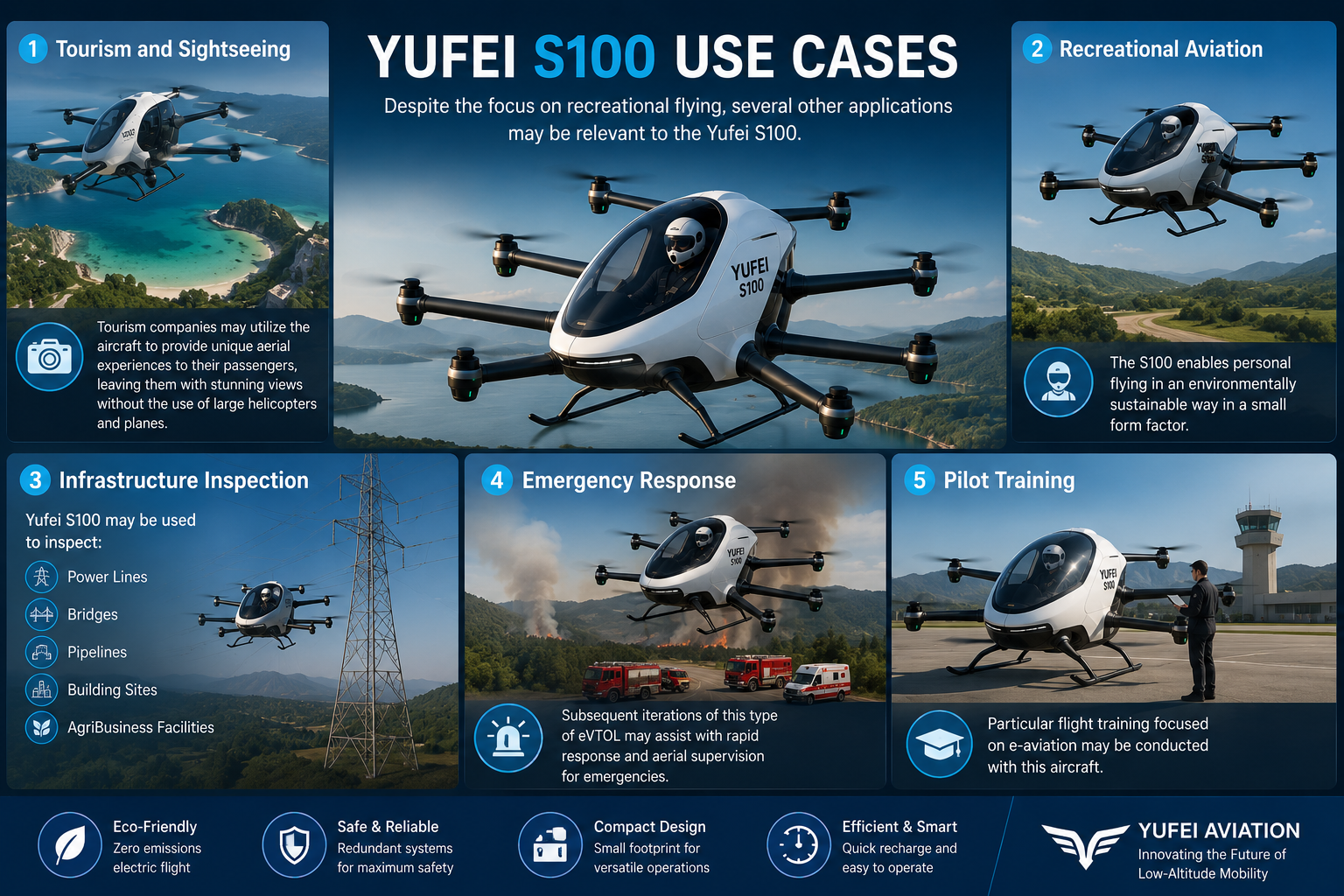
Despite the focus on recreational flying, several other applications may be relevant to the Yufei S100.
Tourism and Sightseeing
Tourism companies may utilize the aircraft to provide unique aerial experiences to their passengers, leaving them with stunning views without the use of large helicopters and planes.
Recreational Aviation
The S100 enables personal flying in an environmentally sustainable way in a small form factor.
Infrastructure Inspection
Yufei S100 may be used to inspect:
- Power Lines
- Bridges
- Pipelines
- Building Sites
- AgriBusiness Facilities
- Emergency Response
Subsequent iterations of this type of eVTOL may assist with rapid response and aerial supervision for emergencies.
Pilot Training
Particular flight training focused on e-aviation may be conducted with this aircraft.
Also Read- The Rise of Vertical Drone Towers in Modern Cities
Environmental Benefits of Electric Flight
All modes of transportation are focusing on sustainability, and the Yufei S100 leads in this space with yet another electric-based aircraft.
Lower Carbon Footprint
Traditional flying means a reliance on fossil fuels. This is not the case with electric flight.
Less Noise Pollution
- Operations are more compatible with urban areas.
- Electric propulsion drives industry pacesetter efficiency.
Sustainability Meets Aviation
As the global shift towards renewable energy continues, electric flight may become even more sustainable. These benefits will undoubtedly help eVTOL technologies to shape and support the infrastructure of sustainable transportation for the future.
eVTOL technology, however, will still encounter some of the challenges facing aviation in general.
Regulatory Approval
The regulations for personal-use eVTOLs haven’t been established by aviation authorities yet.
Battery Technology
The range and time limitations on flights are directly correlated to the limitations of batteries. Higher-energy-density batteries, which take less time to charge, can enable longer flights.
Infrastructure Development
The adoption of eVTOLs will require new LZs, charging infrastructure, and eVTOL-specific maintenance stations.
Public Acceptance
The public is understandably cautious of new technology. However, as more successful flights occur and safety and performance records are established, the public’s perception will improve.
The Yufei S100 and all personal air mobility solutions will require focus on all of the above areas for long-term successful adoption.
The Yufei S100 and the Future of Personal Air Mobility
The Yufei S100 is a personal air travel solution that is just the beginning of eVTOLs being used daily worldwide. As batteries advance and regulations allow, the possibility of eVTOLs being incorporated as common air travel vehicles is only a matter of time.
Other possible advancements include:
- Increased flight times
- Decreased charging times
- Autonomous flight
- Better flight control systems
- Increased number of passengers
- Integration with other modes of transportation in smart cities
The use of air travel will be as common as a car, and travel will no longer be as time-consuming.
Conclusion
The Yufei S100 is fully representative of the future of eVTOLs. The flying experience this craft is able to provide is unlike most other offerings available to the public, due to the systems, design, and requirements of eVTOLs.
The Yufei S100, whatever its application–be it recreation, tourism, aerial inspection, or future applications for urban mobility–shows us just how flexible eVTOL technology is. Along with the advancements in battery technology, as well as automation and air transport technology, the Yufei S100 will potentially redefine how we traverse and interact with the air.
Frequently Asked Questions (FAQs)
1. What does eVTOL mean?
eVTOL refers to Electric Vertical Take-off and Landing, which describes a type of aircraft that is able to take-off and land vertically through an electric propulsion system.
2. How many passengers can the Yufei S100 transport?
As a single-seat aircraft, the Yufei S100 can only transport one person (a pilot).
3. What is the Yufei S100’s maximum speed?
The Yufei S100 is capable of achieving 72 km/h.
4. What is the maximum flight time of the Yufei S100?
The Yufei S100 can achieve a flight time of approximately 20 minutes.
5. Is the Yufei S100 good for the environment?
Yes. The Yufei S100 is fully electric, which means no emissions are created during flight. It is also quieter than a conventional aircraft.
6. What will the Yufei S100 primarily be used for?
The Yufei S100 is primarily used for recreation, tourism and sightseeing. As of now, it can also be used for aerial inspection, as well as better personal air mobility in the future.
7. Does the Yufei S100 have any safety redundancies?
Yes. The Yufei S100 is designed with a durable structure and recessed flight control technology. Pre-flight and redundant power systems are also a part of the design.
8. Are eVTOLs capable of completely replacing all transportation in the future?
eVTOLs are unlikely to be a complete transportation solution. Nonetheless, eVTOLs are a viable option for a large portion of the existing transport integration systems, especially in urban and regional mobility.