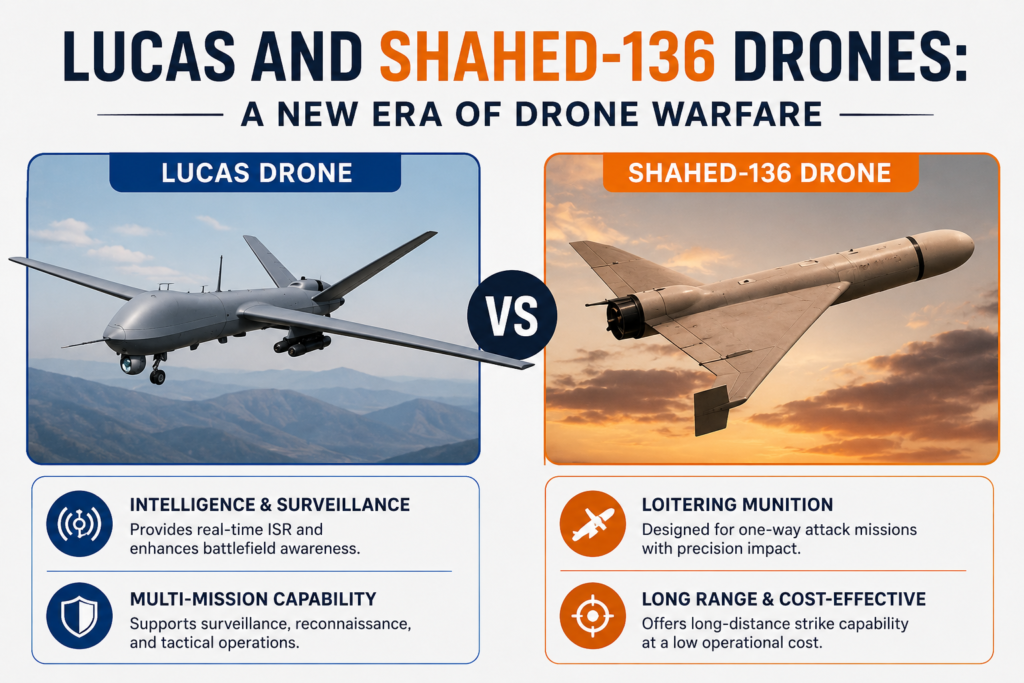
Lucas and Shahed-136 Drones: A New Era of Drone Warfare
+
Table of Contents
- 1 Why Military Drones Are So Important
- 2 What Is the Lucas Drone?
- 3 What is the Shahed-136 Drone?
- 3.1 Key Features of the Shahed-136 Drone
- 3.2 Benefits of the Shahed-136 Drone
- 3.3 Lucas Drone Features Summary
- 3.3.1 Main Highlights
- 3.4 Shahed-136 Features Summary
- 3.4.1 Main Highlights
- 4 Lucas vs Shahed-136 Drone Comparison
- 5 Which Drone is More Effective?
- 5.1 Lucas Drone
- 5.1.1 More effective at:
- 5.2 Shahed-136 Drone
- 5.2.1 More effective at:
- 5.3 How Drones Are Changing Modern Warfare
- 5.3.1 Warfare using Drones
- 5.3.2 Artificial Intelligence
- 5.3.3 Swarm Technology
- 5.3.4 Lower Costs
- 5.3.5 Increased Surveillance
- 5.3.6 Precision Engagement
- 6 Future Outlook for Military Drones
- 7 Conclusion
- 7.1 FREQUENTLY ASKED QUESTIONS
- 7.1.1 1. What is the Lucas drone primarily used for?
- 7.1.2 2. Is the Shahed-136 drone reusable?
- 7.1.3 3. Which drone has a greater range?
- 7.1.4 4. Does the Lucas drone have the ability to strike?
- 7.1.5 5. What are some of the advantages of military drones?
- 7.1.6 6. What does the Shahed-136 bring to the table?
- 7.1.7 7. Are drones replacing Manned Aircraft?
The role of drones in modern warfare is becoming more pronounced as warfare evolves. UAVs (Unmanned Aerial Vehicles) are Important for Gathering Intelligence and Delivering Strikes. The Lucas drone and Shahed-136 drone are two UAVs that have drawn a lot of interest. Although they are both defense drones, they are different in several areas, especially in design and purpose.
We will analyze the Lucas and Shahed-136 drones, their potential, and their significance in the history of warfare.
Why Military Drones Are So Important
Military drones have changed how countries do surveillance, reconnaissance, and combat. Unlike fighters and bombers, drones do not carry pilots and, as a result, can easily conduct strikes at lower costs.
The need for enhanced strikes at lower costs has resulted in increased investment in drones. The use of drones has:
- Increased the level of information in the theater of war.
- Provided the ability to conduct strikes that have a high probability of success over a long distance.
- Reduced the level of risk and exposure to soldiers.
As military conflicts change, the use of drones such as the Lucas and Shahed-136 is becoming a necessary component of military strategy and operations.
What Is the Lucas Drone?
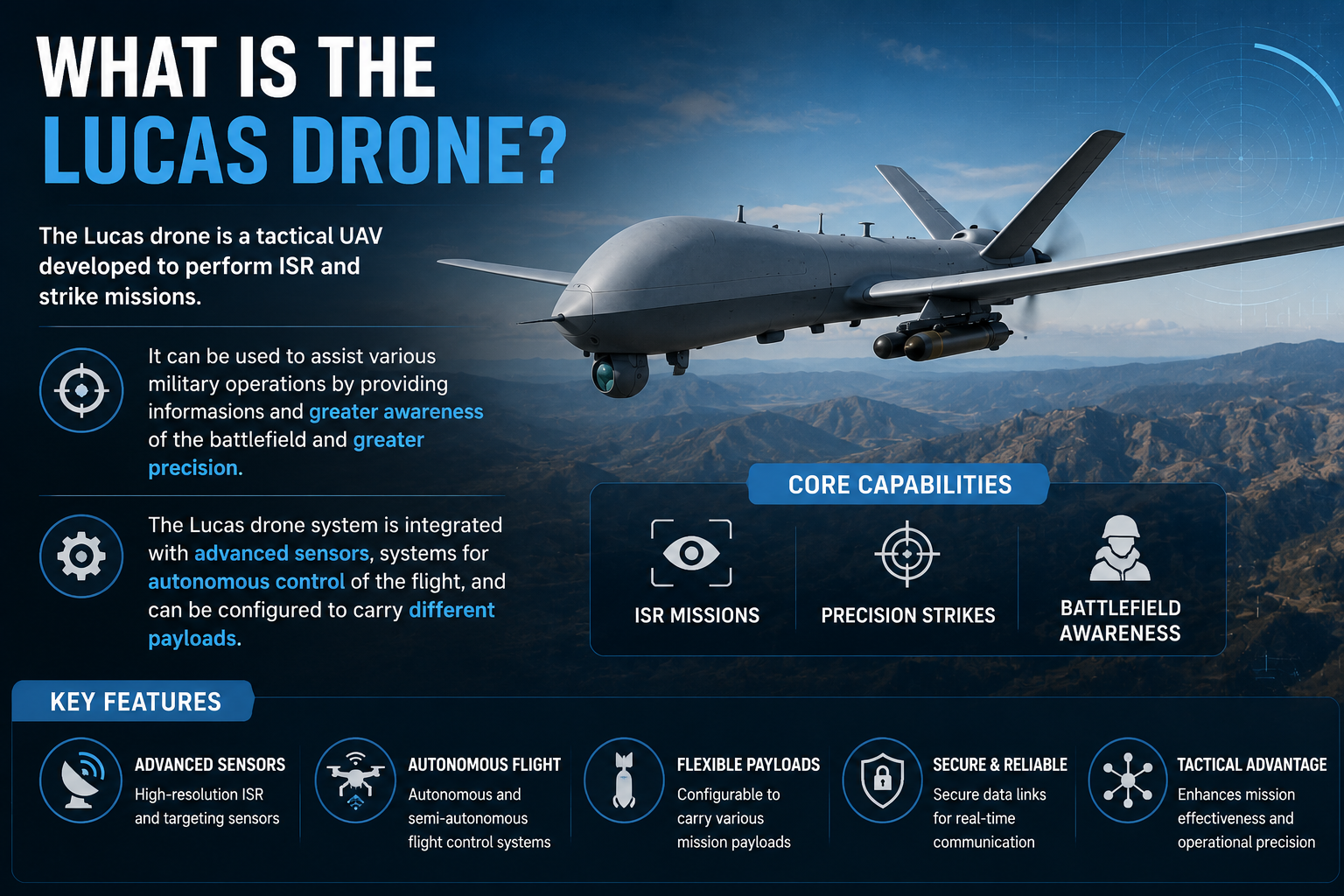
The Lucas drone is a tactical UAV developed to perform ISR and strike missions. It can be used to assist various military operations by providing information and greater awareness of the battlefield and greater precision.
The Lucas drone system is integrated with advanced sensors, systems for autonomous control of the flight, and can be configured to carry different payloads.
Key Features of the Lucas and Shahed-136 Drones
| Feature | Description |
|---|---|
| Mission Type | Surveillance, Reconnaissance, and Strike Support |
| Flight Control | Semi-Autonomous and Autonomous |
| Intelligence Gathering | Real-Time ISR Capability |
| Sensors | Electro-Optical and Infrared Systems |
| Target Tracking | Sophisticated Tracking Technology |
| Battlefield Awareness | Enhanced Situational Awareness |
| Data Transmission | Secure Communication Links |
| Military Role | Support Tactical Operations |
What is the Shahed-136 Drone?
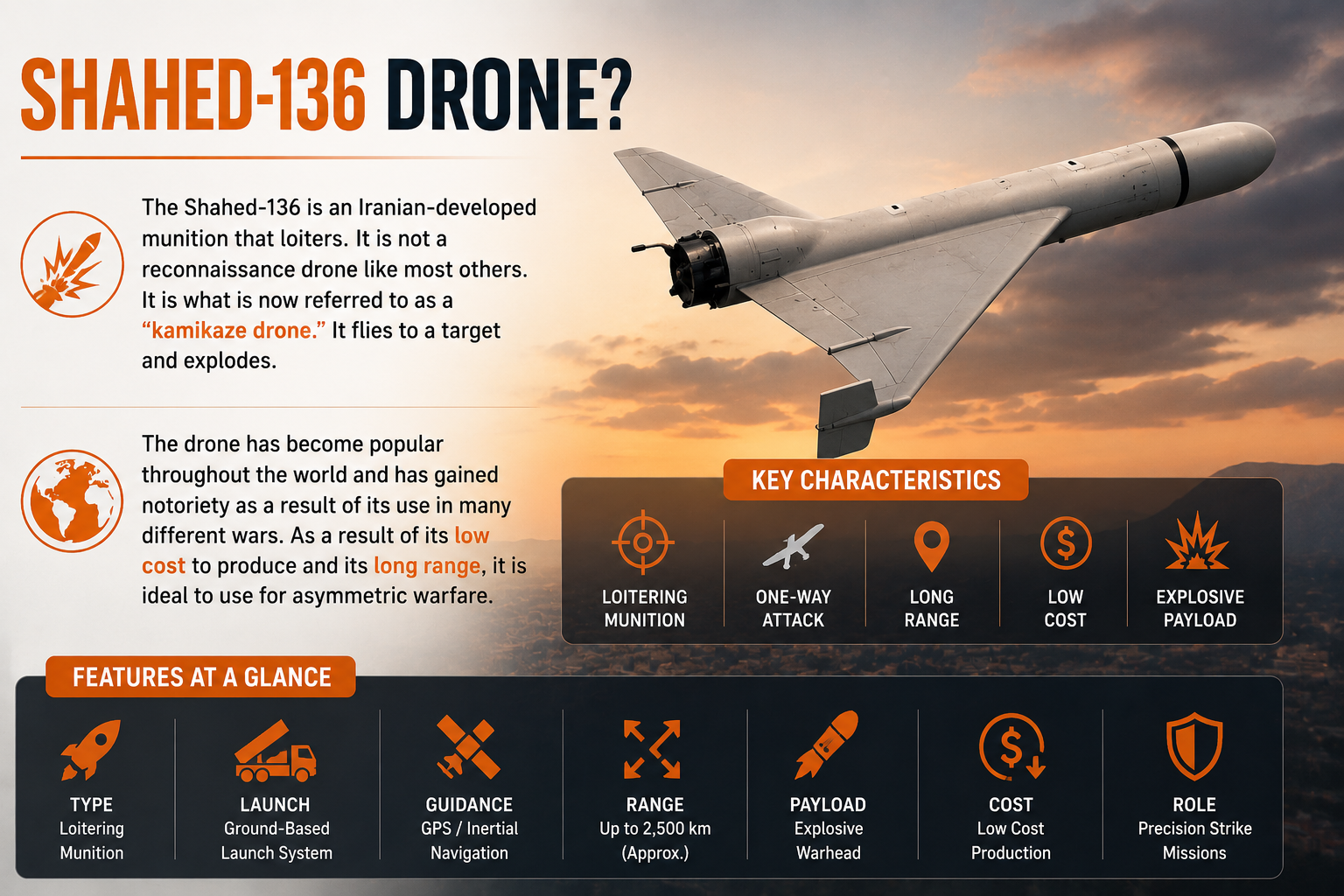
The Shahed-136 is an Iranian-developed munition that loiters. It is not a reconnaissance drone like most others. It is what is now referred to as a “kamikaze drone.” It flies to a target and explodes.
The drone has become popular throughout the world and has gained notoriety as a result of its use in many different wars. As a result of its low cost to produce and its long range, it is ideal to use for asymmetric warfare.
Key Features of the Shahed-136 Drone
| Feature | Description |
|---|---|
| Drone Type | Loitering Munition |
| Mission | One-Way Attack |
| Launch Method | Ground-Based Launch Systems |
| Guidance System | GPS/Navigation-Based |
| Operational Range | Long Distance Capability |
| Payload | Explosive Warhead |
| Cost | Low Cost Compared to Traditional Missiles |
| Combat Role | Precision Strike Missions |
Benefits of the Shahed-136 Drone
- Long range.
- Cost is low and comparable to missiles.
- Hard to intercept due to a large quantity.
- Good for strikes that are tactical in nature.
- Can penetrate most air defense.
Lucas Drone Features Summary
The Lucas drone focuses primarily on support and reconnaissance. It is an eye in the sky for the battalion commander.
Main Highlights
- Information dominance
- Real-time intel
- Tactical mission support
- Operational agility
- Battlefield illumination
The Lucas system focuses on information dominance, which empowers military units to make quicker and better-informed decisions.
Shahed-136 Features Summary
The Shahed-136 takes an alternative approach. Instead of collecting intelligence, this drone has an attack mission.
Main Highlights
- Long-range attack
- Strike capabilities
- Lower production cost
- GPS-guided
- Effective against stationary targets
- Saturation attack tool
Target destruction is the main goal of this system.
Also Read- CRPA Systems: The Future of Anti-Jamming Technology
Lucas vs Shahed-136 Drone Comparison
The main difference between these systems is their primary function.
| Category | Lucas Drone | Shahed-136 Drone |
|---|---|---|
| Primary Role | Surveillance & Reconnaissance | Attack & Loitering Munition |
| Reusability | Reusable | One-Way Mission |
| Intelligence Collection | Yes | Limited |
| Strike Capability | Support Role | Primary Function |
| Payload Type | Sensors & Equipment | Explosive Warhead |
| Mission Duration | Extended ISR Missions | Single Strike Mission |
| Cost Efficiency | Moderate | High |
| Battlefield Awareness | Excellent | Limited |
| Autonomous Features | Highly Developed | Moderate |
| Operational Focus | Information Gathering | Target Elimination |
Which Drone is More Effective?
This answer is based on the mission needs.
Lucas Drone
More effective at:
- Monitoring enemy movements
- Collecting battlefield intel
- Surveillance missions
- Recon missions
- Supporting strikes for
- Tactical awareness
Shahed-136 Drone
More effective at:
- Long-range strikes
- Attacking high-value targets
- Saturation of air defense
- Cost-effective targeting of
- Stationary military targets
Neither drone has a clear advantage over the other as they have fundamentally different purposes.
How Drones Are Changing Modern Warfare
In the assessment of many military experts, the introduction of drones offers significant advantages and enhancements to military operations. Drones promote the ability to conduct military operations more safely and successfully.
Warfare using Drones
A few of the major factors influencing the future of warfare using drones include the following:
Artificial Intelligence
Drones that use AI have the ability to recognize and identify targets, assess threats, and determine paths of travel with little to no human intervention.
Swarm Technology
Drones of the future may operate in fleets and overwhelm defensive capabilities with sheer numbers and work together.
Lower Costs
Military operations and capabilities using drones provide capabilities at a significantly reduced cost compared to using traditional fighter aircraft and missiles.
Increased Surveillance
Drones allow military units to have surveillance of a given situation and maintain an updated sense of knowledge and awareness of the situation.
Precision Engagement
Drones provide military units with the ability to conduct engagements and operations with a high degree of effectiveness and reduced risk of collateral damage.
Future Outlook for Military Drones
The potential military applications of drones are substantial, and countries around the world are investing in military drone technology. Future developments may showcase:
AI and autonomous technology
- Longer flight times
- Improved capabilities to withstand electronic warfare
- Enhanced stealth technology
- Improved sensors
- Drone swarms
The Lucas and the Shahed-136 drones illustrate that they fulfill different military concepts in warfare.
Conclusion
The Lucas and Shahed-136 Drones show two different concepts in how drones can be applied in modern warfare. The Lucas informs the commander with real-time intelligence, surveillance, and reconnaissance, while the Shahed-136 is a cost-effective, long-range, precision strike, loitering munition.
These systems are examples of how advanced drones are affecting warfare around the world. Drones that gather information or carry out assaults are becoming critical components of military operations in the 21st century.
FREQUENTLY ASKED QUESTIONS
1. What is the Lucas drone primarily used for?
The Lucas drone is primarily used for gathering information, conducting surveillance and reconnaissance, and assisting on the battlefield.
2. Is the Shahed-136 drone reusable?
No, the Shahed-136 is a one-way, attacking loitering munition that gets destroyed on impact.
3. Which drone has a greater range?
The Shahed-136 is the drone that has the longest range and is capable of striking long-range targets.
4. Does the Lucas drone have the ability to strike?
The Lucas platform has the ability to support strike missions depending on the configuration, but its primary use is for intelligence and reconnaissance.
5. What are some of the advantages of military drones?
The advantages of military drones include the ability to lower the cost of operations, improve the knowledge of the battlefield, and conduct operations with precision.
6. What does the Shahed-136 bring to the table?
The Shahed-136 is a noteworthy loitering munition because of its long-range, low cost, and one-way attack.
7. Are drones replacing Manned Aircraft?
Drones will not replace aircraft systems. Manned systems are still capable of performing most missions, however, drones will take on missions that are costly, difficult, or too risky for manned systems.