
CRPA Systems: The Future of Anti-Jamming Technology
+
Table of Contents
- 1 What Is a CRPA System?
- 2 How CRPA Systems Work
- 2.0.1 Basic Process
- 3 Key Features of CRPA Systems
- 3.1 1. State-of-the-Art Anti-Jamming
- 3.2 2. Adaptive Beamforming
- 3.3 3. Null Steering Technology
- 3.4 4. Multi-Constellation Support
- 3.5 5. Anti-Spoofing Protection
- 3.6 6. Real-Time Signal Processing
- 3.7 7. High Reliability
- 3.8 8. Compact Design
- 4 CRPA Systems Advantages
- 4.1 1. Improved Navigation Safety
- 4.2 2. Improved Mission Success
- 4.3 3. Improved Accuracy
- 4.4 4. Improved Operational Efficiency
- 4.5 5. Reduced Spoofing Threat
- 4.6 6. Improved Situational Awareness
- 4.7 7. Support for Automated Systems
- 4.8 8. Improved Subsidiary and Opportunity Cost
- 4.9 CRPA System Components
- 4.10 CRPA vs Traditional GNSS Antennas
- 5 Applications of CRPA Systems
- 5.1 Military and Defense
- 5.2 Unmanned Aerial Vehicles (UAVs)
- 5.2.1 Aviation
- 5.2.2 Maritime Operations
- 5.2.3 Critical Infrastructure
- 5.2.4 Autonomous Vehicles
- 5.3 Emerging Trends in CRPA Technology
- 5.3.1 Artificial Intelligence Integration
- 5.3.2 Miniaturization
- 5.3.3 Multi-Layer Security
- 5.3.4 Better Satellite Integration
- 5.3.5 Autonomous Threat Response
- 5.4 Drawbacks of CRPA Systems
- 6 Future of CRPA Systems
- 7 Conclusion
As technology becomes increasingly interconnected, reliable systems are vital for military, aviation, and maritime operations, as well as for autonomous vehicles, drones, and critical infrastructure. The core of most modern positioning systems is Global Navigation Satellite Systems (GNSS) such as GPS, GLONASS, Galileo, and BeiDou. Unfortunately, the signals of these systems are relatively weak when they reach the Earth and are therefore subject to interference, jamming, and spoofing.
As the threats to navigation systems increase, the Controlled Reception Pattern Antenna (CRPA) system is one of the most effective solutions for secure and sustained reception of GNSS signals. The CRPA system exemplifies the future of anti-jamming with the signal protection, accuracy, and resilience that CRPA systems offer.
What Is a CRPA System?
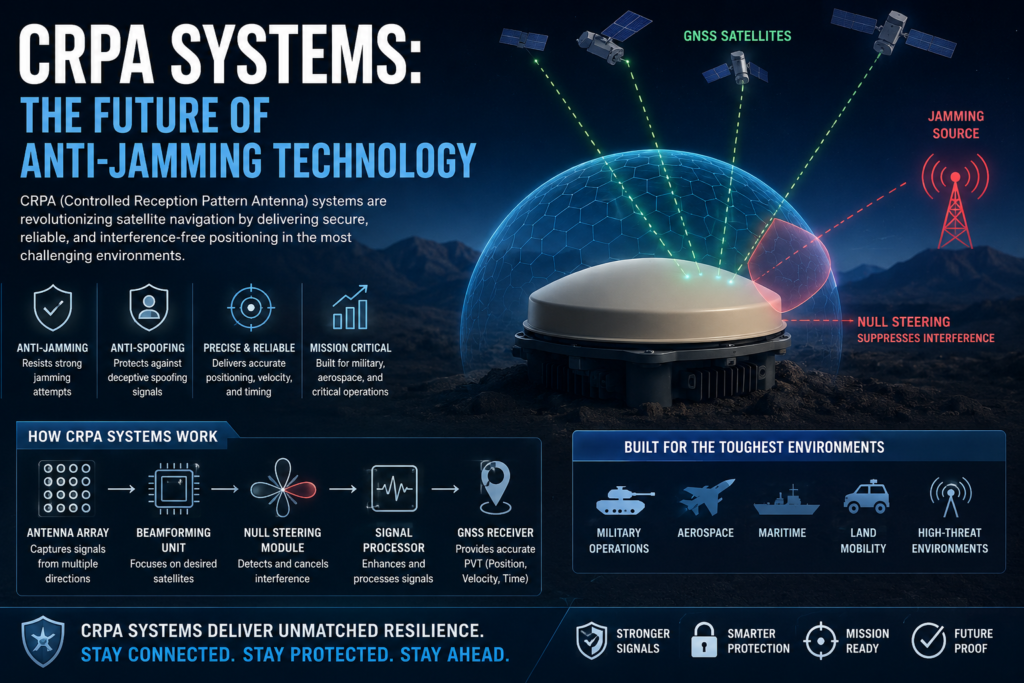
Controlled Reception Pattern Antenna (CRPA) systems are advanced systems of multiple antennas used to protect Global Navigation Satellite Systems (GNSS) receivers from jamming and interference. Unlike standard antennas that receive signals from all directions, CRPA systems can compute which signals to receive and which signals to ignore.
This technology is implemented by modifying the reception pattern of the antenna system. In this way, the system can identify and filter out interference from jamming sources, all while maintaining a reception link to the GNSS satellites.
CRPA systems are utilized in defense, aerospace, maritime, UAVs, and critical operations systems where reliable and constant navigation is a necessity.
Importance of Anti-Jamming Technology
Satellite-based Global Navigation Satellite Systems (GNSS) signals are weak by the time they make it to Earth from thousands of kilometers above. They are vulnerable to disruption from many sources:
- Intentional Attacks
- Spoofing
- Electromagnetic Interference
- Radio Interference
- Electronic Warfare
GPS can be jammed even with low-powered jamming systems over a large area. The disruption of navigation systems can pose a safety and financial risk and cause mission failure for military, commercial, and autonomous operations.
CRPA systems solve this problem by filtering interference and providing reliable PNT services.
How CRPA Systems Work
CRPA systems consist of several elements that capture signals and a processing unit. The unit scans the incoming signals for their direction.
Detected interference is nullified in the pattern through which signals are received, while the system retains gain to the satellites.
Basic Process
- Signals are captured by several antenna elements.
- The signal processor determines the direction of the captured signals.
- Interference is recognized.
- Interference is mitigated through null-steering.
- A signal is received from satellites.
- Navigation is performed accurately.
This system can rapidly respond to a hostile environment due to the real-time processing.
Key Features of CRPA Systems
1. State-of-the-Art Anti-Jamming
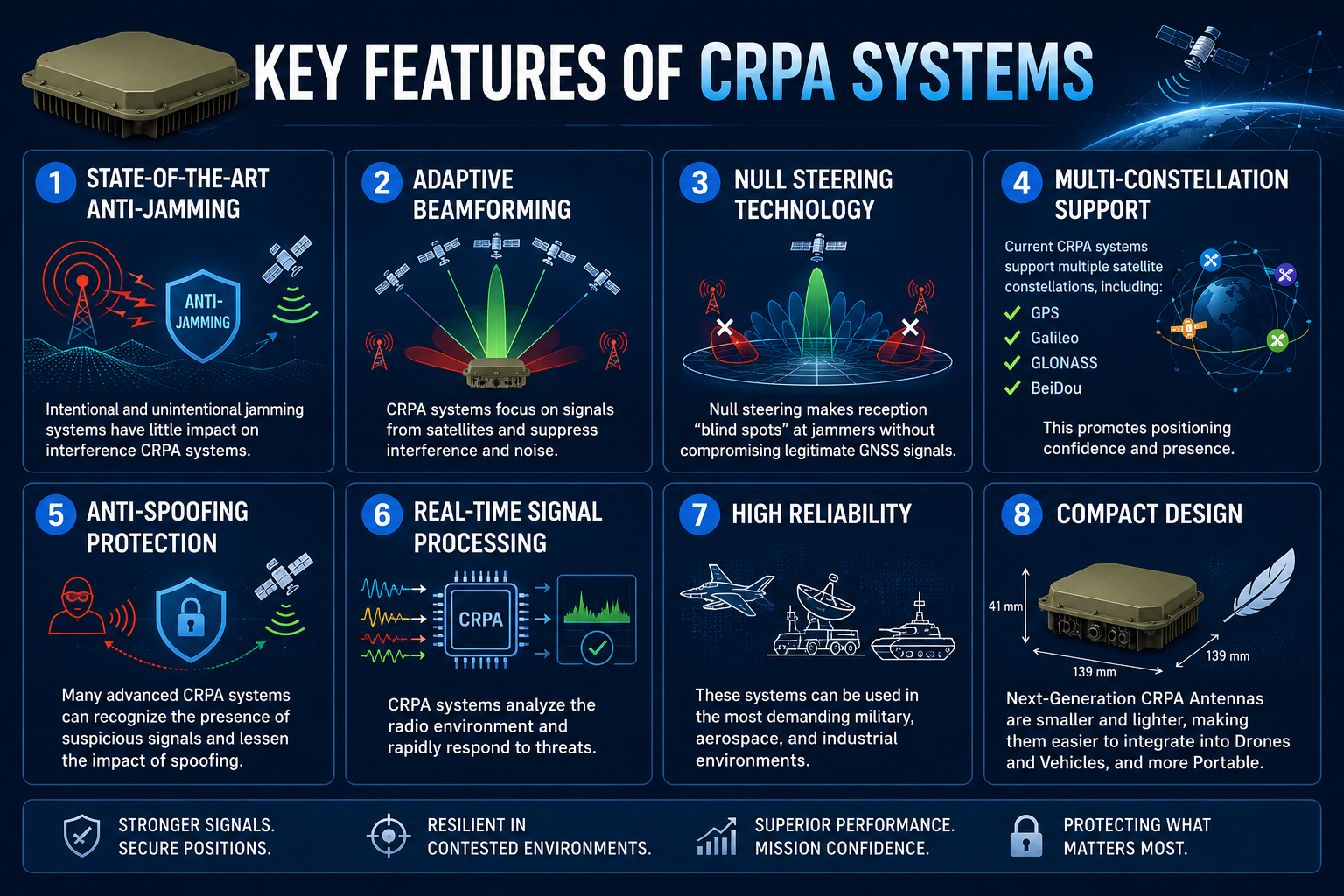
Intentional and unintentional jamming systems have little impact on interference CRPA systems.
2. Adaptive Beamforming
CRPA systems focus on signals from satellites and suppress interference and noise.
3. Null Steering Technology
Null steering makes reception “blind spots” at jammers without compromising legitimate GNSS signals.
4. Multi-Constellation Support
Current CRPA systems support multiple satellite constellations, including:
- GPS
- Galileo
- GLONASS
- BeiDou
This promotes positioning confidence and presence.
5. Anti-Spoofing Protection
Many advanced CRPA systems can recognize the presence of suspicious signals and lessen the impact of spoofing.
6. Real-Time Signal Processing
CRPA systems analyze the radio environment and rapidly respond to threats.
7. High Reliability
These systems can be used in the most demanding military, aerospace, and industrial environments.
8. Compact Design
Next-Generation CRPA Antennas are smaller and lighter, making them easier to integrate into Drones and Vehicles, and more Portable.
Also Read- X2400 VTOL: The Future of Long-Range Drone Technology
CRPA Systems Advantages
1. Improved Navigation Safety
CRPA systems’ sophisticated signal interference countermeasures ensure safe navigation in hostile environments.
2. Improved Mission Success
Military and Commercial activities continue, despite jamming activities.
3. Improved Accuracy
Providing CRPA results in the improved quality of GNSS signals with reduced interference and increased positioning accuracy.
4. Improved Operational Efficiency
Businesses and organizations realize less interruption from CRPA induced signal issues.
5. Reduced Spoofing Threat
CRPA systems’ advanced filtering mechanisms prevent spoofing threats.
6. Improved Situational Awareness
Greater reliability of positioning information aids the decision-making process and improves situational awareness.
7. Support for Automated Systems
The CRPA system’s continuous GNSS support is ideal for Automated Drones, Vehicles, and Robotic Systems.
8. Improved Subsidiary and Opportunity Cost
Preventing navigation system failures improves the organization’s bottom line over time.
CRPA System Components
| Component | Function |
|---|---|
| Antenna Array | Captures GNSS signals coming from different directions. |
| Signal Processor | Processes and applies parameters to the received signals. |
| Beamforming Unit | Directs the antenna array toward satellites of interest. |
| Null Steering Module | Minimizes disturbances caused by jamming signals. |
| GNSS Receiver | Determines position, velocity, and time (PVT). |
| Control Software | Oversees system performance and manages threat control. |
CRPA vs Traditional GNSS Antennas
| Feature | Traditional Antenna | CRPA System |
|---|---|---|
| Anti-Jamming | Only a small amount | Complete protection |
| Anti-Spoofing | Almost none | Highly developed |
| Signal Filtering | Very basic | Advanced |
| Directional Control | None | Dynamic |
| Military Use | Limited | Extensive |
| Interference Resistance | Low | High |
| Operational Reliability | Moderate | Very high |
| Cost | Lower | Higher |
Applications of CRPA Systems
Military and Defense
CRPA systems find applications in:
- Military aircraft
- Naval vessels
- Military ground vehicles
- Missile systems
- Electronic warfare systems
They provide the ability to navigate in hostile environments in which GPS may be jammed.
Unmanned Aerial Vehicles (UAVs)
Modern UAVs depend on GNSS for navigation. CRPA provides jamming protection to UAVs.
Aviation
Commercial and military aircraft provide jamming protection via CRPA.
Maritime Operations
Ships traveling in congested and contested environments gain protection for navigation and positioning.
Critical Infrastructure
Telecommunications, power grids, and financial systems all require precise timing, which CRPA systems provide.
Autonomous Vehicles
Systems that rely on self-navigation, like robotic systems and self-driving cars, are protected using CRPA.
Emerging Trends in CRPA Technology
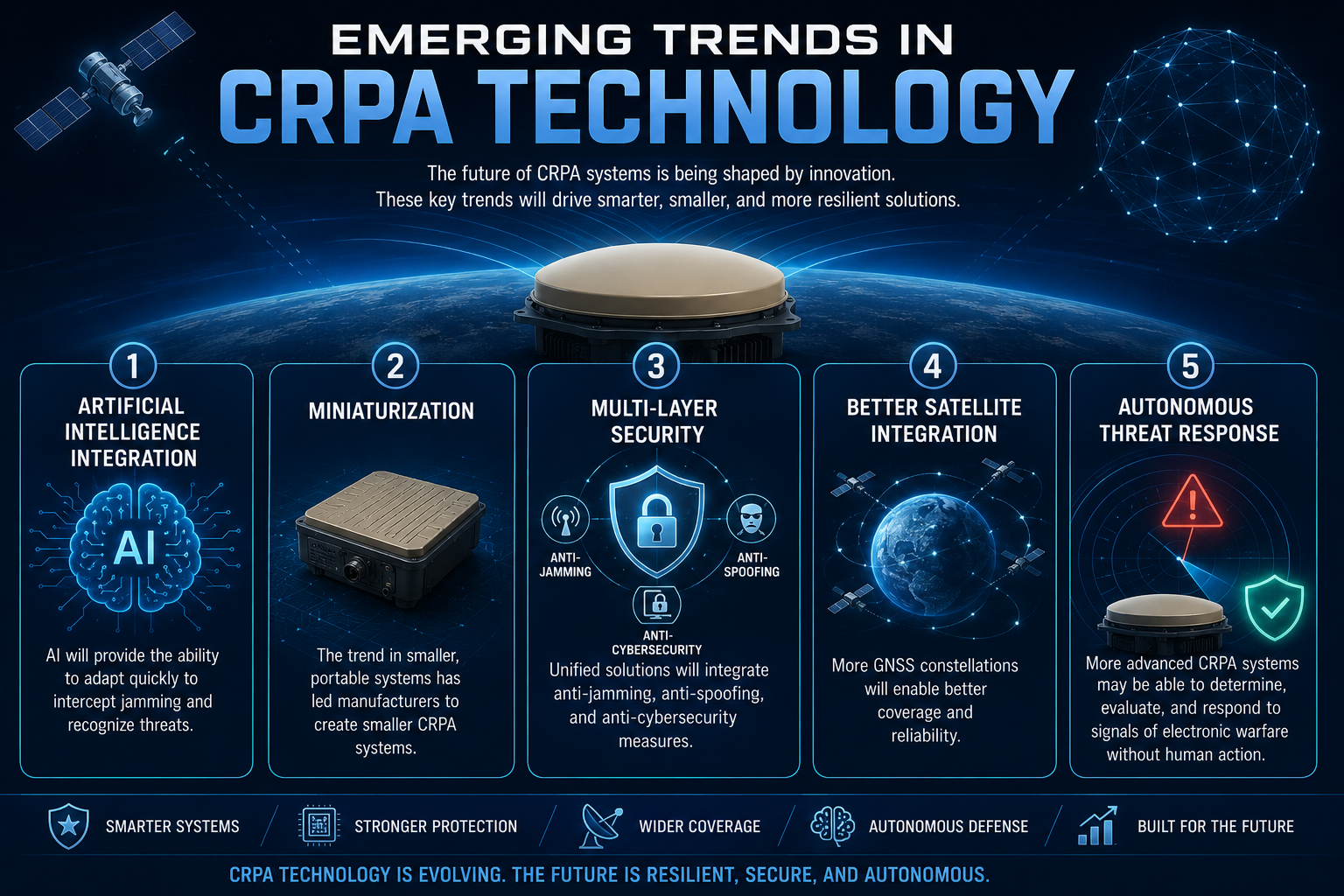
There are a few pathways that dictate the changes for the future of CRPA systems:
Artificial Intelligence Integration
AI will provide the ability to adapt quickly to intercept jamming and recognize threats.
Miniaturization
The trend in smaller, portable systems has led manufacturers to create smaller CRPA systems.
Multi-Layer Security
Unified solutions will integrate anti-jamming, anti-spoofing, and anti-cybersecurity measures.
Better Satellite Integration
More GNSS constellations will enable better coverage and reliability.
Autonomous Threat Response
More advanced CRPA systems may be able to determine, evaluate, and respond to signals of electronic warfare without human action.
Drawbacks of CRPA Systems
There are some disadvantages to CRPA systems, even with the benefits.
- Higher up-front costs
- Greater complexity in the system
- Increased energy costs
- Need to integrate with legacy systems
- Greater need for specialized skills and maintenance
Many of these obstacles will diminish as technology continues to advance.
Future of CRPA Systems
The future of defense systems like autonomous vehicles, smart cities, and advanced urban defense is going to integrate highly adaptable, resilient navigation technology systems. As we advance into this future, the growing dependence on GNSS means the growing need to protect these systems.
CRPA systems will be standard in the most critical applications. The continued development of miniaturization, artificial intelligence, and advanced signal processing will safeguard CRPA systems against electronic threats for even longer.
Many organizations will integrate CRPA systems into their infrastructure as a tool to ensure access to positioning and timing services.
Conclusion
CRPA Systems are one of the leading defense systems against jamming and include multiple systems such as adaptive beam-forming and nulling to protect GNSS from being jammed and spoofed.
With technology evolving, CRPA systems will be vital. For military operations and commercial navigation systems, CRPA technology will be the basis of all secure, reliable positioning services. CRPA systems will take anti-jamming, resilient navigation technology to a whole new level.
Frequently Asked Questions
1. What is CRPA?
CRPA is an acronym for Controlled Reception Pattern Antenna, a resistance jamming technology in GNSS antennas.
2. How does a CRPA system resist jamming?
CRPA systems utilize several antenna elements along with sophisticated signal processing to recognize jamming and to create nulls in the direction of the jamming while still receiving data from legitimate satellites.
3. Where can CRPA systems be found?
Military aircraft, ships, unmanned aerial vehicles, autonomous vehicles, and a majority of critical infrastructures utilize CRPA systems.
4. Can CRPA systems resist attempts at jamming and spoofing?
Yes. Most advanced CRPA systems can detect spoofing and jamming of GNSS signals and will reject these signals.
5. Can CRPA systems receive signals from all satellite systems?
Yes. Most CRPA systems are advanced enough to use signals from the GPS, Galileo, GLONASS, and BeiDou constellations.
6. Why are CRPA systems important for Drones?
Drones are dependent on GNSS navigation. CRPA technology enables the continuous reliable positioning of drones navigation, even in the presence of jamming and interference.