Mori3 Robot: The Shape-Shifting Robot Redefining the Future of Robotics
+
Table of Contents
- 1 What is Mori3 Robot?
- 1.1 How Does Mori3 Robot Operate?
- 1.1.1 1. Assessment of the Environment
- 1.1.2 2. Reconfiguration of the Shape
- 1.1.3 3. Performance of the Task
- 1.2 What are the Features of Mori3 Robot?
- 1.2.1 1. Transforming Capability
- 1.2.2 2. Modularity
- 1.2.3 3. Autonomous Reconfiguration
- 1.2.4 4. Compact Storage
- 1.2.5 5. Advanced Sensors
- 1.2.6 6. Multi-Functional Operation
- 1.2.7 7. Space Exploration Potential
- 1.2.8 8. Scalability
- 2 Mori3 Robot Specifications Overview
- 3 Potential Applications of Mori3
- 3.1 Space Exploration
- 3.2 Search and Rescue Operations
- 3.3 Military and Defense
- 3.4 Scientific Research
- 3.5 Complexity of Control Systems
- 3.5.1 Frequent Morphing
- 3.5.2 Mechanical Fatigue
- 3.5.3 Financial Investment
- 3.5.4 Hurdles in Modularity
- 3.6 What’s Coming in Modular Robotics
- 3.7 What’s the Importance of Mori3
- 4 Conclusion
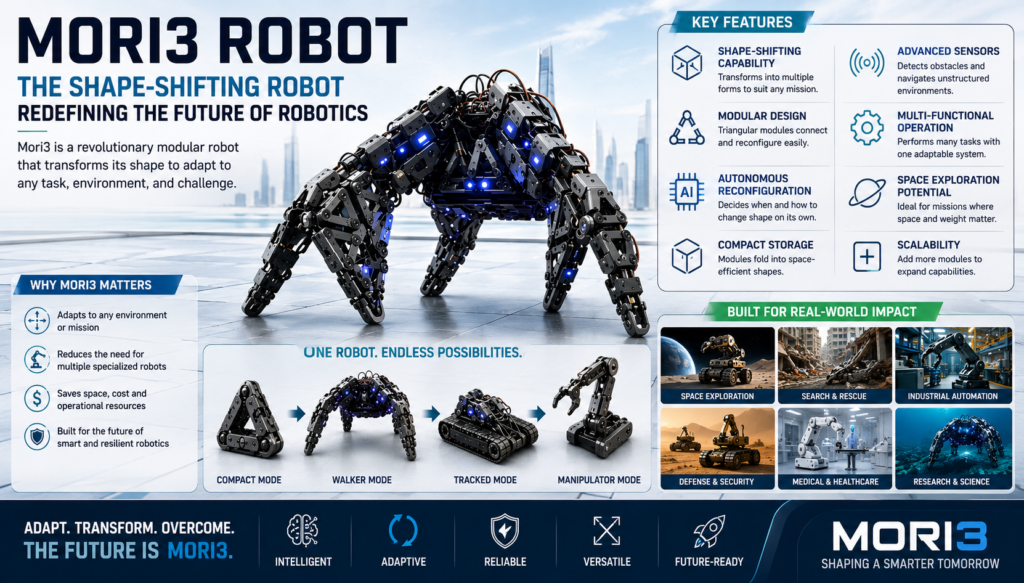
Robot technology has come a long way in a small number of years. Robots have gone from being simple machines to being complex and intelligent systems. One of the more recent advancements in the field is the Mori3 Robot, a shape-shifting modular robot designed by the researchers at the École Polytechnique Fédérale de Lausanne (EPFL) in Switzerland. Unlike the majority of robots which are designed for a single purpose, Mori3 can change form, structures, and can adapt to the environments and tasks that are design for it.
Mori3 is made of modular, triangular units that allow it to change its design, restricting it to a single purpose, like being a walker, a robotic arm, or a tracked vehicle. With the combination of flexibility, optimum design, and advanced engineering, Mori3 is a giant leap into the design of the future of robots. Here, we explain Mori3 in all its glory, from how it works to its basic features, advantages, probable uses, and the impact it will have in the design of the future of robots.
What is Mori3 Robot?
By design, Mori3 is a self-reconfigurable modular robot that is shape changeable to flexible tasks. The design of traditional robots makes them inflexible and restricts their ability to satisfy a multitude of tasks. Mori3 modular design approach is one of the solutions to this problem. The triangular units of Mori3 can rotate, move, and connect in design in flexible ways.
Each Module of Mori3 is independent, each of which can build different robotic configurations. For instance, Mori3 can become any of the following:
- A robot that walks to traverse over uneven surfaces
- A robotic arm to conduct physical tasks
- A robot that travels using tracks
- A custom structure to accomplish a unique objective
The flexibility to transform gives Mori3 an advantage over traditional robotics systems and allows it to operate in places where other robotics systems cannot.
How Does Mori3 Robot Operate?
Modularity is the fundamental principle of design for Mori3. The core of the robot is comprised of unit blocks that are triangular in shape, each having integrated motors, sensors, and a communication interface.
The operation is in three steps:
1. Assessment of the Environment
Sensors acquire data pertaining to the environment. The system then determines the optimal configuration of the robot.
2. Reconfiguration of the Shape
The modules of the robot then rotate and reposition themselves to the new configuration.
3. Performance of the Task
The robot will then perform the task in the new configuration.
The robot can also change its shape multiple times in the case that the objective is modified.
What are the Features of Mori3 Robot?
1. Transforming Capability
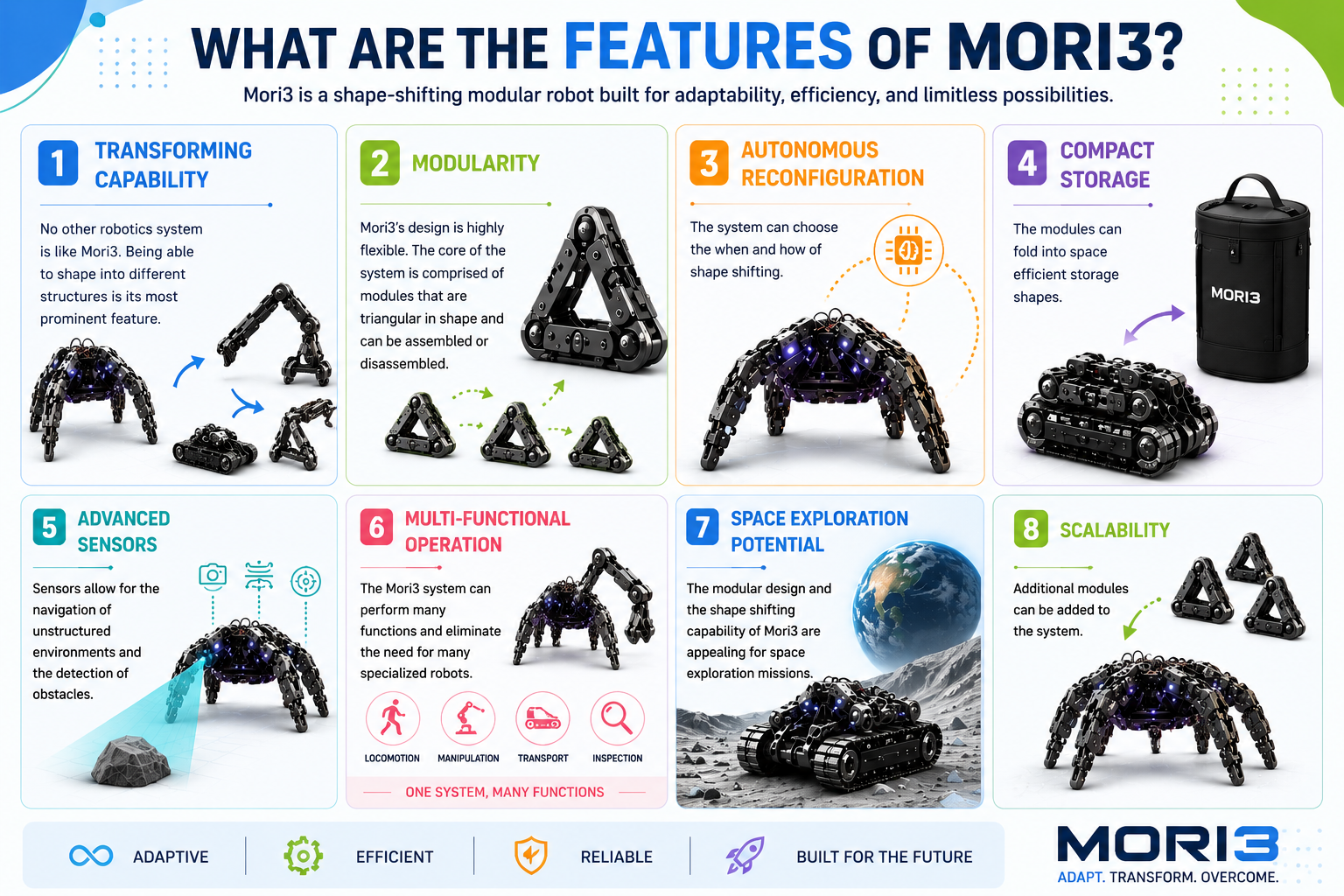
No other robotics system is like Mori3. Being able to shape into different structures is its most prominent feature.
2. Modularity
Mori3’s design is highly flexible. The core of the system is comprised of modules that are triangular in shape and can be assembled or disassembled.
3. Autonomous Reconfiguration
The system can choose the when and how of shape shifting.
4. Compact Storage
The modules can fold into space efficient storage shapes.
5. Advanced Sensors
Sensors allow for the navigation of unstructured environments and the detection of obstacles.
6. Multi-Functional Operation
The Mori3 system can perform many functions and eliminate the need for many specialized robots.
7. Space Exploration Potential
The modular design and the shape shifting capability of Mori3 are appealing for space exploration missions.
8. Scalability
Additional modules can be added to the system.
Mori3 Robot Specifications Overview
| Feature | Details |
|---|---|
| Developer | EPFL (École Polytechnique Fédérale de Lausanne) |
| Robot Type | Modular Shape-Shifting Robot |
| Structure | Triangular Modular Units |
| Transformation Ability | Yes |
| Autonomous Reconfiguration | Yes |
| Navigation System | Sensor-Based |
| Applications | Space, Industry, Defense, Research |
| Scalability | High |
| Storage Efficiency | Excellent |
| Adaptability | Very High |
Benefits of Mori3 Robot
1. Exceptional Versatility
Mori3 can perform many functions and eliminates the needs for traditional systems. This decreases operational costs.
2. Improved Space Efficiency
The ability to fold into smaller configurations means that the Mori3 robot system uses less space than other robotic systems.
3. Cost Reduction
The adaptable design means that many different systems do not need to be purchased.
4. Enhanced Mission Success
The ability to adapt means that the system can function in a greater number of environments increasing the probability for mission success.
5. Better Resource Utilization
Mori3 uses the available hardware with a greater degree of transformation than other systems.
6. Increased Durability
The remaining units can maintain system functionality even if one module is faulty.
7. Ideal for Use in Remote Environments
Mori3 is adaptable, which is beneficial in places where human presence is limited.
8. Built to Last
It will be possible to integrate new modules into the system to increase functionality as technology improves.
Potential Applications of Mori3
Space Exploration
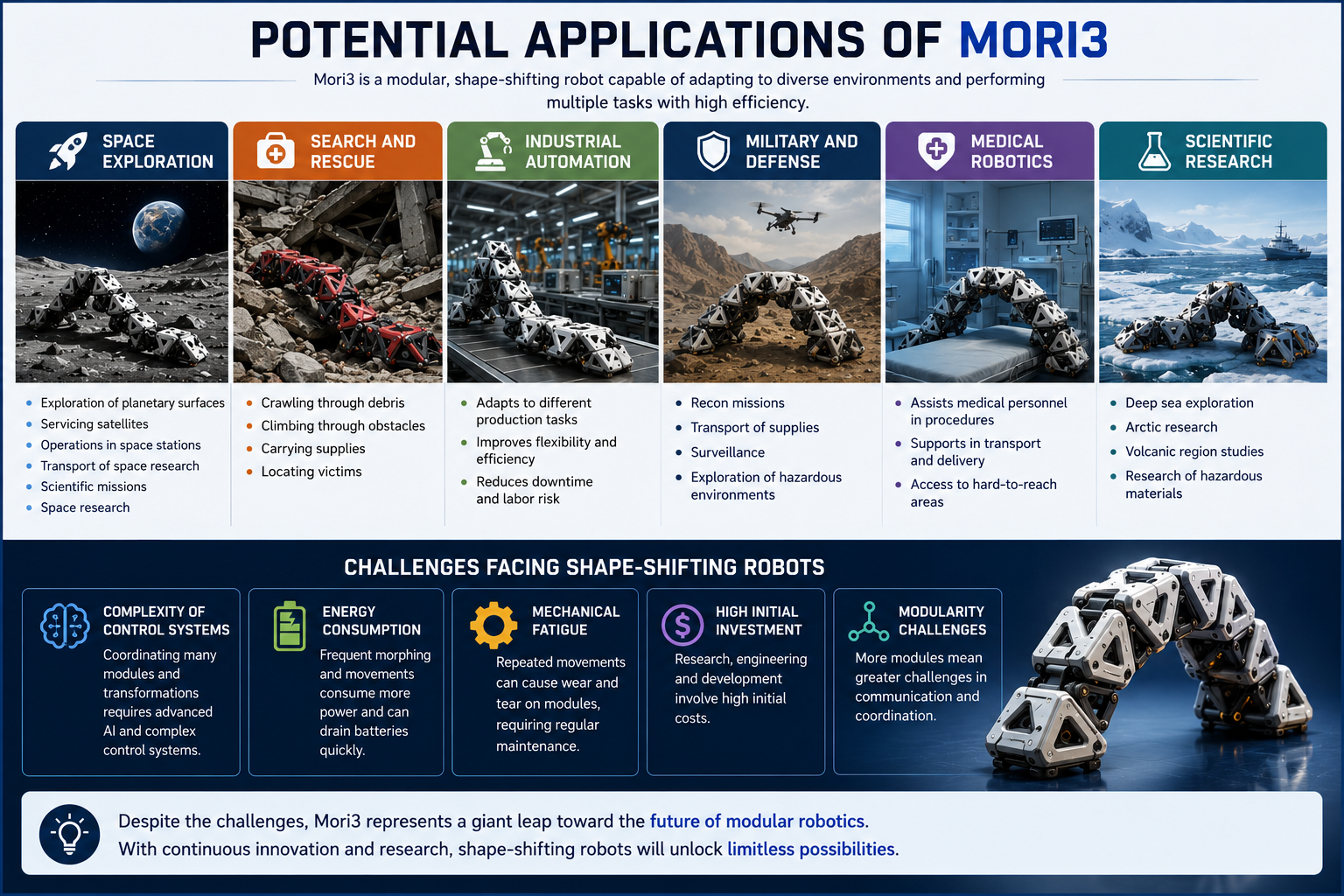
Storage and weight restrictions in space are severe. To resolve this issue, Mori3 would take up little space and have a multiplicity of functions.
Potential space functions are:
- Exploration of planetary surfaces
- Servicing satellites
- Operations in space stations
- Transport of space research
- Scientific missions
- Space research
- Search and Rescue
Search and Rescue Operations
Mori3 can form different shapes to cary out substantially different functions in obstructed environments where traditional robots cannot traverse.
Some of these functions are:
- Crawling through debris
- Climbing through obstacles
- Carrying supplies
- Locating victims
- Industrial Automation
The flexibility of Mori3 can adapt to different production tasks and improve efficiency.
Military and Defense
Transformable robots would be useful in:
- Recon missions
- Transport of supplies
- Surveillance
- Exploration of hazardous environments
- Medical Robotics
Transforming modular robots may come to the aid of medical personnel in different procedures and support functions.
Scientific Research
Mori3 can be utilized for scientific research in environments such as:
- The deep sea
- The arctic
- Volcanic regions
- Research of hazardous materials
- Challenges Facing Shape-Shifting Robots
While Mori3 is an important step in the development of shape-shifting robots, many obstacles remain.
Complexity of Control Systems
The integration of many modules and the coordination of alterations require control systems of great complexity and advanced artificial intelligence.
Frequent Morphing
Electric consumption is a concern since frequent shape changes can drain batteries quickly.
Mechanical Fatigue
Modules can experience fatigue after repetitive movement resulting in a possible need for maintenance.
Financial Investment
Research and engineering make up a bulk of initial costs for the latest robotics.
Hurdles in Modularity
With more modules comes a greater challenge for both communication and coordination.
Restructured robotics may still have many challenges, but the future of modular robotics will improve even more with all the dedicated research.
What’s Coming in Modular Robotics
This early stage of Mori3 will see a lot of advanced changes in robotics, including:
- robots that can think for themselves
- modules that can repair themselves
- better batteries
- Swarm and Collaborative Robotics
- Robotics that use advanced learning
With a vast array of industries including manufacturing and healthcare, space robotics and even disaster robotics, shape-changing robots will become more prevalent. Flexible and adaptable robots will become the go to automation.
Also Read- Atlas & Talon: India’s Drone Power Transforming Modern Warfare
What’s the Importance of Mori3
Mori3 is significant in so many ways, including how it can disrupt the world. Instead of separate robots for every possible application, each system can be designed to be adaptable. This will save costs, improve performance, and help realize new ideas.
Mori3 proved to the world that it is possible for robots to physically change their structure, and therefore, new ways to think about design and purpose for robotics.
Conclusion
Mori3 is cutting-edge modular robotics. Its modularity, autonomy, and adaptability combine to solve many challenges across multiple domains. Spaces, industries, and applications from the unknowns of the cosmos to the rupture zones of disasters, from robotic frameworks to the forefront of research and science, are all aided by the flexibility of Mori3 and robotics.
As flexibility in design and technology grows, so do the visions of different forms and functions. Mori3 embodies this different thinking by combining all the advanced design and technology of robotics to bring flexible, adaptable, and highly intelligent frameworks and systems. All this will allow Mori3 to answer the demands of any space and purpose.
Frequently Asked Questions
1. What is Mori3?
Mori3 is a shape-shifting modular robot made by EPFL that can restructure itself to different robotic shapes to complete different tasks.
2. How does Mori3 change its shape?
The robot consists of triangular modules that are interconnected. These can rotate and change position to create new arrangements.
3. What makes Mori3 different from traditional robots?
Traditional robots have a fixed structure. Mori3 can transform into many forms and perform many tasks, all with the same robot.
4. Who developed Mori3?
Mori3 was made by researchers in the École Polytechnique Fédérale de Lausanne (EPFL), Switzerland.
5. Is Mori3 fully autonomous?
While it isn’t fully autonomous, Mori3 does have the ability to change its form by itself to some extent.
6. What is the future of shape-shifting technology?
The next generation of such technology will combine with advanced artificial intelligence, have varying self-repair, and energy systems as well as be used widely across multiple industries.