Artificial Intelligence and Automation: Building a Smarter Future
+
Table of Contents
- 1 What is Artificial Intelligence?
- 1.1 What is Automation?
- 1.2 Comparison Table of Artificial Intelligence and Automation
- 1.3 Automated Assembly Lines
- 1.4 AI plus automation creates intelligent systems.
- 2 AI and Automation Applications by Industry
- 2.1 Healthcare
- 2.2 Manufacturing
- 2.3 Finance
- 2.4 Retail and eCommerce
- 2.5 Agriculture
- 2.6 Transportation
- 3 Advantages of AI and Automation
- 3.1 Increased Productivity
- 3.2 Improved Accuracy
- 3.3 Cost Savings
- 3.4 Better Decision-Making
- 3.5 Enhanced Customer Experience
- 3.6 24/7 Operations
- 3.7 Challenges and Concerns
- 3.8 Job Displacement
- 3.9 Data Privacy
- 3.10 Bias in Algorithms
- 3.11 Cybersecurity Risks
- 3.12 The Importance of Machine Learning in Automation
- 4 The Future of AI and Automation
- 4.1 Generative AI
- 4.2 Autonomous Systems
- 4.3 Smart Cities
- 4.4 Working Alongside AIs
- 4.5 Edge AI
- 4.6 AI to Personalize Learning
- 5 Why it is Worth Investing in AI and Automation
- 6 In conclusion
- 6.1 Frequently Asked Questions (FAQs)
- 6.1.1 1. What is Artificial Intelligence (AI)?
- 6.1.2 2. What is Automation?
- 6.1.3 3. What are the distinctions between AI and automation?
- 6.1.4 4. In which sectors can AI and automation be most disruptive?
- 6.1.5 5. What are the impacts of AI on employment prospects?
- 6.1.6 6. What is meant by automation enhanced by AI?
- 6.1.7 7. Is AI a secure technology?
- 6.1.8 8. What are the expected challenges and opportunities in AI and automation?
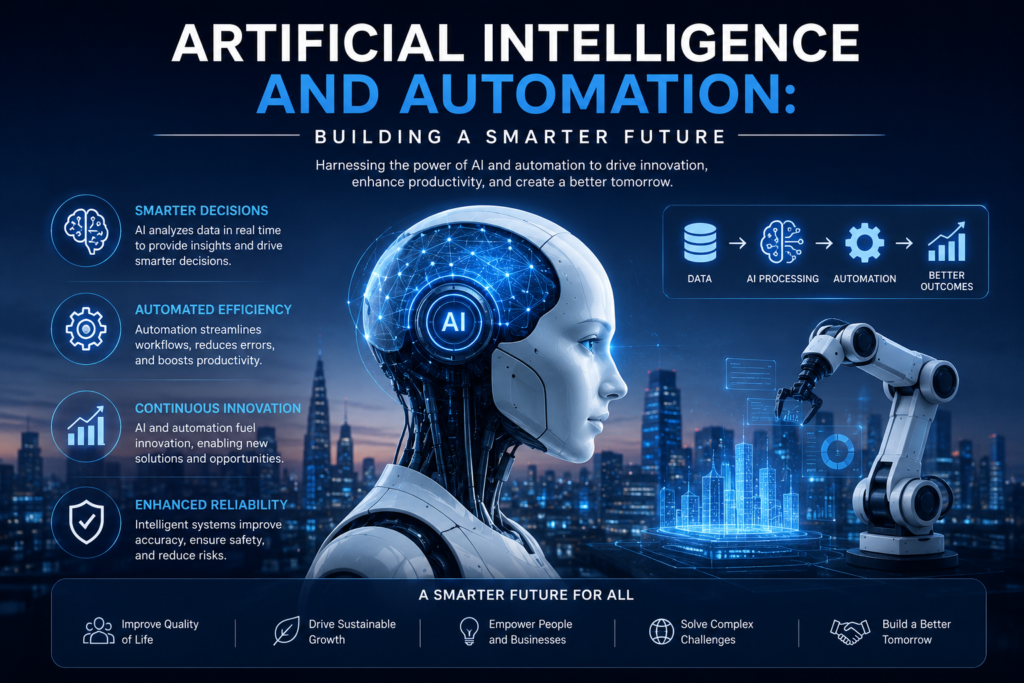
Artificial Intelligence and Automation are redefining the ways humans communicate with machines and even with one another. Additionally, optimized AI is the driving force behind the automation of self-driving cars, virtual and augmented realities, smart factories, predictive healthcare, and robotic assistants. For enhanced connectivity in future societies aimed at higher efficiency, workplaces are seeking to adopt integrated AI and automation systems.
AI has the capability of rapid integration into many different sectors and fields. The incentive to adopt AI in manufacturing, healthcare, education, finance, agriculture, transportation, and retail is derived from the efficiency improvements that result from the implementation of AI. The advent and widespread adoption of such technologies will enhance the global economy and uplift the general living standards of the populace.
What is Artificial Intelligence?
Artificial Intelligence encompasses systems that are capable of performing cognitive tasks such as:
- Learning from data
- Problem-solving
- Decision-making
- Understanding and interpreting language
- Recognizing an image
- Identifying patterns
There are a number of AI applications. AI systems employ algorithms and a variety of models to perform tasks, analyze data, and generate solutions.
Examples of AI applications include:
- Digital personal assistants (Siri, Google Assistant)
- Chatbots
- Recommendation systems
- Self-driving vehicles
AI systems have unprecedented speed and superior processing and storage capabilities compared to traditional systems.
What is Automation?
Automation is a technology utilized in systems to perform tasks with minimal human control, contact, or involvement. Such systems can make decisions and perform tasks with speed and reproducible accuracy, which was previously thought to be the sole domain of humans.
Here are some samples of automation:
- Automated Payment Systems
- Automated Email Marketing
- Automated Smart Home Systems
- Automated Warehouse Robotics
- Manufacturing Automation
With the power of AI, automation takes on new forms. The more complex tasks automation can tackle, the better it can learn and adapt.
Comparison Table of Artificial Intelligence and Automation
Even though AI and automation serve specific functions, they are still dependent on one another.
| Feature | Artificial Intelligence (AI) | Automation |
|---|---|---|
| Purpose | Replicates human reasoning and intelligence | Performs tasks without human intervention |
| Learning Ability | Improves through learning and data analysis | No learning capability; follows predefined rules |
| Decision-Making | Non-linear, adaptive, and improvised | Pre-determined and rule-based |
| Flexibility | Very high | Limited |
| Examples | Image analysis, virtual personal assistants, chatbots, predictive analytics | Assembly lines, robotic process automation (RPA), automated billing systems, workflow automation |
Automated Assembly Lines
AI paired with automation certainly can create systems that can make intelligent decisions, rather than simply taking a preset course of action.
AI plus automation creates intelligent systems.
Automation is great for a set of mundane, repetitive tasks that it can do exceptionally well, but the decisions it makes are nonexistent. AI enhances that. This combination can lead to:
- Automated business process analytics
- Analyzing data to find trends
- Finding anomalies
- Optimizing processes
Developing strategies to improve business operations and customer satisfaction
Consider a customer service automation system. It can further enhance the system’s efficiency and lower its costs, while also providing better customer satisfaction, if an AI chatbot is set up to serve customer requests.
AI and Automation Applications by Industry
Healthcare
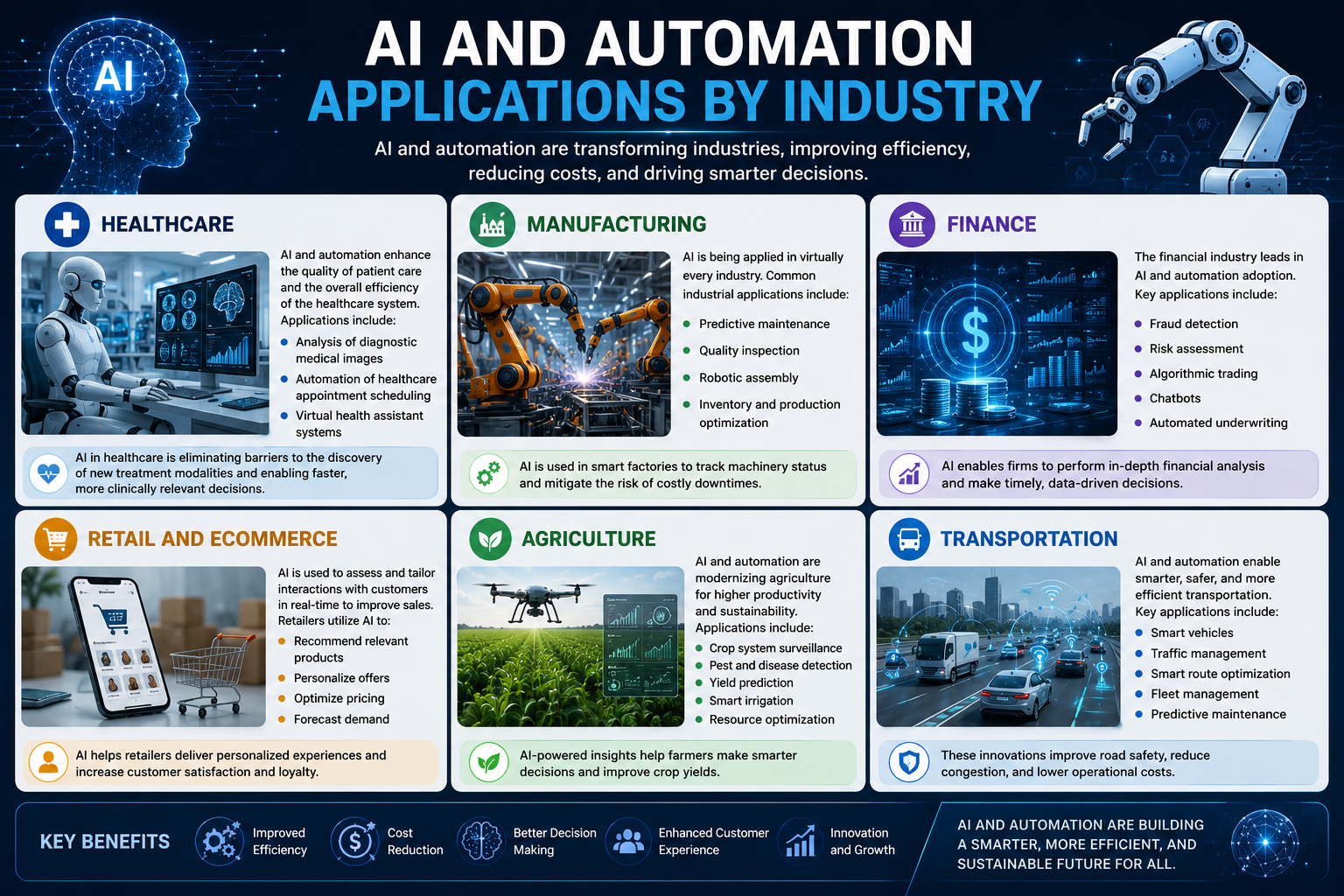
AI and automation enhance the quality of patient care and the overall efficiency of the healthcare system. Applications of AI and automation in healthcare systems include:
- Analysis of diagnostic medical images
- Automation of healthcare appointment scheduling
- Virtual health assistant systems
AI in healthcare is also starting to eliminate the barriers to the discovery of new treatment modalities. There is no doubt that new and improved solutions to diagnostic problems are being created by AI and will enable faster and more clinically relevant decisions than what is currently possible by clinicians.
Manufacturing
AI is being applied in virtually every industry. Some of the more common industrial applications include predictive maintenance, quality inspection, robotic assembly, and inventory and production optimization. AI is also used in smart factories to track the operational status of machinery to mitigate the risk of sustaining costly downtimes.
Finance
The financial industry is the most advanced in terms of AI and automation utilization in services such as fraud detection, risk assessment, algorithmic trading, chatbots, and automated underwriting. AI enables financial services firms to improve their offerings by conducting more in-depth analyses of financial performance and making timely decisions.
Retail and eCommerce
AI is used in retail and eCommerce to assess and tailor interactions with customers in real-time to improve sales. Retailers can utilize AI to suggest the most relevant products to customers based on their purchasing histories.
Agriculture
The agricultural sector is also experiencing high levels of automation with the use of AI and smart automation technologies for crop system surveillance and advanced pest detection.
Transportation
AI and automation in the transport industries allow for smart vehicles, controlled traffic management, smart route and fleet management. All these innovations make transport safer and more efficient, and drive down costs.
Advantages of AI and Automation
Increased Productivity
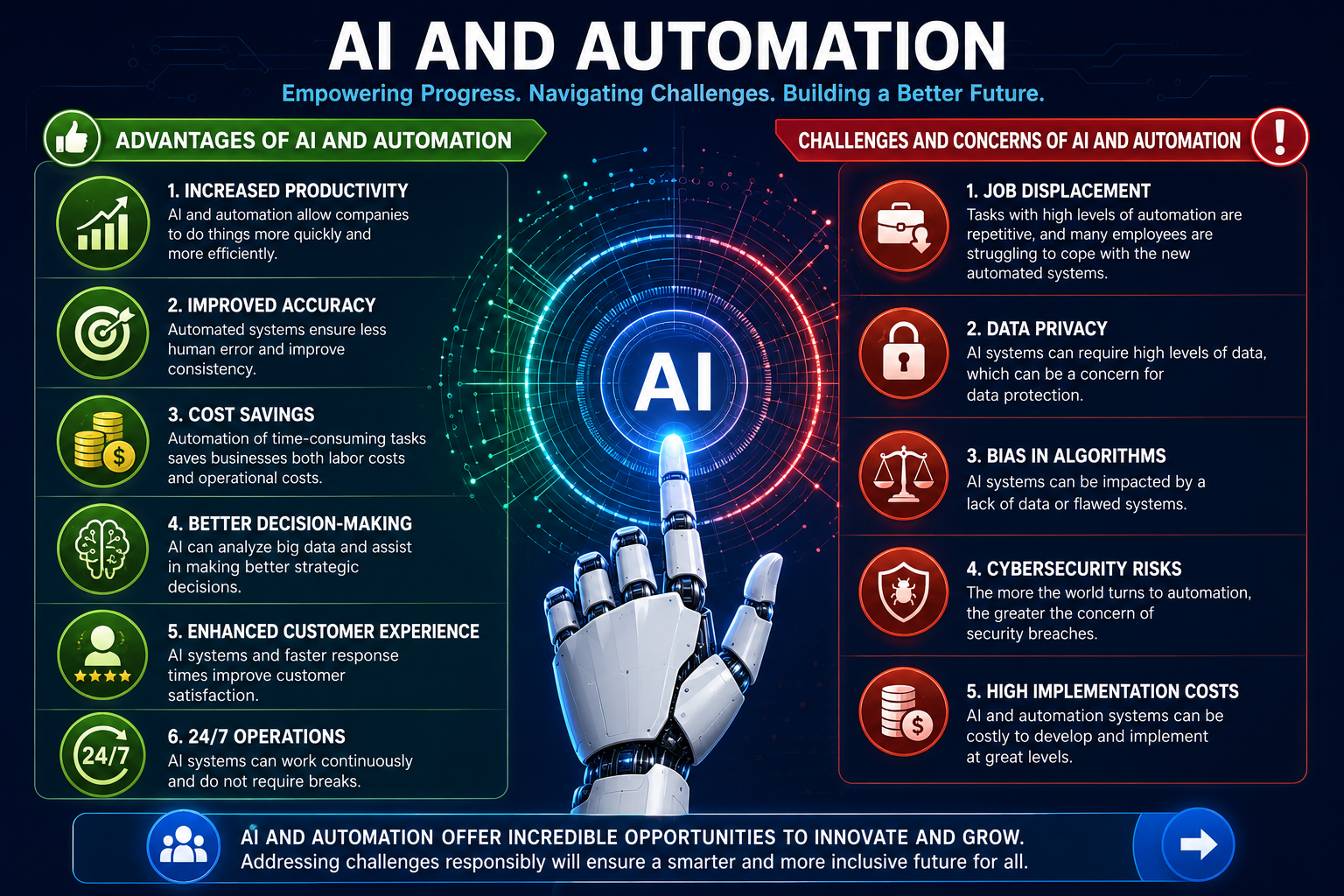
AI and automation allow companies to do things more quickly and more efficiently.
Improved Accuracy
Automated systems ensure less human error and improve consistency.
Cost Savings
Automation of time-consuming tasks saves businesses both labor costs and operational costs.
Better Decision-Making
AI can analyze big data and assist in making better strategic decisions.
Enhanced Customer Experience
AI systems and faster response times improve customer satisfaction.
24/7 Operations
AI systems can work continuously and do not require breaks.
Challenges and Concerns
AI and automation accomplish great things, but there are challenges associated with their use.
Job Displacement
Tasks with high levels of automation are repetitive, and many employees are struggling to cope with the new automated systems.
Data Privacy
AI systems can require high levels of data, which can be a concern for data protection.
Bias in Algorithms
AI systems can be impacted by a lack of data or flawed systems.
Cybersecurity Risks
The more the world turns to automation, the greater the concern of security breaches.
AI and automation systems can be costly to develop and implement at great levels.
Also Read- Yufei S100 eVTOL: Experience the Thrill of Ultimate Low-Altitude Flight
The Importance of Machine Learning in Automation
Machine Learning is artificial intelligence that allows a program to learn from data over time, without staying within the limits of preset instructions.
How is Machine Learning important in automation? Intelligent automation systems use algorithm-driven models for:
- Detecting patterns
- Predicting possible future events
- Changing behavior to improve performance
- Creating adaptations for different situations
There are various examples of systems, the most common being:
- Detecting fraudulent activities
- Recognizing a person by their voice
- Maintaining equipment promptly
- Providing automated suggestions to customers
- Machine Learning is revolutionizing almost all of the business sectors.
The Future of AI and Automation
AI and automation technologies are in the early stages of their development.
Generative AI
AI simplifies the process of producing text, images, videos, music, and even programming code. This propels the user’s creativity and enhances productivity.
Autonomous Systems
Vehicles, drones, and robots that can independently carry out tasks without human involvement are becoming more reliable.
Smart Cities
AI will make better use of public services and resources, making it easier to control traffic and use energy.
Working Alongside AIs
Rather than making human workers redundant, AI systems will be designed to augment human capabilities.
Edge AI
AI systems on devices will help to perform tasks quickly and securely.
AI to Personalize Learning
Creating more opportunities for individualized learning systems will allow students to progress at their own pace with the assistance of automated learning aids.
These systems will make a positive impact on the quality of life.
Why it is Worth Investing in AI and Automation
The investment in AI is being touted as a potential transformative event, and the return on the investment is clear.
Providing the supporting argument or rationale for the case includes:
- Greater efficiencies
- Expedited designs
- Improved customer service
- Enhanced data insights
- Higher profits
Automation and AI Integration will aid organizations in gaining a sustainable edge and a stronger presence in the digital marketplace.
In conclusion
The impact of Automation and AI on Industrial Systems and Economies is considerable. These systems positively change the way Organizations and Institutions operate and conduct business. They help Organizations and Institutions improve the efficiency of their operations and their ability to provide a greater and better range of services to their customers based on intelligent, automated insights. Automation and AI systems impact and change all areas of the Economies and Industries of the World.
Given the clear benefits, the concerns about the loss of some jobs and data privacy and security will fade in time. Automation and AI Integration will transform Industries and Economies to the benefit of both Businesses and Society.
Frequently Asked Questions (FAQs)
1. What is Artificial Intelligence (AI)?
It is a subset of computer science in which the focus is on computer systems that are designed to perform tasks that, in the past, some of the capabilities of human intelligence have been used. For example, computers that are designed to perform tasks in which human learning, human reasoning, or human judgement are used.
2. What is Automation?
Completion of tasks by computer systems, especially tasks that are performed repeatedly, with little or no human intervention.
3. What are the distinctions between AI and automation?
AI offers depth and reasoning as it can recognize patterns and form complex answers. Automation, on the other hand, follows a repetitive set of commands.
4. In which sectors can AI and automation be most disruptive?
AI and automation can be seen incorporated into the healthcare, manufacturing, finance, retail, agriculture, transport, and education sectors.
5. What are the impacts of AI on employment prospects?
As AI progresses, employment opportunities will be concentrated in the domains of human creativity, judgment, and oversight.
6. What is meant by automation enhanced by AI?
Tasks, judgments, and decisions of a complex nature can be automated and augmented by AI.
7. Is AI a secure technology?
If AI is developed with ethical and privacy concerns, and with a balance of safety measures and transparency, it can be a secure technology.
8. What are the expected challenges and opportunities in AI and automation?
We will see highly sophisticated autonomous systems and developments in generative AI with greater personalization, which will result in smart cities with built-out infrastructure. It is anticipated that there will be greater integration and more collaboration between human beings and intelligent machines.