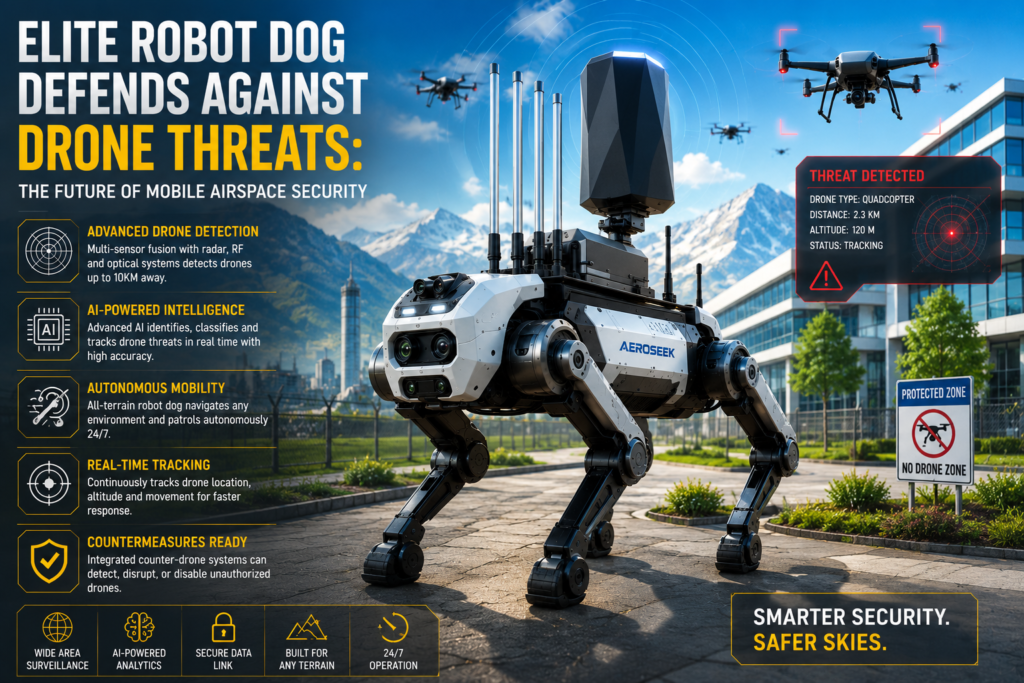
Elite Robot Dog Defends Against Drone Threats: The Future of Mobile Airspace Security
+
Table of Contents
- 1 THE NEED FOR ANTI-DRONE TECHNOLOGY
- 2 What is an Elite Robot Dog?
- 2.1 Key Features of an Elite Robot Dog
- 2.1.1 1. Long Range Drone Detection
- 2.1.2 2. AI-Powered Identification
- 2.1.3 3. Mobile Surveillance Platform
- 2.1.4 4. Real-Time Tracking
- 2.1.5 5. Autonomous Operation
- 2.1.6 6. Counter-Drone Integration
- 2.2 Applications Across Different Industries
- 2.2.1 Better Security Coverage
- 2.2.2 Speedy Threat Action
- 2.2.3 Lower Risk to Personnel
- 2.2.4 Better use of Security Resources
- 2.2.5 Consistent Monitoring
- 2.2.6 Enhanced Threat Intelligence
- 2.2.7 Cross-Industry Applications
- 2.2.8 Military Bases
- 2.2.9 Airports
- 2.2.10 Critical Infrastructure
- 2.2.11 Border Protection
- 2.2.12 Public Security
- 3 Feature Comparison Table
- 4 Conclusion
Security experts are adjusting to a new set of challenges with the rise of commercial and recreational drones. Drones can play a beneficial role in the economy and in our daily lives. However, they can be used for surveillance and other illicit activities. For this reason, advanced counter-drone systems that can detection, track, and engage drones are entering the market.
Mobile Airspace Security combines defense against drones, detection systems, autonomous movement, and tracking systems. Mobile Airspace Security is a robotics, artificial intelligence, and counter-drone systems hybrid. It is a new robotics solution for the operational needs of modern security.
This article examines how Elite Robot Dog Mobile Airspace Security works, what its primary functions are, its advantages, and its role in the future of security.
THE NEED FOR ANTI-DRONE TECHNOLOGY
Drones have the potential to be used for beneficial activities in many different industries, like photography, agriculture, logistics, and emergency response, and even defense. However, their low cost and easy access can play a detrimental role to security. Drones can enter no-fly zones, and sensitive and critical infrastructure. They can also carry harmful payloads.
Current security systems have a hard time addressing the threats that drones pose. Passive systems, like a fixed surveillance camera or a stationary sensor, may not be able to cover a large enough area. This is especially true for large, open, and unobstructed areas. For these reasons, Mobile Airspace Security is especially useful.
Robotic security systems combine mobility and smart detection systems to traverse large areas while watching the skies for open threats.
What is an Elite Robot Dog?
An elite robot dog is a technology that functions on land and has the ability to travel on most terrains. Elite robot dogs are the animal counterparts of robots and are used to transport technology such as advanced sensors and communication devices. These robots have the ability to traverse some of the most difficult and inaccessible terrains where regular robots are unable to travel.
When an Elite Robot Dog Defends Against Drone Threats, it serves the purpose of a mobile security unit with the ability to detect unusual behavior of drones and provide security workers with the information they need in the moment.
Systems of this kind are highly useful and are deployed across all airports, military bases, industrial and energy facilities, border regions, and large public gatherings where airspace security is a concern.
Key Features of an Elite Robot Dog
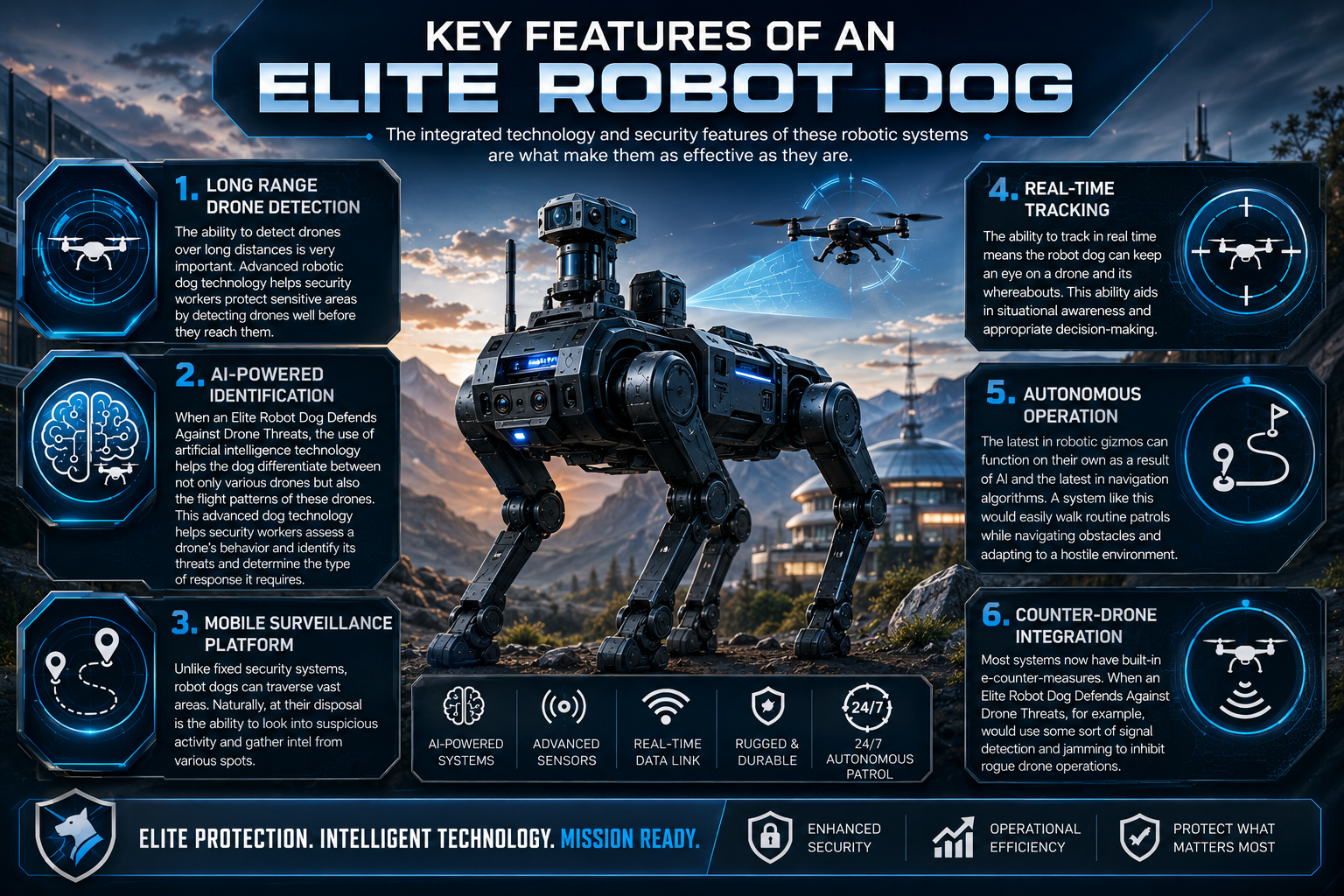
The integrated technology and security features of these robotic systems are what make them as effective as they are.
1. Long Range Drone Detection
The ability to detect drones over long distances is very important. Advanced robotic dog technology helps security workers protect sensitive areas by detecting drones well before they reach them.
2. AI-Powered Identification
When an Elite Robot Dog Defends Against Drone Threats, the use of artificial intelligence technology helps the dog differentiate between not only various drones but also the flight patterns of these drones. This advanced dog technology helps security workers assess a drone’s behavior and identify its threats and determine the type of response it requires.
3. Mobile Surveillance Platform
Unlike fixed security systems, robot dogs can traverse vast areas. Naturally, at their disposal is the ability to look into suspicious activity and gather intel from various spots.
4. Real-Time Tracking
The ability to track in real time means the robot dog can keep an eye on a drone and its whereabouts.
This ability aids in situational awareness and appropriate decision-making.
5. Autonomous Operation
The latest in robotic gizmos can function on their own as a result of AI and the latest in navigation algorithms. A system like this would easily walk routine patrols while navigating obstacles and adapting to a hostile environment.
6. Counter-Drone Integration
Most systems now have built-in e-counter-measures. When an Elite Robot Dog Defends Against Drone Threats, for example, would use some sort of signal detection and jamming to inhibit rogue drone operations.
Applications Across Different Industries
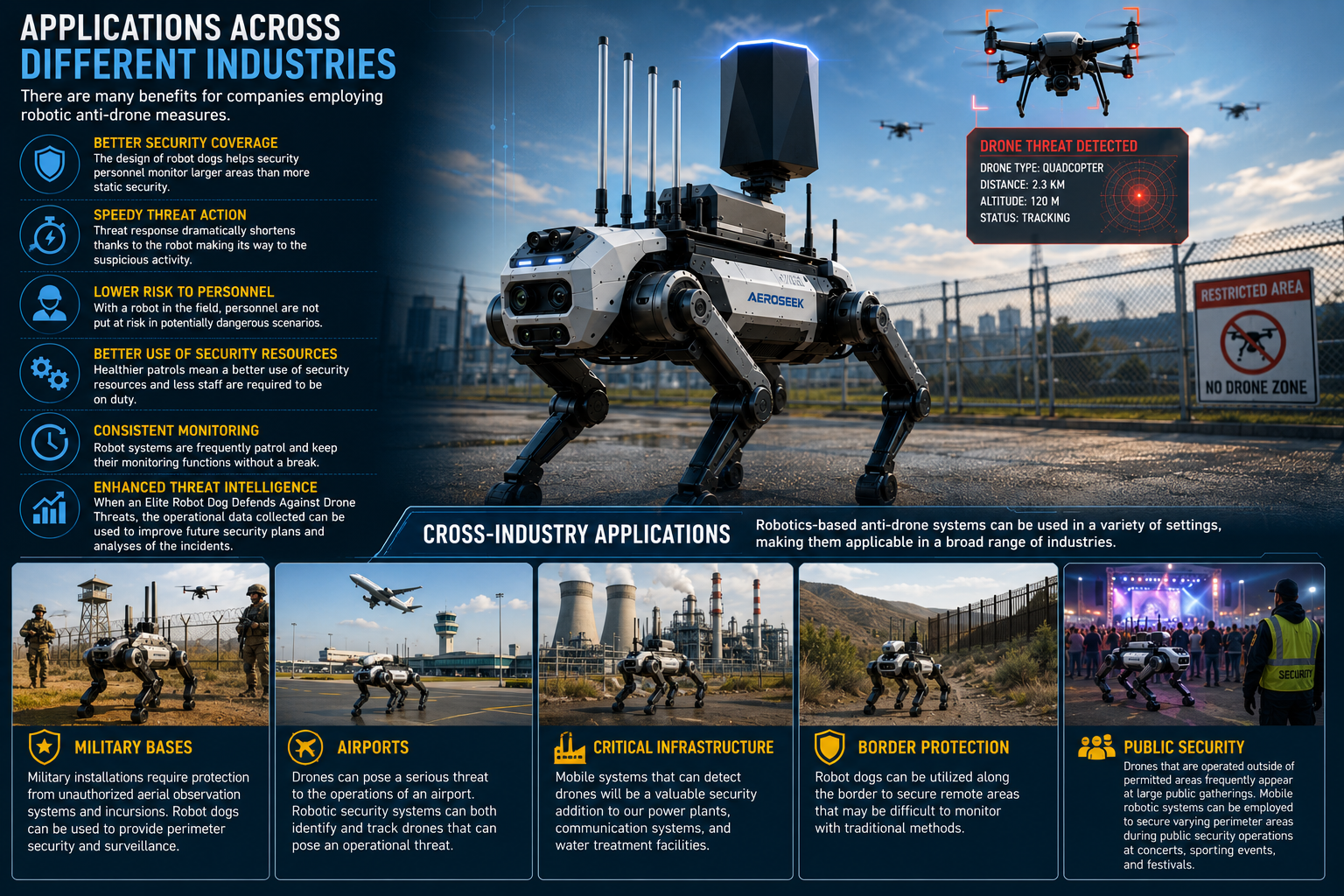
There are many benefits for companies employing robotic anti-drone measures.
Better Security Coverage
The design of robot dogs helps security personnel monitor larger areas than more static security.
Speedy Threat Action
Threat response dramatically shortens thanks to the robot making its way to the suspicious activity.
Lower Risk to Personnel
With a robot in the field, personnel are not put at risk in potentially dangerous scenarios.
Better use of Security Resources
Healthier patrols mean a better use of security resources and less staff are required to be on duty.
Consistent Monitoring
Robot systems are frequently patrol and keep their monitoring functions without a break.
Enhanced Threat Intelligence
When an Elite Robot Dog Defends Against Drone Threats, the operational data collected can be used to improve future security plans and analyses of the incidents.
Cross-Industry Applications
Robotics-based anti-drone systems can be used in a variety of settings, making them applicable in a broad range of industries.
Military Bases
Military installations require protection from unauthorized aerial observation systems and incursions. Robot dogs can be used to provide perimeter security and surveillance.
Airports
Drones can pose a serious threat to the operations of an airport. Robotic security systems can both identify and track drones that can pose an operational threat.
Critical Infrastructure
Mobile systems that can detect drones will be a valuable security addition to our power plants, communication systems, and water treatment facilities.
Border Protection
Robot dogs can be utilized along the border to secure remote areas that may be difficult to monitor with traditional methods.
Public Security
Drones that are operated outside of permitted areas frequently appear at large public gatherings. Mobile robotic systems can be employed to secure varying perimeter areas during public security operations at concerts, sporting events, and festivals.
Also Read- Anthrobots: The Human Cell Robots Reshaping Healthcare
Feature Comparison Table
| Feature | Traditional Security Systems | Elite Robot Dog Defends Against Drone Threats |
|---|---|---|
| Mobility | Limited | High Mobility |
| Drone Detection | Often Stationary | Mobile Detection Platform |
| AI Analysis | Basic | Advanced AI Processing |
| Threat Tracking | Limited Range | Real-Time Tracking |
| Patrol Capability | Human Dependent | Autonomous Patrols |
| Response Speed | Moderate | Rapid Response |
| Operational Hours | Shift-Based | Extended Continuous Operation |
| Situational Awareness | Fixed Coverage | Dynamic Coverage |
Role of Artificial Intelligence
Artificial Intelligence is a key component in the successful operation of an Elite Robot Dog that Defends Against Drone Threats.
AI algorithms have the capability to interpret the data received from multiple sensors in real time and allow the system to:
- Recognize the signatures of drones.
- Detect anomalous flight patterns.
- Determine and anticipate the direction of flight.
- Reduce false alarms.
Improve the accuracy of decisions.
The incorporation of machine learning will allow the system to gradually refine its decisions. Continuous improvement can occur as the system gathers operational experience.
Future Developments
The future of robotic anti-drone technology is bright.
The developments that will make these systems more effective will be better than what we already have.
These future technologies will include:
- Better batteries.
- Better automated navigation.
- Longer detection ranges.
- More advanced artificial intelligence to assess threats.
- Integrating automated security with smart city systems.
- Swarm robotics for a coordinated security response.
Because of technology, the idea of having an Elite Robot Dog defend against drone threats will become a standard security technology for numerous industries.
Conclusion
The rapid improvement of drone technology has made defending against threats more challenging. The use of traditional, passive surveillance will not be able to keep up with the threat of drones. The development of advanced, robotic systems is a necessary response.
The Elite Robot Dog Defends Against Drone Threats combines speed, artificial intelligence, and the long-range detection and tracking of drones into one system. This system provides organizations with the ability to Respond to and Defend Against the unauthorized activity of drones.
With the use of robotic systems, the protection of critical infrastructure, public areas, and controlled environments will be possible. The future of security systems will be a combination of automation, advanced technology, and robotics. Because of this, the Elite Robot Dog Defends Against Drone Threats is one of the most important technologies for defense.