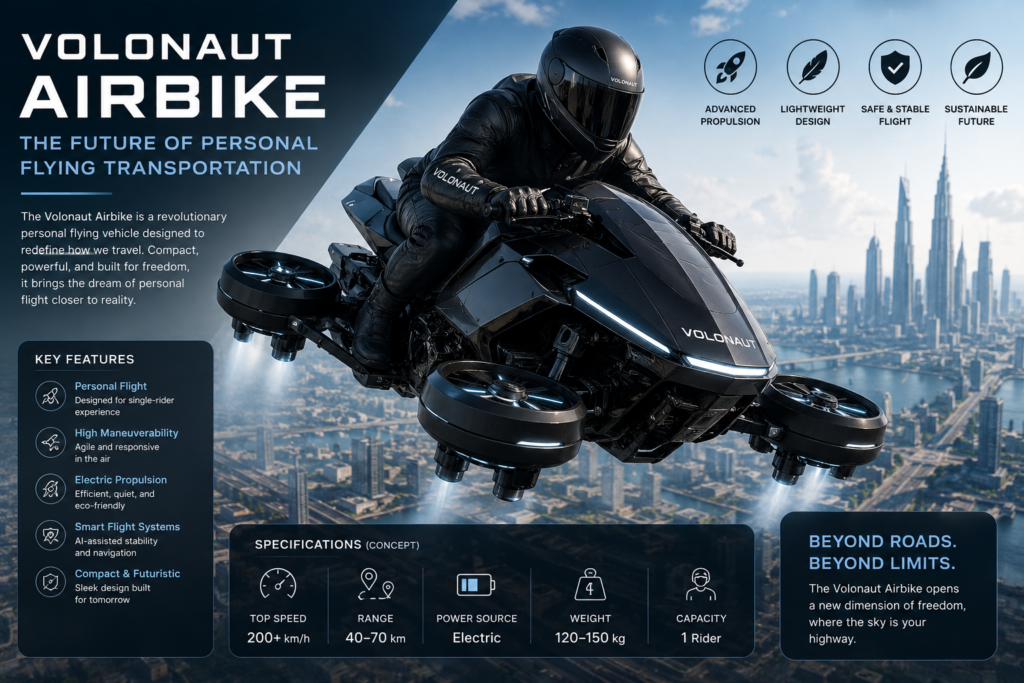
Volonaut Airbike: The Future of Personal Flying Transportation
+
Table of Contents
- 1 What is the Volonaut Air Bike?
- 2 Key Features of the Volonaut Airbike
- 2.1 1. Minimalistic Design
- 2.2 2. Propulsion Systems of the Future
- 2.3 3. Agile Design
- 2.4 4. Futuristic Design
- 2.5 5. Design for Less Harmful Transportation
- 2.6 6. Personal Mobility Focus
- 3 Volonaut Airbike Product Features
- 3.1 How Volonaut Airbike Will Impact the Future of Travel
- 3.2 Ease Traffic Woes
- 3.3 Direct Transport
- 3.4 Aid Transport in Emergencies
- 3.5 Transport Freedom
- 4 Potential Applications of the Volonaut Airbike
- 4.1 Personal Commuting
- 4.2 Tourism and Recreation
- 4.3 Security and Surveillance
- 4.4 Emergency Services
- 4.5 Military Applications
- 4.6 Advantages of the Volonaut Airbike
- 4.6.1 Time Efficiency
- 4.6.2 Innovative User Experience
- 4.6.3 Reduced Infrastructure Dependence
- 4.6.4 Future Urban Mobility
- 4.6.5 Technological Advancement
- 4.6.6 Challenges Facing Personal Flying Vehicles
- 4.6.7 Regulatory Approval
- 4.6.8 Safety Concerns
- 4.6.9 Cost
- 4.6.10 Infrastructure Development
- 4.6.11 Public Acceptance
- 4.7 The Role of Technology in Airbike Development
- 4.7.1 Electric Propulsion
- 4.7.2 Lightweight Materials
- 4.7.3 Artificial Intelligence
- 4.7.4 Autonomous Flight Systems
- 4.7.5 Advanced Battery Technology
- 4.8 The Future of Personal Air Mobility
- 5 Conclusion
- 5.1 Frequently Asked Questions (FAQs)
- 5.1.1 1. What is the Volonaut Airbike?
- 5.1.2 2. Will the Volonaut Airbike be for sale?
- 5.1.3 3. How is the Volonaut Airbike different from a helicopter?
- 5.1.4 4. Will the Volonaut Airbike help with traffic?
- 5.1.5 5. How will Airbike technology impact industries?
- 5.1.6 6. Are flying vehicles friendly to the environment?
The Volonaut Airbike is a modern iteration of the flying car. The dream of personal flying vehicles has captivated imaginations since the advent of science fiction. It is only recently, though, with the invention of sophisticated electronics and the advancement of battery technology and lightweight fabrication, that this dream has begun to be realized. The Volonaut is an innovative flying vehicle that promises to change the future of personal transportation.
The futuristic design of the Volonaut Air Bike makes no compromises in the imagination of engineers and the cutting edge of propulsion technology. The Volonaut Air Bike is still in the developmental phase, yet it already has the attention of technology fans and enthusiasts, the world of aviation, and investors.
This article will examine the features of the Volonaut Air Bike, its potential use and application, and the benefits and challenges it will present to the future of personal transportation.
What is the Volonaut Air Bike?
The Volonaut Air Bike is a personal flying vehicle that does not utilize traditional communication and transportation infrastructure like flying or traveling vehicles do. The Air Bike is designed to be compact and modeled after a bicycle to make the flying experience more accessible and easy to understand.
The goal is to build a light and agile vehicle with the ability to perform short-distance travel in the air. The Airbike is a new model of transportation to utilize to avoid the congestion of traffic and decrease the amount of time to get to a destination by using the modernized propulsion systems and new forms of aerodynamics.
Because of its design, the Airbike has the capability of being a very visually impressive form of futuristic transportation. The design is similar to the hoverbikes from sci-fi films, and for that reason, it is one of the most visually impressive designs of transportation.
Key Features of the Volonaut Airbike
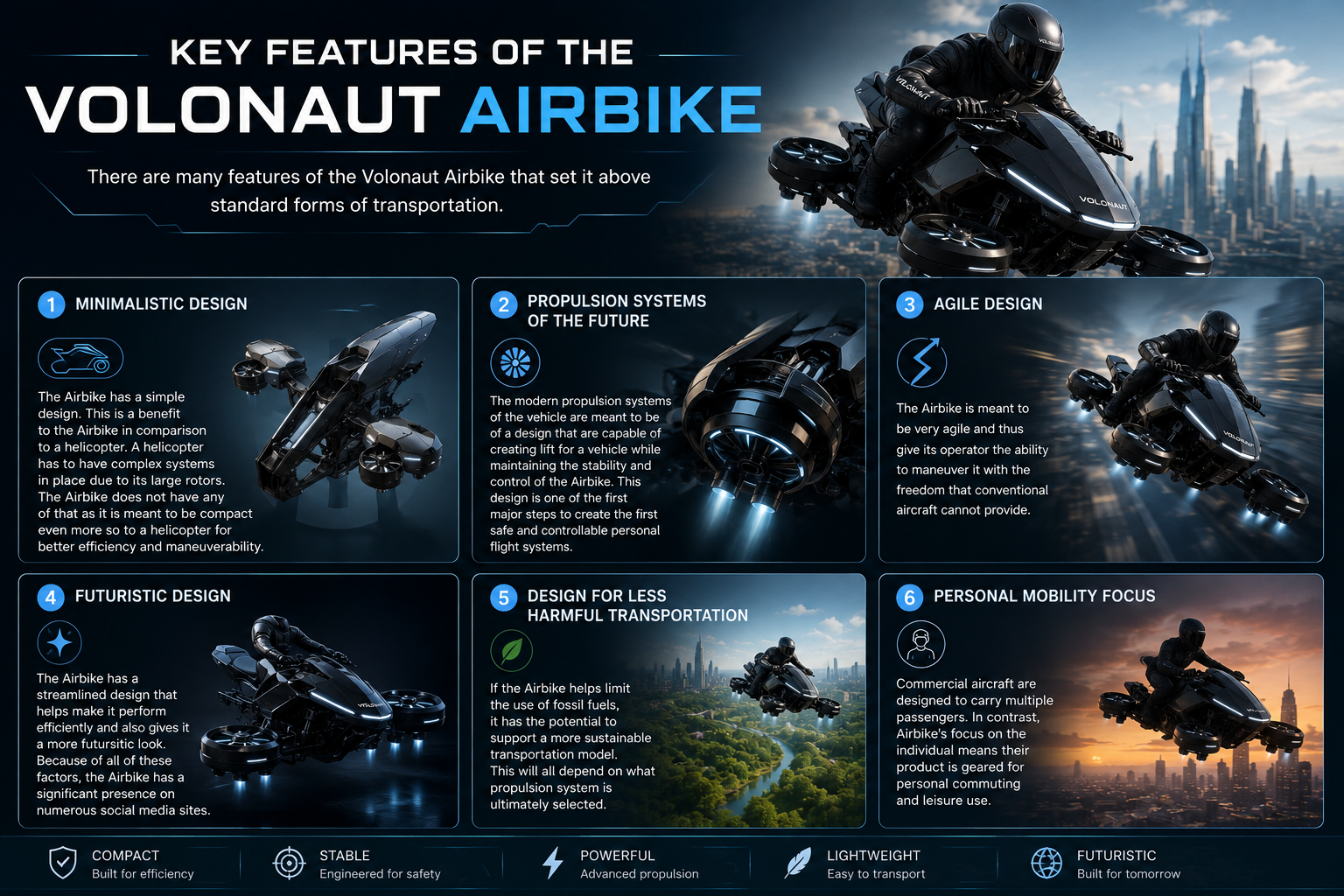
There are many features of the Volonaut Airbike that set it above standard forms of transportation.
1. Minimalistic Design
The Airbike has a simple design. This is a benefit to the Airbike in comparison to a helicopter. A helicopter has to have complex systems in place due to its large rotors. The Airbike does not have any of that as it is meant to be compact, even more so than a helicopter, for better efficiency and maneuverability.
2. Propulsion Systems of the Future
The modern propulsion systems of the vehicle are meant to be of a design that are capable of creating lift for a vehicle while maintaining the stability and control of the Airbike. This design is one of the first major steps to create the first safe and controllable personal flight systems.
3. Agile Design
The Airbike is meant to be very agile and thus give its operator the ability to maneuver it with the freedom that conventional aircraft cannot provide.
4. Futuristic Design
The Airbike has a streamlined design that helps make it perform efficiently and also gives it a more futuristic look. Because of all of these factors, the Airbike has a significant presence on numerous social media sites.
5. Design for Less Harmful Transportation
If the Airbike helps limit the use of fossil fuels, it has the potential to support a more sustainable transportation model. This will all depend on what propulsion system is ultimately selected.
6. Personal Mobility Focus
Commercial aircraft are designed to carry multiple passengers. In contrast, Airbike’s focus on the individual means their product is geared for personal commuting and leisure use.
Volonaut Airbike Product Features
| Feature | Description |
|---|---|
| Lightweight | Easy to carry and transport. |
| Single Rider | A means of transport for one person. |
| Novel Lift and Propulsion | New methods of lift and propulsion. |
| Highly Agile | Able to move through a variety of environments with ease. |
| Sci-fi Inspired | Appearance is like a sci-fi flying vehicle. |
| Air Traffic Solutions | Could help relieve congestion on roadways. |
| Eco-Tech Ready | Could employ green technologies. |
| Adventure and Leisure | Suitable for recreational and leisure activities. |
Designed for use in leisure activities and adventures.
How Volonaut Airbike Will Impact the Future of Travel
The challenges of overpopulation and environmental degradation are placing a burden on the travel systems of every country. The Volonaut Airbike is one concept of many that could help address these issues as an aerial personal transport system.
Ease Traffic Woes
Most major urban centers experience traffic delays that cost a great deal of time for commuters. The Airbike, designed to utilize the air and avoid the crowded roadways, has the potential to ease this problem.
Direct Transport
Travel through traditional transport systems requires travel on fixed road networks. Personal Air Transport Systems are able to travel in a more direct manner and will therefore travel a greater distance in a shorter time.
Aid Transport in Emergencies
During a time of crisis like a natural disaster, the Airbike could help emergency services personnel reach previously inaccessible areas.
Transport Freedom
The Airbike introduces a brand-new means of transport, allowing people to have more freedom in how they wish to travel.
Potential Applications of the Volonaut Airbike
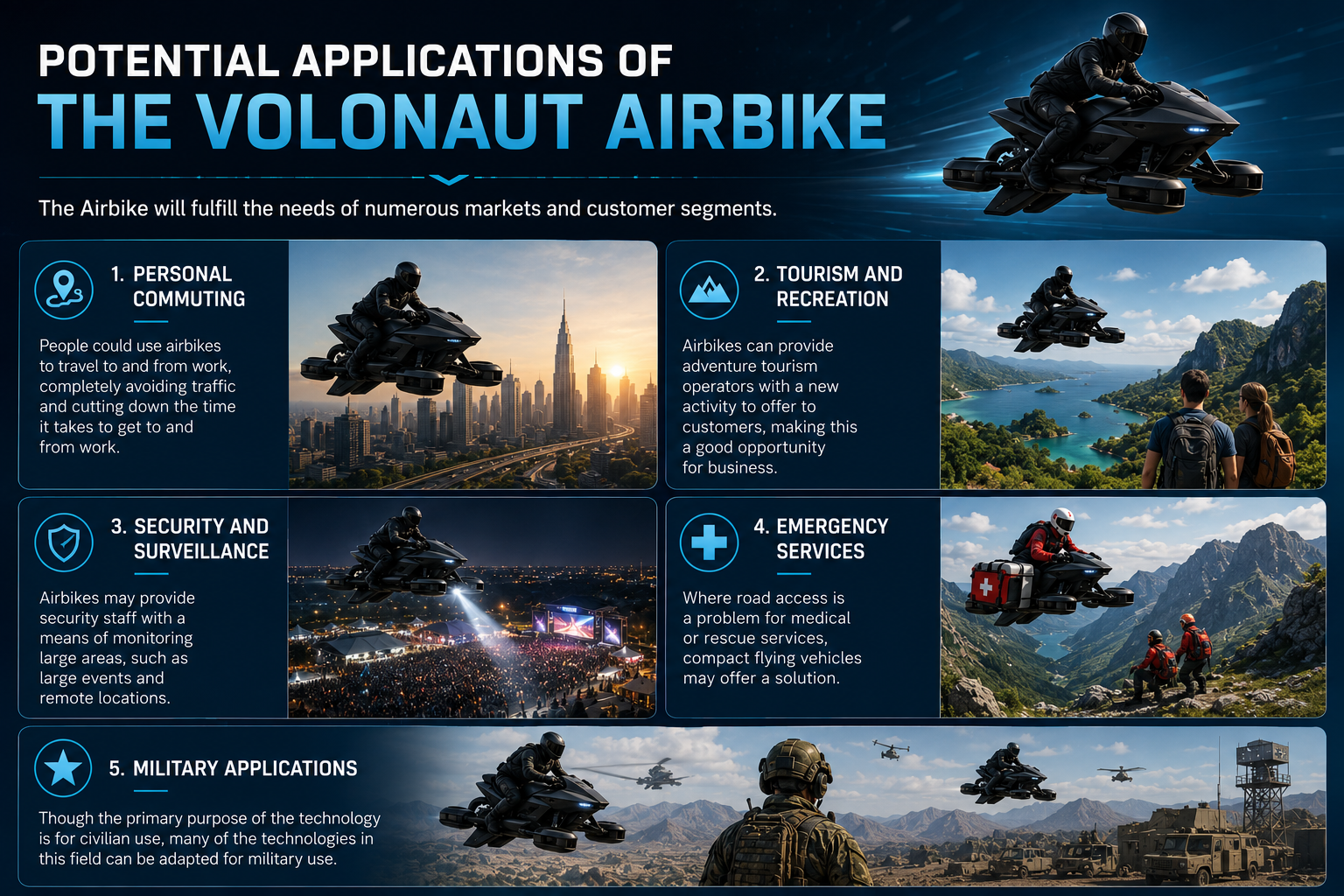
The Airbike will fulfill the needs of numerous markets and customer segments.
Personal Commuting
People could use airbikes to travel to and from work, completely avoiding traffic and cutting down the time it takes to get to and from work.
Tourism and Recreation
Airbikes can provide adventure tourism operators with a new activity to offer to customers, making this a good opportunity for business.
Security and Surveillance
Airbikes may provide security staff with a means of monitoring large areas, such as large events and remote locations.
Emergency Services
Where road access is a problem for medical or rescue services, compact flying vehicles may offer a solution.
Military Applications
Though the primary purpose of the technology is for civilian use, many of the technologies in this field can be adapted for military use.
Also Read- Lucas and Shahed-136 Drones: A New Era of Drone Warfare
Advantages of the Volonaut Airbike
Time Efficiency
Traveling to a location using the Airbike is quicker than any other method of transport.
Innovative User Experience
Users will find the experience of flying to their destination much more exciting than the dull experience of traveling by other means.
Reduced Infrastructure Dependence
Airbikes are much less dependent on roads, railroads, and other major components of the transport network than cars, trains, and other vehicles.
Future Urban Mobility
Airbikes are likely to be a major component of the transport system in future cities.
Technological Advancement
The Airbike will advance the state of technology in many areas, including aerospace and battery technology, and autonomous systems.
Challenges Facing Personal Flying Vehicles
There are many challenges that must be accommodated before the use of personal flying vehicles becomes common.
Regulatory Approval
Aviation authorities will have to create a personal flying vehicle safety regulation approval and operating framework.
Safety Concerns
For personal flying vehicles to be safe, systems will have to be designed to be fail safe, and emergencies will have to be accounted for in the vehicle’s design. Pilot training systems will also have to be established.
Cost
High prices of early generation Airbikes prevent access for the average consumer.
Infrastructure Development
New charging, air traffic, and maintenance infrastructure may be needed.
Public Acceptance
People may need time to feel comfortable sharing the air with personal flying vehicles.
The Role of Technology in Airbike Development
The development of Volonaut Airbike and similar air vehicles relies on several technologies.
Electric Propulsion
Electric motors provide compact and clean power solutions for future aircraft.
Lightweight Materials
Advanced alloys and carbon fiber composites help reduce materials of sufficient structural strength and stiffness.
Artificial Intelligence
AI-controlled flight systems support improvements to stability, control, and enhanced safety margins.
Autonomous Flight Systems
Future Airbikes may feature even more simplified piloting, which reduces the demands placed on the pilot.
Advanced Battery Technology
Improved battery performance is required to improve flight range, further enhancing air vehicles’ efficiency and economics.
The Future of Personal Air Mobility
The Volonaut Airbike is a visionary personal air mobility vehicle, a glimpse into the future of personal transport. Continued investment and development make the Airbike system part of a growing ecosystem of aerial transport in personal air vehicles.
Rapid urbanization and increased population density make personal air vehicles an increasingly attractive solution to urban transport.
Safety, affordability, and regulation challenges must be addressed first for Airbikes to become a common sight across urban and rural environments in the coming decades.
Conclusion
The Volonaut Airbike transports us to the precipice of what mobility will look like in coming decades. It combines the cutting edge of design, enginery, and propulsion to answer the question of what the future will look like when people will no longer be bound to the roads. There is a great deal of work that needs to be done for a personal flying vehicle to be a common sight, but, with the Airbike, we can see the future of personal air transport.
With the Volonaut Airbike, the future offers the promise of technology and regulations that will ease the burden of traffic and air travel by substantially making farther and previously unreachable destinations accessible with infinite possibilities. It represents a paradigm shift towards the ubiquitous use of flying personal vehicles by offering the tools to make that change for commuting, recreation, or any purpose.
Frequently Asked Questions (FAQs)
1. What is the Volonaut Airbike?
The Volonaut Airbike is a personal flying vehicle that uses air travel technology and propulsion to offer a private flying option.
2. Will the Volonaut Airbike be for sale?
Because the Airbike is in a demonstration and developing phase, further testing and industry regulations will decide when it will be for sale.
3. How is the Volonaut Airbike different from a helicopter?
The Airbike was designed for personal use and is substantially smaller and lighter. Helicopters are larger vehicles that have the capability to offer transport to many passengers.
4. Will the Volonaut Airbike help with traffic?
Yes, personal flying machines will ease traffic because they use airspace instead of roadways.
5. How will Airbike technology impact industries?
Airbike technology will have an impact on personal travel, moving people for leisure, emergency services, moving security, and even specialized services for industry.
6. Are flying vehicles friendly to the environment?
Newer designs should incorporate electric propulsion with sustainable technologies. These would be better for the environment than the propulsion systems used in traditional forms of transport.