From Flight to Dive: Inside the Aalborg University Hybrid Drone
+
Table of Contents
- 1 What Is the Aalborg University Hybrid Drone?
- 2 Key Features of the Aalborg University Hybrid Drone
- 2.1 1. Air to Water Transition Capabilities
- 2.2 2. Water-to-Air Reemergence
- 2.3 3. Dual-Environment Propeller System
- 2.4 4. Waterproof Construction
- 2.5 5. Light Frame
- 2.6 6. Autonomous Navigation
- 2.7 7. Rapid Environmental Adaptation
- 3 Technical Specifications Overview
- 3.1 Applications of the Aalborg University Hybrid Drone
- 3.1.1 1. Search and Rescue Operations
- 3.1.2 2. Military and Defense Missions
- 3.1.3 This drone can:
- 3.1.4 3. Environmental Monitoring
- 3.1.5 4. Infrastructure Inspection
- 3.1.6 5. Maritime Security
- 3.1.7 6. Scientific Exploration
- 3.2 Engineering Challenges Overcome
- 3.2.1 Thrust
- 3.2.2 Waterproof Electronics
- 3.2.3 Weight Optimization
- 3.2.4 Stability Control
- 3.3 Future of Hybrid Drones
- 4 Conclusion
Rapid developments are underway in the world of Unmanned Aerial Vehicles (UAVs). We can now see new concepts daily. One such development, the Aalborg University Hybrid Drone, is certainly captivating. As an interdisciplinary initiative, the project brings together researchers and students in engineering from Aalborg University in Denmark. The drone operates in air and water, demonstrating the capabilities of future robotic systems to operate in completely disparate environments.
Unlike traditional drones, which can only conduct tasks in the air, the Aalborg University Hybrid Drone can fly through the air, dive through water to conduct underwater tasks, and surface to continue air operations. With this capability, the Hybrid Drone can easily be used for a multitude of operations, including, but not limited to, scientific research, military operations, search-and-rescue, and monitoring of environmental conditions.
This article explores the design of the Hybrid Drone, its features and the technology used, as well as the possible applications of the drone and the impacts it will have in the future.
What Is the Aalborg University Hybrid Drone?
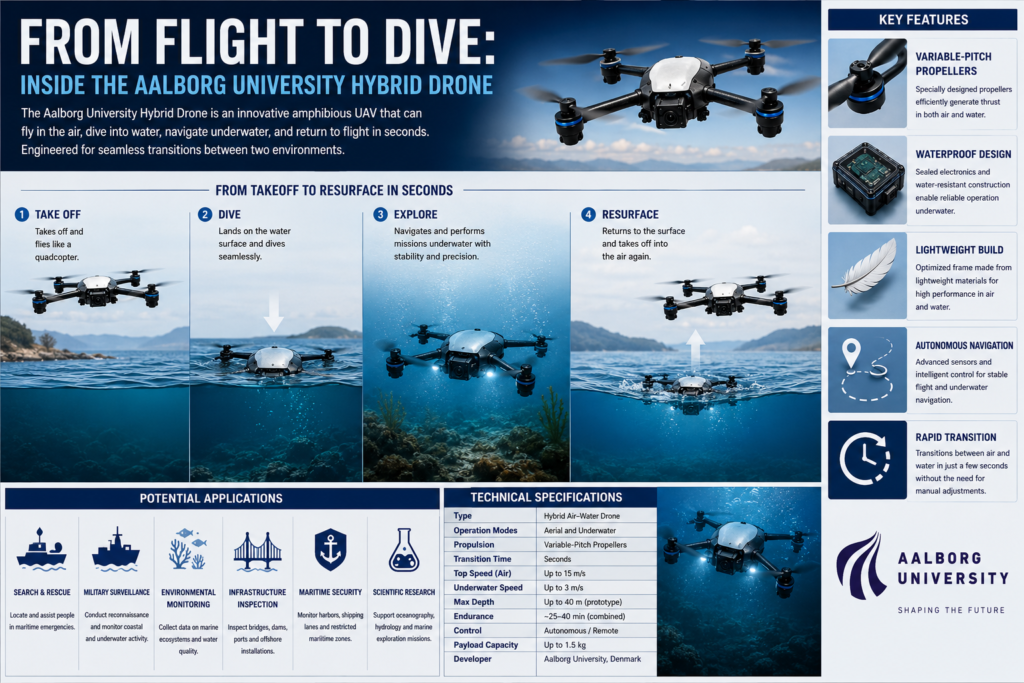
This hybrid drone is an unmanned, amphibious, fully integrated system. Unlike traditional drones that are designed for air flight or robots that are designed for underwater operation, this hybrid drone combines the two systems into a single platform. This presents a great engineering design challenge.
To tackle these difficulties, researchers at Aalborg University built a drone with a propulsion system that works well in both air and water. This innovation meant the propulsion system could be used on a vehicle that:
– Takes off and flies like a quadcopter
– Lands on a water surface
– Dives underwater
– Navigates underwater
– Resurfaces
– Returns to flying
The ability to transition between mediums in only a matter of seconds sets this drone apart from traditional UAVs and underwater robotics.
Benefits of Hybrid Drones
The ability to operate in multiple environments creates a significant advantage over traditional unmanned systems.
Improved Mission Flexibility
Instead of needing to launch multiple vehicles to cover different mission mediums, only a single system needs to be deployed.
Lower Operational Costs
Fewer systems mean a reduction in the cost of equipment and a reduction in maintenance costs since only a single system needs to be maintained.
Better Data Collection
It is possible to collect data above and below the water surface, giving a more thorough assessment of an area.
Improved Access to Difficult Environments
Many locations, especially coastal and offshore areas, require both water and air inspections. Hybrid drones can easily cover these areas.
Key Features of the Aalborg University Hybrid Drone
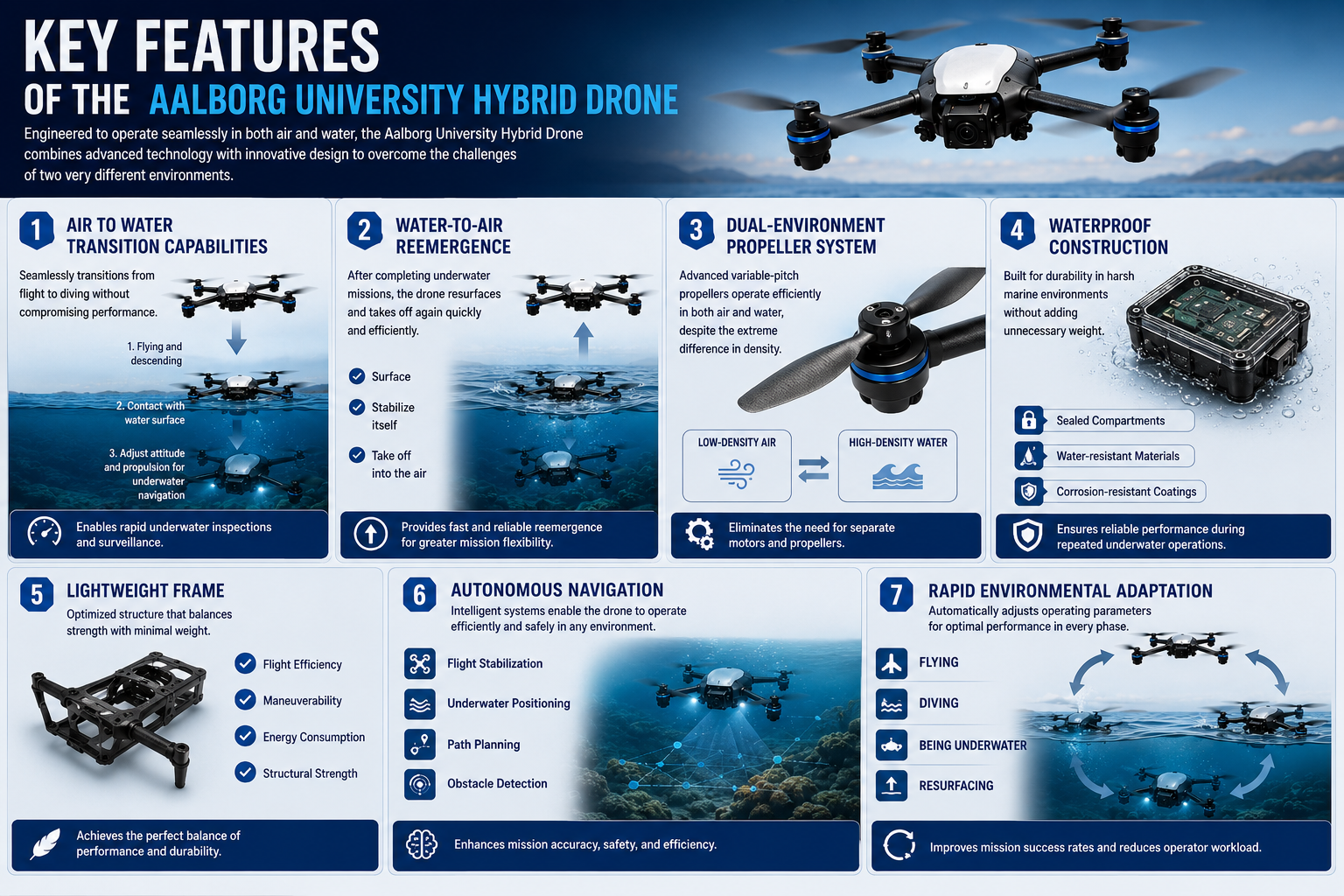
The blend of innovative engineering and hybrid capabilities has made the Aalborg University Hybrid Drone a significant success. The following are a few of the impressive features of this hybrid drone.
1. Air to Water Transition Capabilities
The hybrid drone has seamless transitioning capabilities between air and water, and this may be its greatest feature.
Unlike traditional UAVs that cannot be exposed to water, the hybrid drone can easily dive into water without impeding functionality.
The transition process consists of:
- Flying and then descending.
- Making contact with the water surface.
- Adjusting attitude and propulsion for underwater navigation.
The rapid speed of the drone for underwater inspections and surveillance is greatly enhanced by this capability.
2. Water-to-Air Reemergence
The drone can also perform the opposite process.
After completing tasks in an underwater environment, the drone can:
- Surface.
- Stabilize itself.
- Then, make contact with the air.
This fast and easy surfacing and taking-flight capability provides a lot more flexibility for the drone’s tasks.
3. Dual-Environment Propeller System
Along the same lines, another major technological advancement is the propellers.
Since water and air have a major difference in density, it is easily seen that having the same propulsion system that would work in both environments is quite the feat.
The Aalborg drone has the most advanced variable-pitch propellers that can work in both:
- Low-density air
- High-density water.
This system, once again, eliminated the need for a new motor and propellers.
4. Waterproof Construction
A major focus for the construction of the drone was to go in the opposite direction of a traditional UAV, going down the route of a more durable construction, but without compromising weight.
To ensure performance was not compromised, the construction of the drone includes:
- Sealed Compartments.
- Water-resistant materials.
- Corrosion-resistant coatings.
5. Light Frame
Once again, the focus of the project was to create a balance between a lightweight construction of:
- Flight efficiency.
- Maneuverability.
- Energy consumption.
- Structural strength.
Achieved once again with the construction of variable-pitch propellers.
6. Autonomous Navigation
The drone’s navigation system aids in:
- Flight Stabilization
- Underwater Positioning
- Path Planning
- Obstacle Detection
All of these systems help the drone operate efficiently in different environments.
7. Rapid Environmental Adaptation
Most robots require physical modification to function in a different environment.
The Aalborg Hybrid Drone automatically adjusts its operating parameters for:
- Flying
- Diving
- Being Underwater
- Resurfacing
This Rapid Environmental Adaptation increases mission success and decreases the workload of the operator.
Technical Specifications Overview
| Feature | Description |
|---|---|
| Type | Hybrid Air-Water Drone |
| Developer | Aalborg University |
| Operation Modes | Aerial and Underwater |
| Propulsion | Variable-Pitch Propellers |
| Flight Capability | Multirotor UAV Functionality |
| Underwater Capability | Controlled Navigation |
| Waterproof Design | Fully Protected Electronics |
| Transition Speed | Seconds Between Environments |
| Navigation | Autonomous and Remote-Controlled |
| Potential Applications | Military, Research, Inspection, Rescue |
Applications of the Aalborg University Hybrid Drone
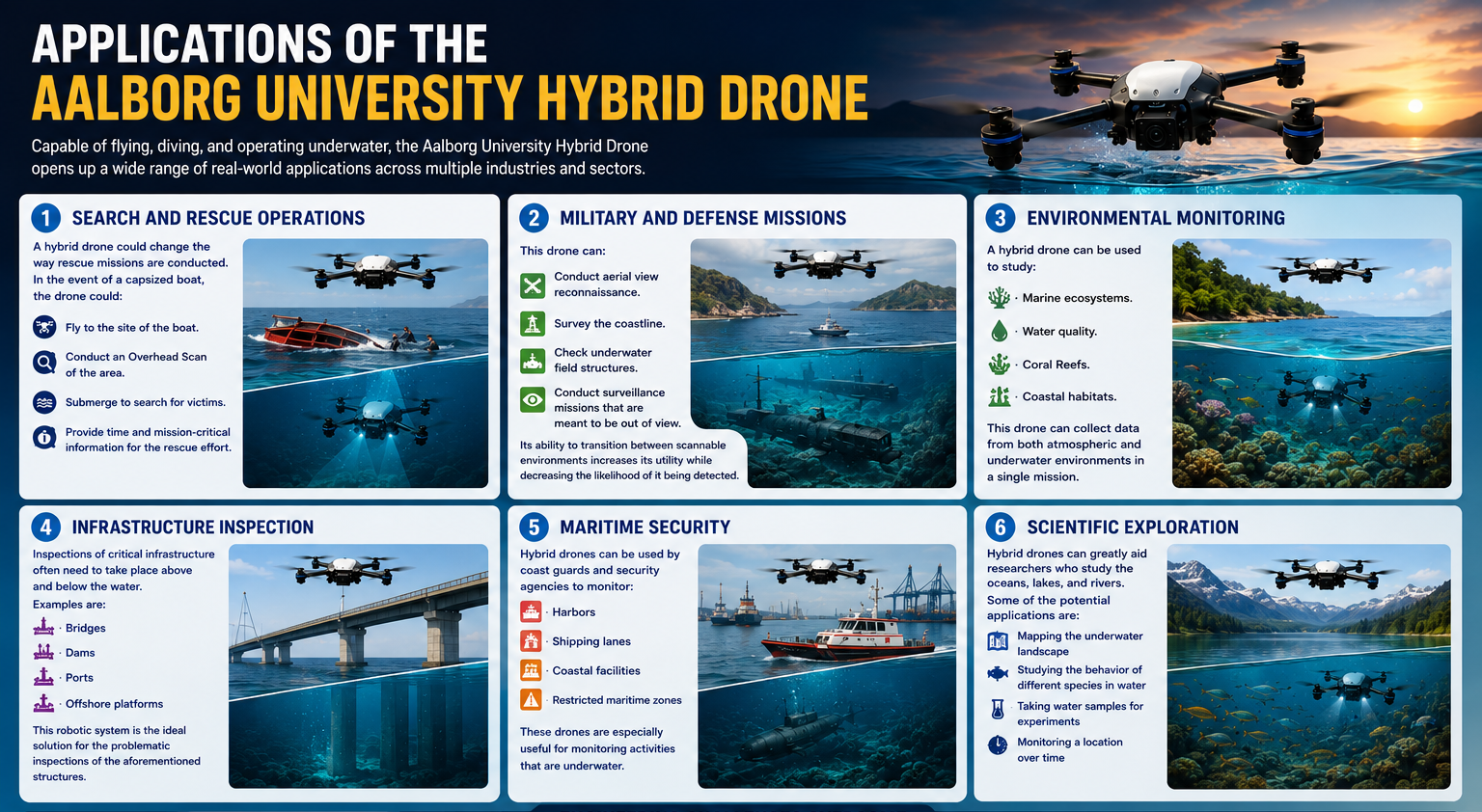
1. Search and Rescue Operations
A hybrid drone could change the way rescue missions are conducted. In the event of a capsized boat, the drone could:
- Fly to the site of the boat.
- Conduct an Overhead Scan of the area.
- Submerge to search for victims.
Provide time and mission-critical information for the rescue effort.
2. Military and Defense Missions
Military organizations are always on the lookout for tools of surveillance that have flexible and versatile usage.
This drone can:
- Conduct aerial view reconnaissance.
- Survey the coastline.
- Check underwater field structures.
- Conduct surveillance missions that are meant to be out of view.
Its ability to transition between scannable environments increases its utility while decreasing the likelihood of it being detected.
3. Environmental Monitoring
A hybrid drone can be used to study:
- Marine ecosystems.
- Water quality.
- Coral Reefs.
- Coastal habitats.
This drone can collect data from both atmospheric and underwater environments in a single mission.
4. Infrastructure Inspection
Inspections of critical infrastructure often need to take place above and below the water.
Examples are:
- Bridges
- Dams
- Ports
- Offshore platforms
This robotic system is the ideal solution for the problematic inspections of the aforementioned structures.
5. Maritime Security
Hybrid Drones can be used by coast guards and security agencies to monitor:
- Harbors
- Shipping lanes
- Coastal facilities
- Restricted maritime zones
These drones are especially useful for monitoring activities that are underwater.
6. Scientific Exploration
Hybrid Drones can greatly aid researchers who study the oceans, lakes, and rivers.
Some of the potential applications are:
- Mapping the underwater landscape
- Studying the behavior of different species in water
- Taking water samples for experiments
- Monitoring a location over time
- Engineering Challenges Overcome
Engineering Challenges Overcome
Creating a drone that can transport itself through both water and air was a challenging task.
There were many hurdles to overcome, including:
Thrust
Because water is about 800 times denser than air, both media require different and completely specialized methods of propulsion.
Waterproof Electronics
The drone’s electronics must be waterproof and remain functional after repeated exposure to water.
Weight Optimization
Drones require a trade-off between waterproofing and weight. Increased waterproofing inhibits the drone’s ability to take flight.
Stability Control
The drone must be adequately stabilized to remain in control while crossing between air and water.
These challenges illustrate the success of the Aalborg University project.
Future of Hybrid Drones
The Aalborg Hybrid Drone serves as a functional demonstration of a new generation of hybrid drones.
Some of the improvements that will be seen in future iterations of the drones:
- Battery life
- Autonomous travel
- operating in unison
- switching between media seamlessly
- greater detection capabilities
- carrying larger loads
The advances in technology may allow hybrid drones to be used in a number of different industries.
Conclusion
The Hybrid Drone from Aalborg University is an exceptional example of the integration of robotics and engineering of unmanned systems. The combination of the capabilities of aerial flight and underwater navigation means that the researchers are able to perform missions that would have previously required several systems.
The Hybrid Drone is an excellent example of innovation as a result of the combination of pitch-variable propellers, waterproofing, underwater and aerial autonomous navigation, and rapid adaptation and transition. Included in the missions that may utilize the drone are military reconnaissance, monitoring of the environment, inspection of civil infrastructure, and research. Amphibious UAV systems are at the beginning of their application.
Amphibious Hybrid UAV systems will be employed in the future of autonomous operations and will aid in the expansion of systems used in exploration and in the safety and security of systems.
Frequently Asked Questions (FAQs)
1. What is the Aalborg University Hybrid Drone?
The drone is a fully amphibious drone that can fly and dive underwater as well as travel underwater and return to the surface to fly again.
2. How does the drone operate in both air and water?
The drone is engineered to be waterproof and employs pitch-variable propellers, designed to be efficiently effective in both mediums.
3. What makes this drone unique?
The drone’s ability to transition from aerial to underwater operations in a matter of seconds is unique to unmanned vehicles.
4. What are the main applications of the drone?
The main applications of the drone are search and rescue, military operations, surveillance, reconnaissance, environmental monitoring, inspection of infrastructure, maritime security, and research.
5. How likely is it that hybrid drones will be a common technology in the future?
With the improvement of AI, battery, and hybrid automation, it will be likely that hybrid drones will be more common in commercial as well as scientific and defense operations.