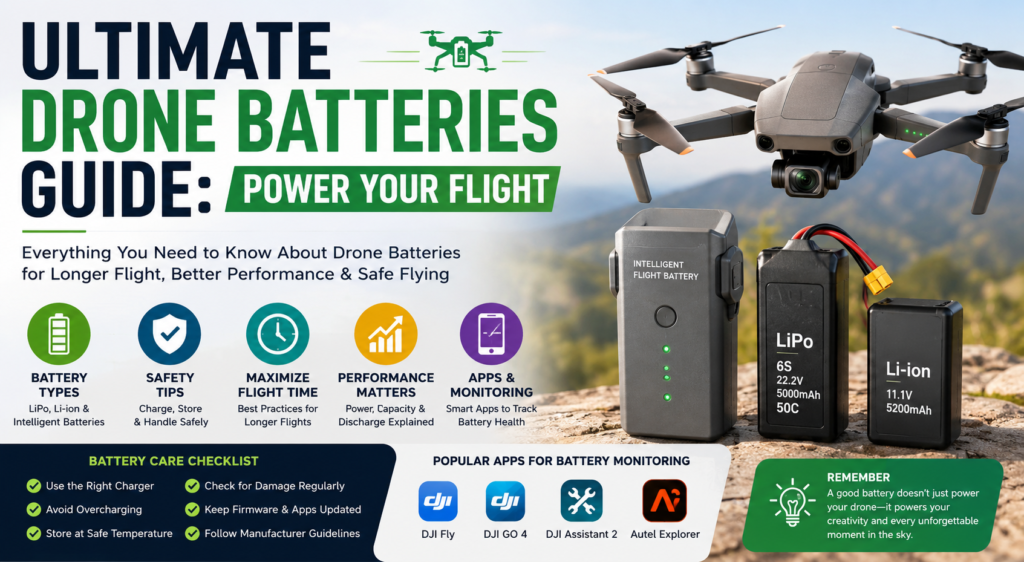
Ultimate Drone Batteries Guide: Power Your Flight
+
Table of Contents
- 1 Why Drone Batteries Matter
- 2 Before buying any battery, check the specs
- 2.1 1. Voltage
- 2.2 2. Capacity
- 2.3 3. Discharge Capability
- 2.4 4. Battery Chemistry
- 3 Popular Apps for Monitoring Drone Batteries
- 3.1 1. DJI Fly
- 3.2 2. DJI GO 4
- 3.3 3. DJI Assistant 2
- 3.4 Advantages of Battery Monitoring Apps
- 3.5 How to Correctly Charge Your Drone Batteries
- 3.5.1 During charging:
- 3.6 How to Store Drone Batteries
- 3.7 Signs That a Battery Needs Replacement
- 3.8 Tips for Improving Battery Lifespan
- 3.9 Choosing the Right Drone Battery
- 3.10 Drone Battery Safety Checklist
- 4 Conclusion
Camera drones, just like other multirotors, require good components to perform well. Without good batteries, no flight is possible. Batteries affect airtime, flight characteristics, performance, and, most importantly, safety. The right battery and good battery care can improve flying drones.
Filming drones, like most other commercial and prosumer drones, use lithium batteries. They can deal with weight, energy density, and power loss well. Even with good design properties, these batteries require a good deal of care when charging, storing, and using. This is true for all drones at all price points, from cameras to aircraft.
This guide fully explains the inner workings of drone batteries, the specs to consider when buying, how to use battery BMS apps, and how to improve battery life.
Why Drone Batteries Matter
The weight impact of each component is amplified on smaller vehicles like drones compared to others. They also have size limitations. This results in manufacturers choosing light batteries that pack a lot of power. They have too much weight to compensate for.
Beyond impacting air time, a battery can determine factors such as acceleration; how well the drone hovers; how well its motors perform; and how much payload it can carry.
Li-Polymer batteries are ideal for drones. They have a fast discharge rate. Many camera drones use batteries with built-in electronics that give a battery’s state of charge, internal temperature, and other diagnostics.
Like many drone control apps, DJI Fly shows battery status by displaying its level and estimated remaining flight time.
Before buying any battery, check the specs
1. Voltage
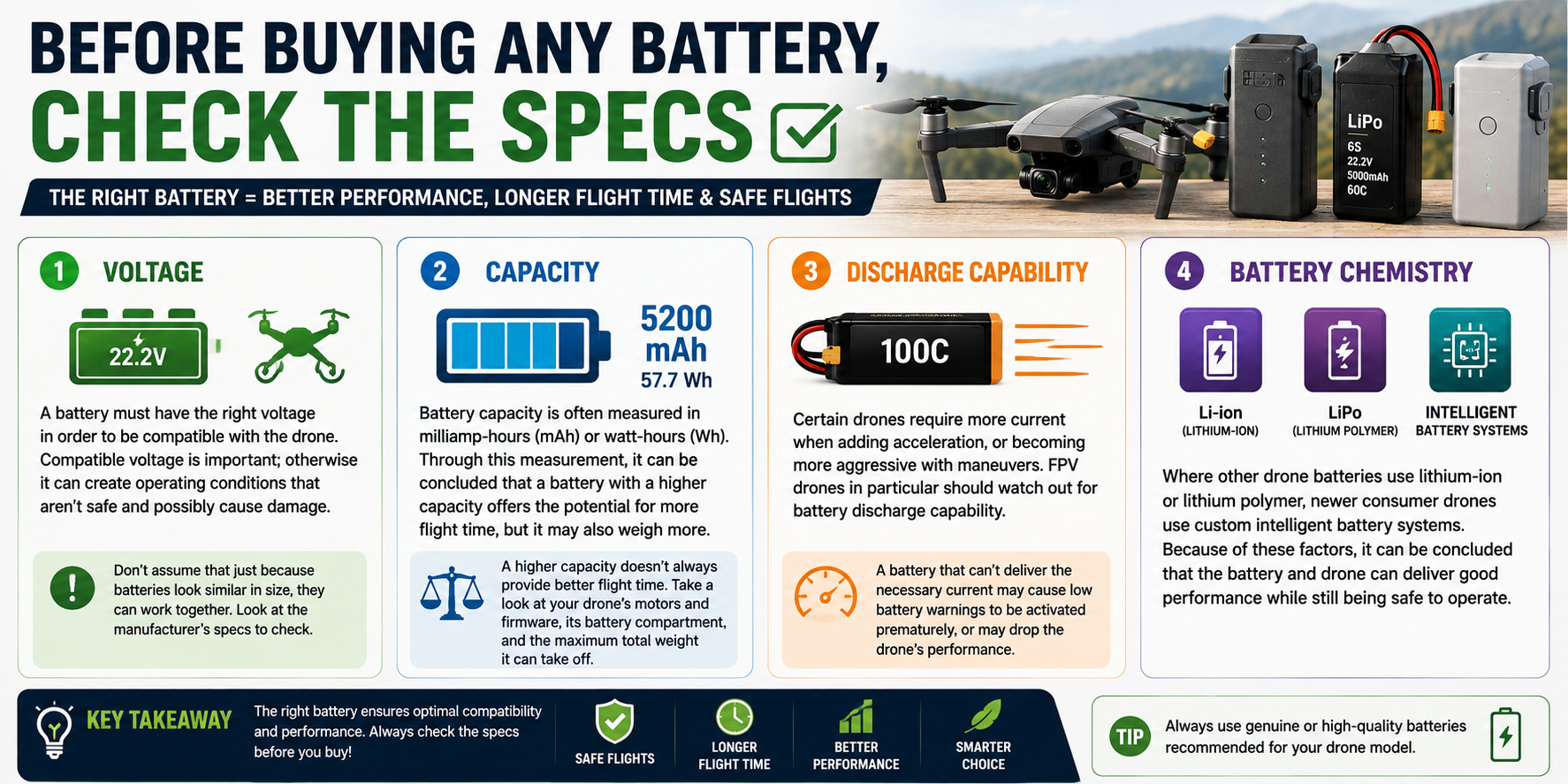
A battery must have the right voltage in order to be compatible with the drone. Compatible voltage is important; otherwise it can create operating conditions that aren’t safe and possibly cause damage.
Don’t assume that just because batteries look similar in size, they can work together. Look at the manufacturer’s specs to check.
2. Capacity
Battery capacity is often measured in milliamp-hours (mAh) or watt-hours (Wh). Through this measurement, it can be concluded that a battery with a higher capacity offers the potential for more flight time, but it may also weigh more.
A higher capacity doesn’t always provide better flight time. Take a look at your drone’s motors and firmware, its battery compartment, and the maximum total weight it can take off.
3. Discharge Capability
Certain drones require more current when adding acceleration, or becoming more aggressive with maneuvers. FPV drones in particular should watch out for battery discharge capability.
A battery that can’t deliver the necessary current may cause low battery warnings to be activated prematurely, or may drop the drone’s performance.
4. Battery Chemistry
Where other drone batteries use lithium-ion or lithium polymer, newer consumer drones use custom intelligent battery systems. Because of these factors, it can be concluded that the battery and drone can deliver good performance while still being safe to operate.
Also Read- Best Agricultural Drones: Incredible Solutions for Modern Farming
Popular Apps for Monitoring Drone Batteries
There are multiple battery management apps used to monitor drone batteries better. The apps rely on companion apps and provide flight data and battery data on either a cell phone or controller.
| App | Features | Benefits | Optimal Use |
|---|---|---|---|
| DJI Fly | Shows estimated flight time, battery level, battery information, voltage, and cycle count on supported aircraft | Convenient battery monitoring, safety alerts, and better flight planning | Newer DJI drones |
| DJI GO 4 | Provides battery status, safety information, aircraft controls, and other flight-related information | Detailed monitoring and control for compatible older models | Older DJI drones |
| DJI Assistant 2 | Offers firmware updates, diagnostics, aircraft management, and maintenance tools | Helps with troubleshooting, maintenance, and firmware management | Computer-based maintenance |
| Manufacturer-Specific Apps | Battery status, flight information, safety alerts, and controls vary by drone manufacturer and model | Integrated flight control and battery monitoring in one application | Other compatible drones |
1. DJI Fly
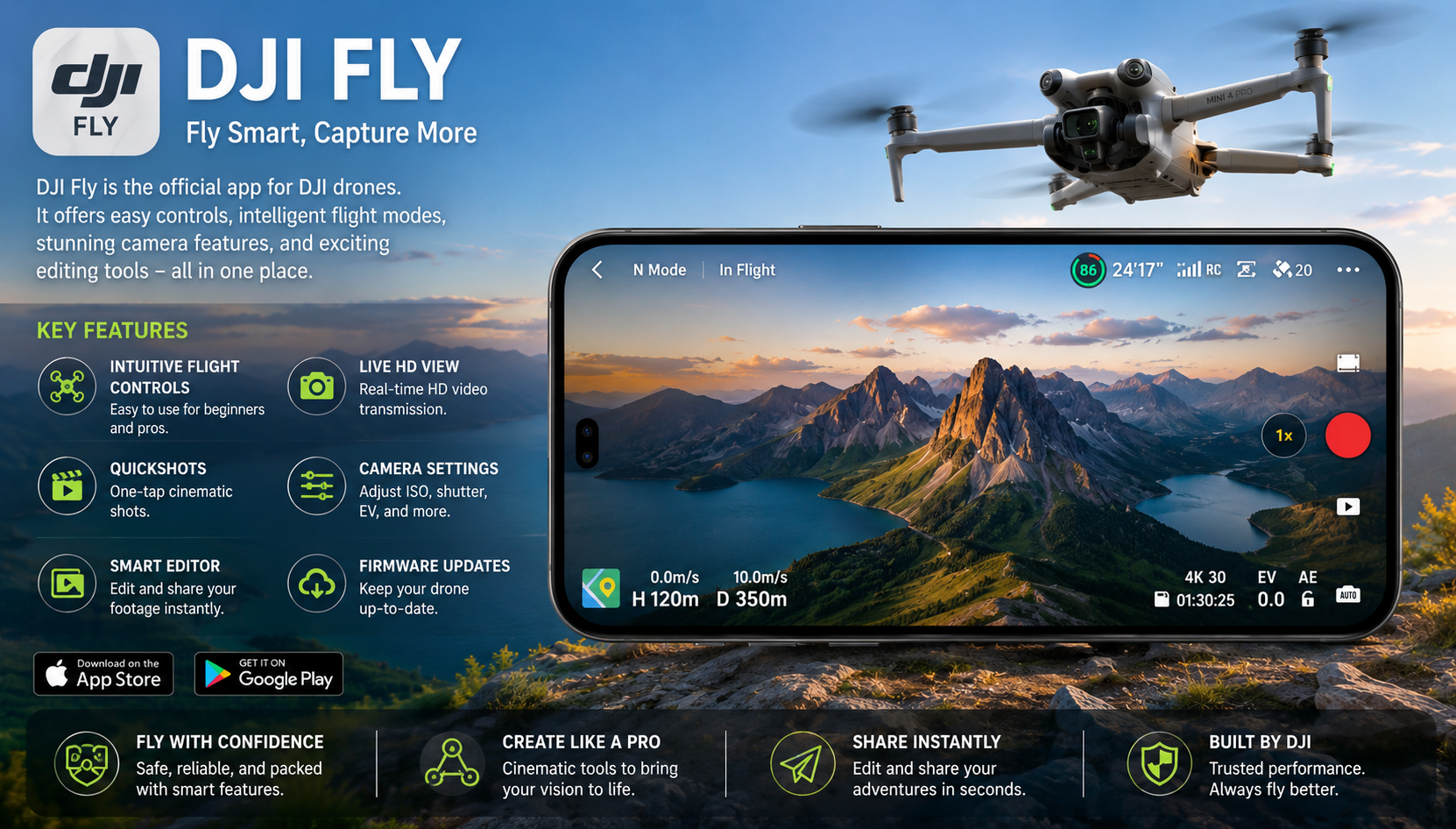
Basically, DJI Fly is highly effective and provides a great deal of control to the pilot. While flying, the battery status and estimated flight time are provided on the camera user interface. Furthermore, safety settings provide access to battery information. As reported, users are able to access information such as voltage and cycle count through Safety > Battery Info on supported aircraft.
2. DJI GO 4
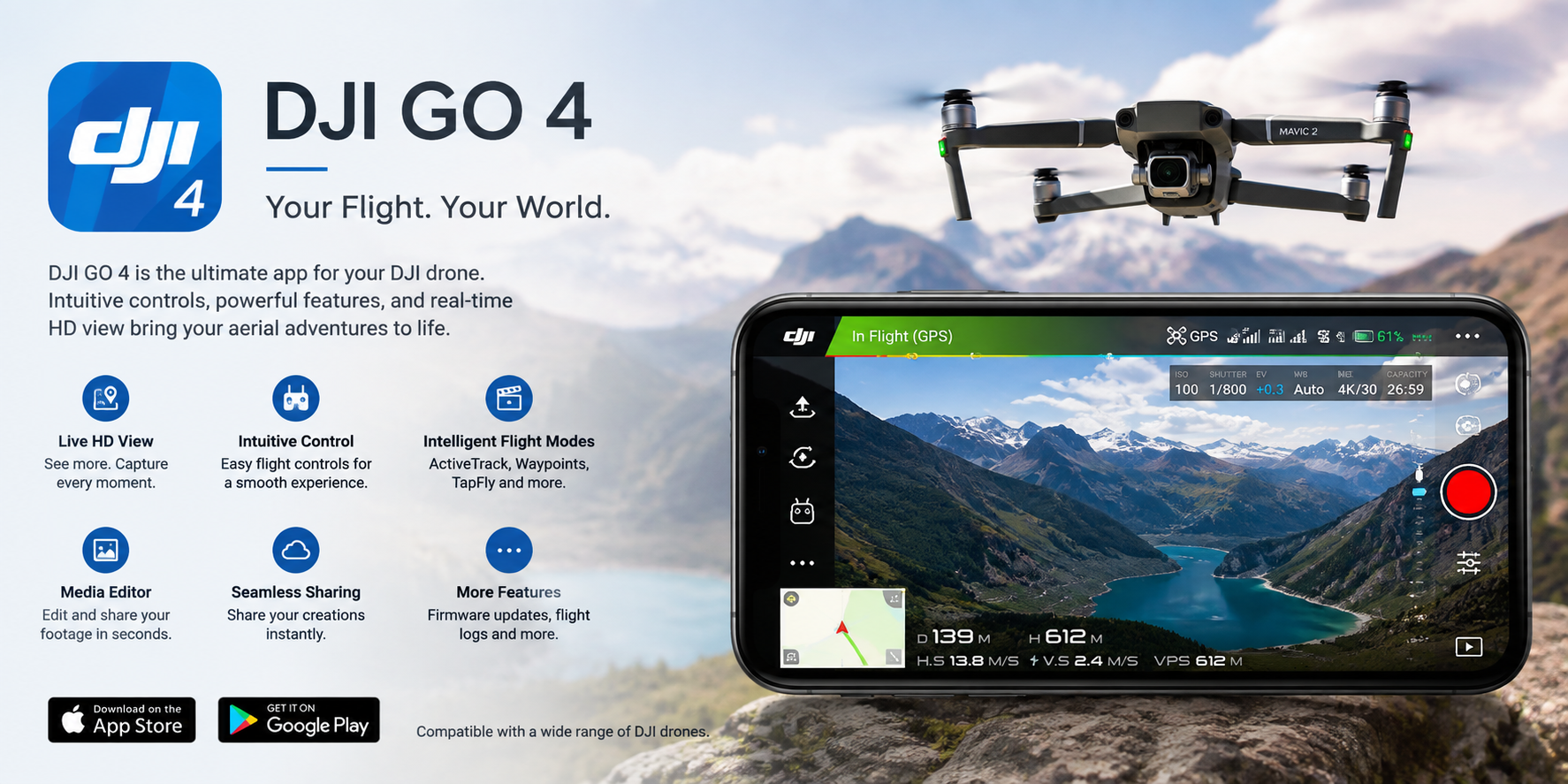
DJI GO 4 supports several old DJI aircraft. Depending on the aircraft, the app provides battery details in the aircraft control settings or in the battery section.
3. DJI Assistant 2
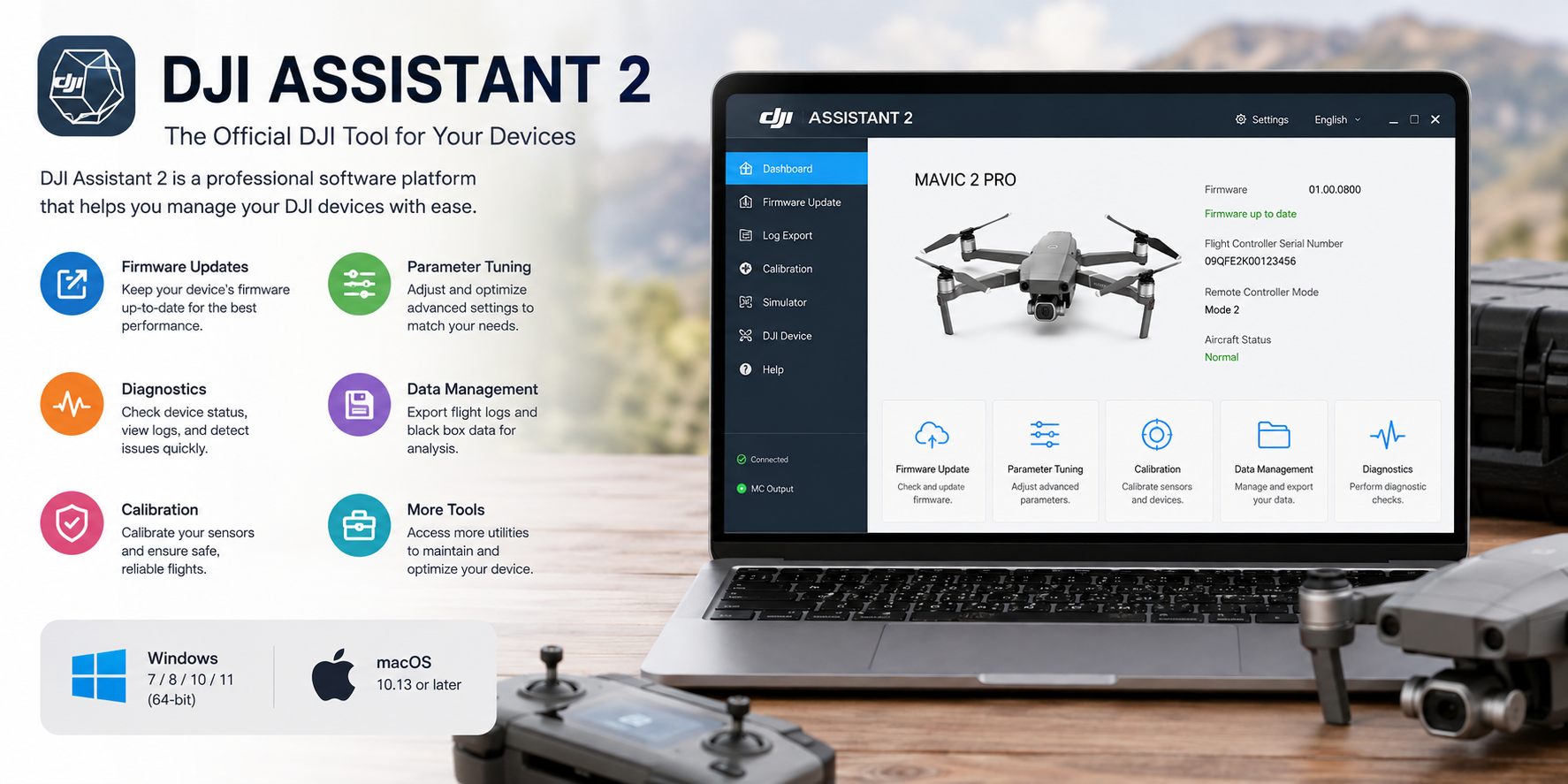
DJI Assistant 2 is a different class of utility application that takes the place of a flight control application. It’s useful for updates, diagnostics, and control of aircraft.
Pilots who fly several drones can find it easier to troubleshoot from having both a mobile flight app and a desktop maintenance app.
Advantages of Battery Monitoring Apps
Battery Monitoring Apps have several useful advantages.
- Better flight plans: Knowing roughly how much flight time is remaining helps a pilot know when it is likely best to return.
- Early warnings: Software can tell when a battery is having a problem and give a warning before it becomes a more serious problem.
- Battery history: Software gives users cycle count information, which lets users know how many times a battery has been used.
- Maintenance support: Diagnostic and firmware tools can help keep compatible aircraft and batteries working properly.
- Safety improvements: While flying, giving a pilot more information about the battery being used improves safety.
Battery monitoring becomes more important during long flights, commercial inspections, photography missions, and flights in bad and/or changeable weather.
How to Correctly Charge Your Drone Batteries
Charging is a big part of how a user takes care of a battery.
Always use the battery’s designated charger, and do not use damaged chargers or cables, and do not use batteries that are visibly damaged.
A battery can become warm during use, but charging a battery recently used can increase the risk of damage. In order to avoid damage to the battery, DJI suggests cooling batteries before charging.
During charging:
- Place the battery on a stable surface that is also non-flammable.
- Always use the recommended charger.
- Charging should never be done unsupervised.
- Batteries should be inspected before charging each time.
- Never use a visibly damaged or swollen battery.
- Batteries should be allowed to cool before charging if they became too hot during use.
- Lithium batteries should never be repaired unless a user has the needed tools and training to repair them.
How to Store Drone Batteries
Proper battery storage is different from battery charging. Lithium batteries, especially if they’re charged up and stored for extended periods of time, will degrade faster. The partial charge storage recommendation by the DJI team is to store long-term at roughly 40 to 65 percent charge and to perform a charge-discharge cycle every three months.
The environment you store the battery in is important. LiPo batteries don’t like being stored in a hot car or in the sun or in a place that is moist. Be mindful of the storage temperature. Cold temperatures will limit performance.
Also Read- Best Video Editing Software: Powerful Tools for Stunning Videos
Signs That a Battery Needs Replacement
The longer LiPo batteries are used, the higher the chance they are in need of being replaced.
Give the following points consideration:
- Swelling
- Deformation
- Unusual heating
- Decreased flight time
- Battery warnings in the app
- Dysregulated cell voltage
- Weak charge hold
A battery that is significantly swollen and deformed should no longer be used. For all other forms of damage, the recommendation by DJI and an authorized dealer is to cease the use of the battery.
Since there is no set number of battery cycles that determines battery lifespan, a battery that has been used heavily does not have to be replaced. Decline of a battery is expected, but noticeable decline of performance can be negated through proper maintenance.
Tips for Improving Battery Lifespan
- Avoiding deep discharges is the first step. An appropriate amount of charge on the battery, as a reserve, should be maintained before landing.
- The second step is to ensure that extended storage is not done at 100 percent charge. Many manufacturers specifically state not to do this.
- Avoid exposing batteries to high or low temperatures. Both can impact your drone. Heat can accelerate the aging of batteries. Cold can impact the performance of your drone.
- Inspect batteries each time you fly. You must perform a thorough check of your batteries before every flight. During these inspections, pay close attention to connectors, as they can be damaged easily.
- Check battery statistics and notifications available in the app. Temperature and voltage of the batteries can indicate how your batteries are performing during flight.
Choosing the Right Drone Battery
When purchasing a new battery for your drone, first consider compatibility. Compatibility will be determined by your drone model number, the battery model number, manufacturer, voltage, and battery capacity. If your drone uses a manufacturer-specified smart battery, for your safety, it is always advised to purchase a new battery from the original manufacturer, as the aircraft and battery have close communications. If you fly FPV drones or custom drones, you may have a wider selection and freedom to adjust battery capacity within your drone and flight requirements.
A larger battery doesn’t always mean a better battery. Any increase in battery size can increase the weight of your drone. An increased weight on the drone can stress the flight motors and negatively impact your flight time.
Drone Battery Safety Checklist
Be sure to follow the checklist below before every flight
- Inspect the battery for swelling or physical damage.
- Check battery warnings in the companion app.
- Inspect that the battery is unmoved and in place.
- Consider the local weather and temperature to determine if it is optimal for flight.
- Monitor the battery level as you fly to avoid critical drainage.
- Allow a cool down of the battery as you land.
- Store remaining batteries as directed by the battery manufacturer.
- This simple routine can prevent many avoidable battery-related problems
Conclusion
The purpose of this section is to highlight the importance of battery management in ensuring safe and effective drone operation. Familiarity with battery capacity and voltage, battery discharge characteristics, battery temperature, battery charging, and battery storage will allow the pilots to fly their drones consistently.
Battery management applications may be present in a drone controller and show the pilot remaining flight time, battery status, warnings, and battery cycle count. If these applications are present, the pilot must manage the battery according to the directions. Additionally, the pilot should fully cool the battery before charging, store the battery properly, frequently inspect the battery, and remove the battery from circuitry as soon as it is detected to be damaged or swollen.
The best drone batteries will be those that are compatible with the drone along with proper maintenance and safe handling throughout their service life. If you manage your battery as part of the drone, your flights will be safer and more productive.
FAQs
1. How long do drone batteries last?
There are many factors that influence battery life including battery chemistry, usage, charging habits, temperature, and the drone, but the average flight time a drone will experience is 10 to 40 minutes.
2. Should I fully charge a drone battery before flying?
It is advised that consumer drones are charged to the appropriate level by the manufacturer, but it is best to avoid leaving lithium batteries fully charged for long periods of time.
3. Is it possible to buy a higher-capacity battery?
Only as approved by the drone manufacturer and/or the battery system manufacturer. A bigger battery will certainly increase the weight of the drone and can impact the balance, performance, and aeronautics of the drone.
4. Why do drone batteries get hot?
More current draw, aggressive flying, hot weather, and charging are the biggest contributors to battery temperatures. Excessive heating is usually due to a battery issue, and shouldn’t be taken lightly.
5. Can an app give me insights on my battery health?
Depending on the app and the battery, these indicators may provide an idea on battery health. However, it is important to remember that these indicators are not a comprehensive diagnosis, and should be complemented with a physical examination.