Cosmos 3: The Next Revolution in Physical AI
+
Table of Contents
- 1 What Is Cosmos 3?
- 2 Key Features of Cosmos 3
- 2.1 1. Advanced Understanding of the World
- 2.1.1 With this, robots can:
- 2.2 2. Advanced Intelligence for Robotics
- 2.2.1 Examples of use are:
- 2.3 3. Physical Predictive Reasoning
- 2.4 4. Large-Scale Simulation Training
- 2.5 5. Multimodal Processing
- 2.6 Benefits of Cosmos 3
- 2.6.1 Increased Efficiency
- 2.6.2 Increased Safety
- 2.6.3 Reduced Development Costs
- 2.6.4 More Adaptability
- 2.6.5 More Rapid Innovation
- 3 Features & Benefits Table
- 3.1 Applications of Cosmos 3
- 3.1.1 Healthcare
- 3.1.2 Transportation
- 3.1.3 Agriculture
- 3.1.4 Smart Cities
- 3.1.5 Challenges and Considerations
- 3.1.6 High Computing Requirements
- 3.1.7 Data Complexity
- 3.1.8 Ethical Concerns
- 3.1.9 High Costs
- 3.2 The Future of Cosmos 3 and Physical AI
- 4 Conclusion
The last decade has witnessed the development of multiple generations of Artificial Intelligence and their applications in diverse domains such as health care, finance, education, and entertainment. The next big thing, however, will not be digital intelligence. It is Physical AI, which refers to sophisticated AI systems that understand the world around them, engage with it, and can work within it. NVIDIA’s Cosmos 3 is a step in this direction. It offers advanced features tailored to the needs of robots, autonomous systems, and intelligent machines.
Cosmos model is not the run-of-the-mill AI model. It is designed to narrow the chasm between logic and action, helping machines better perceive their environments, forecast the consequences of their actions, and make rational decisions. As more and more businesses adopt robotics and automation, Cosmos model is positioned to be a game-changer in the world of Physical AI.
What Is Cosmos 3?
Cosmos 3 is NVIDIA’s next-generation AI model focused on the intersection of robotics and Physical AI. Unlike most contemporary language models, which process and respond to text, Cosmos Model is an AI model with the capability to perceive and reason about the world.
The platform assists autonomous systems and robots in recognizing their environments, anticipating interactions, and performing a wide range of physical tasks with a high degree of precision. For this reason, Cosmos 3 will be highly beneficial to automation-dependent industries like manufacturing, logistics, health care, transportation, and intelligent infrastructure.
With the combination of massive AI training, simulation, and advanced reasoning, Cosmos 3 will help machines work successfully in the fast-changing, unpredictable real world.
The Importance of Physical AI
Standard AI can interpret data and produce responses to queries. Unfortunately, the real world is complex and constantly in flux. Robots need to maneuver through challenges, ascertain the characteristics of objects, anticipate their movements, and adjust to the unforeseen.
The goal of Physical AI is to allow machines to:
- Comprehend the relationships of objects in a space
- Understand what they are perceiving
- Predict the outcome of events
- Engage with humans in a safe manner
- Embrace the variability of the world
- Complete difficult, multifaceted, and nuanced tasks
Cosmos 3 provides the advanced intelligence for physical systems to address these needs.
Key Features of Cosmos 3
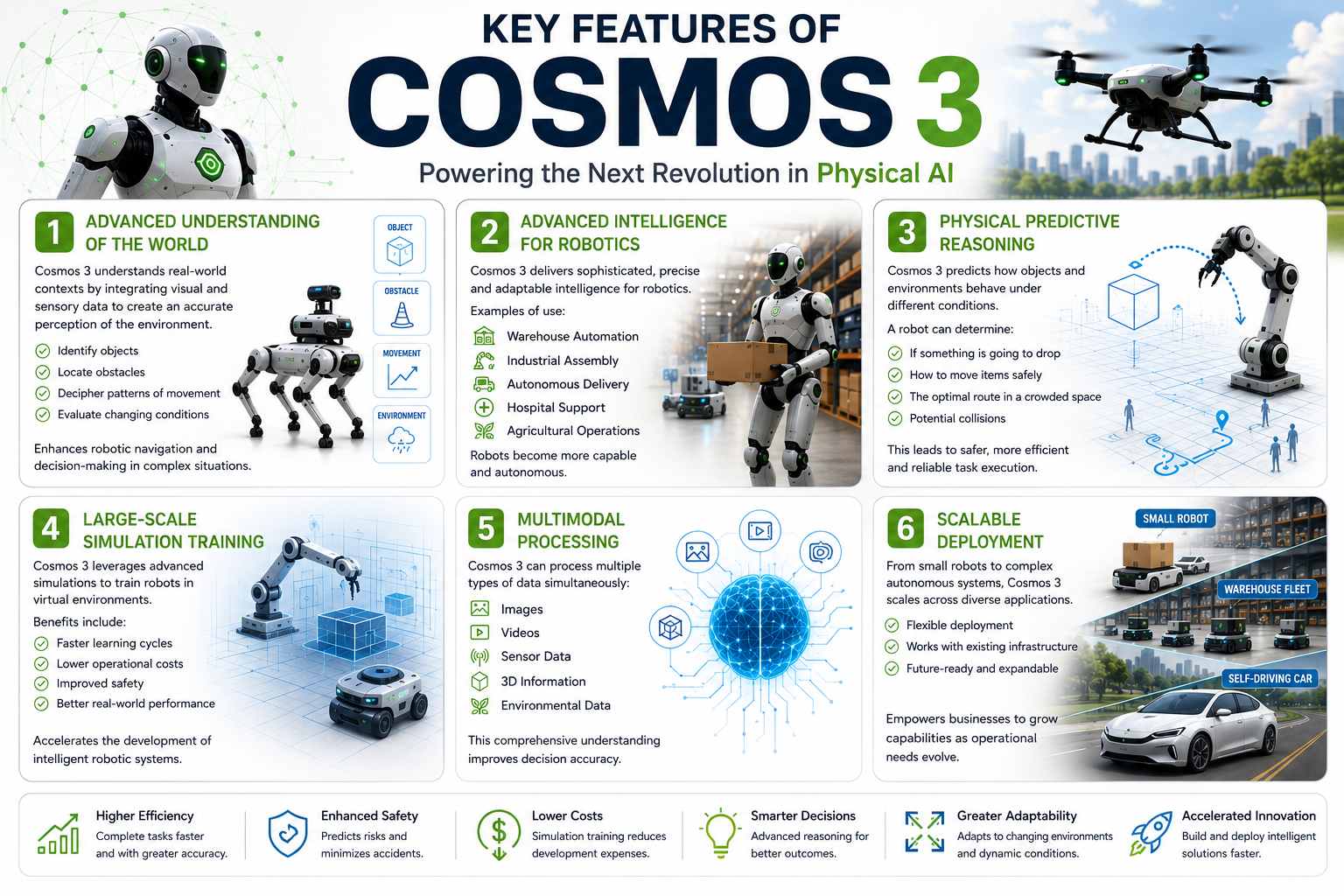
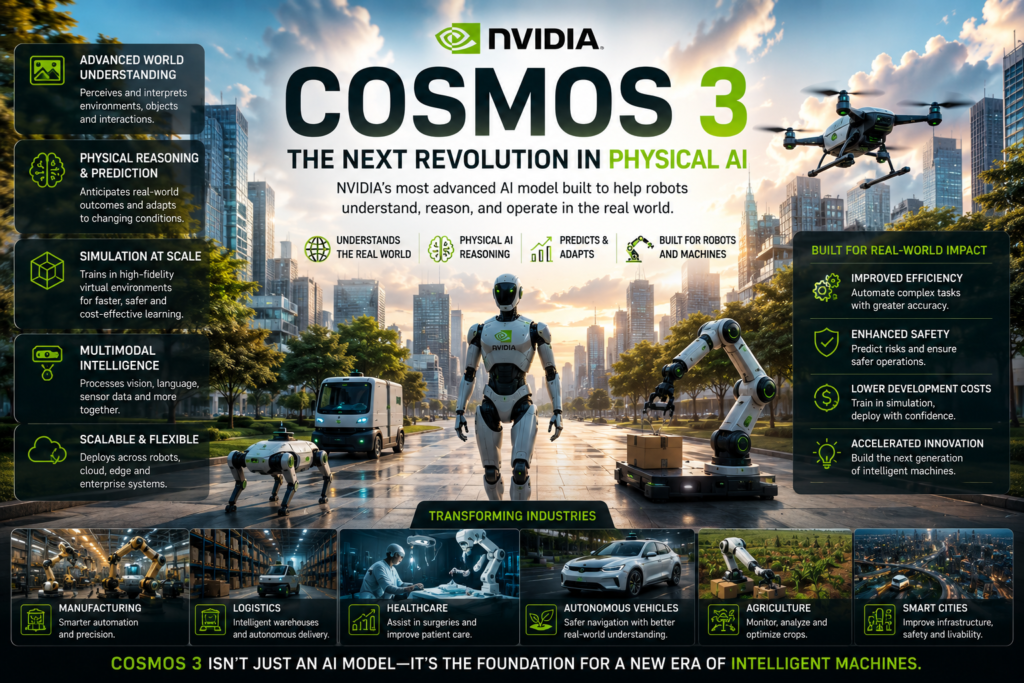
1. Advanced Understanding of the World
Among many impressive functionalities of Cosmos Model, one of the most advanced is its ability to comprehend real-world contexts. The model possesses the ability to integrate advanced visual and other sensory data to form a clear and accurate depiction of what surrounds it.
With this, robots can:
- Identify objects
- Locate obstacles
- Decipher patterns of movement
- Evaluate changing environmental conditions
All of these abilities enhance robotic navigation and decision-making in complex situations.
2. Advanced Intelligence for Robotics
With the robotic domain in focus, any robot powered by Cosmos Model can complete tasks with a level of sophistication requiring the ability to be coordinated, as well as precise and flexible.
Examples of use are:
- Automation of warehouse operations
- Assembly in an industrial setting
- Autonomous delivery
- Support in the hospital
- Operations in agriculture
Advanced intelligence for robotics means that robots work better and are more autonomous.
3. Physical Predictive Reasoning
At its core, the functionality of Cosmos Model is Physical Reasoning. The model has the ability to predict the behavior of objects and environments under differing conditions.
For instance, a robot can determine:
- If something is going to drop
- How to avoid breaking or damaging something while moving it
- What is the optimal route for traveling through a packed space
- What is going to cause it to bump into another object
Being able to do this is a big step forward in being able to safely and efficiently complete tasks.
4. Large-Scale Simulation Training
Training robots in the real world is slow and expensive. Cosmos 3 utilizes the power of advanced simulation to allow robots to learn and perform the tasks in the virtual world.
This provides an advantage to the real world in that:
- The time it takes to learn is greatly reduced
- The cost to operate is significantly decreased
- The tasks can be performed more safely
- The robots are more capable in the performed tasks
Training robots in a virtual world under simulations greatly speeds up the development of intelligent robotic systems that are intelligent.
5. Multimodal Processing
Cosmos Model is capable of simultaneously processing:
- Pictures
- Videos
- Data from sensors
- 3D information
- Data from the surrounding environment
Being able to process all of this simultaneously enhances the systems knowledge of the world and improves the accuracy of the system’s decisions.
6. Scalable Deployment
From powering a small robotic warehouse worker to a sophisticated self-driving car, flexible Cosmos 3 deployment is possible throughout the range of applications.
Cosmos Model allows businesses to use the current infrastructure and definitely expand capabilities to meet the future demands of operations.
Benefits of Cosmos 3
The use of Cosmos 3 in operations and research has a lot of benefits.
Increased Efficiency
The tasks performed by robots that are equipped with the Cosmos 3 system are performed faster and more accurately resulting in fewer delays and increased productivity.
Increased Safety
The understanding and risk-predicting capabilities of Cosmos 3 reduce the incidence of accidents between robots and people.
Reduced Development Costs
Development costs are lower because real-world testing is not as necessary with simulation-based learning.
More advanced reasoning will enable machines to be even better at making decisions throughout more complex scenarios.
More Adaptability
Cosmos 3 allows systems to be more adaptable to even further changes within their environment without needing substantial human monitoring.
More Rapid Innovation
Developers are able to create more advanced robotic systems, expanding the possibilities for multi-industry innovations.
Features & Benefits Table
| Feature | Description | Primary Benefit |
|---|---|---|
| World Understanding | Ability to comprehend physical surroundings | Improved navigation and situational awareness |
| Robotics Optimization | Tailored for robotic systems | Improved performance of robotic automation |
| Physical Reasoning | Ability to comprehend and predict real-world interactions | Improved safety and accuracy |
| Simulation Training | Virtual environments for learning | Lower training costs |
| Multimodal Processing | Ability to process and integrate various forms of information | Better decision-making |
| Scalable Architecture | Ability to be deployed in various sizes | Flexible use across applications |
| Advanced AI Models | Ability to perform high-level reasoning | Improved operational efficiency |
| Real-Time Analysis | Ability to quickly assess the environment | Faster response and action execution |
Applications of Cosmos 3
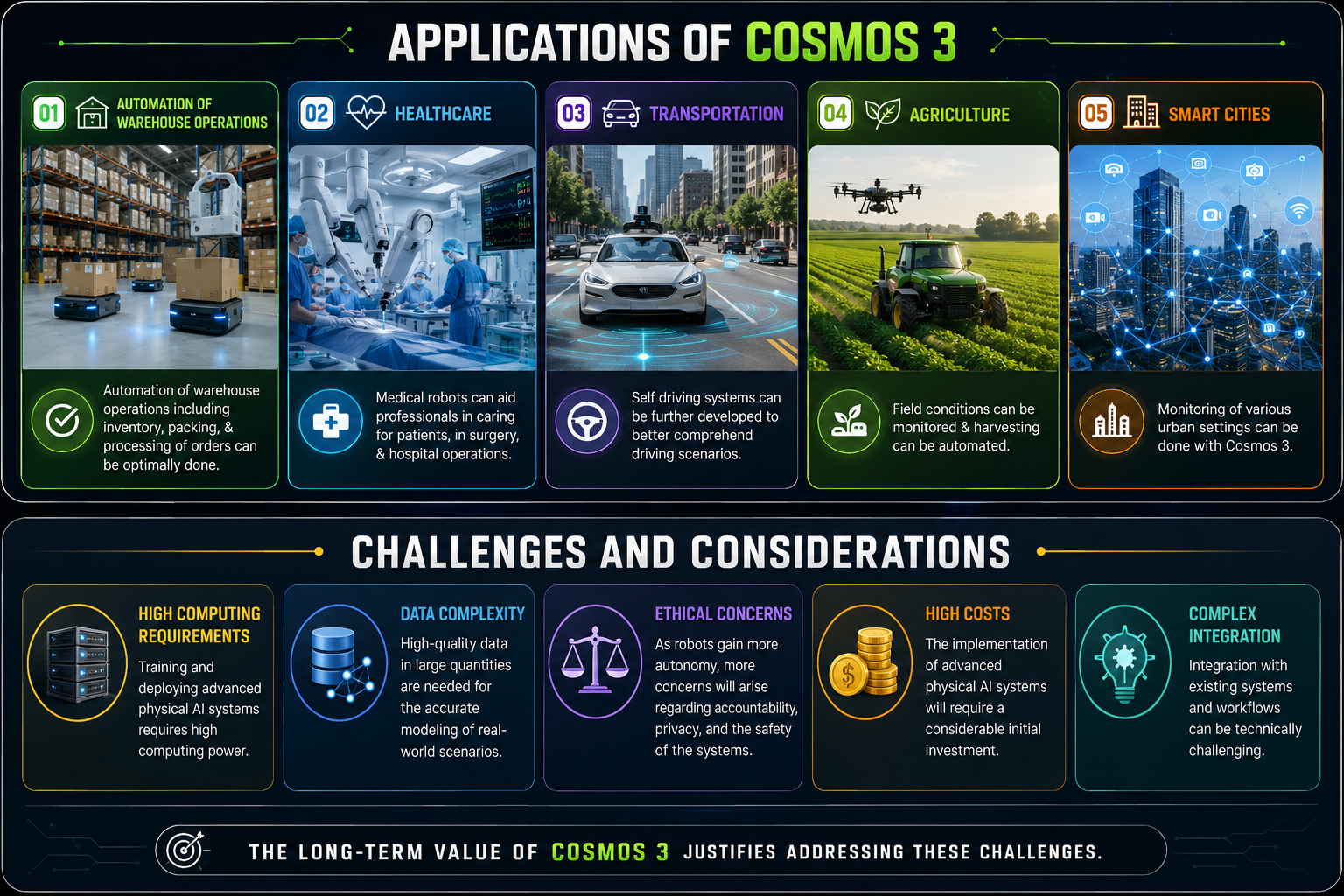
Automation of warehouse operations, including inventory, packing, & processing of orders, can be optimally done.
Healthcare
Medical robots can aid professionals in caring for patients, in surgery, & hospital operations.
Transportation
Self-driving systems can be further developed to better comprehend driving scenarios.
Agriculture
Field conditions can be monitored, & harvesting can be automated.
Smart Cities
Monitoring of various urban settings can be done with Cosmos 3.
Challenges and Considerations
There are several challenges that must be addressed despite the game-changing potential offered by Cosmos 3.
High Computing Requirements
Training and deploying advanced physical AI systems require high computing power.
Data Complexity
High-quality data in large quantities is needed for the accurate modeling of real-world scenarios.
Ethical Concerns
As robots gain more autonomy, more concerns will arise regarding accountability, privacy, and the safety of the systems.
High Costs
The implementation of advanced physical AI systems will require a considerable initial investment.
The long-term value of Cosmos 3 justifies addressing these challenges.
Also Read- Revolutionary Cobra 600: Germany’s Powerful New Interceptor Drone
The Future of Cosmos 3 and Physical AI
The future of Cosmos 3 is extremely bright. The advanced AI systems of models will allow for the development of more physically intelligent and interactive robots.
Potential developments include:
- Advanced humanoid robots
- Sophisticated industrial automation
- Completely autonomous logistics systems
- Advanced healthcare robotics
- Sophisticated robotics for disaster response
- Advanced systems for more optimal transportation
Cosmos 3 provides the necessary components for the intelligence of machines to successfully operate in the physical domain and will make each of these developments and more a reality.
Conclusion
The advanced capabilities of Physical AI brought by Cosmos 3 are a leap forward in the discipline. By harnessing predictive reasoning, augmented world understanding, simulation-based learning, and multimodal processing, the interaction of robots and advanced systems with the physical domain will be unprecedented.
Automation is rapidly reshaping entire industries. In this new landscape of robotics and automated systems, Cosmos 3 is likely to play a pivotal role. There are always challenges to overcome, but the technology is currently well-positioned. Innovations in efficiency, safety, and adaptability mean that organizations that want to invest in physical AI should consider that Cosmos 3 will be the underlying platform.
Frequently Asked Questions (FAQs)
1. What is Cosmos 3?
Cosmos 3 is NVIDIA’s new AI platform that helps robots and physical AI technologies to understand and interact with the world.
2. How is Cosmos 3 different from other AI models?
Most AI models work with text and data that are purely digital, but Cosmos 3 works with the physical world and understands actions and interactions in the real world.
3. Who can use Cosmos 3 technology?
Cosmos 3 can be used in industries such as manufacturing, logistics, healthcare, agriculture, and transportation, as well as in the infrastructure of future smart cities.
4. How will Cosmos 3 change robotics?
Better understanding and reasoning about the world and greater ability to simulate different scenarios and process many forms of data will enhance the intelligence of robots that use Cosmos 3.
5. What is Physical AI?
Physical AI refers to artificial intelligence that can understand and interact with the world and does not function in purely digital environments.
6. What is the envisioning of Cosmos 3?
The envisioning of Cosmos 3 is to fuel complex robotics, driverless cars, intelligent infrastructure, automated healthcare, and next-gen robust Physical AI.