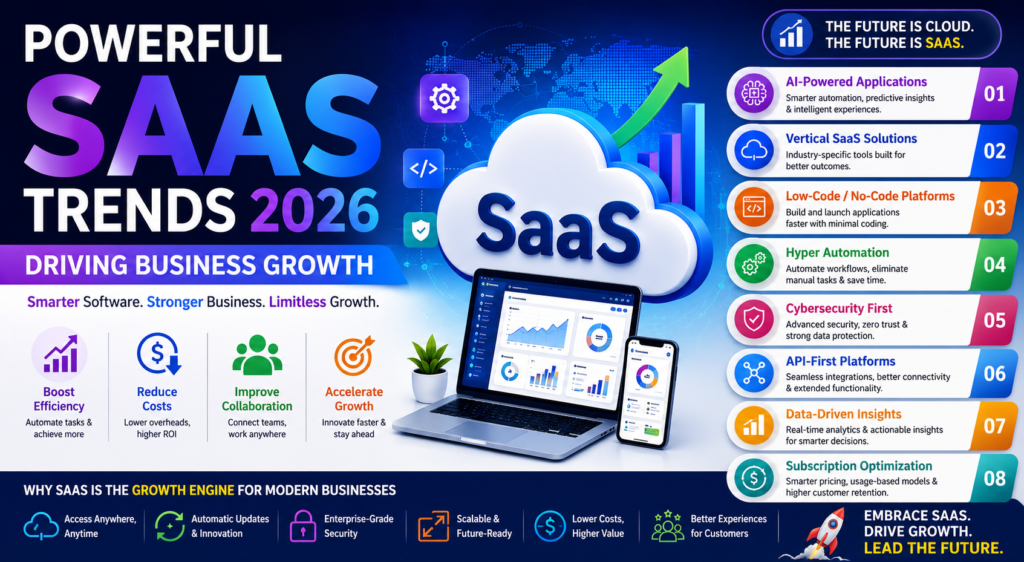
Powerful SaaS Trends 2026 Driving Business Growth
+
Table of Contents
- 1 What Is SaaS?
- 1.1 What’s Driving the Powerful SaaS Trends in 2026 Driving Business Growth?
- 1.1.1 Remote and Hybrid Work
- 1.1.2 Artificial Intelligence Integration
- 1.1.3 Reduced IT Costs
- 1.1.4 Cybersecurity Improvements
- 1.1.5 Faster Innovation
- 2 Top Powerful SaaS Trends 2026 Driving Business Growth
- 2.1 1. AI-Powered SaaS Applications
- 2.1.1 AI SaaS is used for:
- 2.2 2. Vertical SaaS Solutions
- 2.3 3. Low-Code and No-Code Development
- 2.4 4. Hyper Automation
- 2.5 5. Cybersecurity-First SaaS
- 2.6 6. API-First SaaS Solutions
- 2.7 7. SaaS and Data-Driven Decisions
- 2.8 8. Optimized Subscriptions
- 2.9 A Modern SaaS Solution’s Key Features
- 2.9.1 Cloud Accessibility
- 2.9.2 Automatic Updates
- 2.9.3 AI Enhancements
- 2.9.4 Scalability
- 2.9.5 Real-Time Collaboration
- 2.9.6 Enterprise Security
- 2.9.7 Easy Integration
- 2.9.8 Analytics Dashboard
- 2.10 Comparison Table of Powerful SaaS Trends 2026 Driving Business Growth
- 3 Benefits of Powerful SaaS Trends 2026 Driving Business Growth
- 3.1 1. Reduced Cost of Ownership
- 3.2 2. Increased Flexibility
- 3.3 3. Increased Business Agility
- 3.4 4. Enhanced Team Collaboration
- 3.5 5. Increased Data Security
- 3.6 6. Constant Improvement
- 3.7 7. Enhanced Customer Experience
- 3.8 Challenges Businesses May Face
- 3.8.1 Data Privacy Regulations
- 3.8.2 Vendor Lock-In
- 3.8.3 Internet Dependency
- 3.8.4 Subscription Management
- 3.8.5 Employee Training
- 3.9 Best Practices for Implementing SaaS in 2026
- 3.9.1 Select Growth-Ready Solutions
- 3.9.2 Security Priority
- 3.9.3 Systems Integration
- 3.9.4 Performance Management
- 3.9.5 Employee Training
- 3.9.6 Vendor Review
- 3.10 Future of SaaS Beyond 2026
- 3.11 The Cost of Waiting
- 4 Summary
The landscape of SaaS in 2026 is actively shifting how all businesses, from small startups to large corporations, run their day-to-day operations. It is clear how impactful SaaS has become in regard to offering businesses more cost-effective methods of providing services to their clients, improving employee productivity, and helping businesses enter the digital space at an increased pace. The Powerful SaaS Trends 2026 Driving Business Growth are customizing the way software is delivered and offering businesses solutions that are more flexible, secure, and built around the needs of their clients.
Businesses are making a large leap into more modern SaaS systems, as AI, automation, low-code, and vertical-cloud systems become more prevalent. Businesses that want to remain competitive and prepare for more disruptive technologies need to understand these trends.
This article explains the Powerful SaaS Trends 2026 Driving Business Growth, their most important characteristics, their use cases, and why they are important to businesses of any scale.
What Is SaaS?
SaaS (Software as a Service) is a model of software delivery via the cloud. Rather than businesses buying software to install on their computers, businesses buy subscriptions to use a software system that is hosted on the provider’s computers.
Integration of SaaS frameworks into systems has become common due to the flexibility, automatic updates, scalability, and decreased costs of infrastructure.
What’s Driving the Powerful SaaS Trends in 2026 Driving Business Growth?
Numerous initiatives are leading to the industry-wide acceptance of the Powerful SaaS Trends 2026 Driving Business Growth.
Remote and Hybrid Work
Widespread adoption of remote work has led to a greater need for cloud computing. SaaS allows employees to work from anywhere.
Artificial Intelligence Integration
AI assistants, predictive analytics, smart automation, and tailored customer experiences are now embedded in SaaS applications.
Reduced IT Costs
Clients no longer have to purchase costly servers or maintain large IT staffs to run applications. Computing on a subscription basis improves budgeting.
Cybersecurity Improvements
Security is a top priority for cloud vendors who improve security through encryption, multi-factor authentication, automated monitoring, and compliance certifications.
Faster Innovation
Continuous updating of software allows businesses to use new features without the need for installations or downtime.
Top Powerful SaaS Trends 2026 Driving Business Growth
1. AI-Powered SaaS Applications
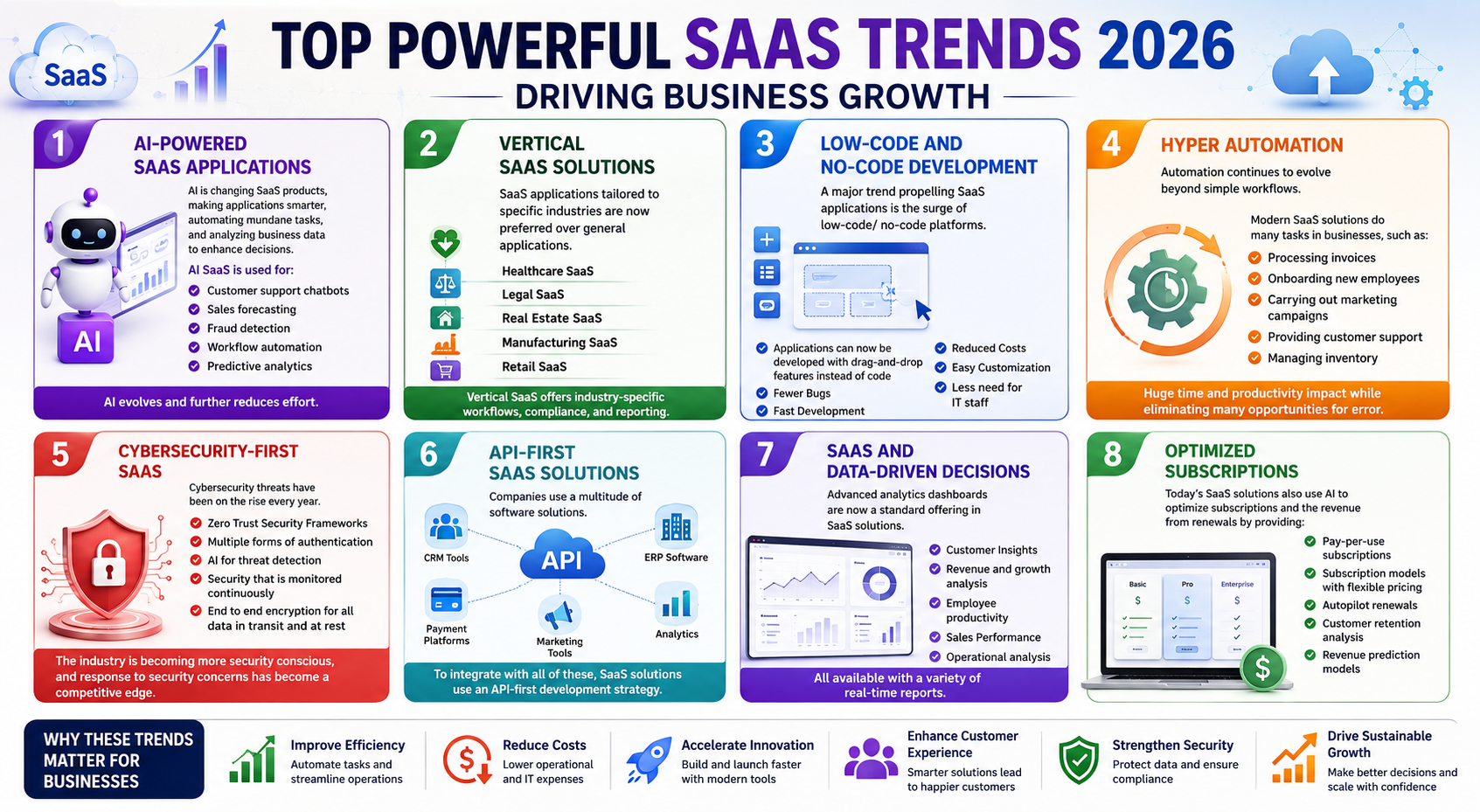
AI is changing SaaS products, making the applications smarter, able to automate mundane tasks, and able to interpret and analyze business data to enhance decisions.
AI SaaS is used for:
- Customer support chatbots
- Sales forecasting
- Fraud detection
- Workflow automation
- Predictive analytics
AI evolves and further reduces effort.
2. Vertical SaaS Solutions
SaaS applications tailored to specific industries are now preferred over general applications.
- Healthcare SaaS
- Legal SaaS
- Real Estate SaaS
- Manufacturing SaaS
- Retail SaaS
Vertical SaaS offers industry-specific workflows, compliance, and reporting.
3. Low-Code and No-Code Development
A major trend propelling SaaS applications is the surge of low-code/ no-code platforms.
Applications can now be developed with drag-and-drop features instead of code.
- Fewer Bugs
- Fast Development
- Reduced Costs
- Easy Customization
- Less need for IT staff
4. Hyper Automation
Automation continues to evolve beyond simple workflows.
Modern SaaS solutions do many tasks in businesses, such as:
- Processing invoices
- Onboarding new employees
- Carrying out marketing campaigns
- Providing customer support
- Managing inventory
The result is a huge time and productivity impact while also eliminating many opportunities for error.
5. Cybersecurity-First SaaS
Cybersecurity threats have been on the rise every year.
Some of the most advanced SaaS solutions offer:
- Zero Trust Security Frameworks
- Multiple forms of authentication
- AI for threat detection
- Security that is monitored continuously
- End-to-end encryption for all data in transit and at rest
The industry is becoming more security conscious, and response to security concerns has become a competitive edge.
6. API-First SaaS Solutions
Companies use a multitude of software solutions.
Modern SaaS apps integrate with many different software solutions, such as:
- CRM tools
- ERP software
- Payment platforms
- Marketing tools
- Different analytics
To integrate with all of these, SaaS solutions use an API-first development strategy.
7. SaaS and Data-Driven Decisions
Advanced analytics dashboards are now a standard offering in SaaS solutions.
These enable insights for businesses on
- Customer Insights
- Revenue and growth analysis
- Employee productivity and
- Sales Performance
- Even operational analysis
This is all available with a variety of real-time reports.
8. Optimized Subscriptions
Today’s SaaS solutions also use AI to optimize subscriptions and the revenue from renewals by providing:
- Pay-per-use subscriptions
- Subscription models with flexible pricing
- Autopilot renewals
- Customer retention analysis, and
- Revenue prediction models
Also Read- Best VPN for Netflix: Unlock Unlimited Streaming Instantly
A Modern SaaS Solution’s Key Features
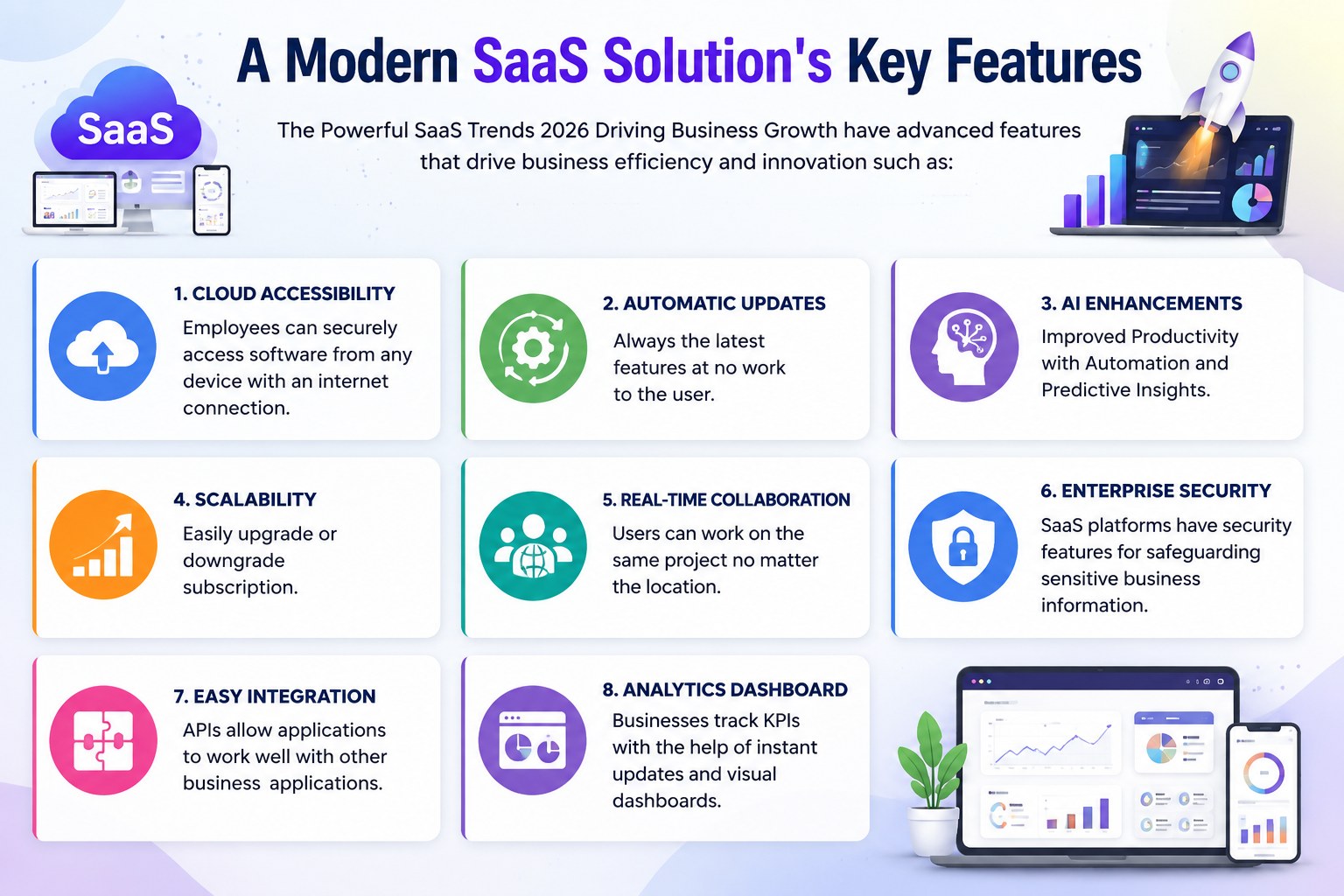
The Powerful SaaS Trends 2026 Driving Business Growth have advanced features that drive business efficiency and innovation, such as:
Cloud Accessibility
Employees can securely access software from any device with an internet connection.
Automatic Updates
Always the latest features with no work for the user.
AI Enhancements
Improved Productivity with Automation and Predictive Insights
Scalability
Easily upgrade or downgrade your subscription.
Real-Time Collaboration
Users can work on the same project no matter the location.
Enterprise Security
SaaS platforms have security features for safeguarding sensitive business information.
Easy Integration
APIs allow applications to work well with other business applications.
Analytics Dashboard
Businesses track KPIs with the help of instant updates and visual dashboards.
Comparison Table of Powerful SaaS Trends 2026 Driving Business Growth
| SaaS Trend | Primary Purpose | Business Benefit |
|---|---|---|
| AI-Powered SaaS | Smart Automation | Higher productivity |
| Vertical SaaS | Niche solutions | Improved operational efficiency |
| Low-Code Platforms | Quick app building | Faster advancements |
| Hyper Automation | Task automation | Less manual work |
| Cybersecurity SaaS | Covers data safety | Better compliance |
| API-First Platforms | App integration | Improved connections |
| Advanced Analytics | Analytics | Decisions based on data |
| Subscription Optimization | Control revenue | Improved customer retention |
The Powerful SaaS Trends 2026 Driving Business Growth have become very important for companies that want to be successful in the long term in the last few years. Gaining these innovations has meant that companies have greater flexibility, better customer experiences, and safer, more efficient operations. The pace of change in the digital marketplace is forcing companies to adopt new SaaS technologies, and the ones that do will best allow them to compete.
Benefits of Powerful SaaS Trends 2026 Driving Business Growth
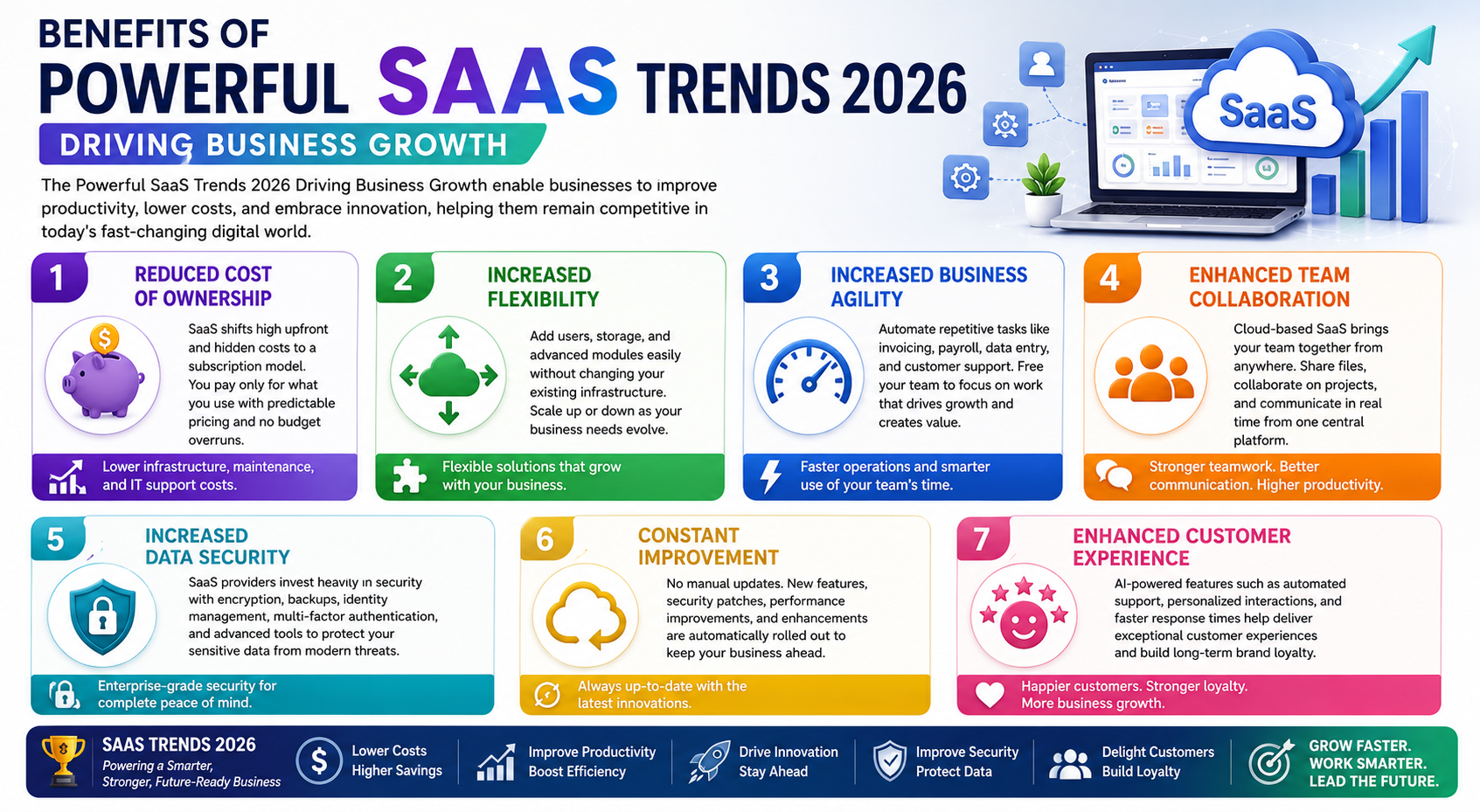
The Powerful SaaS Trends 2026 Driving Business Growth enable businesses to improve productivity, lower costs, and embrace innovation, helping them remain competitive in today’s fast-changing digital world. The design of these cutting-edge, cloud-based solutions is to help companies more easily adapt to rapidly changing market conditions while also improving the employee and customer experience.
1. Reduced Cost of Ownership
Server-based software entails high upfront and hidden costs, including a lengthy acquisition process, purchase of expensive infrastructure, maintenance, and a dedicated IT Support staff. SaaS pivots most of these costs to a subscription model and only allows payments for services used, so costs are more predictable with no budget overruns.
2. Increased Flexibility
Software needs change as businesses grow. SaaS Applications allow businesses to add users, storage, and even modules for advanced features without changing existing infrastructure. This flexibility simplifies scaling operations.
3. Increased Business Agility
From an automation standpoint, SaaS Applications have a higher advantage over server-based applications. Instead of spending hours on repetitive tasks such as invoicing, payroll, data entry, and customer support, employees can rely on automation and dedicate more time to work that drives business growth.
4. Enhanced Team Collaboration
Since SaaS Applications are cloud-based, they allow collaboration among dispersed teams. Employees can easily share files, work together on projects, and communicate in real time from one central platform.
5. Increased Data Security
SaaS Providers make a significant investment in security. Encryption, automatic data backups, identity management, multi-factor authentication, and other tools protect sensitive data from much-advanced cyber security threats.
6. Constant Improvement
SaaS Applications eliminate the need to manually update software. Features, security and performance improvements, and other enhancements are made available automatically to all clients.
7. Enhanced Customer Experience
SaaS Applications rely on Artificial Intelligence to enhance customer interaction. Features such as automated customer support and improved response time enhance customer experience and loyalty to the brand.
Also Read- Powerful Cloud Computing Trends Transforming Business
Challenges Businesses May Face
Data Privacy Regulations
Organizations must ensure SaaS providers adhere to data privacy and protection laws and standards globally.
Vendor Lock-In
Transitioning to another SaaS platform can be difficult. Businesses should select SaaS vendors that provide open integrations and portability.
Internet Dependency
SaaS solutions are web-based; therefore, the business must have a dependable internet connection.
Subscription Management
The adoption of additional SaaS products increases the costs and the need to effectively manage subscriptions and licenses.
Employee Training
Employees may need some training to use new software effectively.
Best Practices for Implementing SaaS in 2026
To gain the most from the SaaS Trends 2026 Driving Business Growth, these practices should be adopted:
Select Growth-Ready Solutions
Select SaaS solutions that are designed to grow with your business.
Security Priority
Select SaaS vendors that provide encryption, compliance, and security audits, as well as advanced authentication.
Systems Integration
Select SaaS solutions that provide and support APIs for easy integration.
Performance Management
SaaS solutions should provide built-in analytics to manage business performance and the ROI of the SaaS solution.
Employee Training
Training users on SaaS solutions should be a continual practice.
Vendor Review
Downtime is highly reduced, and the user experience is greatly improved with SaaS vendors that provide reliable support.
Future of SaaS Beyond 2026
The continued application of artificial intelligence, machine learning, automation, and advanced technology and systems will further enhance the cloud software space and SaaS.
The next generation of SaaS platforms will likely have:
- AI-powered and virtual business assistants
- Predictive business intelligence
- Fully autonomous workflow automation
- AI solutions tailored for specific industries
- Machine Learning (ML) enhances cybersecurity and makes it more robust
- Customized user experience
- Sustainable cloud frameworks
- Advanced integration of Internet-of-Things (IoT) devices
Advancing and implementing these solutions first will help position your organization to capture the value of your marketplace and maintain a competitive advantage in a position of strength, especially in this digital economy.
The Cost of Waiting
Delaying the adoption of new cloud technologies will threaten your organization’s position in the market and in your industry. Organizations that are first to implement the Powerful SaaS Trends 2026 Driving Business Growth will achieve enhanced operational and business agility and competitive advantage.
No matter the size or type of your organization, directly investing in SaaS technologies today will offer you immediate benefits.
Summary
The Powerful SaaS Trends 2026 Driving Business Growth offers technologies that integrate the full set of business and operational frameworks, technologies, and tools required for the success of any organization in the digital economy.
SaaS technologies will be at the forefront of the next generation of business frameworks that will enable organizations to grow and innovate sustainably while maintaining a competitive advantage.
Most Asked Queries Answered
1. What are the Powerful SaaS trends in 2026 Driving Business Growth?
Some of the trends we will likely see include: AI apps, low-code dev, hyper automation, vertical SaaS, cybersecurity-first platforms, advanced analytics, API-first, and subscription optimization.
2. Why will SaaS be more popular in 2026?
SaaS will be preferred by organizations because of the higher presence of lower IT costs, higher support for elasticity, better support for distributed employees, auto updates, and increased pace of innovations.
3. In what ways does AI enhance SaaS?
AI increases the automation of mundane tasks, enhances the ability of the app to provide predictive analytics, and even helps improve customer service by providing smart decision tools to prevent fraud.
4. How many sectors benefit from SaaS?
Healthcare, Finance, Retail, Manufacturing, Education, Logistics, Legal, Real Estate, and virtually all sectors of the economy benefit from SaaS.
5. Is SaaS Business Safe?
Yes. It is safe as the top leading companies of SaaS provide encryption, multi-factor authentication, automated backups, 24/7 monitoring, compliance certifications, and AI detection of secure threats to prevent violation of business data.
6. How do businesses prepare for future SaaS trends?
Adapting to trends requires organizations to invest in flexible platforms, zero trust strategies, cyber hygiene integrations, and in continual employee training as well as AI analytics to help organizations sustain competitive advantage.