Zipline: The Powerful Rise of Drone Delivery
+
Table of Contents
- 1 What is Zipline?
- 2 Major Products and Platforms
- 2.1 1. Platform 1
- 2.2 2. Platform 2
- 3 Key Features of Zipline Technology
- 3.1 1. Autonomous Flight
- 3.2 2. Quick Delivery
- 3.3 3. P2 Precise Drop-Off Technology
- 3.4 4. Quiet Operation
- 3.5 5. Electric and Zero-Emission Aircraft
- 4 Benefits of Drone Delivery
- 4.1 Benefits for Businesses
- 4.2 Benefits for Consumer
- 4.3 Challenges Facing Drone Delivery
- 4.4 The Future of Drone Delivery
- 5 Conclusion
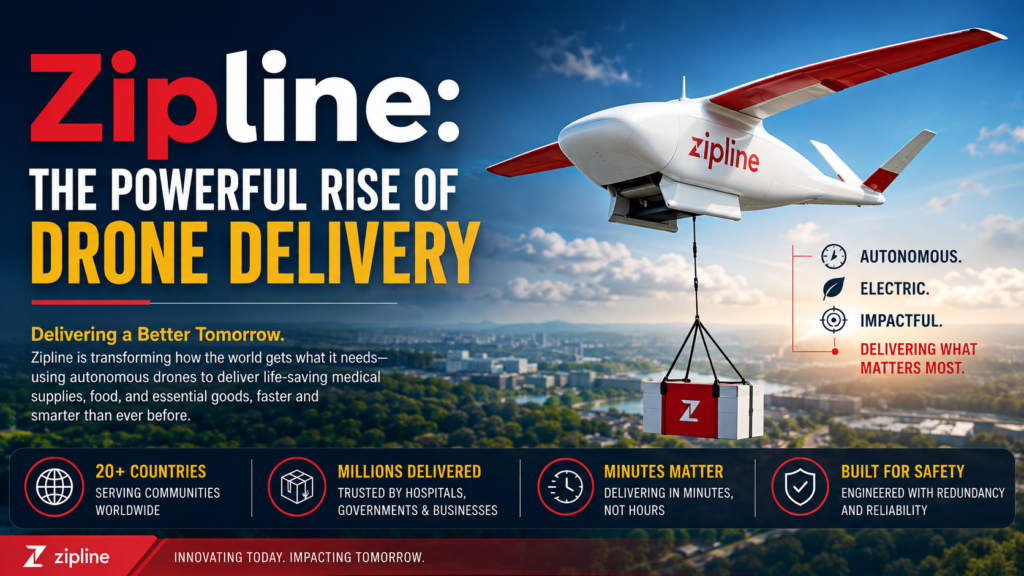
The future of delivery belongs in the air. Autonomous aircraft provide a new way of delivering food, medicine, groceries, and other essentials to customers. Zipline is leading the charge in designing technologies to make this new future of delivery fast, efficient, and scalable.
Using their own technology, Zipline has delivered critical supplies, in particular healthcare supplies and medicines, around the world. They are now looking to other areas of food, retail, and convenience delivery. In 2024, Zipline completed its one millionth autonomous drone delivery. This serves as a testament to how far the company has come delivering via drone.
Currently, Zipline has developed two main delivery systems: Platform 1 (P1) and Platform 2 (P2).
What is Zipline?
Zipline is an autonomous drone delivery company. Unlike other delivery companies that utilize trucks, motorcycles, or traditional courier networks, Zipline utilizes electric aircraft to deliver throughout its network.
Zipline first gained recognition for its role in healthcare logistics. Zipline’s aircraft deliver blood, vaccines, and other medical supplies to locations that are out of reach via traditional means or that have a slow and unreliable transport network.
This extensive experience allowed Zipline to develop its technology for delivery in real-world, challenging environments before it began to penetrate the consumer delivery market.
The company optimizes its new technologies for a range of markets, including healthcare, restaurant, grocery, retail, and convenience. This technology is perfect for delivery situations that necessitate speed and reliability, with the added feature of precision in drop-off location.
How the Drone Delivery System Works
The automated system consists of placing an order, preparing the order, and transporting the order via a drone.
The automation of this system is what differentiates it from other delivery systems. Several drones can be programmed to travel a predetermined route and, using built-in software, can also learn to maneuver using onboard sensors.
For home deliveries, the P2 system has a primary drone system, which hovers above the delivery site. It is then tethered to a smaller delivery system, called a Droid. The Droid then delivers the package via its tether.
This system lets the drone remain above both delivery and safety concerns while the Droid delivers the package to the target location.
Major Products and Platforms
The company’s technology can be primarily segmented into two product divisions.
1. Platform 1
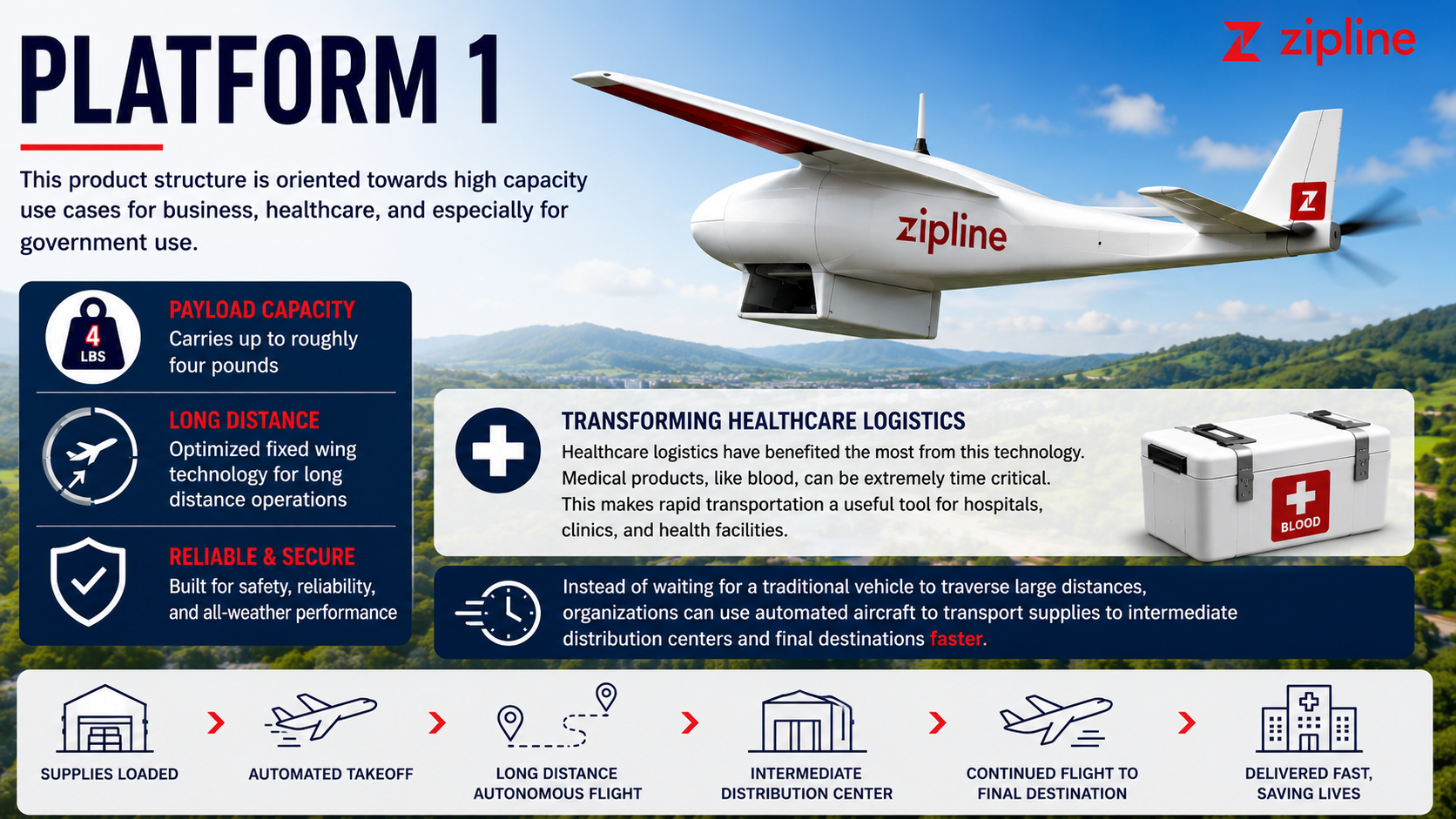
This product structure is oriented towards high-capacity use cases for business, healthcare, and especially for government use.
According to the company’s fact sheet, P1 can carry up to roughly four pounds. It has optimized fixed-wing technology for long-distance operations.
Healthcare logistics have benefited the most from this technology. Medical products, like blood, can be extremely time-critical. This makes rapid transportation a useful tool for hospitals, clinics, and health facilities.
Instead of waiting for a traditional vehicle to traverse large distances, organizations can use automated aircraft to transport supplies to intermediate distribution centers and final destinations faster.
2. Platform 2
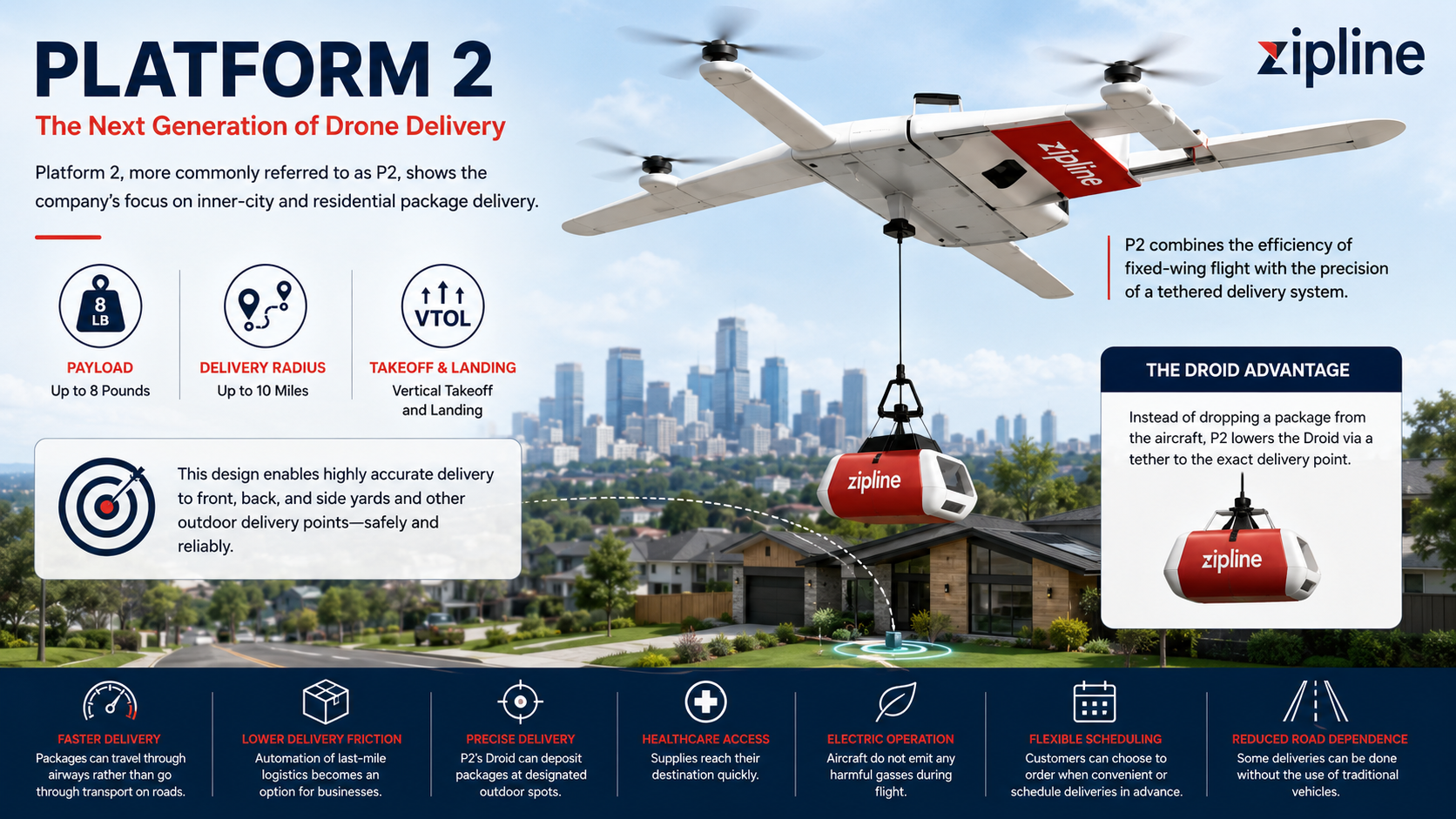
Platform 2, more commonly referred to as P2, shows the company’s focus on inner-city and residential package delivery.
The aircraft employs technology for vertical takeoff and landing, and once in the air, uses a fixed-wing design. It can carry eight pounds and serves a delivery radius of about 10 miles, per the company’s specifications.
The biggest distinguishing factor is the Droid, which instead of dropping a package from the aircraft, delivers the package via a tether that lowers the Droid to the delivery point.
This design enables highly accurate delivery to front, back, and side yards and other such delivery points.
Also Read- Kamikaze Drone Guide: The Ultimate Strike Technology
Key Features of Zipline Technology
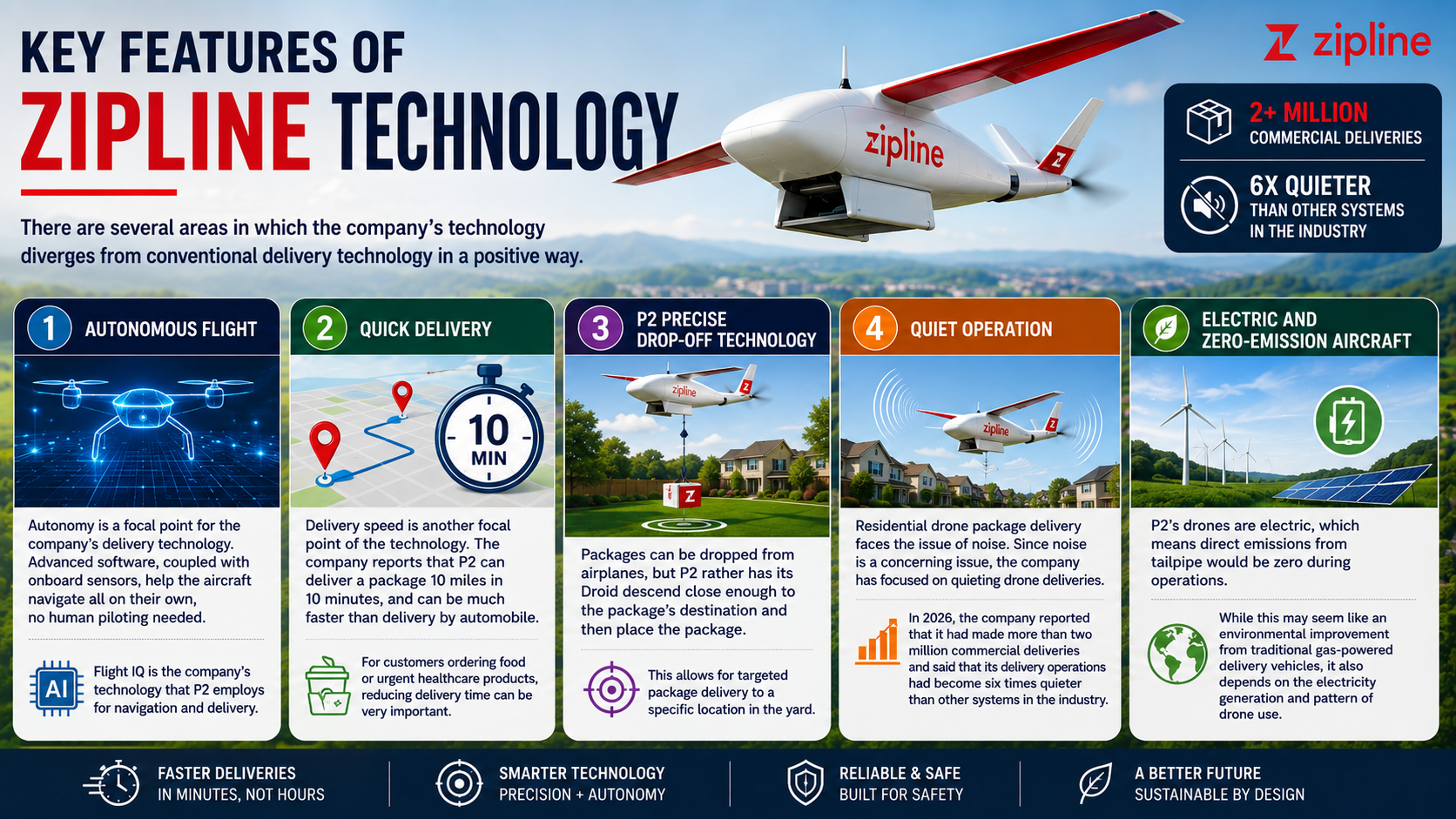
There are several areas in which the company’s technology diverges from conventional delivery technology in a positive way.
1. Autonomous Flight
Autonomy is a focal point for the company’s delivery technology. Advanced software, coupled with onboard sensors, helps the aircraft navigate all on their own, no human piloting needed.
Flight IQ is the company’s technology that P2 employs for navigation and delivery.
2. Quick Delivery
Delivery speed is another focal point of the technology. The company reports that P2 can deliver a package 10 miles in 10 minutes, and can be much faster than delivery by automobile.
For customers ordering food or urgent healthcare products, reducing delivery time can be very important.
3. P2 Precise Drop-Off Technology
Packages can be dropped from airplanes, but P2 has its Droid descend close enough to the package’s destination and then place the package. This allows for targeted package delivery to a specific location in the yard.
4. Quiet Operation
Residential drone package delivery faces the issue of noise. Since noise is a concerning issue, the company has focused on quieting drone deliveries.
In 2026, the company reported that it had made more than two million commercial deliveries and said that its delivery operations had become six times quieter than other systems in the industry.
Quieter aircraft would make autonomous package delivery more acceptable in neighborhoods where constant noise from drone package delivery would otherwise become a concern.
5. Electric and Zero-Emission Aircraft
P2’s drones are electric, which means direct emissions from the tailpipe would be zero during operations. While this may seem like an environmental improvement from traditional gas-powered delivery vehicles, it also depends on the electricity generation and pattern of drone use.
Benefits of Drone Delivery
The inclusion of autonomous delivery has many potential pros both in the commercial and individual sectors.
| Benefit | How It Helps |
|---|---|
| Faster Delivery | Packages can travel through the air rather than relying on road transportation. |
| Lower Delivery Friction | Automation makes last-mile logistics easier and more efficient for businesses. |
| Precise Delivery | P2’s Droid can deposit packages at designated outdoor locations. |
| Healthcare Access | Medical supplies can reach their destinations quickly, improving access to essential products. |
| Electric Operation | Electric aircraft produce no direct harmful gas emissions during flight. |
| Flexible Scheduling | Customers can order when convenient or schedule deliveries in advance. |
| Reduced Road Dependence | Some deliveries can be completed without relying on traditional road vehicles. |
Benefits for Businesses
Restaurants, retail stores, pharmacies, and healthcare can take advantage of autonomous delivery to help provide a wider delivery service window.
For restaurants, faster delivery can keep their food safe because a meal that reaches the customer in a shorter amount of time is less likely to be cold or lose its texture, etc.
Healthcare organizations can also benefit more from this. A delayed medicine, blood product, or diagnostic supply can cause a customer to be dissatisfied, but it can have even more serious effects on an organization. Rapid aerial logistics can help organizations move essential products.
The P2 system aims to make delivery intrinsic to a business. The company says its system can integrate with third-party ordering, and businesses can use dedicated loading solutions to prepare orders.
Also Read- Claude AI Review: The Ultimate AI Assistant for Smarter Work in 2026
Benefits for Consumer
The biggest appeal for consumers is convenience. Instead of waiting for a courier to deliver an order that could take hours, consumers can get their orders quickly and efficiently. This convenience will likely lead to even greater value as instant commerce increases.
There are many advantages of drone delivery, but one unique aspect of drone delivery is contactless delivery. Goods can be delivered contactless because, instead of coming to the customer’s doorstep, a drone can drop packages from the air because of the nature of drone delivery.
Another cool feature of drone delivery is scheduled delivery. Instead of staggering the delivery process, customers can choose when they want to receive their delivery.
Challenges Facing Drone Delivery
There are barriers to fully realizing drone delivery, and one of them is regulation. When taking place over a wide area, drone delivery has to comply with the laws of the sky and of airlines.
There has been progress in this regard. In 2023, the company was able to fly beyond visual line of sight in the U.S. after receiving regulatory approval. This is seen as a major milestone in the eventual scaling of operations.
Weather is another concern. The weather can negatively affect airplane operations.
The economics and the infrastructure have to be there. A substantial delivery network means a lot of infrastructure like aerial delivery systems, planes, and maintenance.
Autonomous flights may make delivery much faster, but communities may still be uncomfortable with aerial delivery.
The Future of Drone Delivery
The potential for delivery drone technology can expand much further than replacing a few delivery vans.
If the technology is developed and the regulations are developed, drone deliveries can be used to connect warehouses, hospitals, stores, and even individual homes.
The company’s development of urban and residential delivery demonstrates how technology allocated to one sector can often spill over into others. One example is how the government and private partnership in Rwanda is expanding on P2 urban delivery, and in the U.S., P2 is being used in retail and food delivery.
Continuous progress of regulations, economics, infrastructure, and public acceptance suggests that in the future, autonomous delivery will be more crucial in last-mile delivery.
Conclusion
Zipline was the innovator for the use of logistics drones in healthcare delivery; however, their additional investments in ‘Platform 2’ target various industries outside healthcare, including food, retail, convenience, and residential deliveries.
Autonomous flight, electric aircraft, rapid transport, precision delivery, and the lack of noise have potential and combine to be an advanced technology. Weather, regulated infrastructure, public acceptance, and economics still pose a challenge.
Innovation focuses on offering more than delivery via drones; instead, it involves revolutionizing intercontinental package transport with a logistically superior network.
FAQs
1. What is Zipline’s innovation?
Incredibly, they were the first logistics drone innovators for transporting healthcare. However, the company has since moved into food, retail, grocery, and residential deliveries.
2. What is Platform 1?
Platform 1 is the company’s enterprise, business, and government focused long-range delivery system. Each vehicle can carry up to 4 pounds, and can deliver round-trip services over 120 miles.
3. What is Platform 2?
Platform 2 is a home delivery system. It involves a larger autonomous aircraft and a Droid that delivers packages.
4. How fast can P2 deliver?
The company says a 10 mile delivery with P2 should take about 10 minutes. The company reports that P2 can deliver in conditions that are much faster than delivery by a conventional automobile.
5. What can the drones deliver?
Depending on the platform and service, the systems can deliver medical supplies, food, groceries, convenience products, and other eligible packages.
6. Will drone delivery replace traditional delivery?
It is unlikely to replace all delivery. Rather, it is likely that autonomous drone delivery will become one of the many delivery systems, especially for short distance and time critical deliveries where delivery speed matters most.