VTOL Military Drones: The Future of Warfare
+
Table of Contents
- 1 What Are VTOL Military Drones?
- 1.1 Key Features of VTOL Military Drones
- 1.1.1 1. Vertical Takeoff and Landing
- 1.1.2 2. Hybrid Flight Capability
- 1.1.3 3. Advanced Sensor Payloads
- 1.1.4 4. Autonomous Flight
- 1.1.5 5. Long Flight Times
- 1.1.6 6. Modular Payloads
- 2 Applications of Military VTOL Drones
- 2.1 Benefits of Military VTOL Drones
- 2.1.1 Increased Deployment Flexibility
- 2.1.2 Reduced Infrastructure Requirements
- 2.1.3 Improved Situational Awareness
- 2.1.4 Lower Risk to Human Personnel
- 2.1.5 Multi-Mission Capability
- 2.1.6 Operation in Challenging Environments
- 2.2 VTOL Military Drones vs. Conventional Drones
- 2.3 Challenges and Limitations
- 2.4 The Future of VTOL Military Drones
- 3 Conclusion
- 3.1 FAQs
- 3.1.1 1. What are VTOL military drones?
- 3.1.2 2. What does VTOL stand for?
- 3.1.3 3. What are VTOL military drones used for?
- 3.1.4 4. Do VTOL drones need a runway?
- 3.1.5 5. Are VTOL drones better than fixed-wing drones?
- 3.1.6 6. Can VTOL military drones fly autonomously?
- 3.1.7 7. Why are VTOL drones important for future warfare?
Improvements in technology, especially in the design of unmanned systems, will continue to radically redefine the concept of modern warfare. VTOL military drones are uniquely capable of combining the best elements of manned and unmanned aircraft, thus creating an entirely new class of military aircraft.
Traditional fixed-wing military drones are limited in range by their inability to take off and land vertically. VTOL military drones eliminate this limitation. In comparison to traditional military drones, VTOL military drones can operate in severely restricted and congested environments because they can take off and land vertically.
Of course, the primary appeal of VTOL military drones is their versatility. Given their ability to combine operational capabilities and advanced technologies, VTOL military drones will play an essential role in modern military campaigns.
What Are VTOL Military Drones?
VTOL military drones are designed to operate on the battlefield without a manned cockpit. However, given their ability to take off and land vertically, they are uniquely designed to operate in an environment traditionally dominated by manned aircraft.
VTOL drones are able to combine the best of both the fixed-wing and rotary-wing designs. This allows the military to deploy them in scenarios in which traditional manned military aircraft would be difficult to use.
Key Features of VTOL Military Drones
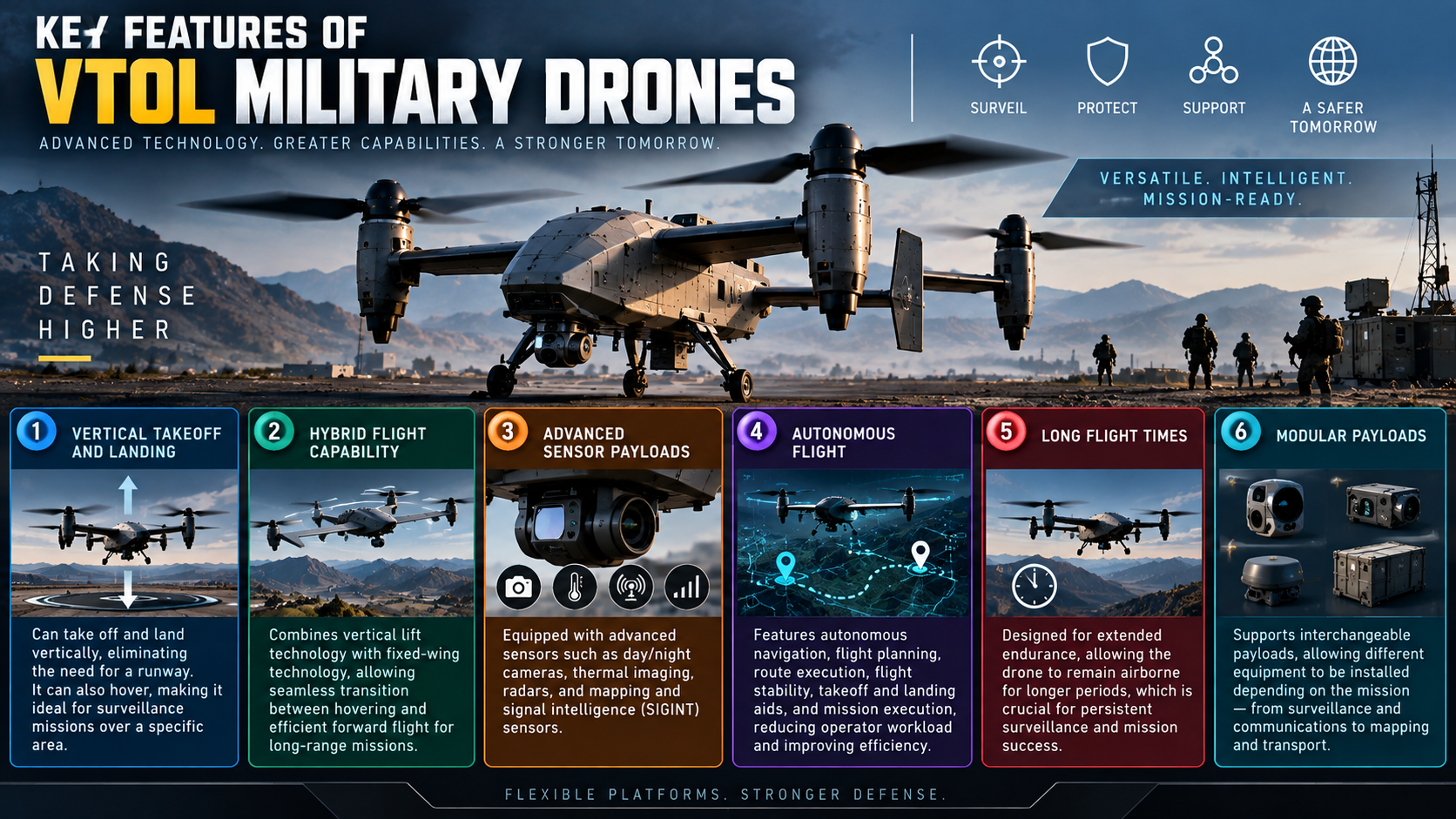
Modern military drones integrate multiple technologies for flight, surveillance, communication, and automation. Here are some of the key features of VTOL military drones.
1. Vertical Takeoff and Landing
The first, and perhaps the most identifiable, feature of a VTOL drone is the ability to take off and land vertically. This flexibility in operation eliminates the need for a runway.
Furthermore, a drone is able to hover, providing utility for surveillance missions over a particular region.
2. Hybrid Flight Capability
Most modern VTOL craft combine vertical lift technology with fixed-wing technology. This allows a drone to transition between hovering and more efficient forward movement.
In this case, the drone is able to operate as a vertical platform to hover, while also operating as a fixed-wing aircraft for long-range missions.
3. Advanced Sensor Payloads
One of the primary functions of a military drone is surveillance. Modern military drones can be equipped with an array of advanced sensors including day/night cameras, thermal imaging, radars, and advanced mapping and signal intelligence (SIGINT) sensors.
4. Autonomous Flight
Automation of unmanned aircraft is becoming increasingly important. Systems can now provide autonomous navigation, flight plan routing, flight stability, takeoff aids, landing aids, and mission plan execution.
Eliminating the burden of routine flight tasks allows more focus to be placed on mission execution.
5. Long Flight Times
Designs that incorporate lift technology that results in more efficient forward flight can keep drones airborne for extended periods of time.
Long endurance is important for surveillance because an aircraft is able to remain above an area for longer periods rather than continually returning to its point of launch.
6. Modular Payloads
Payload flexibility is essential because different types of equipment can be installed, depending on the mission.
A drone designed for surveillance may contain sophisticated imaging equipment, while one configured for communications may prioritize equipment for communications, mapping, or transportation.
Applications of Military VTOL Drones
The great flexibility of these systems means that they can be designed for many military and defense purposes.
| Application | Primary Purpose |
|---|---|
| Surveillance | To monitor a region from the air |
| Reconnaissance | To collect information about an area and the activities that occur there |
| Border Monitoring | To survey and monitor remote and inaccessible areas |
| Maritime Operations | To provide aerial support to operations from naval vessels |
| Communications | To extend the range of communications |
| Logistics | To transport lightweight supplies and equipment |
| Mapping | To create aerial maps and collect data and information about an area |
| Search and Rescue | To locate personnel in difficult environments |
| Disaster Response | To survey damaged or inaccessible areas |
| Tactical Support | To provide operational units with aerial information |
Benefits of Military VTOL Drones
Increased Deployment Flexibility
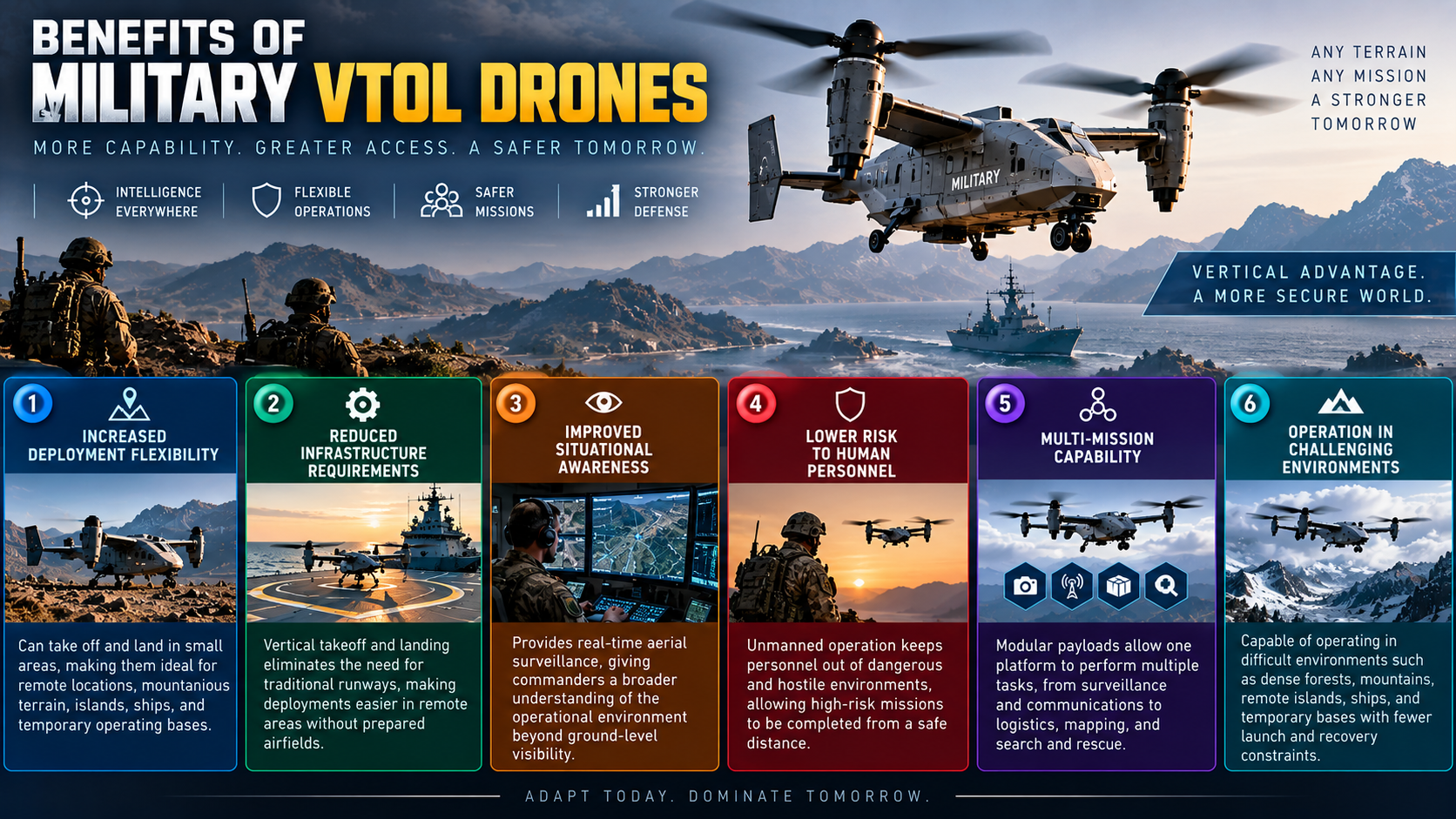
One of the greatest advantages of these aircraft is deployment flexibility. Traditional-type aircraft require a great deal of prepared infrastructure, but VTOL systems can take off and land in small areas.
This makes them ideal for deployments in remote areas, mountainous and/or island terrain, on ships, or at temporary operating bases.
Reduced Infrastructure Requirements
Because these aircraft can take off and land vertically, military units require less traditional supporting infrastructure for aviation.
This can make deployments easier in remote areas that are far from an airfield with prepared infrastructure.
Improved Situational Awareness
Commanders and personnel can gain a more comprehensive understanding of an operational zone through aerial surveillance.
Rather than relying solely on observation from the ground, teams are able to monitor terrain and information received to them from above through aerial sensors.
Lower Risk to Human Personnel
Since the aircraft is unmanned, there are no physical occupants and therefore potentially less risk to personel to send crewed aircraft into dangerous and harsh environments.
Through this technology, missions that would typically put personnel at risk are able to be accomplished with personnel many miles away from the threat.
Multi-Mission Capability
Flexible VTOL platforms can be more mission versatile through use of interchangeable payloads and mission equipment.
Increased mission versatility can benefit an organization that, in place of owning/maintaining multiple aircraft types, relies on one aircraft type to perform many different tasks.
Operation in Challenging Environments
Difficult environments for conventional aircraft include dense forests, mountainous regions, remote islands, and even ships and temporary bases.
VTOL systems are largely capable of operating with significantly fewer launch and recovery constraints in these environments.
VTOL Military Drones vs. Conventional Drones
When compared to VTOL systems, conventional drones of the fixed-wing variety sacrifice convenience in the tricky environments where VTOL systems operate for increased range and improved endurance.
Multirotor drones, on the other hand, can hover vertically but generally sacrifice endurance and range.
Like the other drone designs, VTOL systems focus on existing designs and innovating for the tradeoff between convenience of launch and recovery vs. range and endurance.
| Feature | VTOL (Vertical Take-Off and Landing) Drone | Fixed-Wing Drone | Multirotor Drone |
|---|---|---|---|
| Vertical Takeoff | Yes | Usually No | Yes |
| Vertical Landing | Yes | Usually No | Yes |
| Hovering | Yes | No | Yes |
| Long-Endurance Potential | High | High | Moderate |
| Runway Required | No | Often Required | No |
| Operational Flexibility | Very High | Moderate | High |
| Forward Flight Efficiency | High | Very High | Lower |
| Mission Versatility | High | High | Moderate |
Challenges and Limitations
Although VTOL military drones have clear advantages, they do have their limitations.
VTOL systems can add considerable weight to a drone. Extra components, like additional propulsion systems, can require more maintenance and provide more failure points.
Battery-powered VTOL drones may have challenges with limited flight time, range, and/or payload capacity. Some of these challenges may be resolved with the use of hybrid designs, but they can also add considerable weight and cost to the drone.
Environmental factors such as heavy rain, wind, gusts, and extreme temperatures may affect flight performance.
Signals to and from drone control systems are critical to the success and safety of any flight. Loss of communications or interruptions may cause significant drone control challenges.
Also Read- AI Meeting Assistants: The Ultimate Productivity Boost
The Future of VTOL Military Drones
Automation through the integration of artificial intelligence, coupled with improved sensors, communications, and simplified controls, all point to significantly improved VTOL military drones.
Autonomous systems may be designed with considerably advanced intelligence to perform a flight operation with very minimal human guidance.
VTOL military drones may soon have the capability of mission planning without human intervention. AI and autonomous systems may allow drones to rapidly interpret data from onboard sensors to prioritize threats and direct flight plans accordingly.
Another major trend is collaborative construction of unmanned systems. Rather than using single drones in isolation, future operations might utilize multiple aircraft to share information and coordinate their actions.
Flight endurance could also improve due to the increased capability of batteries and the use of advanced lightweight construction materials.
With these advances, VTOL platforms could become smaller, lighter, more efficient, more autonomous, and more adaptable.
Conclusion
VTOL military drones will serve an increasingly important role in modern military unmanned aerial systems. Vertical takeoff and landing, along with the long flight time, provides a unique balance of flexibility and endurance.
VTOL military drones are well suited for providing surveillance, reconnaissance, mapping, communication, logistics, maritime and land operations, and search and rescue. Add in the fact that VTOL military drones can operate in remote theaters, and the case is clear for their immediate and continued use.
There are remaining issues of cost, payload, autonomy, and communications. Still, it is likely these will be resolved over time.
Thereof and more, the future of military aviation will not be defined by a single modern aircraft. It will instead be dominated by a network-centric integrated framework of both manned and unmanned aircraft, and autonomous systems. Within that framework, VTOL military drones will be quick and efficient.
FAQs
1. What are VTOL military drones?
VTOL military drones are unmanned aircraft capable of taking off and landing vertically. They are designed for missions such as surveillance, reconnaissance, communications, logistics, and aerial monitoring.
2. What does VTOL stand for?
VTOL stands for Vertical Take-Off and Landing. Any aircraft that can take off and/or land vertically without needing a runway is considered a VTOL aircraft.
3. What are VTOL military drones used for?
VTOL military drones are used for missions that require surveillance, reconnaissance, monitoring, mapping, communication, maritime, logistics, search and rescue, and support missions.
4. Do VTOL drones need a runway?
VTOL drones do not need a runway. They can take off and land vertically, allowing them to operate in remote and restricted areas.
5. Are VTOL drones better than fixed-wing drones?
There is no better option. Fixed wing drones have the advantage of a large flight range and endurance. VTOL drones have the advantage of deploying to remote areas.
6. Can VTOL military drones fly autonomously?
Many drone systems can fly themselves. Modern drones have systems that aid in navigation, stabilization, take-off, landing and mission management. The level of autonomy is different from system to system.
7. Why are VTOL drones important for future warfare?
VTOL drones have the ability to deploy vertically, and have endurance and advanced sensors, and can be automated. These drones will be instrumental in providing information and will support military operations.