Military Drones Explained: The Future of Modern Warfare Technology
+
Table of Contents
- 1 What Are Military Drones?
- 2 How Military Drones Work
- 2.1 1. Ground Control Station
- 2.2 2. Sensors and Cameras
- 2.3 3. GPS and Navigation Systems
- 2.4 4. Communication Systems
- 2.5 5. Weapons Systems
- 3 Major Types of Military Drones
- 4 Examples of the Most Commonly Used Military Drones
- 4.1 MQ-9 Reaper
- 4.2 Bayraktar TB2
- 4.3 RQ-4 Global Hawk
- 4.4 Shahed Drones
- 4.5 Wing Loong Series
- 4.6 The Use of AI in Military Drones
- 4.7 Concerns and Limitations of Military Drones
- 4.7.1 Threat of Cyber Attacks
- 4.7.2 Moral Issues
- 4.7.3 Safety of Non-Combatants
- 4.7.4 Boundaries of the Law
- 4.7.5 Electronic Disruption
- 4.8 Military Drones are the Future of War Technology
- 4.9 Drones and the Evolving Strategies of Warfare
- 4.9.1 artificial intelligence
- 5 Conclusion
- 5.1 FAQs
- 5.1.1 What are military drones used for?
- 5.1.2 Are military drones controlled by humans?
- 5.1.3 What is the most famous military drone?
- 5.1.4 Can military drones carry weapons?
- 5.1.5 What are drone swarms?
- 5.1.6 Are military drones expensive?
- 5.1.7 Which countries have advanced military drone programs?
- 5.1.8 What is the future of military drones?
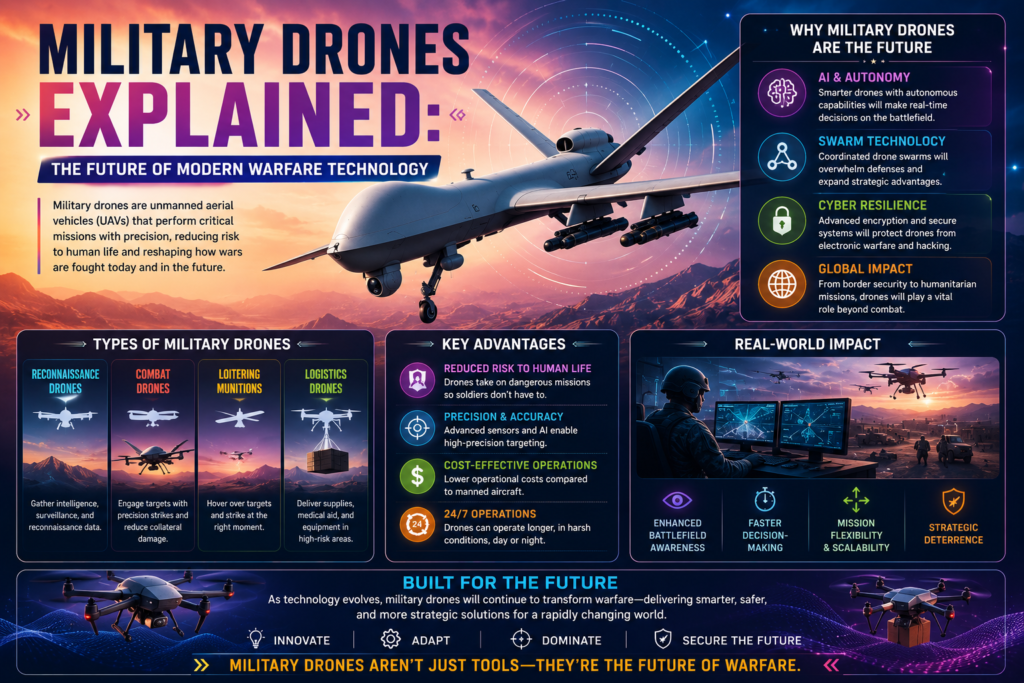
Over the past two decades, various factors have contributed to significant changes in the face of modern-day warfare. One of the biggest contributors to this evolving nature of warfare is the development of military-grade drones. These advanced, unmanned—also referred to as uncrewed— aerial vehicles, or UAVs, have been adopted by military forces across the globe for surveillance, reconnaissance, and intelligence missions, as well as for combat. Military drones range from compact portable systems used for real-time battlefield surveillance to advanced long-endurance aircraft capable of operating for over 24 hours with precision reconnaissance and combat support capabilities.
As of today, drones are no longer an innovative technology that has only been used in proof-of-concept systems. For many nations, they are an integral part of a nation’s defense strategy. Drones have become one of the most significant military advancements in recent history due to their capability to mitigate risk to personnel, their ability to provide time-sensitive, actionable intelligence, and their ability to conduct time-sensitive, precision strikes.
In this article, we explain everything you need to know about military drones, their operation, their primary categories, their advantages, their challenges, and their role in the future of modern combat technology.
What Are Military Drones?
Uncrewed military drones are a form of aircraft that are operated remotely or in an autonomous fashion, designed to fly using advanced software, sensors, and communication systems. Unlike a missile or a fighter aircraft, there is no pilot on board the drone.
These systems can be used in a multitude of defense roles, such as:
- surveillance and intelligence collection
- border security
- combat and strike missions
- reconnaissance
- electronic warfare
- search and rescue
- naval defense
Military drones are made, and models are diverse in terms of capabilities and size. Some can be as tiny as a shoe, while others can be as large as a commercial airliner.
How Military Drones Work
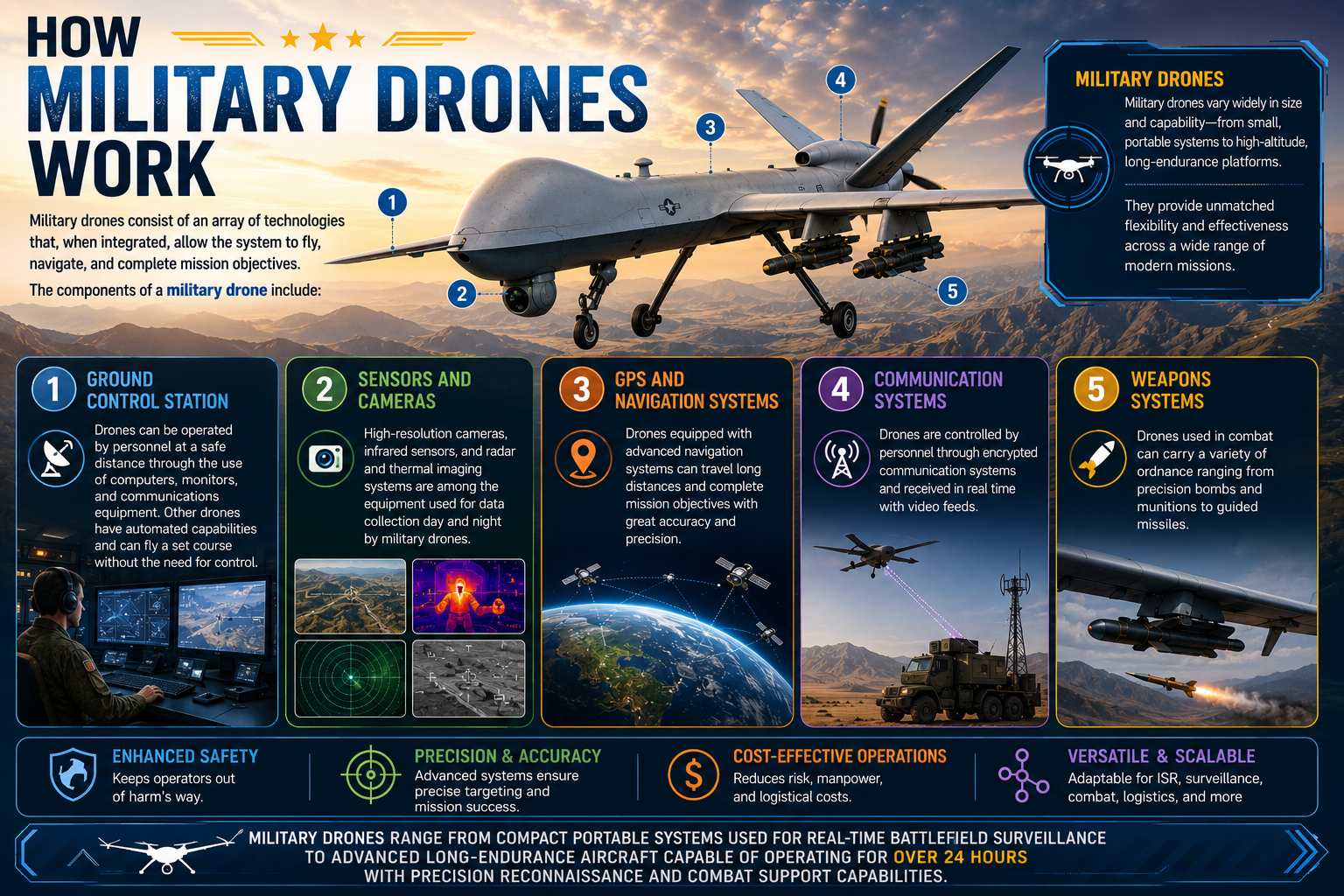
Military drones consist of an array of technologies that, when integrated, allow the system to fly, navigate, and complete mission objectives. The components of a military drone include:
1. Ground Control Station
Drones can be operated by personnel at a safe distance through the use of computers, monitors, and communications equipment. Other drones have automated capabilities and can fly a set course without the need for control.
2. Sensors and Cameras
High-resolution cameras, infrared sensors, and radar and thermal imaging systems are among the equipment used for data collection day and night by military drones.
3. GPS and Navigation Systems
Drones equipped with advanced navigation systems can travel long distances and complete mission objectives with great accuracy and precision.
4. Communication Systems
Drones are controlled by personnel through encrypted communication systems and received in real time with video feeds.
5. Weapons Systems
Drones used in combat can carry a variety of ordnance ranging from precision bombs and munitions to guided missiles.
Major Types of Military Drones
Different military missions require different types of drones. Here are the most common categories.
| Drone Type | Primary Use | Key Features |
|---|---|---|
| Surveillance Drones | Intelligence gathering | Long flight time, advanced cameras |
| Combat Drones | Airstrikes and attacks | Precision weapons and targeting systems |
| Reconnaissance Drones | Battlefield monitoring | Real-time video and mapping |
| Loitering Munitions | Kamikaze-style attacks | Self-destruct after target impact |
| Naval Drones | Maritime security | Operate over oceans and coastlines |
| Mini Tactical Drones | Short-range operations | Portable and lightweight |
Military drones provide several major advantages compared to traditional military aircraft.
Also Read- Best Commercial & Business Drones for Professional Use in 2026
Less Human Exposure to Potentially Fatal Situations
- Drones take away the need for a pilot to be physically present in combat, carrying out missions from a remote location to prevent any potential fatalities.
- Drones provide live footage and can assist in delivering information instantaneously to aid in the execution of the mission.
- Drones are cost-effective in comparison to deploying a whole unit of the military or operating a fighter jet.
- Surveillance and drone strikes can be accomplished more accurately with new technology capable of precision targeting.
- Drones can be continuously used for more than 24 hours to complete missions of monitoring high-value locations.
- To prevent and locate illicit border crossings, many countries have taken to using drones along their borders.
Examples of the Most Commonly Used Military Drones
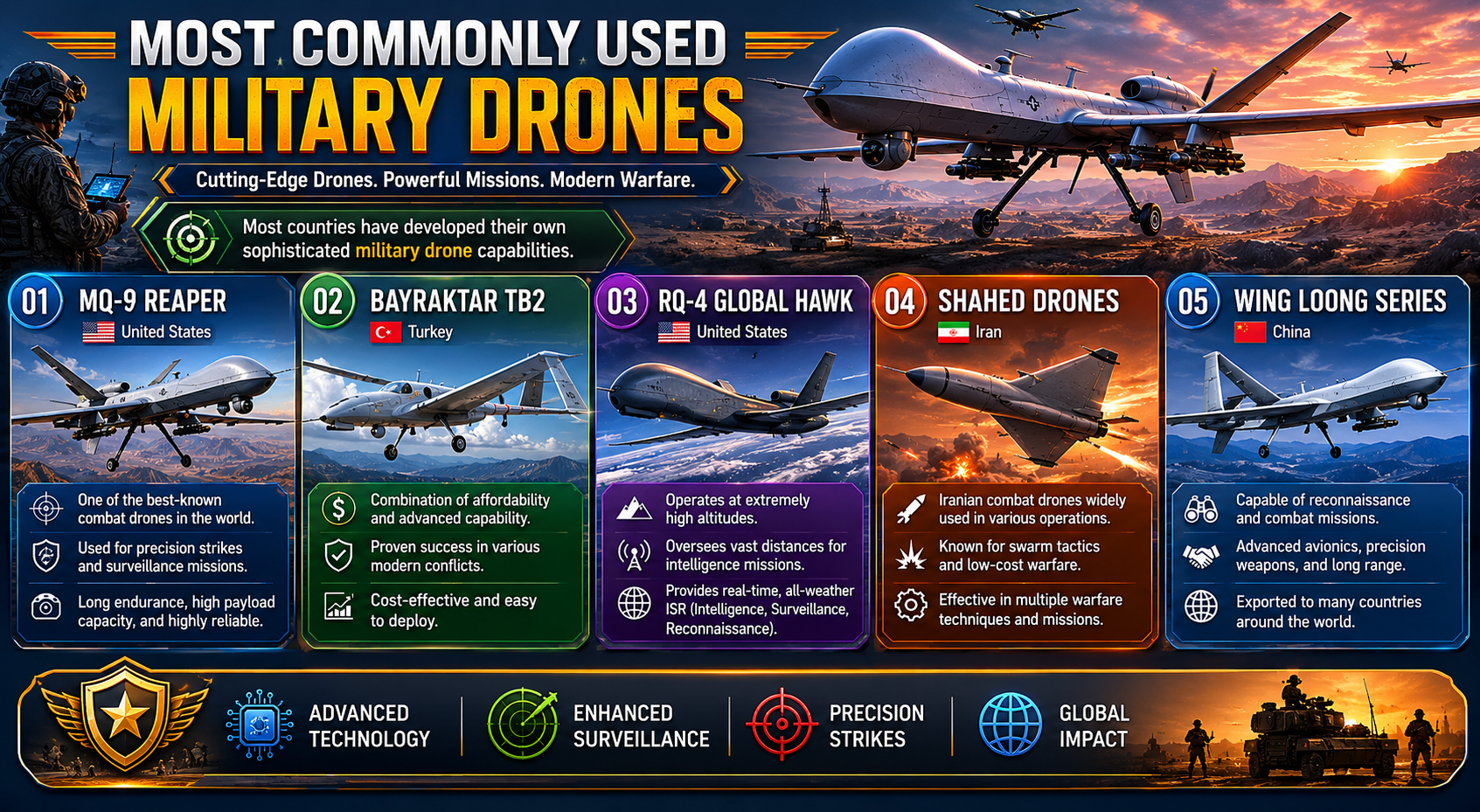
Most countries have developed their own sophisticated military drone capabilities.
-
MQ-9 Reaper
Used by the United States, this system of drones is one of the best-known combat drones in the world and is utilized for strikes and surveillance.
-
Bayraktar TB2
This Turkish drone uses a combination of affordability and capability to gain a lot of attention through its effective results in various modern conflicts.
-
RQ-4 Global Hawk
This drone operates at a great height and can be used to oversee great distances to complete an intelligence mission.
-
Shahed Drones
This system of Iranian combat drones has gained a lot of attention through its military application and ability to conduct various warfare techniques.
-
Wing Loong Series
This system of Chinese drones has the capability not only to carry out reconnaissance and combat, but can also be sold for use by other countries.
The Use of AI in Military Drones
Military drone technology increasingly integrates artificial intelligence (AI). With AI, drones can process information, recognize threats, and execute tactical decisions in a more timely manner.
Drones equipped with AI have the capability to:
- Identify hostile vehicles automatically
- Process battlefield information instantaneously
- Fly without human guidance
- Interrelate with a swarm of drones
- Execute operations with improved precision
The use of AI in swarm technology is another significant advancement. Using swarm technology, drones can operate in unison and use AI to penetrate adversarial defenses or survey vast areas.
Concerns and Limitations of Military Drones
While employing military drones can be advantageous, there are also substantial concerns and limitations.
Threat of Cyber Attacks
Exploitation or interference with drone operations can be executed by the enemy.
Moral Issues
There is a moral conundrum for a machine to decide the fate of humans.
Safety of Non-Combatants
Due to erroneous intelligence or malfunctioning targeting, striking a drone may result in undesired loss of non-combatant lives.
Boundaries of the Law
The laws of warfare and the use of drones are oscillating and impetuous. There is much speculation surrounding the acceptable uses of drones in warfare.
Electronic Disruption
A drone can be defenseless against an electronic attack that interferes with or disrupts its operations.
Military Drones are the Future of War Technology
There is a close relationship between the advancement of military technology and the use of drones. Defense industry specialists expect an impactful and fast-paced advancement of drones to be integrated into warfare in the foreseeable future.
Potential Characteristics of Future Military Drones:
- Expect future military drones to be
- entirely autonomous combat units
- artificial intelligence combat swarms
- ultra-fast hypersonic drones
- radar-evading stealth drones
- underwater drones
- space-based defense systems
Countries around the world are investing billions in drone technology due to the strong military advantages it offers. Advanced military operations will incorporate drone technology, integrated satellite systems, cyber warfare, and AI systems.
Drones and the Evolving Strategies of Warfare
War used to specialize in large troop movements, ground vehicles, and air combat. The incorporation of drones has shifted combat to a more flexible, tech-centric warfare.
With drones, commanders can:
- Battlefield communication drones provide unprecedented and rapid intelligence.
- Civilian Developments and Military Drones
An interesting and prominent trend is the impact of civilian technology on military drones. Because of advancements in civilian industries like:
artificial intelligence
- much more capable batteries
- camera technologies
- global positioning systems
- communication networks
- autonomous systems
military drones have become much more capable. Military research also offers advancements in civilian logistics, agriculture, filmmaking, and disaster response.
Conclusion
Modern military drones showcase the advanced nature of today’s warfare by performing global surveillance, intelligence gathering, precision attacks, and autonomous combat operations. The incorporation of drones into military operations is changing the face of warfare.
Recent advancements in artificial intelligence, robotics, automation, and communication mean that drones are likely to offer more capabilities as the technology progresses. With this, however, come important ethical, cybersecurity, and regulatory concerns that defense units and governments need to ensure are being addressed.
Military Drones: On Top of Digital, Autonomous, and Technology Driven Warfare
FAQs
-
What are military drones used for?
Drones perform tasks such as intelligence and data collection, border security, and active combat.
-
Are military drones controlled by humans?
Some military drones are operated via control by humans, but many modern, advanced military drones operate via artificial intelligence.
-
What is the most famous military drone?
Due to its ability to perform both combat and surveillance tasks, the MQ-9 Reaper is one of the most famous military drones in the world.
-
Can military drones carry weapons?
Yes. Drones that perform combat are operated with weapons, bombs, and other payloads.
-
What are drone swarms?
Designed to communicate and operate as a single entity, these drones are a single unit, but operate via artificial intelligence.
-
Are military drones expensive?
The cost of military drones varies, but a small tactical drone may cost less than a more advanced military drone, which could reach millions.
-
Which countries have advanced military drone programs?
Countries such as the United States, China, Turkey, Israel, Russia, and Iran have developed advanced military drones technologies.
-
What is the future of military drones?
Along with the ability to perform improved communications and swarm capabilities, future military drones are expected to have the ability to remain invisible to radars.