The Rise of Vertical Drone Towers in Modern Cities
+
Table of Contents
- 1 What Are Vertical Drone Towers?
- 2 How Vertical Drone Towers Operate
- 3 Key Features of Modern Drone Towers
- 3.1 1. Automated Operations
- 3.2 2. Vertical Urban Footprints
- 3.3 3. Rapid Charging Technology
- 3.4 4. Safety in Varied Weather
- 3.5 5. Built-in Security
- 3.6 6. Intelligent Connectivity
- 3.7 Advantages of Vertical Drone Towers for Smart Cities
- 3.7.1 More Efficient Delivery
- 3.7.2 Less Traffic and Pollution
- 3.7.3 Improved Emergency Response
- 3.7.4 Increased Security
- 3.7.5 Streamlined Inspections
- 3.8 Environmental Benefits of Electric Drones
- 3.8.1 Applications Across Industries
- 3.8.2 Logistics and Delivery
- 3.8.3 Healthcare
- 3.8.4 Construction and Real Estate
- 3.8.5 Agriculture
- 3.8.6 Public Safety
- 3.8.7 Telecommunications
- 3.8.8 Challenges and Concerns
- 3.8.9 Regulatory Issues
- 3.8.10 Privacy Concerns
- 3.8.11 Cybersecurity Risks
- 3.8.12 High Infrastructure Costs
- 3.8.13 Noise Pollution
- 3.8.14 Air Traffic Management
- 3.9 Future of Vertical Drone Towers
- 4 Conclusion
- 4.1 FAQs
- 4.1.1 1. What is a vertical drone tower?
- 4.1.2 2. Why are vertical drone towers important for smart cities?
- 4.1.3 3. Which industries use vertical drone towers?
- 4.1.4 4. Are drone towers fully automated?
- 4.1.5 5. What are the biggest challenges facing drone towers?
- 4.1.6 6. Can vertical drone towers reduce pollution?
- 4.1.7 7. What technologies are used in drone towers?
- 4.1.8 8. What is the future of vertical drone towers?
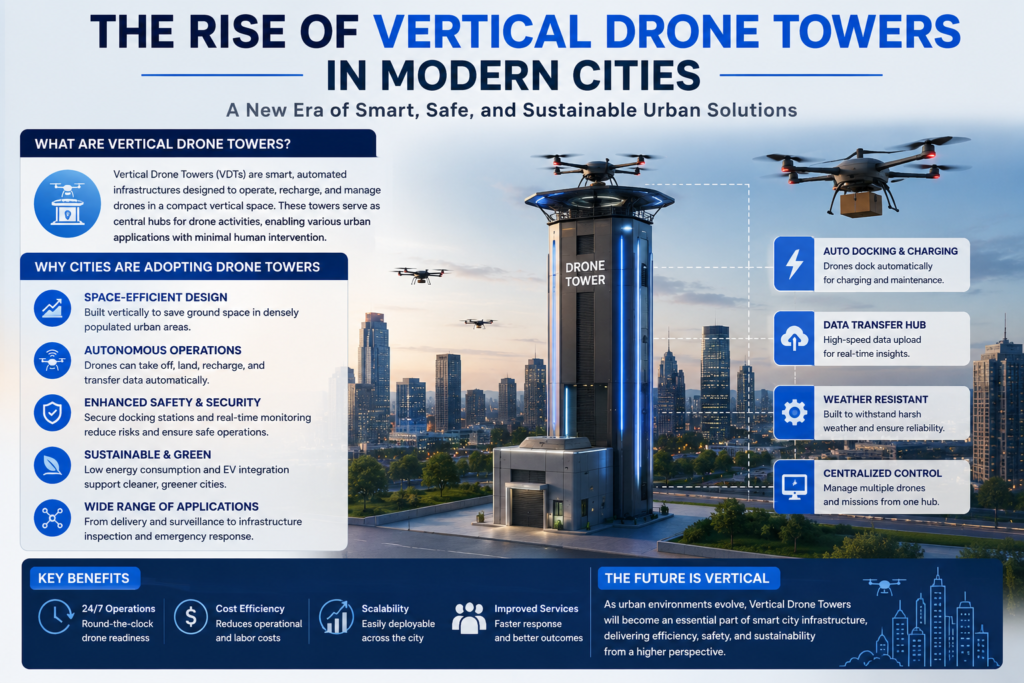
Drone technology is improving the way urban centers function. Effective management and control of drones within a city is essential, and vertical drone towers are a step in that direction. Vertical drone towers are innovative structures that accommodate drone functions in urban centers. As smart cities continue developing, these towers are likely to be essential components in future city planning.
One of the many challenges contemporary cities face is traffic. Drone technology can help alleviate traffic through rapid aerial delivery and vertical transportation. Additionally, automated vertical drone towers can help streamline drone operations and management. As a result, drone technology is being rapidly implemented by governments, logistics providers, and companies with the aim of optimizing drone-based urban networks.
What Are Vertical Drone Towers?
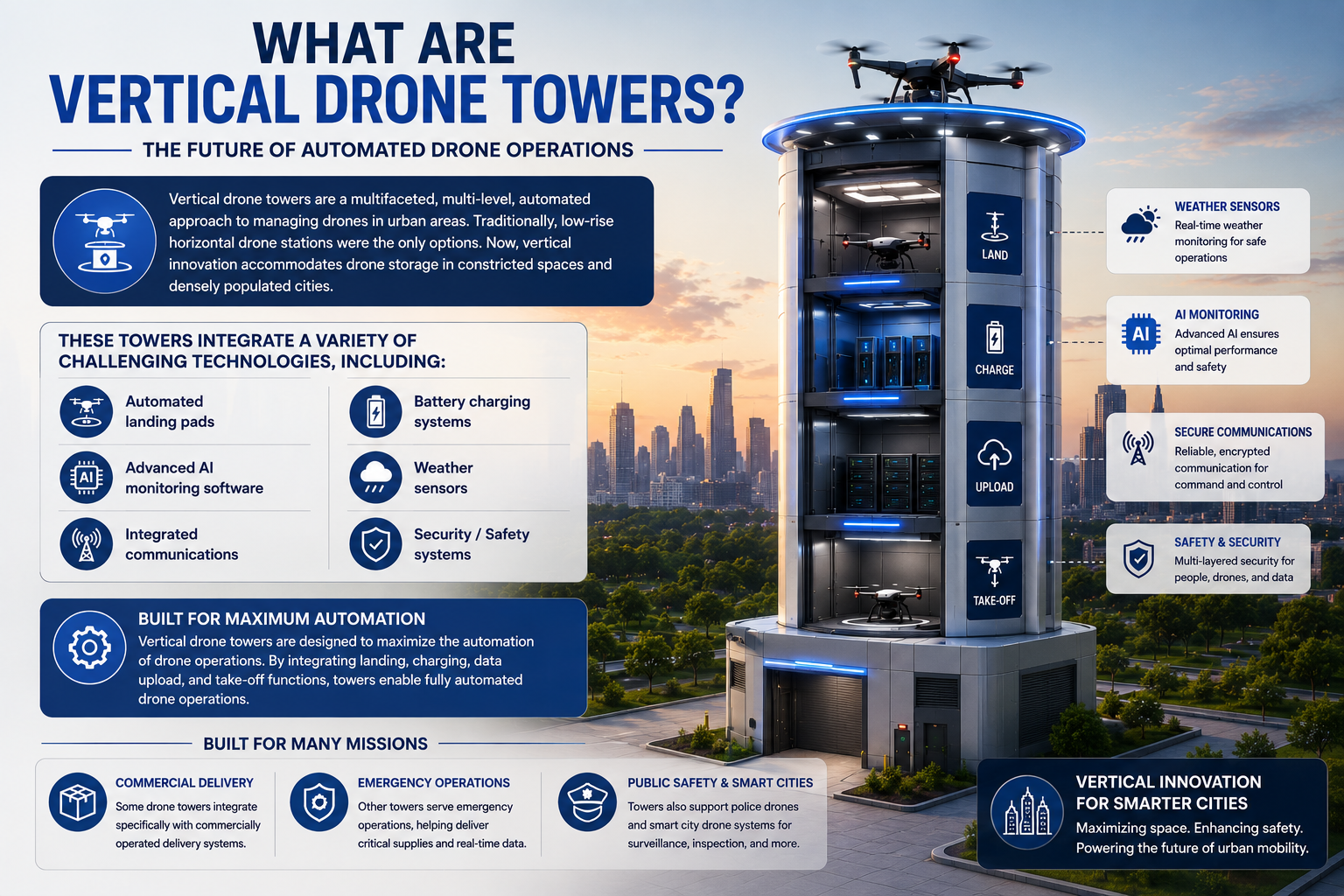
Vertical drone towers are a multifaceted, multi-level, automated approach to managing drones in urban areas. Traditionally, low-rise horizontal drone stations were the only options. Now, vertical innovation accommodates drone storage in constricted spaces and densely populated cities.
These towers integrate a variety of challenging technologies, including:
- Automated landing pads
- Battery charging systems
- Advanced AI monitoring software
- Weather sensors
- Integrated communications
- Security/Safety systems
Vertical drone towers are designed to maximize the automation of drone operations. By integrating landing, charging, data upload, and take-off functions, towers enable fully automated drone operations.
Some drone towers integrate specifically with commercially operated delivery systems. Other towers serve emergency operations, police drones, or smart city drone systems.
How Vertical Drone Towers Operate
Vertical drone towers fully function as automated drone airports. The towers themselves become the operating systems that ensure coordinated movement of the drones.
In general, the process functions as follows:
1. Drone Arrival
A drone approaches the tower via GPS and AI Flight control systems.
2. Automated Descent
The drone descends to a landing pad that is equipped with precision sensors.
3. Recharge and/or Battery Change
The drone either replaces its battery or charges while the pad performs a battery swap.
4. Data Download and Diagnostics
The pad performs a data download to the central control system and receives updates about the drone’s condition, along with flight data.
5. Departure for Next Mission
Once the system is ready, the drone is assigned its next mission and can remove itself from the tower.
These towers connect via the Internet to a central control system that monitors and manages hundreds of drones. Flight optimization is achieved through AI technologies that balance safety with operational efficiency.
Key Features of Modern Drone Towers
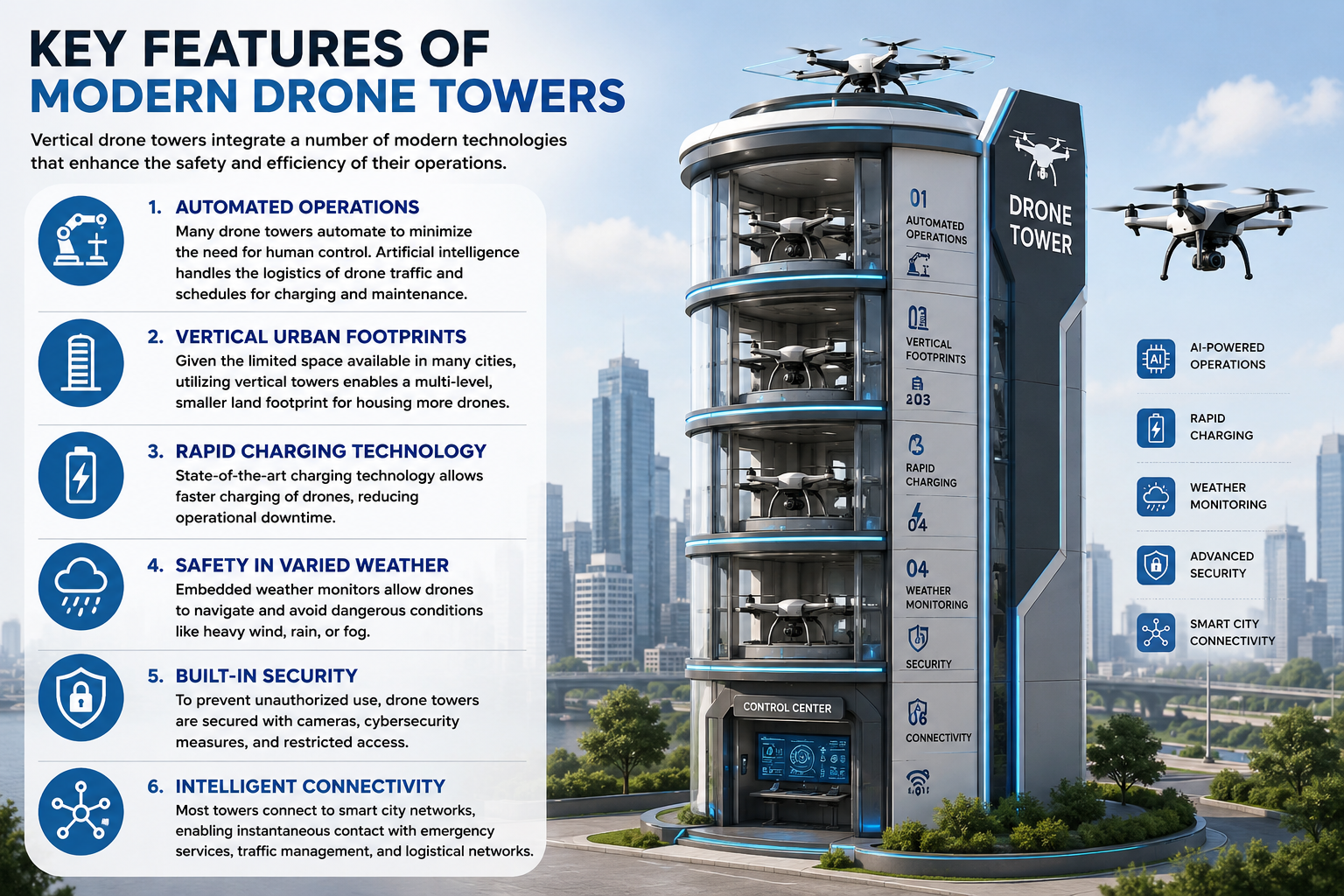
Vertical drone towers integrate a number of modern technologies that enhance the safety and efficiency of their operations.
1. Automated Operations
Many drone towers automate to minimize the need for human control. Artificial intelligence handles the logistics of drone traffic and schedules for charging and maintenance.
2. Vertical Urban Footprints
Given the limited space available in many cities, utilizing vertical towers enables a multi-level, smaller land footprint for housing more drones.
3. Rapid Charging Technology
State-of-the-art charging technology allows faster charging of drones, reducing operational downtime.
4. Safety in Varied Weather
Embedded weather monitors allow drones to navigate and avoid dangerous conditions like heavy wind, rain, or fog.
5. Built-in Security
To prevent unauthorized use, drone towers are secured with cameras, cybersecurity measures, and restricted access.
6. Intelligent Connectivity
Most towers connect to smart city networks, enabling instantaneous contact with emergency services, traffic management, and logistical networks.
Advantages of Vertical Drone Towers for Smart Cities
Vertical drone towers offer multiple benefits for the new urban city.
More Efficient Delivery
Vertical drone towers allow eCommerce firms to make faster deliveries, which reduces road congestion and lowers overall delivery times.
Less Traffic and Pollution
Drone transit reduces the number of delivery vehicles on the road, diminishing traffic and pollution.
Improved Emergency Response
Emergency drones can deliver supplies, monitor a situation, or even aid a rescue effort during an emergency.
Increased Security
Drones can be used by law enforcement for monitoring, crowd control, and ensuring public safety and security.
Streamlined Inspections
Drones used for inspections, flown from vertical towers, can check buildings and even power lines faster than traditional inspection methods.
Also Read- The Future of Flight: How VTOL Drones Are Changing Aviation
Environmental Benefits of Electric Drones
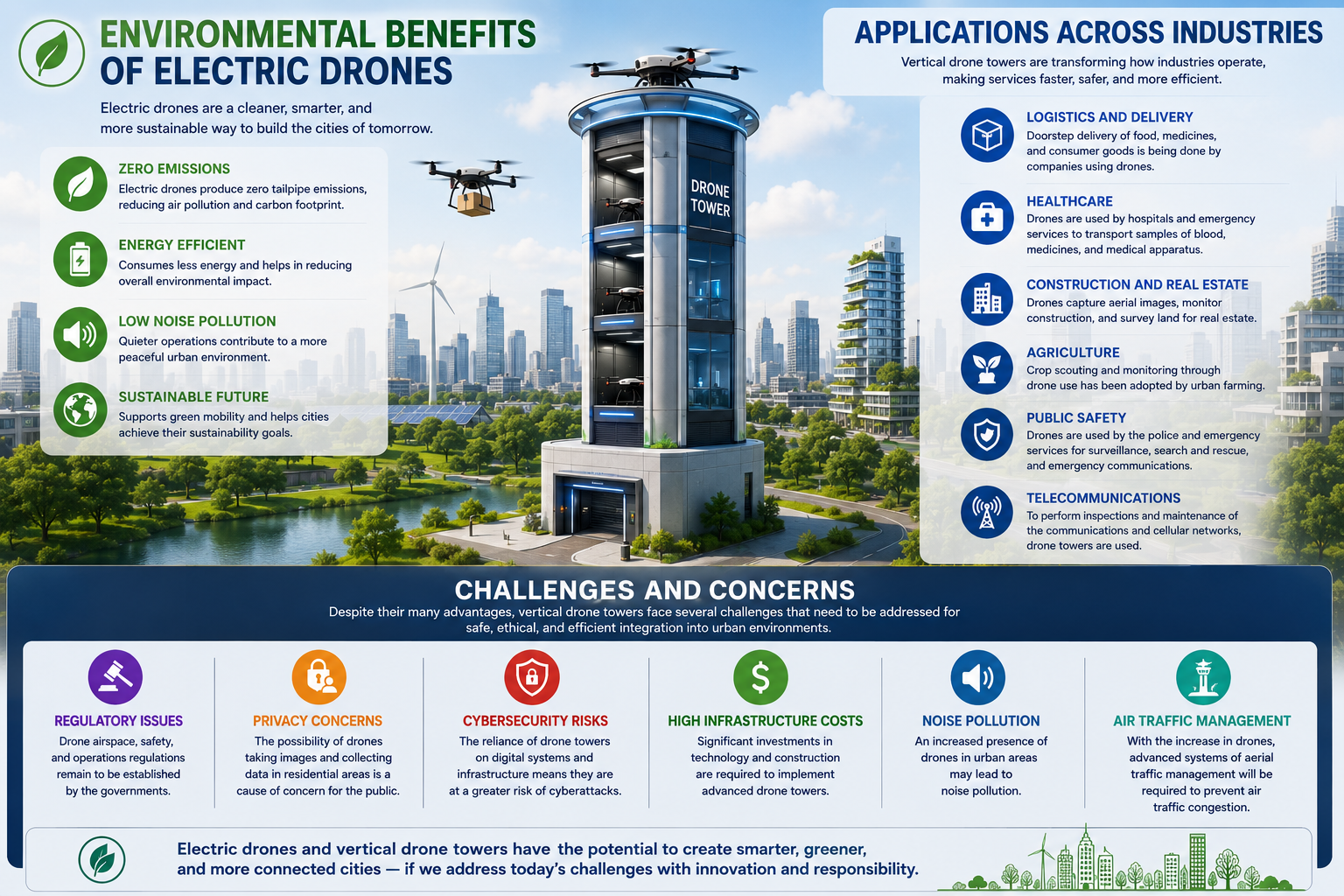
Fuel-powered vehicles adversely affect the environment. Urban transportation systems would become greener with the use of electric drones instead.
Applications Across Industries
The adoption of vertical drone towers is becoming widespread across numerous segregated applications.
Logistics and Delivery
Doorstep delivery of food, medicines, and consumer goods is being done by companies using drones.
Healthcare
Drones are used by hospitals and emergency services to transport samples of blood, medicines, and medical apparatus.
Construction and Real Estate
Drones capture aerial images, monitor construction, and survey land for real estate.
Agriculture
Crop scouting and monitoring through drone use has been adopted by urban farming.
Public Safety
Drones are used by the police and emergency services for surveillance, search and rescue, and emergency communications.
Telecommunications
To perform inspections and maintenance of the communications and cellular networks, drone towers are used.
Challenges and Concerns
The vertical drone towers are accompanied by numerous challenges despite the advantages it offers.
Regulatory Issues
Drone airspace, safety, and operations regulations remain to be established by the governments.
Privacy Concerns
The possibility of drones taking images and collecting data in residential areas is a cause of concern for the public.
Cybersecurity Risks
The reliance of drone towers on digital systems and infrastructure means they are at a greater risk of cyberattacks.
High Infrastructure Costs
Significant investments in technology and construction are required to implement advanced drone towers.
Noise Pollution
An increased presence of drones in urban areas may lead to noise pollution.
Air Traffic Management
With the increase in drones, advanced systems of aerial traffic management will be required to prevent air traffic congestion.
Future of Vertical Drone Towers
The future is bright for vertical drone towers. Urban populations continue to grow, and with that growth comes the need for better transport and logistics systems.
Vertical drone towers may feature:
- AI-driven traffic control
- Solar charging stations
- Integration with flying taxis and other air mobility systems
- Fully automated, self-maintaining systems
- Advanced drone parking
- 5G and 6G wireless networks
Some experts think that drone towers will be as ubiquitous as cell towers and transport stations. Governments and multinational corporations have several pilot studies underway with rapid deployment in smart cities.
As rapid, urban air mobility solutions become more widespread, vertical drone towers will become common building components.
Conclusion
Vertical drone towers provide charging and maintenance solutions, as well as traffic control and automatic systems.
As the use of drones in logistics, healthcare, and other services becomes widespread, drone towers will be the solution to aerial service management.
Regulatory, cybersecurity, and privacy challenges remain, but vertical drone towers will become an intelligent and integral part of urban mobility automation.
FAQs
1. What is a vertical drone tower?
The design of a vertical drone tower encompasses multiple levels to accommodate drone landings, charging, maintenance, and communication across urban environments.
2. Why are vertical drone towers important for smart cities?
Vertical drone towers enhance drone system management, making urban environments less congested. They allow quick and efficient deliveries and improve the support of emergency services.
3. Which industries use vertical drone towers?
Vertical drone towers are used in logistics, healthcare, construction, agriculture, security, and telecommunications.
4. Are drone towers fully automated?
The majority of new-age drone towers are fully autonomous for landing, charging, and monitoring, and contain robotics for maintenance.
5. What are the biggest challenges facing drone towers?
Among the many challenges pertaining to drone towers, the most prominent are regulations, the risk of cyber-attacks, privacy, the financial burden of infrastructure, and managing air traffic safely.
6. Can vertical drone towers reduce pollution?
Electric drones can decrease the number of vehicles on the road in cities, thus decreasing urban pollution.
7. What technologies are used in drone towers?
Drone towers are equipped with AI, IoT, cloud-based systems, GPS, automated charging, and advanced communication technologies.
8. What is the future of vertical drone towers?
Vertical drone towers will incorporate smart cities, flying taxis, renewable energy sources, and completely self-regulating drone networks.