Atlas & Talon: India’s Drone Power Transforming Modern Warfare
+
Table of Contents
- 1 What Are Atlas & Talon Drones?
- 2 Key Features of Atlas Drone
- 2.1 1. Precision Payload Delivery
- 2.2 2. Advanced Flight Stability
- 2.3 3. Vertical Take-Off and Landing (VTOL)
- 2.4 4. Real-Time Monitoring
- 2.5 5. Autonomous Navigation
- 2.6 6. Rapid Deployment
- 3 Key Features of Talon Drone
- 3.1 1. First-Person View Technology
- 3.2 2. High-Speed Operations
- 3.3 3. Precision Strike Capability
- 3.4 4. Lightweight Construction
- 3.5 5. Enhanced Reconnaissance
- 3.6 6. Tactical Flexibility
- 4 Atlas & Talon: A Comprehensive Features Comparison
- 4.1 Atlas and Talon Drone Comparison
- 4.1.1 1. Real-Time Intelligence
- 4.1.2 2. Reduced Risk to Personnel
- 4.1.3 3. Rapid Response
- 4.1.4 4. Cost-Effective Capability
- 4.1.5 5. Flexible Missions
- 4.1.6 6. Enhanced Precision
- 4.1.7 7. Force Multiplier
- 4.2 Strategic Importance for India
- 4.3 Future Potential of Atlas and Talon
- 4.4 Challenges Facing Military Drones
- 4.4.1 Electronic Interference
- 4.4.2 Limited Flight Duration
- 4.4.3 Environmental Conditions
- 4.4.4 Counter-Drone Systems
- 5 Conclusion
- 5.1 Frequently Asked Questions
- 5.1.1 1. What is the Atlas drone?
- 5.1.2 2. What is the Talon drone?
- 5.1.3 3. What makes Atlas and Talon significant?
- 5.1.4 4. Can these drones operate in tough terrain?
- 5.1.5 5. What are the key advantages of military drones?
- 5.1.6 6. Why are FPV drones beneficial in a combat scenario?
- 5.1.7 7. Are Atlas and Talon part of India’s indigenous defense strategy?
- 5.1.8 8. What does the future hold for drone warfare in India?
Innovations native to India are fundamental to India’s harnessing of drone technologies and bolstering the safety of the Indian nation. Drone technologies like the Atlas & Talon, which are already more advanced than others, are sophisticated systems and mark the beginning of defense self-reliance by Indian development. As technologies like these are used by the Indian military, Indian defense self-reliance is aided.
With the dominance of strategies that incorporate the use of systems that are unmanned to a greater degree, especially systems that are used to perform attack or strike functions, as well as to carry out surveillance and reconnaissance, the Atlas and Talon systems, which are advanced and flexible to a great extent as well as economical, add value to the ever-increasing Indian combat drone systems.
What Are Atlas & Talon Drones?
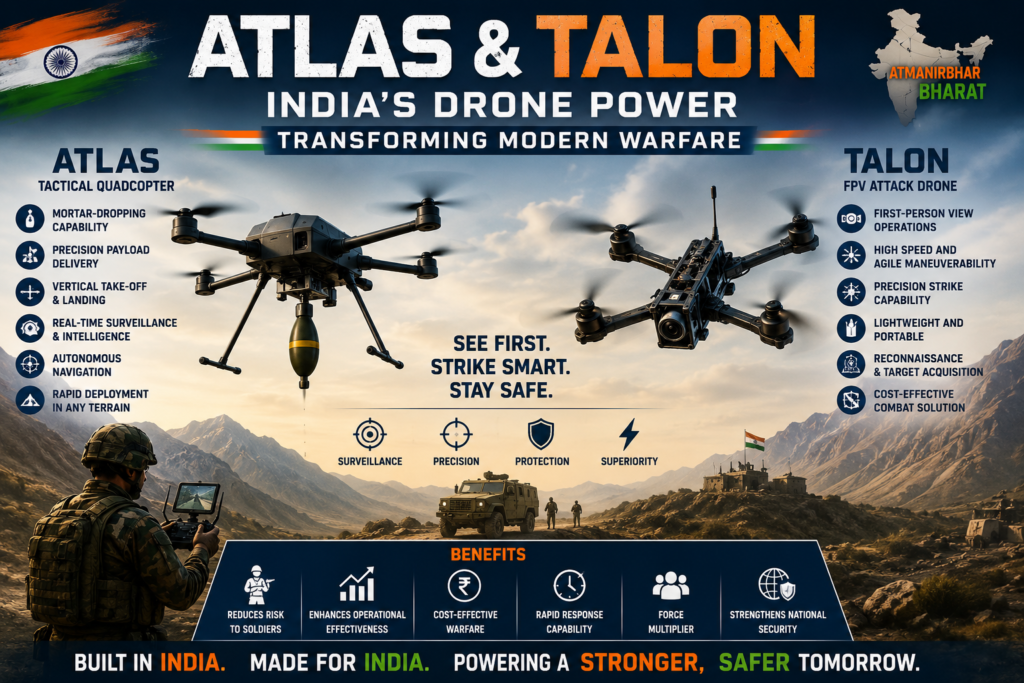
Atlas and Talon drones are military-grade drone systems, each of which is designed to perform a specific and separate, yet interconnected, function.
Atlas is a heavy-duty quadcopter that can carry and unleash a payload with precision. Therefore, it is designed for tactical strike operations as well as support operations conducted from the air.
Talon is a fast and agile First-Person View (FPV) drone designed to perform surveillance and reconnaissance as well as swift attack operations. Its design allows personnel to evaluate the battlefield and strike the target with a quick time delay.
Together, they improve the operational capabilities of defense systems and provide forces with improved combat capabilities and greater situational awareness.
Key Features of Atlas Drone
1. Precision Payload Delivery
The design of the Atlas drone enables it to carry a payload and deliver it to a target with precision, thus ensuring that the purpose of the mission is accomplished while the collateral damage is minimized.
2. Advanced Flight Stability
Modern stabilization technology allows the drone to perform effectively regardless of the weather or the terrain.
3. Vertical Take-Off and Landing (VTOL)
Atlas can take off and land vertically, so it doesn’t need a runway. This makes it ideal for operating in remote locations and areas with limited space.
4. Real-Time Monitoring
Atlas, because of its monitoring systems, relays up-to-date information about the battlefield to the operators, allowing them to make more informed decisions.
5. Autonomous Navigation
The drone maintains correct positioning to carry out the mission along its preset flight path.
6. Rapid Deployment
The design enables personnel to carry out the mission rapidly, even in difficult conditions.
Key Features of Talon Drone
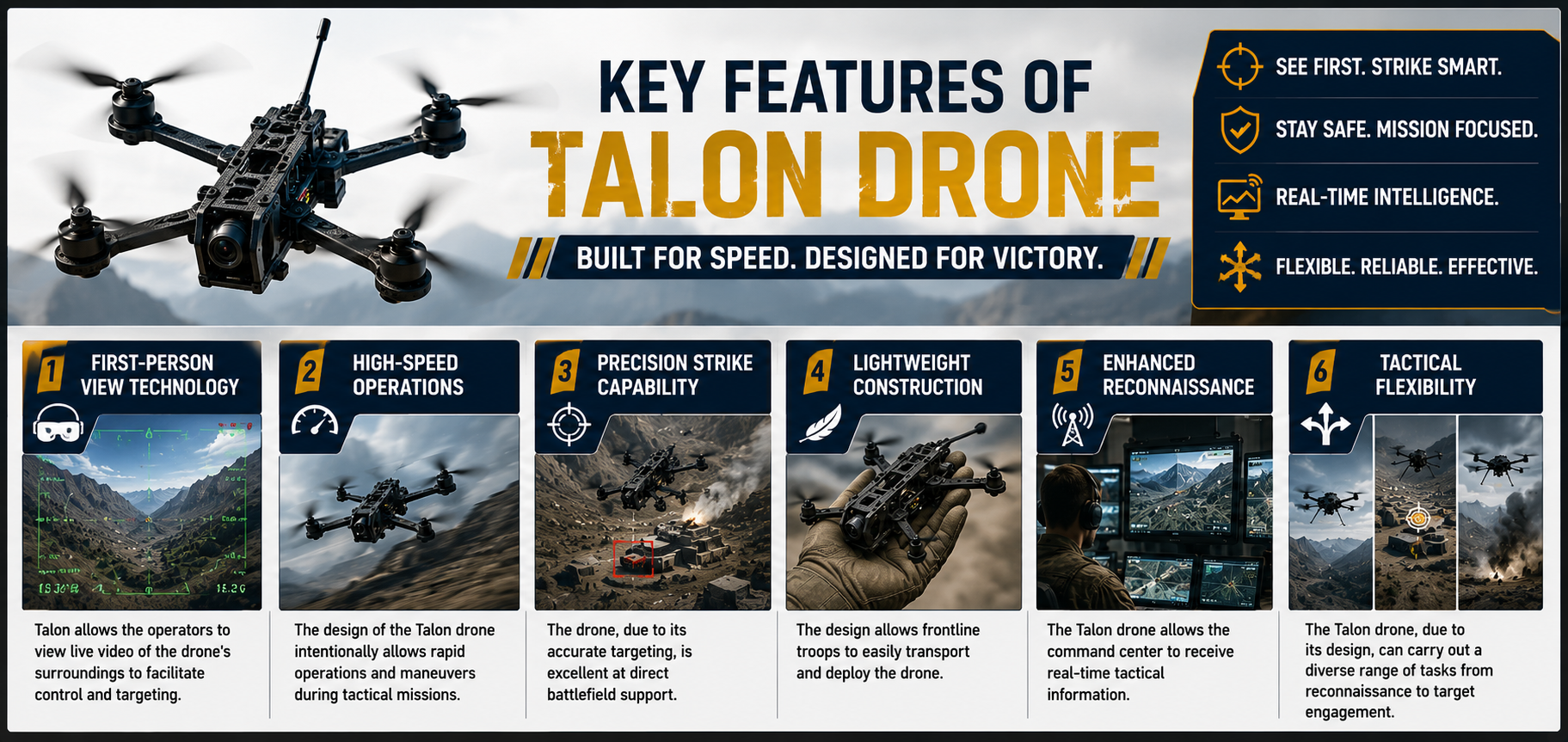
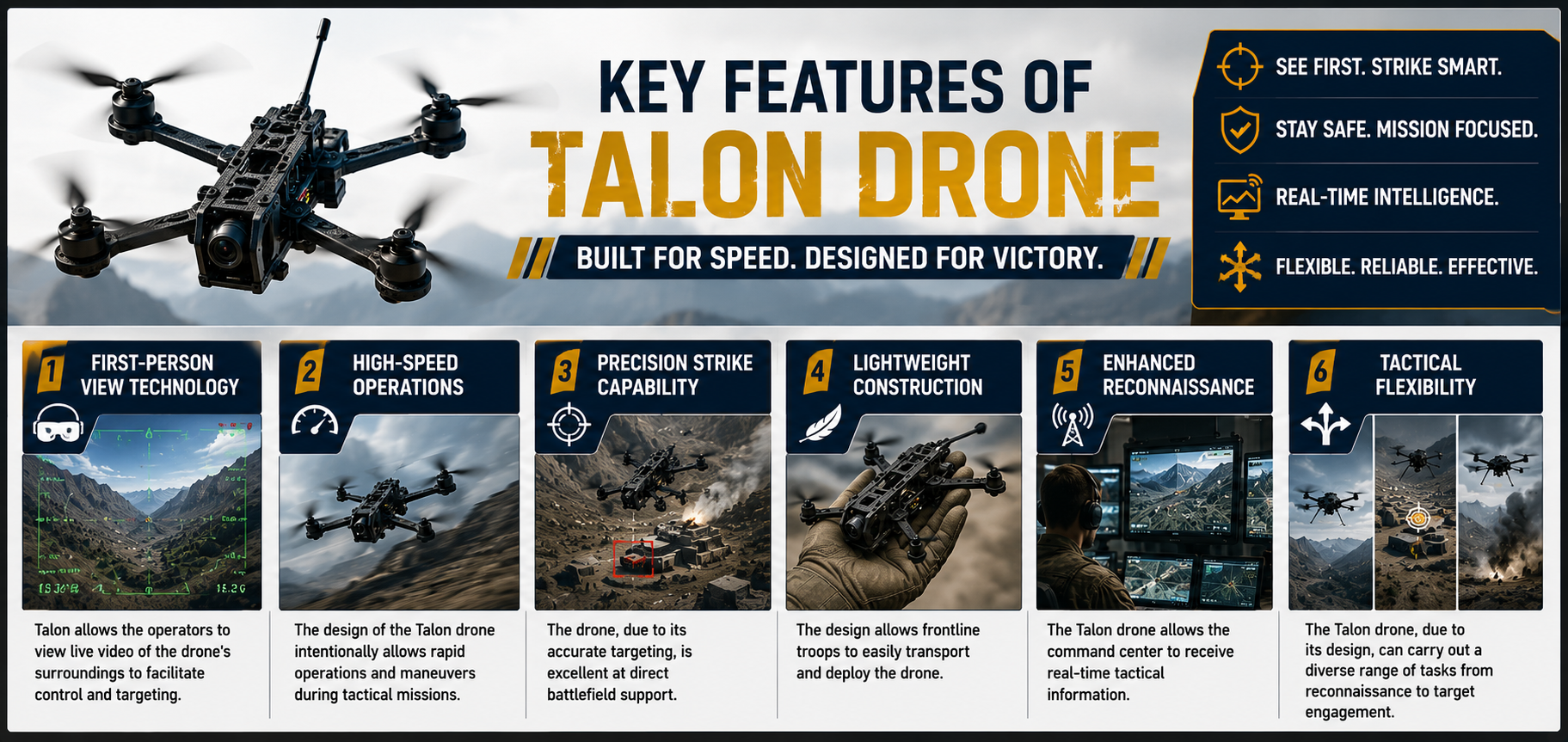
1. First-Person View Technology
Talon allows the operators to view live video of the drone’s surroundings to facilitate control and targeting.
2. High-Speed Operations
The design of the Talon drone intentionally allows rapid operations and maneuvers during tactical missions.
3. Precision Strike Capability
The drone, due to its accurate targeting, is excellent at direct battlefield support.
4. Lightweight Construction
The design allows frontline troops to easily transport and deploy the drone.
5. Enhanced Reconnaissance
The Talon drone allows the command center to receive real-time tactical information.
6. Tactical Flexibility
The Talon drone, due to its design, can carry out a diverse range of tasks from reconnaissance to target engagement.
Atlas & Talon: A Comprehensive Features Comparison
| Feature | Atlas Drone | Talon Drone |
|---|---|---|
| Drone Type | Tactical Quadcopter | FPV Drone |
| Primary Role | Payload Delivery and Strike Missions | Reconnaissance and Precision Attack |
| Flight Control | Autonomous and Manual | Real-Time FPV Control |
| Speed | Moderate | High |
| Surveillance Capability | Yes | Yes |
| Target Engagement | Precision Payload Deployment | Direct Tactical Strike |
| Deployment Method | VTOL (Vertical Take-Off and Landing) | Portable Launch |
| Battlefield Application | Tactical Support | Rapid Response Operations |
| Operator Control | Semi-Autonomous | Fully Operator Guided |
| Military Use | Strike and Support Missions | Reconnaissance and Attack Missions |
Atlas and Talon Drone Comparison
1. Real-Time Intelligence
Talon and Atlas drones offer commanding bodies real-time data on enemy troop movements.
2. Reduced Risk to Personnel
Drones offer fly over potentially dangerous locations to conduct surveillance or strike.
3. Rapid Response
Drones offer military commands the capability to rapidly deploy.
4. Cost-Effective Capability
Compared to manned aircraft, drones offer a cheaper option for surveillance and strike.
5. Flexible Missions
Atlas and Talon can carry out various mission types such as surveillance, tracking, and engagement.
6. Enhanced Precision
Drones offer precise target strike options, which in turn lessen the risk for collateral damage.
7. Force Multiplier
Small teams can accomplish what used to require larger military units with drone systems.
Strategic Importance for India
The inclusion of Atlas and Talon is in line with India’s goals to develop in-country defense systems and decrease reliance on foreign systems. As conflicts continue to show the necessity of investing in unmanned systems, India is making a significant commitment to new developments in the drone space to keep ahead of the curve.
The introduction of these systems will:
- Enhance the capability of national defense
- Improve border patrol
- Assist in counter-terrorism
- Offer greater situational awareness on the battlefield
- Advanced indigenous defense systems
- Spur advancements in the field of aviation
The investment in unmanned systems will prove the increasing role unmanned systems will play in future military engagements.
Also Read- ASML and TSMC: The Semiconductor Revolution Powering AI and Innovation
Future Potential of Atlas and Talon
Unmanned systems will continue to evolve and may soon incorporate features such as:
- AI-based target selection
- Swarming technology
- Greater Range
- Improved survivability in the electronic warfare domain
- Advanced night vision and improved Batteries
- Full automation of mission
The future of unmanned systems for military use in India will be very exciting.
Challenges Facing Military Drones
Even with their significant advantages, there are challenges that limit the military use of drones.
Electronic Interference
The systems of many drones are still vulnerable to the techniques of electronic warfare used to disrupt communications and navigation.
Limited Flight Duration
Battery technology is still an issue with compact systems.
Environmental Conditions
Strong winds, heavy rains, and extreme temperatures can all impact a mission.
Counter-Drone Systems
As the use of drones proliferates, systems that are specifically designed to detect and defeat drones are also evolving.
The effectiveness of future military operations with the use of drones will require that many of these issues be solved.
Conclusion
Atlas and Talon show an extraordinary achievement in India’s development of advanced indigenous defense technology. These drones, which use surveillance, reconnaissance, precision engagement, and tactical flexibility, give military forces the ability to operate in modern, highly mutable environments.
Since Atlas and Talon improve situational awareness, decrease the threat to defense personnel, and provide an effective combat and defense capability for the future, they will become even more important in the advancement of India’s military capability and defense technology. As the technology for military drones improves, so will their capability.
Frequently Asked Questions
1. What is the Atlas drone?
The Atlas drone is a tactical quadcopter designed to deliver payloads and conduct surveillance and battlefield support missions.
2. What is the Talon drone?
The Talon drone is an FPV reconnaissance and precision attack drone.
3. What makes Atlas and Talon significant?
These drones improve military capabilities by acting as tools for real time surveillance, engagement, and precision targeting.
4. Can these drones operate in tough terrain?
Yes, they can. Because of their compact design, they can easily navigate tough environments and remote locations.
5. What are the key advantages of military drones?
Some advantages include better situational awareness and fewer risks to military personnel, increased efficiency, and reduced costs.
6. Why are FPV drones beneficial in a combat scenario?
FPV drones provide operators with a real time view, allowing precise navigation and targeting.
7. Are Atlas and Talon part of India’s indigenous defense strategy?
Yes, these drones are part of India’s efforts to strengthen its domestic defense industry and reduce dependence on foreign technology.
8. What does the future hold for drone warfare in India?
Future advancements are anticipated to include the integration of AI technologies, more automation, swarm technology, and improved situational awareness on the battlefield.