Mosquito Drones: The Next Generation of Warfare
+
Table of Contents
- 1 What are Mosquito Drones?
- 1.1 The Importance of Mosquito Drones
- 1.2 Features of Mosquito Drones
- 1.2.1 1. Miniature Drones
- 1.2.2 2. Quiet Flight
- 1.2.3 3. High-Definition Cameras
- 1.2.4 4. Artificial Intelligence
- 1.2.5 5. Real Time Data
- 1.2.6 6. Flight Restrictions
- 1.2.7 7. Usage of Composites
- 1.2.8 8. Collective Functionality
- 2 Features at a Glance
- 2.1 Advantages of Mosquito Drones
- 2.1.1 Improved Military Surveillance
- 2.1.2 Less Danger to Soldiers
- 2.1.3 Better Urban Combat
- 2.1.4 Faster Information Gathering
- 2.1.5 Lower Cost
- 2.1.6 Difficult to Combat
- 2.1.7 Search and Rescue
- 2.1.8 Scientific Research
- 2.2 Military Applications of Mosquito Drones
- 2.3 Drawbacks of Mosquito Drones
- 2.3.1 Limited Battery Life
- 2.3.2 Payload Issues
- 2.3.3 Flight Stability
- 2.3.4 Safety Issues
- 2.3.5 Advanced Engineering
- 2.4 The Future of Mosquitos Drones
- 3 Mosquito Drones vs. Traditional Military Drones
- 4 Conclusion
- 4.1 Frequently Asked Questions (FAQs)
- 4.1.1 1. What are Micro drones?
- 4.1.2 2. How are Micro drones utilized in warfare?
- 4.1.3 3. Are Miniature drones being used in any modern-day military operations?
- 4.1.4 4. What are some of the benefits of Miniature drones?
- 4.1.5 5. Are Miniature drones able to be used in situations outside of the military?
The rapid evolution of modern combat technology has put Mosquito Drones at the forefront of cutting-edge military innovations. These tiny Mosquito inspired drones perform ISR (Intelligence, Surveillance, Reconnaissance) and special operations. These ultra-small drones can maneuver dense and confined environments, evade detection, and gather crucial information, all while keeping troops safe.
With many countries advancing and investing in their defense systems, Mosquito Drones are predicted to be an integral aspect of future combat. Innovation is happening rapidly across the globe, and the early prototypes and research initiatives are a glimpse into the future of the military, artificial intelligence, and miniaturization.
What are Mosquito Drones?
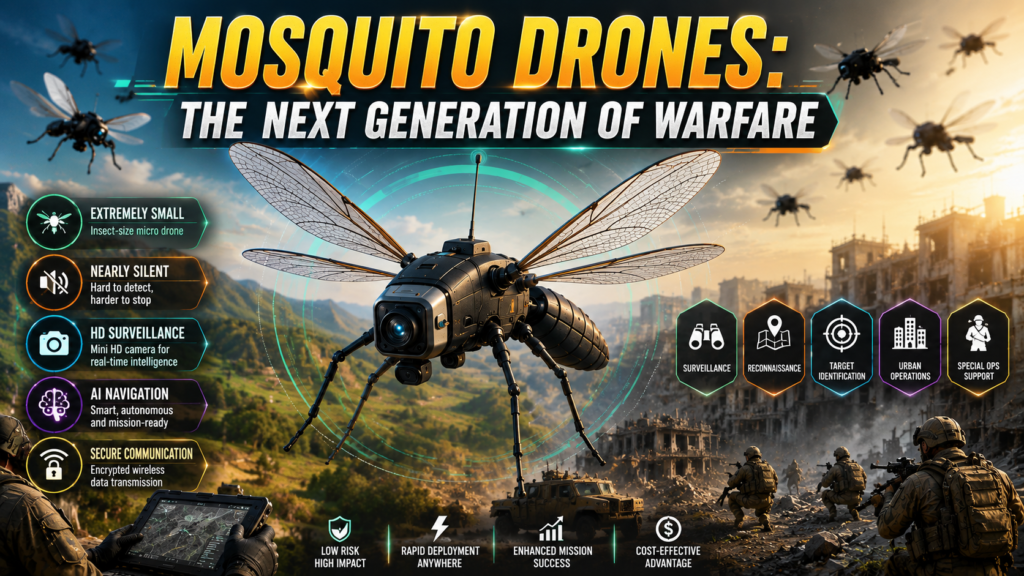
Mosquito Drones are MAVs (Micro Aerial Vehicles) designed to mimic the flight patterns and size of actual mosquitoes. These drones, most of which are only a few centimeters long, are extremely lightweight and small. This allows them to perform missions that larger drones cannot and are especially useful for surveillance.
Small-sized and lightweight drones are only possible with the combination of many technologies, including:
- AI
- Micro cameras and microphones
- Wireless communication
- GPS with enhanced indoor navigation and lightweight, long-lasting batteries
- Advanced Autonomous Flight Control
Some of the newer prototypes are taking drone design one step further by designing their wings to mimic the insect movement to further improve stealth.
The Importance of Mosquito Drones
Rapid intelligence gathering becomes more crucial on modern battlefields. This necessity should not come at the cost of human life. Traditional long-range drones typically have the disadvantage of being easily detected by either the radar or the observers of the adversary. Micro drones provide a near-invisible solution for an almost undetectable reconnaissance effort.
Military planners consider them instrumental in the following activities:
- Tracking the movements of enemies
- Entering collapsed or structurally unsafe buildings
- Assessing the environments of battlefield tunnels
- Operating in urban conflict settings
- Conducting standard or non-standard operations
- Drones of this size can easily evade most defense systems.
Features of Mosquito Drones
1. Miniature Drones
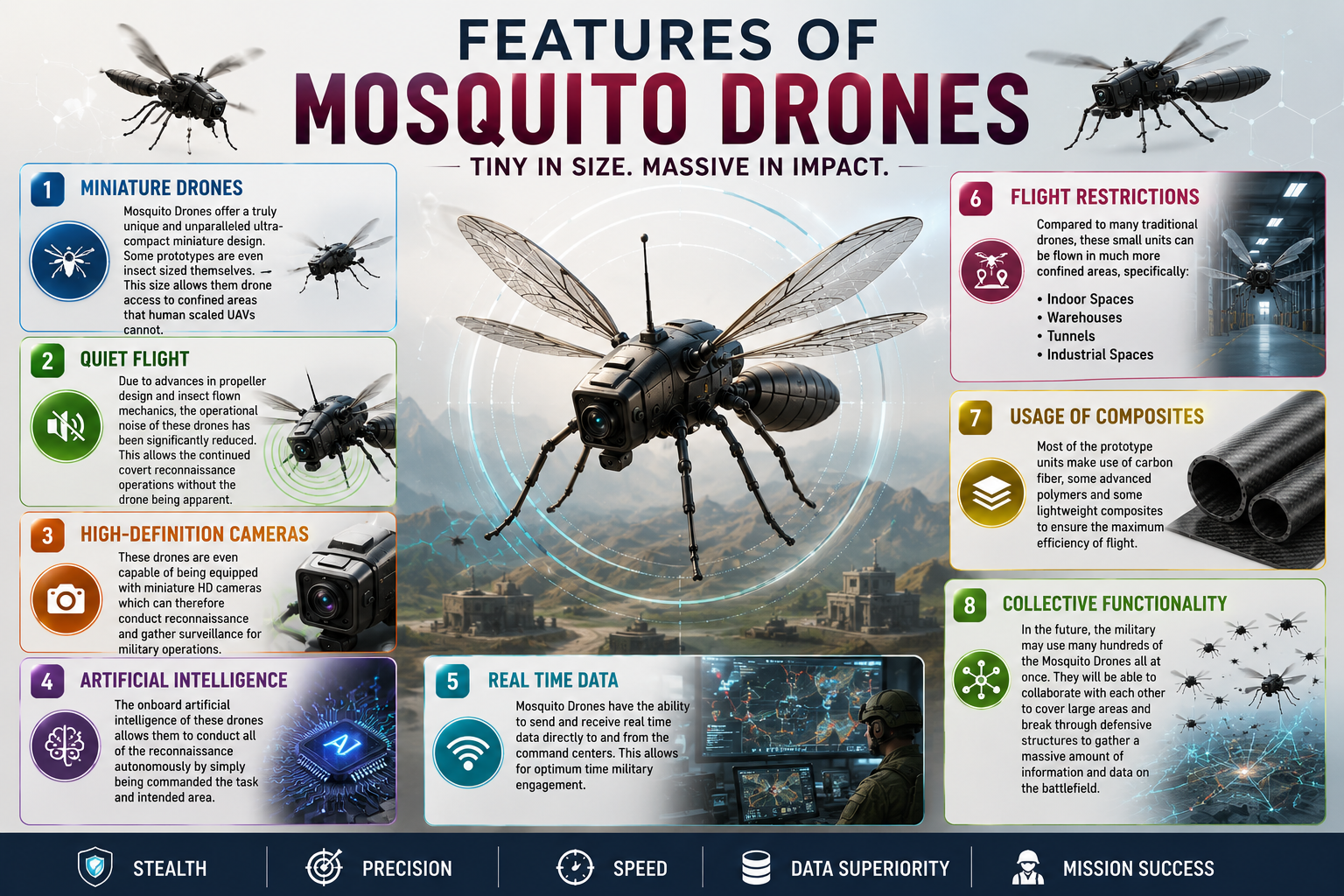
Micro drones offer a truly unique and unparalleled ultra-compact miniature design. Some prototypes are even insect-sized themselves. This size allows them drone access to confined areas that human-scaled UAVs cannot.
2. Quiet Flight
Due to advances in propeller design and insect flight mechanics, the operational noise of these drones has been significantly reduced. This allows the continued covert reconnaissance operations without the drone being apparent.
3. High-Definition Cameras
These drones are even capable of being equipped with miniature HD cameras which can therefore conduct reconnaissance and gather surveillance for military operations.
4. Artificial Intelligence
The onboard artificial intelligence of these drones allows them to conduct all of the reconnaissance autonomously by simply being commanded the task and intended area.
5. Real Time Data
Micro drones have the ability to send and receive real time data directly to and from the command centers. This allows for optimum time military engagement.
6. Flight Restrictions
Compared to many traditional drones, these small units can be flown in much more confined areas, specifically:
- Indoor Spaces
- Warehouses
- Tunnels
- Industrial Spaces
7. Usage of Composites
Most of the prototype units make use of carbon fiber, some advanced polymers and some lightweight composites to ensure the maximum efficiency of flight.
8. Collective Functionality
In the future, the military may use many hundreds of the Micro drones all at once. They will be able to collaborate with each other to cover large areas and break through defensive structures to gather a massive amount of information and data on the battlefield.
Features at a Glance
| Feature | Description |
|---|---|
| Size | Insect-sized micro drone |
| Weight | Only a few grams |
| Flight | Silent, agile, and fast maneuverability |
| Camera | Mini HD camera for surveillance and reconnaissance |
| Navigation | AI-powered autonomous navigation with obstacle avoidance |
| Communication | Secure wireless communication for real-time data transmission |
| Battery | Lightweight rechargeable battery |
| Applications | Surveillance, reconnaissance, intelligence gathering, search and rescue, and military operations |
Advantages of Mosquito Drones
Improved Military Surveillance
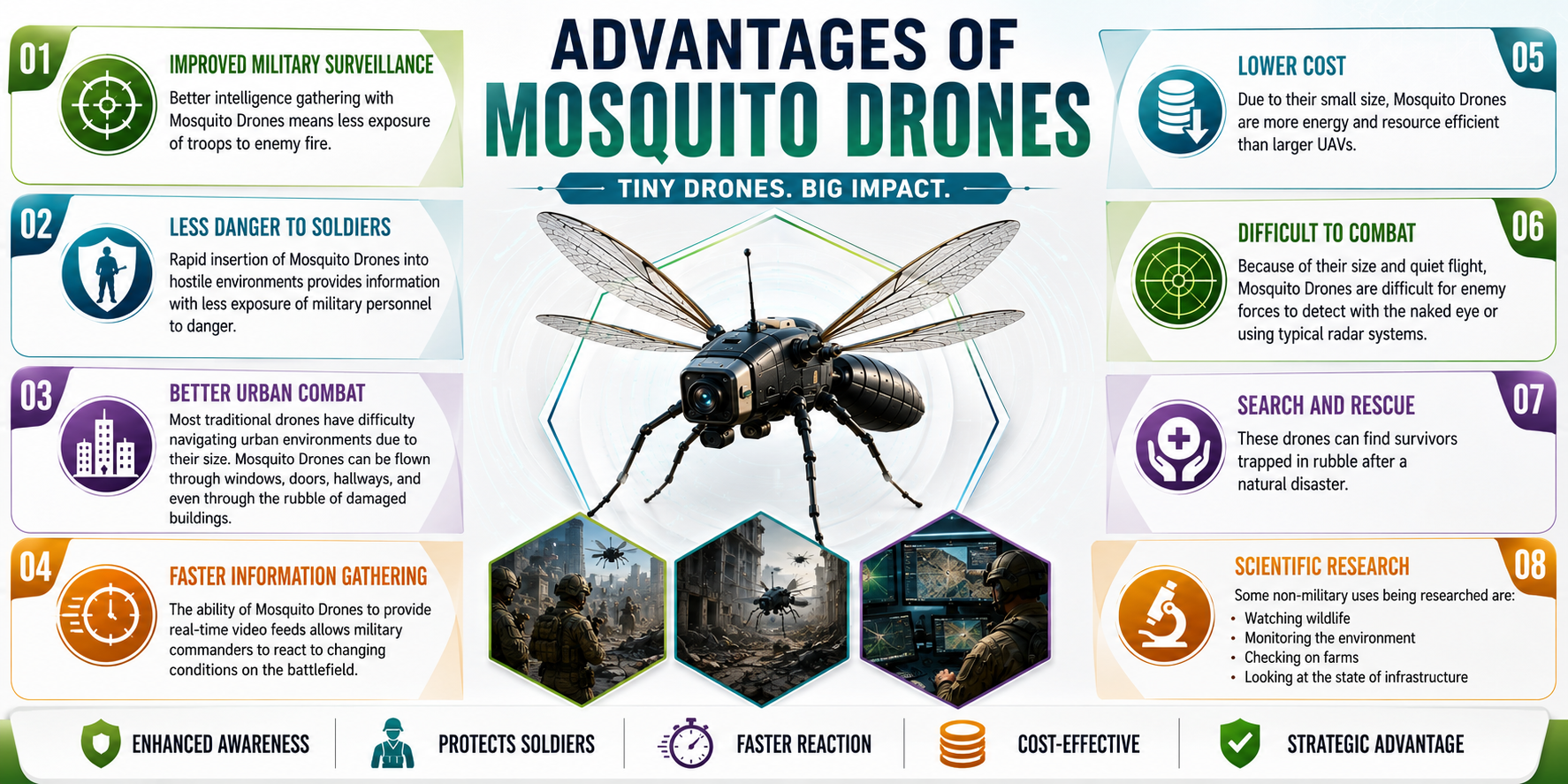
Better intelligence gathering with Micro drones means less exposure of troops to enemy fire.
Less Danger to Soldiers
Rapid insertion of Micro drones into hostile environments provides information with less exposure of military personnel to danger.
Better Urban Combat
Most traditional drones have difficulty navigating urban environments due to their size. Micro drones can be flown through windows, doors, hallways, and even through the rubble of damaged buildings.
Faster Information Gathering
The ability of Micro drones to provide real-time video feeds allows military commanders to react to changing conditions on the battlefield.
Lower Cost
Due to their small size, Micro drones are more energy and resource efficient than larger UAVs.
Difficult to Combat
Because of their size and quiet flight, Micro drones are difficult for enemy forces to detect with the naked eye or using typical radar systems.
Search and Rescue
These drones can find survivors trapped in rubble after a natural disaster.
Scientific Research
Some non-military uses being researched are:
- Watching wildlife
- Monitoring the environment
- Checking on farms
- Looking at the state of infrastructure
Also Read- 10 Best Hosting for Small Business to Skyrocket Your Success
Military Applications of Mosquito Drones
There are many uses for Micro drones on the battlefield being considered by military organizations like:
- Reconnaissance
- Border Patrol
- Gathering intel
- Supporting special operations
- Planning a hostage rescue
- Inspecting tunnels
- Watching buildings
- Identifying targets
- Relaying communication
- Electronic reconnaissance
In time, with further advancements of AI, these drones may perform an even greater number of tasks with little to no human assistance.
Drawbacks of Mosquito Drones
While these drones are very advanced, there are many obstacles facing their further development.
Limited Battery Life
Currently the smallest batteries give the shortest flight times.
Payload Issues
Small batteries mean small payloads.
Flight Stability
Wind and rain affect flight stability.
Safety Issues
These drones are very hackable, and protecting them from being hacked and messed with is a must.
Advanced Engineering
Insect sized flying robots are very difficult to engineer and manufacture.
Micro drones bring many ethical concerns with them as well.
Some of the concerns may be:
- Surveilling citizens
- Infringement of privacy
- Using them against civilians
- International laws of warfare
- Autonomous warfare
This is is why governments will have very tight controls on these systems.
The Future of Mosquitos Drones
The future of Micro drones is bright with advancements in nanotech, AI, and battery tech. Researchers are focusing on developing drones that:
- Fly longer
- Navigate better and more autonomously
- Avoid obstacles better
- Have more secure communications
- Can swarm and work together better
- Have better integrated sensors
Drones in the future may work along with Satellites, Ground Robots, and even larger UAVs.
Most of the systems described have not reached full production. However, micro-robotics and rapid developments have the potential to reach the systems described.
Mosquito Drones vs. Traditional Military Drones
| Feature | Mosquito Drones | Traditional Military Drones |
|---|---|---|
| Size | Extremely small | Large UAV |
| Visibility | Very difficult to detect | Easily visible |
| Noise Level | Nearly silent | Moderate |
| Indoor Operation | Excellent | Limited |
| Payload Capacity | Very small | Large |
| Flight Time | Short | Long |
| Operational Cost | Generally lower | Higher |
| Primary Use | Covert surveillance | Long-range missions |
Conclusion
Micro drones lead the pack of modern military technology innovations. The size, shape, and features of Micro drones give them the ability to perform surveillance and reconnaissance in highly restricted areas. Continued focus on battery life, size, payload, and cybersecurity will help to optimize the Mosquito Drone.
The size and capabilities of Micro drones offer a large range of potential uses beyond military. Examples include disaster response, environmental monitoring, scientific research, and industrial inspection.
Mosquito Drones have the potential to impact both the defense and civilian markets. Continued focus on this modern technology will help to innovate within the civilian and military markets for the way missions are performed and the way information is obtained.
Frequently Asked Questions (FAQs)
1. What are Micro drones?
Micro drones are extremely miniature UAVs built for reconnaissance and surveillance. They imitate the size and movement of flying insects.
2. How are Micro drones utilized in warfare?
Micro drones are used mainly for intelligence, reconnaissance, and target location. They can also assist with routine battlefield surveillance and special operations.
3. Are Miniature drones being used in any modern-day military operations?
Micro-drone technology is being used in some capacity. However, many of the insect-sized Miniature drones are still being researched, tested, or are in the prototype phase.
4. What are some of the benefits of Miniature drones?
Miniature drones are extremely small and discreet. They collect data in real-time, are far less dangerous than manned transportation, and can operate in tight or small areas.
5. Are Miniature drones able to be used in situations outside of the military?
Absolutely. Some of the more promising uses for Miniature drones outside of the military are monitoring and assessing the environment, checking up on hard to reach human structures, and even helping with some types of farming.