Kamikaze Drone Guide: The Ultimate Strike Technology
+
Table of Contents
- 1 What Is a Kamikaze Drone?
- 1.1 How Do Kamikaze Drones Differ From Conventional Military UAVs?
- 1.2 Key Features of Kamikaze Drones
- 1.2.1 1. Compact Airframes
- 1.2.2 2. Electro-Optical and Other Sensors
- 1.2.3 3. Navigation Systems
- 1.2.4 4. Communication Links
- 1.2.5 5. Integrated Warhead
- 2 Applications of Kamikaze Drone Technology
- 2.1 Benefits of Kamikaze Drones
- 2.1.1 Cost Effective
- 2.1.2 No Pilot is Required
- 2.1.3 Flexible Mission Profiles
- 2.1.4 Rapid Evolution of Technology
- 2.2 Major Risks and Challenges
- 2.3 Legal and Ethical Considerations
- 2.4 The Future of Kamikaze Drone Technology
- 3 Conclusion
As technologies of modern warfare continue to rapidly evolve, they may increasingly rely on unmanned aerial systems. Of these, one of the most controversial systems is kamikaze drones, also called loitering munitions or one-way attack drones. As opposed to typical surveillance drones, these systems are designed to search for and eventually destroy their targets by crashing. According to the International Committee of the Red Cross (ICRC), loitering munitions are expendable, uncrewed aerial systems that can hover and destroy a target by detonating themselves.
Because of their ability to combine characteristics associated with drones and precision-guided munitions, the systems are being used more often. While they get more use, they are raising serious ethical concerns about protecting civilians, human control, responsibility and accountability, and adherence to international humanitarian law.
What Is a Kamikaze Drone?
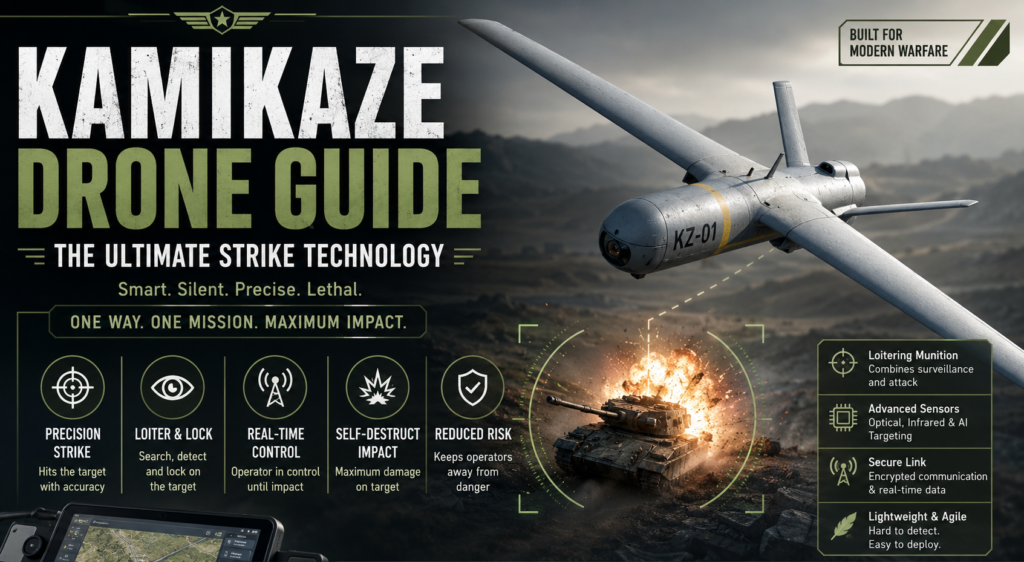
A kamikaze drone is a type of unmanned aerial system designed to strike a target by crashing into it. Unlike a combat drone, an attack drone system becomes the weapon itself once it is launched.
In popular and media discourse, the system is most colloquially referred to as a kamikaze drone, while the military and defense literature tends to use terms such as loitering munition, one-way attack UAV (unmanned aerial vehicle), or one-way attack drone.
Some systems can fly while searching for suitable targets, while others operate against previously identified targets. There are varying degrees of autonomy. The ICRC mentions that some loitering munitions include some automated and/or some autonomous functions, but the autonomy in navigation is not necessarily the same as autonomy in target selection.
How Do Kamikaze Drones Differ From Conventional Military UAVs?
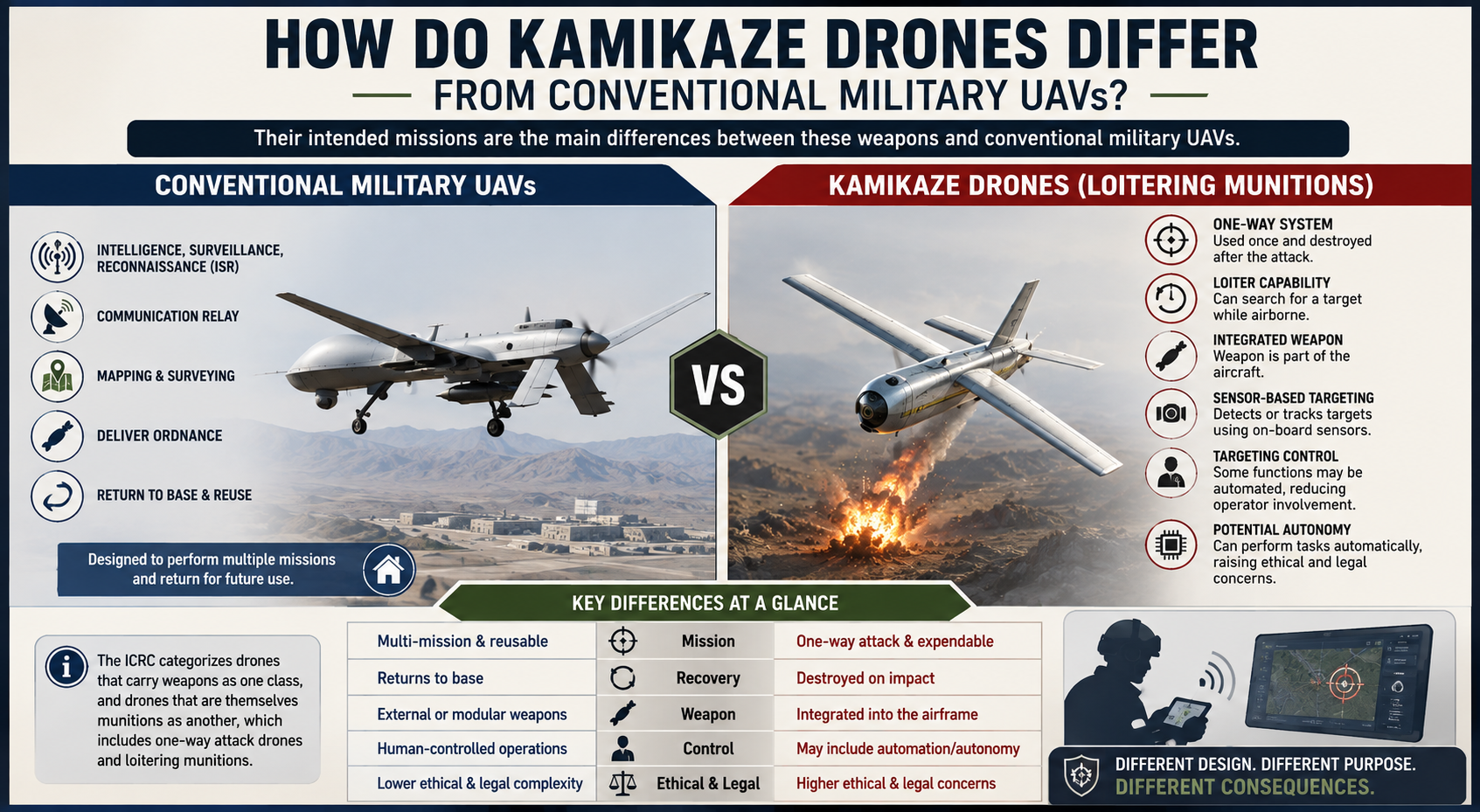
Their intended missions are the main differences between these weapons and conventional military UAVs.
Conventional military UAVs can perform tasks such as intelligence, surveillance, and reconnaissance (ISR); act as communication relay aircraft; perform mapping duties; or even deliver ordnance, and then fly back to base for use again. In comparison, loitering munitions are almost always designed to be an expendable system.
This design results in several characteristics:
- It is a one-way system: The aircraft is used and normally destroyed after the attack.
- Loiter Capability: Some systems are designed to be able to search for a target while remaining airborne.
- Integrated Weapon: The weapon is part of the aircraft as opposed to an externally carried weapon.
- Sensor-based Targeting: Some systems can detect or track targets using on-board sensors.
- Targeting Control: Depending on the system, some of the functions may be done automatically, leaving a potentially uninvolved operator.
- Potential Autonomy: Some systems may be able to perform some tasks automatically, creating Ethical and Legal problems.
The ICRC categorizes drones that carry weapons as one class, and drones that are themselves munitions as another, which includes one-way attack drones and loitering munitions.
Also Read- Ultimate Drone Batteries Guide: Power Your Flight
Key Features of Kamikaze Drones
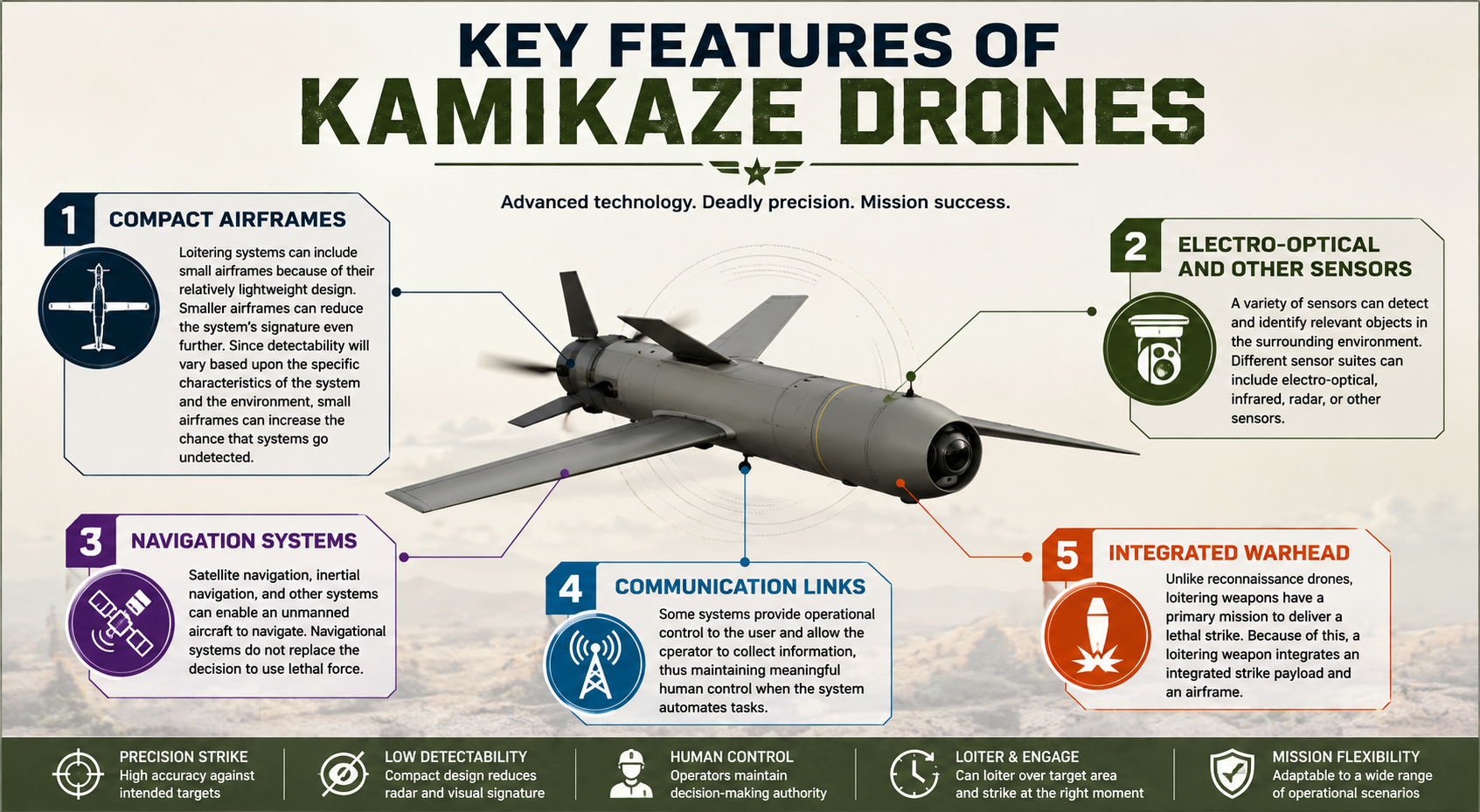
The technology behind these systems combines several aerospace and electronics technologies.
1. Compact Airframes
Loitering systems can include small airframes because of their relatively lightweight design. Smaller airframes can reduce the system’s signature even further. Since detectability will vary based upon the specific characteristics of the system and the environment, small airframes can increase the chance that systems go undetected.
2. Electro-Optical and Other Sensors
A variety of sensors can detect and identify relevant objects in the surrounding environment. Different sensor suites can include electro-optical, infrared, radar, or other sensors.
3. Navigation Systems
Satellite navigation, inertial navigation, and other systems can enable an unmanned aircraft to navigate. Navigational systems do not replace the decision to use lethal force.
4. Communication Links
Some systems provide operational control to the user and allow the operator to collect information, thus maintaining meaningful human control when the system automates tasks.
5. Integrated Warhead
Unlike reconnaissance drones, loitering weapons have a primary mission to deliver a lethal strike. Because of this, a loitering weapon integrates an integrated strike payload and an airframe.
Applications of Kamikaze Drone Technology
The use of kamikaze drones has primarily centered on military strike operations, although historically, loitering systems have been developed for use against radars, armored vehicles, artillery, and other military equipment.
This is how we summarize the broader military applications of loitering munitions:
| Application | Main Purpose | Main Advantage |
|---|---|---|
| Counter-radar missions | Engage relevant military radar targets | Combines search and strike functions |
| Anti-armor missions | Attack military vehicles | Provides a remotely operated strike option |
| Battlefield surveillance-to-strike | Locate and engage designated objectives | Reduces the separation between observation and attack |
| Precision strike missions | Engage specified military objectives | Potentially more selective than unguided area weapons |
| Stand-off operations | Keep personnel farther from immediate danger | Reduces exposure of some operators |
These are general applications, and the actual military use of loitering munitions will ultimately be dependent on existing military doctrine and applicable laws, mission requirements, and the available system and target capabilities.
Benefits of Kamikaze Drones
There is significant interest in a system that combines surveillance and strike as a single, compact system. Rather than using two systems, it would significantly reduce the expense of time and resources.
Cost Effective
Some loitering munitions are designed to be low-cost and expendable compared to missiles or more advanced aircraft.
No Pilot is Required
Drones can eliminate the need to fly a pilot to the target.
Flexible Mission Profiles
Depending on the design, a loitering munition can support a wide variety of missions.
Rapid Evolution of Technology
The power of the larger UAS industry accelerates the technology of smaller UAS.
These systems can easily be integrated with the military in the near future.
Though automated targeting systems offer clear benefits, including enhanced impact and reduced risk to the user, they should not be interpreted as decreasing civilian harm. The ICRC notes the level of impact and safety of armed drones is dependent on technology as well as the quality and relevance of data.
Major Risks and Challenges
Concerns regarding the proliferation of kamikaze drones are numerous and valid.
For starters, there is the risk of mistaken identification. Sensors and software can interpret and even misidentify objects. Additionally, it is possible that a target can be situated in proximity to non-combatants and/or civilian targets.
Proliferation of inexpensive drone technology has the potential to provide greater lethality, thus worsening global stability.
Legal and Ethical Considerations
UAV strike technology tends to be permitted under international humanitarian law. However, they must be used in accordance with accepted principles including distinction, proportionality and precaution. They must be directed against lawful targets and used against military objectives. Additionally, reasonable measures to limit civilian harm must be employed.
Autonomous systems create a lot of complications for the law. The ICRC has encouraged the development of new international rules for the use of autonomous weapons. The existing legislative gap will increase in the future due to the rapid developments in technology.
It is necessary to have responsible human oversight for the use of fully autonomous weapon systems for the future of unmanned strike systems.
Also Read- Powerful Graphic Design Software: Create Stunning Designs
The Future of Kamikaze Drone Technology
The Kamikaze Drone is expected to become an even more advanced system incorporating innovation in the areas of automation, advanced sensors, better communications, and even smaller systems. Sophisticated computing and even more advanced AI may help systems with object recognition and even some decision-making.
There will always be the need for greater international oversight of the technology of warfare. Governments and Non-governmental humanitarian organizations will always be interested in the balance parents need to strike between automating systems and ensuring there is meaningful human control over systems.
The central challenge will be making drones more capable, while ensuring that the technology of automation, accountability, and compliance with international humanitarian law is developed alongside automation.
Conclusion
Kamikaze drone systems may be considered a significant advancement in modern autonomous warfare because they integrate a number of systems to include an aircraft, sensors, navigation, communications, and a destructive payload, all in a single system.
The systems can be deployed with a flexible sensor and strike capability with reduced exposure of personnel. However, the systems can lead to significant negative impacts if misused. These include target identification and civilian impacts, as well as concerns of proliferation, automation, and accountability.
As military technology progresses, systems of the future will require both engineering advancements and considerate decisions alongside effective international policies.
FAQs
1. What is a kamikaze drone?
Kamikaze drones can refer to one-way attack drones or loitering munitions that can strike and self-destruct.
2. What is the difference between Kamikaze drones and military drones?
Because regular military drones are usually reusable and can be employed to perform various tasks, from reconnaissance to delivering a payload, Kamikaze drones are often used to mean loitering munitions which are designed to be used only once.
3. Do all loitering munitions have autonomy?
No. There can be different levels of autonomy across the systems, but some can be controlled by operators while others can have automated or autonomous functions.
4. What are some potential positive impacts of these systems?
These systems can potentially have positive impacts, such as exposed pilots being eliminated, smaller systems, greater mission flexibility, and increased system integration.
5. Are military drones illegal?
Even though there are no specific international laws that prohibit the use of military drones, there are binding laws of war which state that military drones must comply with distinction, proportionality, and precautionary measures.