Best Digital Marketing Tools: Powerful Picks for Success
+
Table of Contents
- 1 Digital Marketing Tools
- 2 Top Digital Marketing Tools to Consider
- 2.1 1. Semrush
- 2.1.1 Best for:
- 2.2 2. Ahrefs
- 2.2.1 Best for:
- 2.3 3. Google Analytics
- 2.3.1 Best for:
- 2.4 4. HubSpot
- 2.4.1 Best for:
- 2.5 5. Canva
- 2.5.1 Best for:
- 2.6 6. Mailchimp
- 2.6.1 Best for:
- 2.7 7. Buffer
- 2.7.1 Best for:
- 3 Quick Comparison of the Best Tools
- 3.1 Key Benefits of Using Digital Marketing Tools
- 3.2 How to Choose the Right Marketing Tools
- 3.3 The Future of Digital Marketing Software
- 4 Conclusion
- 4.1 FAQs
Competition in digital marketing has skyrocketed. Businesses must use technology more creatively if they are to stand out. Today’s marketers mine data, create content, manage social media, engage customers, and assess campaign performance. Every team needs user-friendly digital marketing tools to analyze, track, and measure data faster.
Whether you run a small business, manage an agency, or work in a growing brand, the right marketing software can boost productivity and performance. There are now programs that can fulfill almost every request a marketer may have, whether it is an SEO software, an analytics tools, an email marketing tool, or an app to help with design.
Digital Marketing Tools
Software designed to aid digital marketing tasks at every stage, from planning to execution to measurement, is what makes up a digital marketing tool. These tools help in search engine optimization (SEO), marketing through content, social media marketing, advertising, analytics, CRM (customer relationship management), customer conversion, and more.
When automation and integrations are used, digital marketing tasks can be performed using the least possible number of applications. The right digital marketing stack will depend on a firm’s specific goals.
Top Digital Marketing Tools to Consider
Here are some worthwhile tools for various needs of the market.
1. Semrush
Semrush is an all-in-one tool for marketing through the search engine, assessing the competition, generating content, and managing visibility. Marketers can use Semrush to help them analyze, understand, and discover competitors in the market, as well as keywords and possible opportunities to grow their business organically.
Key features include keyword research, backlink analysis, competitor analysis, site auditing, rank tracking, and other content-related features. This helps SEO professionals identify issues and develop strategies based on search data.
Best for:
SEO professionals, agencies, content teams, and businesses that prioritize organic traffic.
2. Ahrefs
Ahrefs is another popular tool. It excels in keyword research, backlink analysis, competitor analysis, and site auditing. Ahrefs is particularly valuable because of the large volume of links.
While using Ahrefs, marketers can discover key SEO opportunities, analyze competitor backlinks, and conduct keyword research.
Best for:
SEO analysts, agencies, publishers, and marketers who focus heavily on SEMy data.
3. Google Analytics
Google Analytics provides additional information about users and visitor engagement. Digital marketers can analyze user acquisition, user engagement, and the conversion funnels.
One of the benefits of Google Analytics is that it provides a foundation for understanding what happens post-click. If Google Analytics is configured correctly, then businesses can see campaign impact and understand the outcome.
Best for:
Businesses of any size that are concerned with the performance of their website.
Also Read- Powerful Business Automation Software: Work Smarter, Grow Faster
4. HubSpot
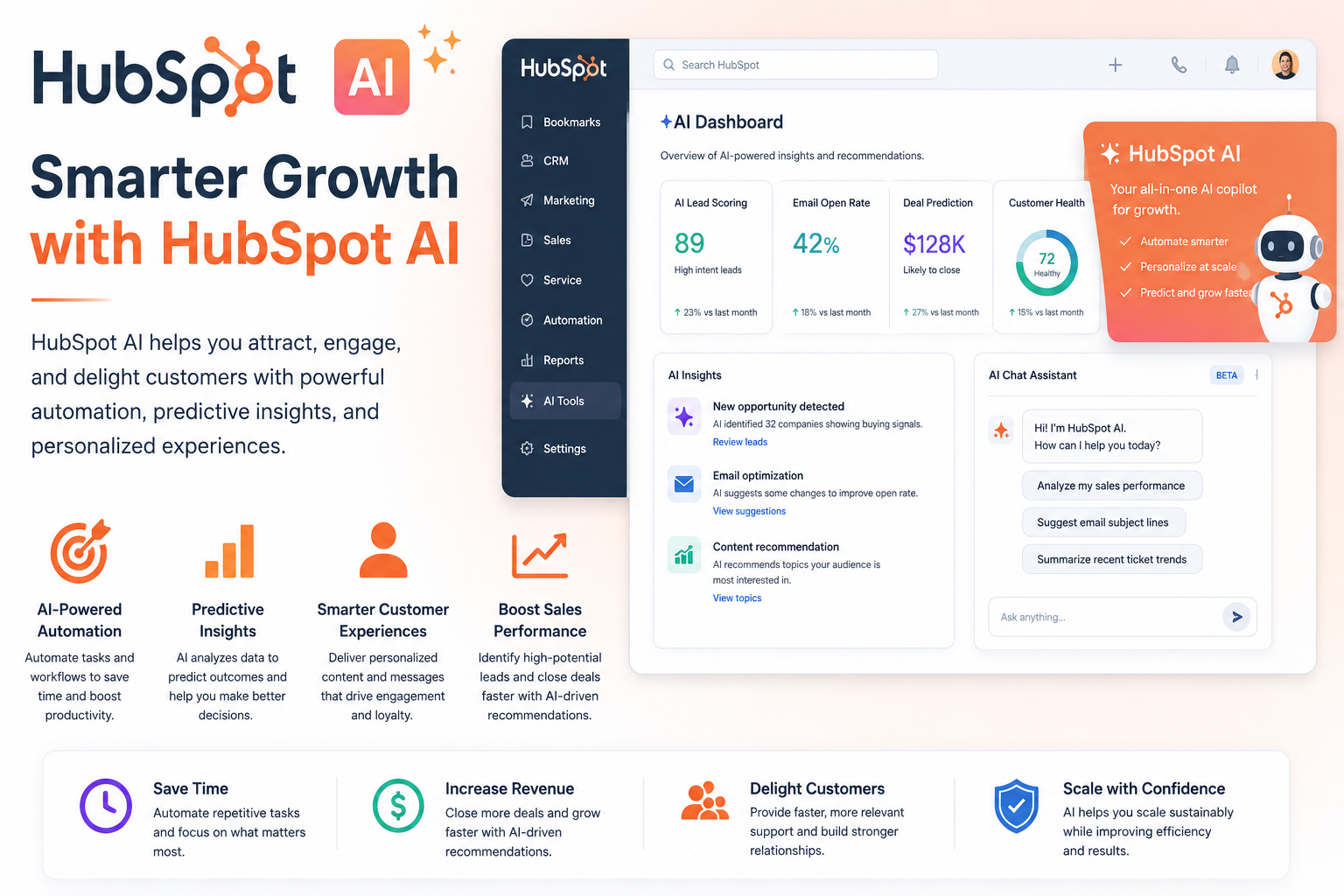
HubSpot combines different tools into a singular platform and includes marketing, CRM, customer engagement, customer insight, and automation tools. Within the HubSpot Marketing Hub tools, marketers find campaign tools for emails, forms, social media, personalization, and automation as well as a reporting dashboard.
One of the main strengths of this system is its commitment to bringing together customer and marketing data. With this integration, teams can manage and nurture leads, personalize outreach, and automate workflows and tasks while improving their understanding of the customer journey.
Best for:
Growing businesses, sales and marketing teams, and companies wanting an integrated platform.
5. Canva
Canva assists marketers with limited graphic design ability with the ability to create professional looking designs. The platform utilizes a drag and drop design and offers a range of templates to create designs for various marketing needs including graphics for social media, presentations, infographics, advertisements, blog graphics, and more. Canva’s platform provides tools to help marketers and teams create consistent design patterns across multiple structures and be reflective of portfolio brands with tools to manage designs, colors, patterns, and text.
Best for:
Content creators, social media marketers, small businesses, and marketing teams.
6. Mailchimp
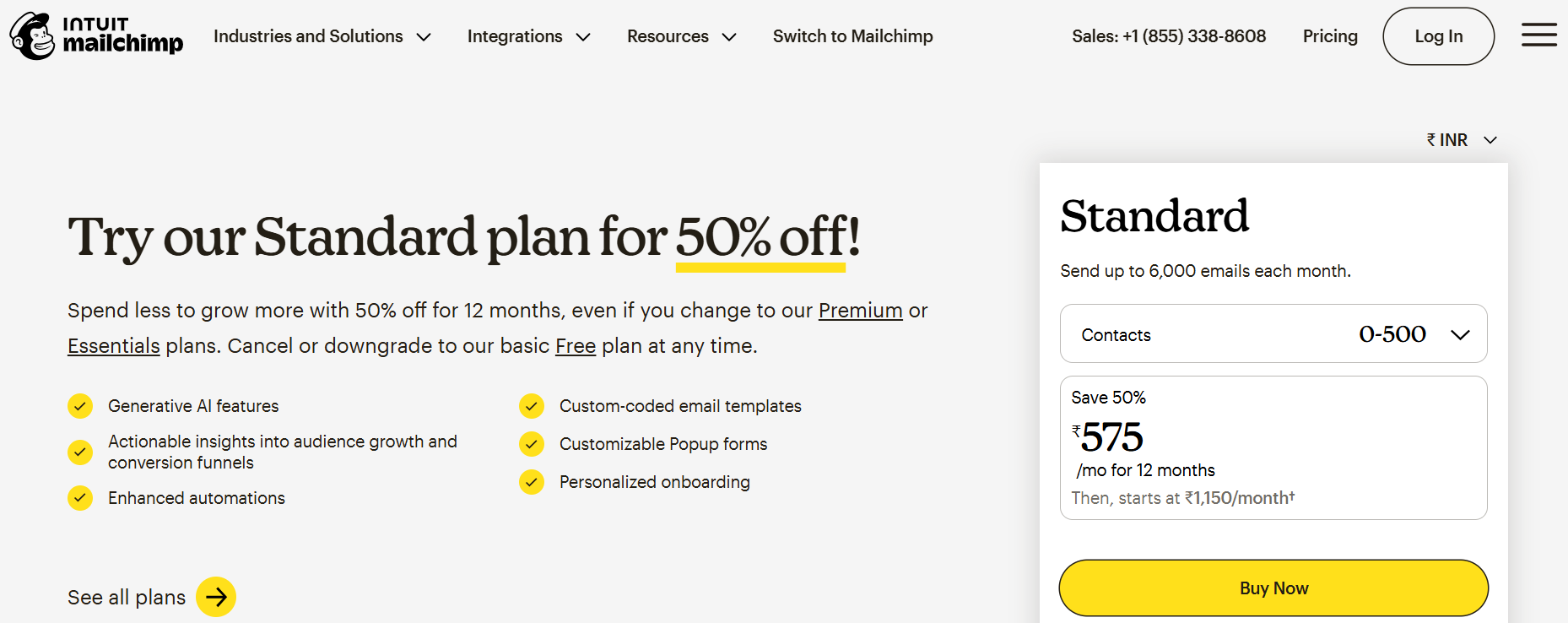
Mailchimp is a platform that businesses utilize to send and manage marketing emails. The platform helps businesses to develop segments of audiences, automate marketing tasks, and create performance reports.
Email marketing automation is a feature that helps with the development of marketing sequences that are triggered by user behavior. Sequences can be utilized for email marketing of products, welcoming new customers, newsletters, re-engagement, and marketing to nurture potential customers.
Best for:
Small businesses, ecommerce companies, creators, and teams developing email campaigns.
7. Buffer
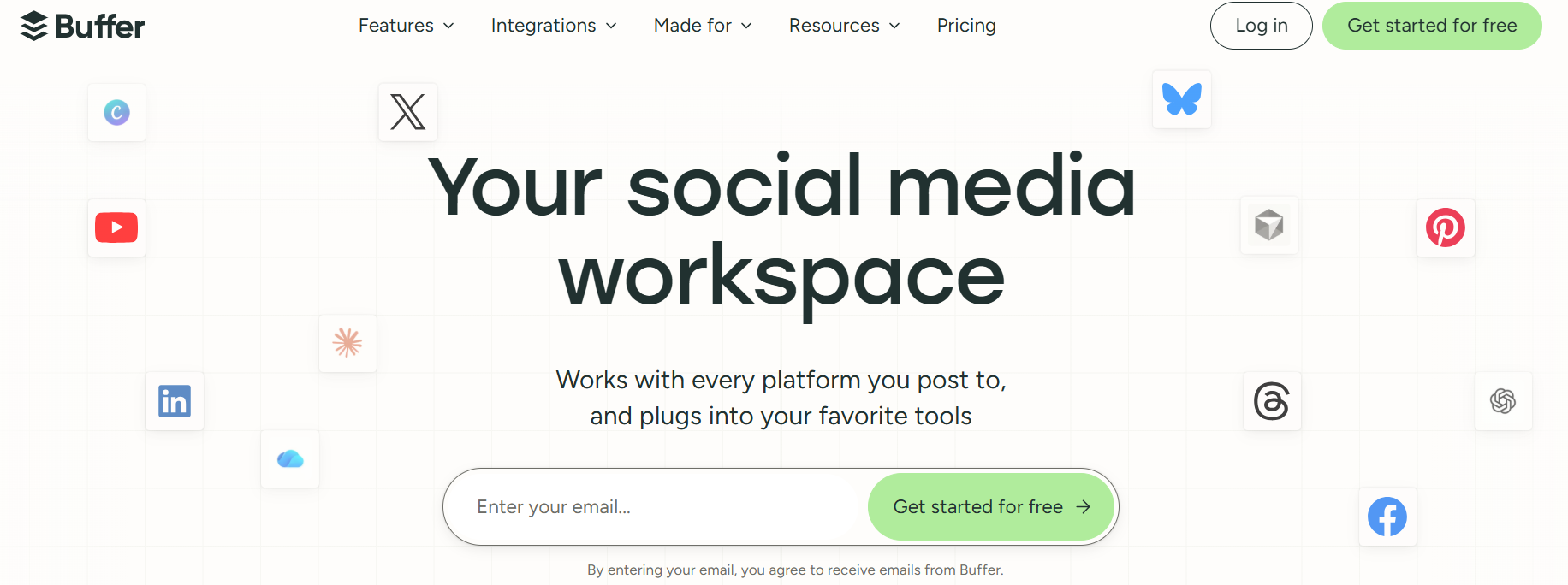
buffer is a social media management and publishing tool that allows marketers to prepare social media content for publishing at future dates. Allows marketers to save time that they would otherwise spend manually publishing individual posts on various social media platforms.
Buffer helps social media teams with social publishing and facilitates a consistent publishing schedule.
Best for:
Freelancers, creators, small businesses, and social media teams.
Quick Comparison of the Best Tools
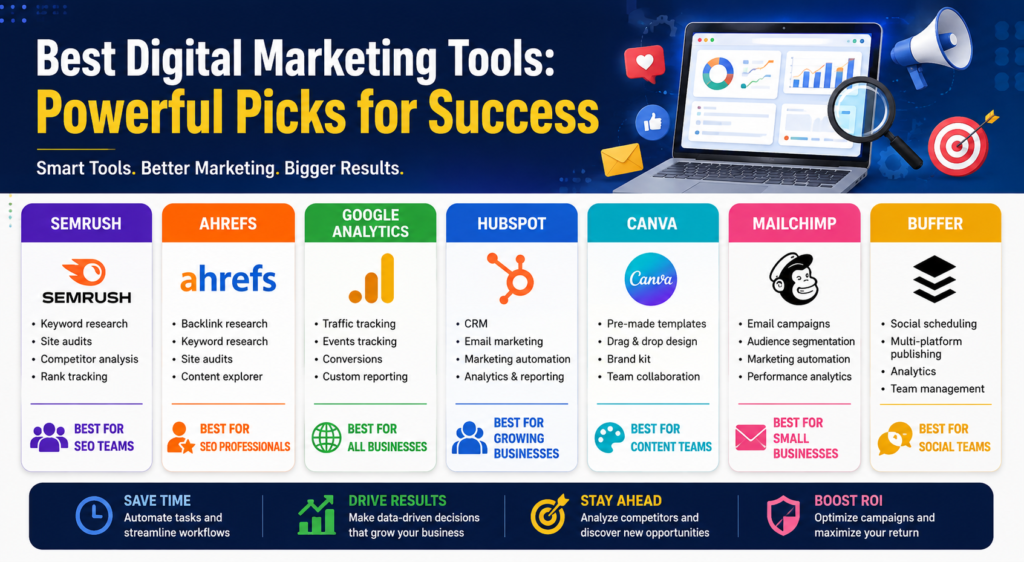
| Name | Key Features | Main Purpose | Best For |
|---|---|---|---|
| Semrush | Keyword research, site audits, competitor analysis | SEO & research | SEO teams |
| Ahrefs | Backlink research, keyword research, site audits | SEO & backlinks | SEO professionals |
| Google Analytics | Traffic tracking, events, conversions, reporting | Web analytics | All businesses |
| HubSpot | CRM, email marketing, automation, analytics | Marketing automation | Growing businesses |
| Canva | Templates, graphic design, brand tools | Visual content | Content teams |
| Mailchimp | Campaigns, audience segmentation, automation | Email marketing | Small businesses |
| Buffer | Social scheduling, publishing, management | Social media marketing | Social media teams |
Key Benefits of Using Digital Marketing Tools
Time is money and that is certainly the case when it comes to digital marketing tools. Virtual assistants can help marketers cut down regular, yet vital tasks when it comes to the day-to-day operations of a digital marketing strategy.
Virtually, assistants can also help marketers solve the guesswork when it comes to digital marketing. analytical tools can provide insights on traffic patterns, customer engagements, leads, and conversions.
Another great benefit of marketing tools is flexibility. a centralized system can save marketers time by eliminating the need to switch between multiple spreadsheets, communication tools, and analytics dashboards needed for digital marketing.
Marketing tools also help personalize your digital marketing strategy. Audience segmentation can help businesses create personalized messages based on interest and previous engagements and interactions.
Marketing tools also help with scalability. Automated scheduling, reporting, lead follow up, and other repetitive tasks can help small teams execute large digital marketing campaigns.
Also Read- Game-Changing Machine Learning Trends to Watch in 2026
How to Choose the Right Marketing Tools
For you, what matters is what solves your marketing needs. So identify the biggest marketing challenge that you are facing, and then work your way backwards to a solution.
For prioritizing organic search, Semrush and Ahrefs are popular options. For measuring websites, Google Analytics will serve you well. HubSpot may also serve you well for customer management and automation, but it offers a wider range of functions.
Of course, budget will also weigh in. There are many solutions that offer free or free-to-use options, and the full range of tools may require a fee. The current industry comparison shows many free, freemium, and premium offerings, so the expected value should be weighed above price.
Integration will matter as well. Your tools should work together. Analytics can inspire content creation, and SEO data may dictate an editorial calendar. CRM data can help personalize email outreach.
Finally, avoid the platform subscription trap. It’s better to have a few quality tools that your team actually uses than a pile of cool, but unused, tools.
The Future of Digital Marketing Software
Artificial Intelligence (AI) is definitely going to be a large part of how marketers have to interact with software. The marketing software of the future will have AI for automated personalization, optimization, audience analysis, reporting, and for content creation.
Automation is great and has its place, but digital marketing still needs the human brain. Understanding your audience, developing content that adds value, critical evaluation of data, and understanding your positioning are just some of the tasks that AI does not replace.
The future of digital marketing also incorporates AI to automate repetitive tasks, while humans retain their roles in the strategic, brand, customer, and decision spaces.
Conclusion
Businesses can benefit from the right digital marketing tools in multiple ways. These tools can help attract an audience through audience building tools, assist in content creation, lead generation, and tracking results. There are several tools such as Semrush, Ahrefs, Hubspot, Google Analytics, Canva, and Mailchimp among others that can help with these functions.
There is not going to be one tool that all businesses can benefit from. In order to be successful at finding the right tools for your business, you have to understand your objectives. After you know those, you can start to assess what software will help your business and whether the integrations and the costs are worth it. You also have to see if the return on investment is worth it.
When you combine technology and marketing strategy, using the correct tools will help your business scale and make the growth you do achieve more efficient.
FAQs
1. Which digital marketing tools can a beginner use?
Tools that are useful for beginners and easy to learn include Google Analytics, Canva, Buffer, and an SEO tool.
2. What digital marketing tool should I use for my SEO?
For SEO, two very popular digital marketing tools are Semrush and Ahrefs.
3. What is the price range of useful digital marketing tools?
Not all useful digital marketing tools are expensive. Some useful platforms have a free version, and others offer a free version with limited features, with more tools available through paid upgrades. A business should weigh the cost of the tool against how much time will be saved, the value of the insights, and how much profit the tool will help receive.
4. Do small businesses use marketing software?
Yes, usng automation, analytics, design, email, social, or other tools, small businesses can level the playing the field by competing with mid-sized and large organizations. The key here is to choose no more than a few tools that help overcome the most pressing marketing issues.
5. How many marketing tools should one business use?
The number of tools a business uses is case specific. It is important to determine the marketing activities that are critical to your business and find a way to cover those activities with a complimentary suite of tools. Simpler is often better in these situations as your systems will be easier to manage and measure.