AI Marketing: Supercharge Your Success
+
Table of Contents
- 1 What is AI Marketing?
- 1.1 Marketing in the Age of AI
- 1.2 Where AI Marketing Makes the Biggest Difference
- 1.2.1 Marketing Content Development
- 1.2.2 Marketing SEO Content
- 1.2.3 Marketing Campaign Development
- 1.2.4 Customer Personalization
- 1.2.5 Social Media
- 2 Top AI Marketing Apps for Modern Businesses
- 2.1 1. Jasper
- 2.1.1 Key Features
- 2.1.2 Benefits
- 2.2 2. Surfer
- 2.2.1 Key Features
- 2.2.2 Benefits
- 2.3 3. Albert
- 2.3.1 Key Features
- 2.3.2 Benefits
- 2.4 4. Sprout Social
- 2.4.1 Key Features
- 2.4.2 Benefits
- 2.5 5. HubSpot
- 2.5.1 Key Features
- 2.5.2 Benefits
- 2.6 6. Canva
- 2.6.1 Key Features
- 2.6.2 Benefits
- 3 AI Marketing Apps Comparison
- 3.1 Major Benefits of AI Marketing
- 3.1.1 Faster Marketing Workflows
- 3.1.2 More Customized Customer Experiences
- 3.1.3 Better Data Analysis
- 3.1.4 Greater Content Efficiency
- 3.1.5 More Responsive Campaign Management
- 3.2 Building an AI Marketing Strategy
- 3.2.1 1. Identify the Problem
- 3.2.2 2. Choose the Right Application
- 3.2.3 3. Establish a Baseline
- 3.2.4 4. Run a Small Pilot
- 3.2.5 5. Review the Results
- 3.2.6 6. Expand Carefully
- 3.3 The Future of AI Marketing
- 4 Conclusion
Understanding your customers has always been central to marketing. But now, companies have access to more data than ever before. This includes data on customer behaviors, pain points, purchasing preferences, the messaging that captures their attention, and prompts them to interact with an advertisement, subscribe, or transact.
The success of your marketing approach lies in the speed at which you can turn this data into actionable insights. This is where AI Marketing shines. From audience research to developing personalized campaigns and seamlessly optimized Ads, AI Marketing can process data and automate marketing activities.
AI cannot replace the role of the creative human marketer. While AI can process an incredible amount of information, humans provide a layer of context and empathy that is critical to successful marketing.
The truth is, the opportunity is not about AI versus marketing. Marketing is about collaboration.
What is AI Marketing?
AI marketing is the use of artificial intelligence across various marketing functions such as content creation, customer segmentation, personalization, advertising, search optimization, and automation.
With a stream of modern technology and data systems, modern AI marketing can work with large sets of data and create draft versions of highly sophisticated marketing assets.
To illustrate, an online retailer can employ AI to identify interests of potential customers, customize emails for customer segments, and assess the level of engagement that each segment achieved in a campaign.
AI can help automate and analyze marketing activities, but marketing strategies are set by teams. “Supercharged” marketing is just marketing that works better.
Marketing in the Age of AI
Traditional marketing relied on research, captured customer data, grouped audience segments, and executed marketing campaigns sequentially. Still, it allowed users to evaluate campaign performance after it was completed.
Digital marketing brought measurable customer behavior. AI deepens this by helping marketers act on audience data more quickly.
| Feature | Traditional Marketing | AI-Based Marketing |
| Data Analysis | Manual analysis of historical data | Real-time automated data processing |
| Audience Outreach | Broad demographic targeting | Hyper-personalized audience segmentation |
| Content Generation | Manual content creation and drafting | Automated, AI-assisted content drafting |
| Marketing Campaigns | Scheduled, fixed campaign control | Dynamic, real-time campaign adjustments |
| Reporting | Post-campaign evaluation of results | Continuous, predictive performance tracking |
| Marketing Messages | One-size-fits-all communication | Tailored, dynamic audience experiences |
Even with automation and processing results quicker, Marketing does not lack creativity, storytelling, interest, and maintaining customer/audience relationships.
Where AI Marketing Makes the Biggest Difference
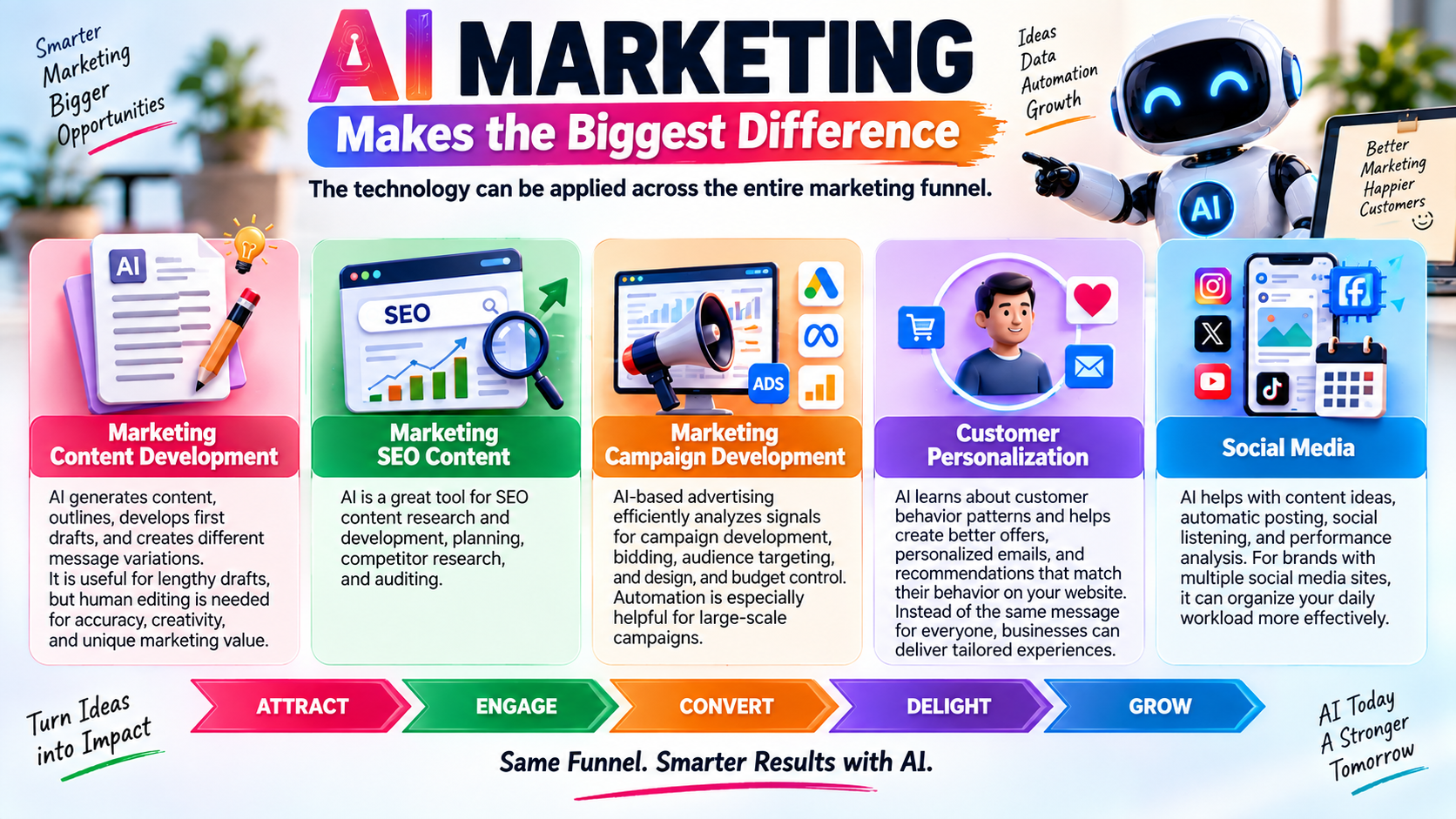
The technology can be applied across the entire marketing funnel.
Marketing Content Development
AI is useful for Marketing content development to a great extent. It generates content and outlines, develops a first draft, and creates different variations of messages.
AI is useful for lengthy first drafts, but rewrites require human editing because content accuracy, creativity, and marketing uniqueness are contextual and subjective.
Marketing SEO Content
AI is a great tool for SEO Marketing in Content research and development, planning, competitor research, and auditing.
Marketing Campaign Development
AI-based advertising efficiently analyzes signals for campaign development, bidding, audience targeting, advertisement design, and budget control.
Automation would be helpful, especially with big data campaigns.
Customer Personalization
AI learns about your customer’s behavior patterns and helps you create better offers, personalized emails, and suggestions that match their behavior within your website.
Rather than push the same message to every customer, businesses can create an experience that is tailored to the customer’s interest.
Social Media
AI can help you with ideas for content, automatic posting, listening for social media conversations, and analysis regarding how your content performs.
For brands that have many social media sites, it can help you organize your daily workload.
Also Read- AI Spreadsheet Tools: Powerful Ways to Work Smarter
Top AI Marketing Apps for Modern Businesses
Because different platforms specialize in different aspects of marketing, it is better to select applications based on the specific goals you want to accomplish, rather than looking for one that meets multiple aspects.
1. Jasper
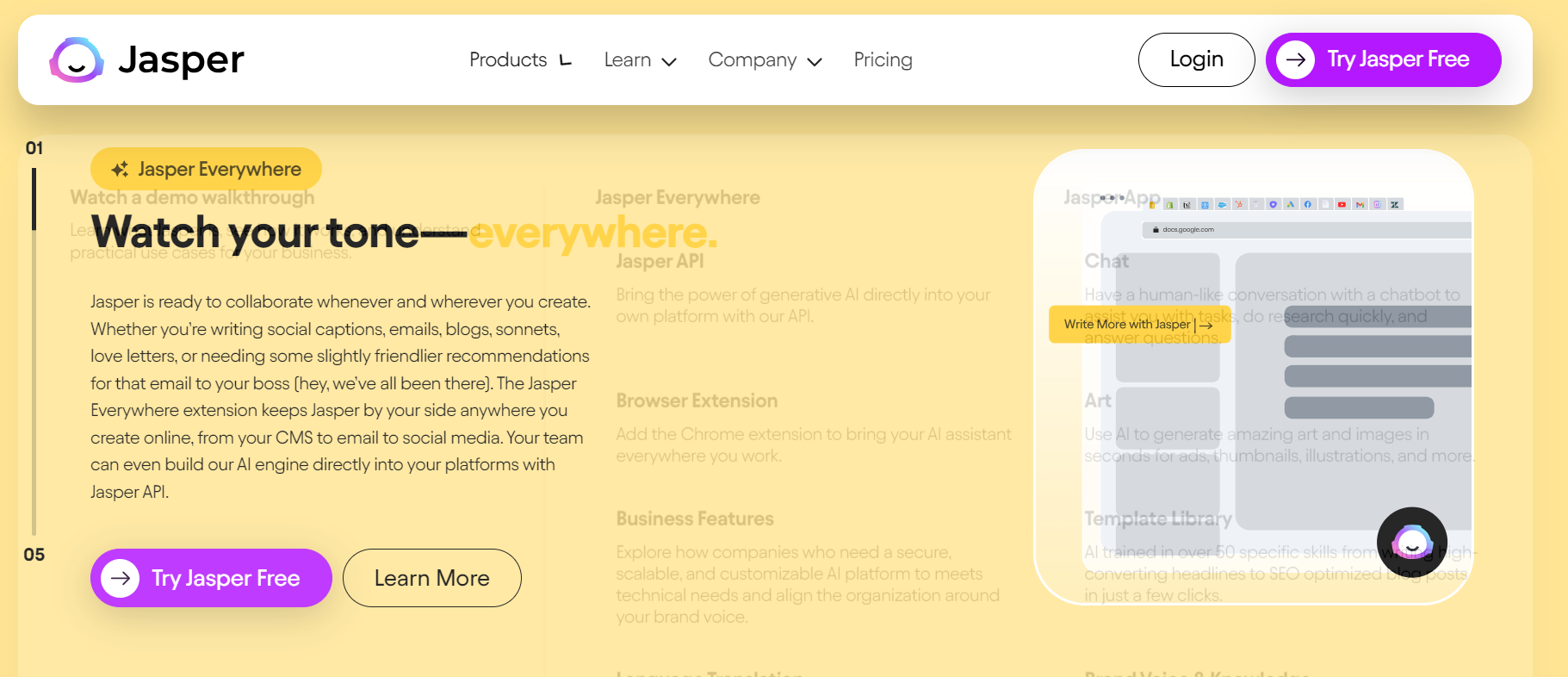
Jasper specializes in marketing automation and content. It has a feature that can capture the style of an organization and help it to be consistent in its writing, which other writers can follow. Jasper also understands the audiences of an organization and guides their writing. It also has other marketing-related features.
Key Features
- Brand Voice
- Brand Knowledge
- Audience Profiles
- Marketing Content Generator
- Workflows
- Style Guidelines
Benefits
By using Jasper, content teams have the ability to create more content faster, while maintaining consistency across their work, collaboratively, in a shorter amount of time.
Though Jasper writes first drafts, the final content must be reviewed.
2. Surfer
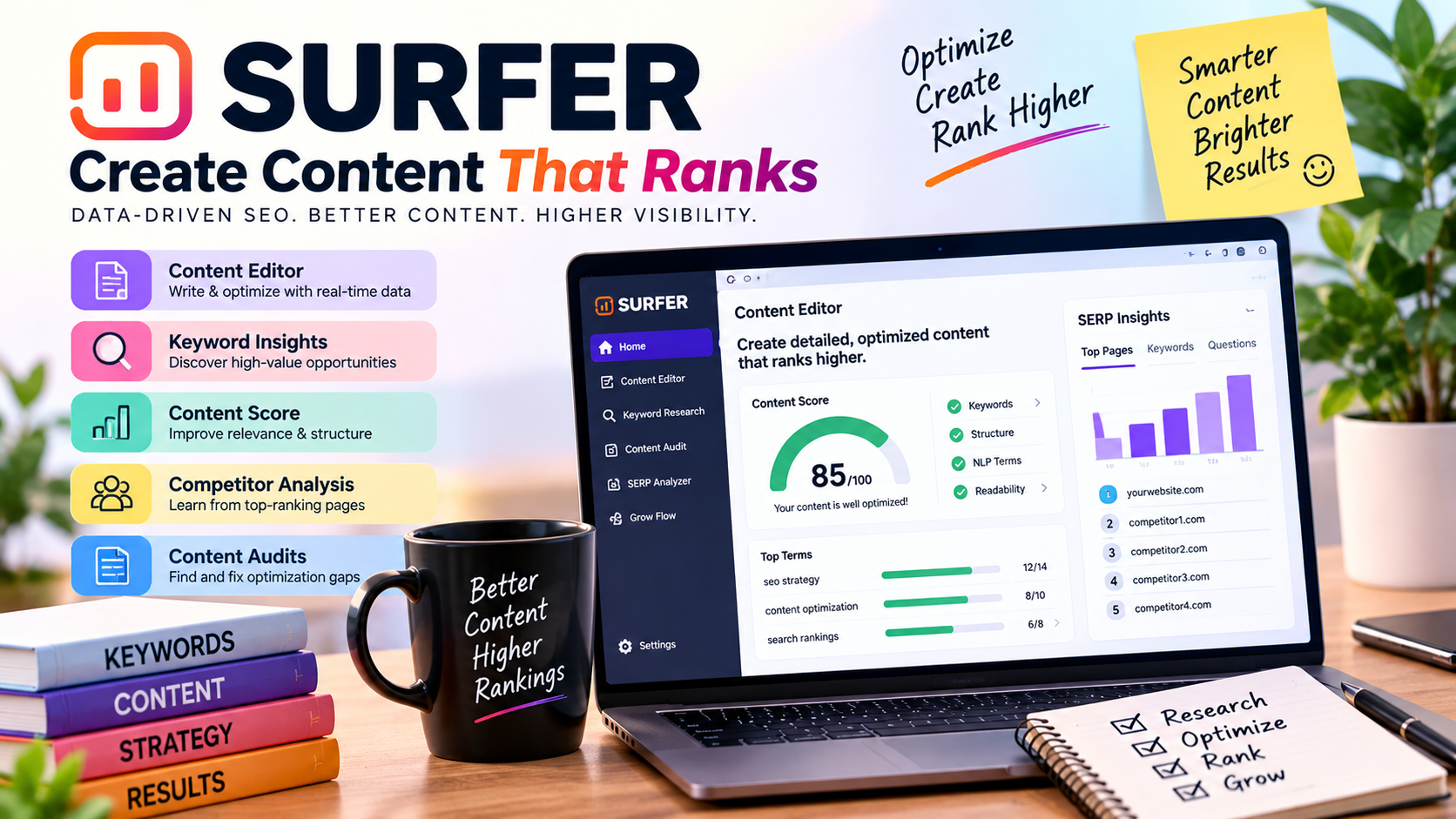
Surfer specializes in the optimization of content and SEO. Their tool offers Guide for Content and SEO that provides marketers with data about content, as well as related topics and search patterns based on the dominant content on the web. They also optimize content based on patterns of the top content.
Key Features
- Content Editor
- Content optimization
- SEO content briefs
- Keyword and topic guidance
- Content audits
- Competitor analysis
- AI-assisted content workflows
Benefits
Surfer’s user interface reduces the cognitive burden while writing SEO content. Before writing, the user is able to analyze and understand important SEO considerations and content gaps that they would otherwise have to write an article and then analyze the article after writing for optimization.
For publishers and agencies involved in SEO, Surfer streamlines and enhances the research and optimization processes.
3. Albert
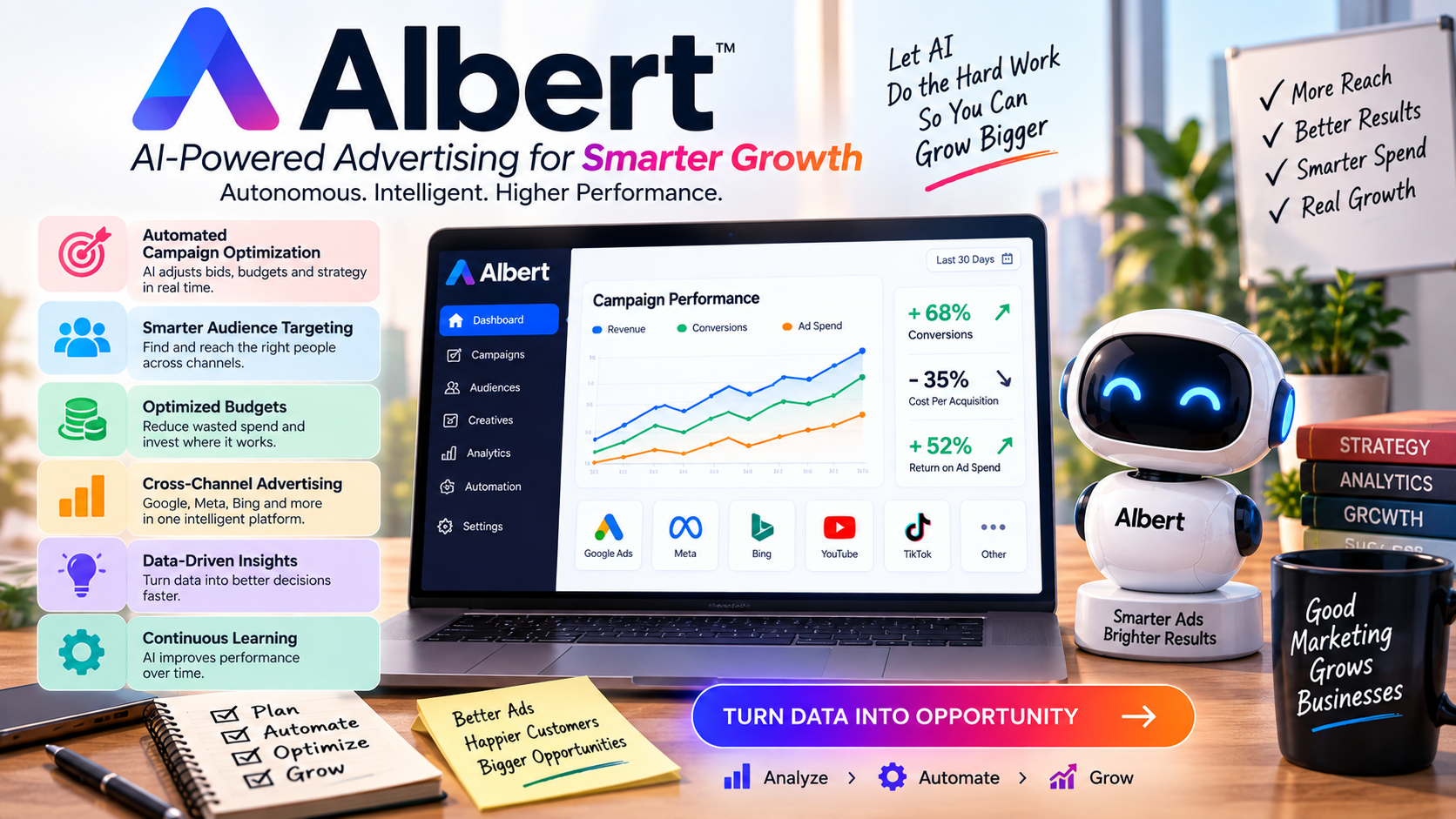
Albert specializes in automated digital advertising and campaign optimization. The platform is designed to enable users to optimize paid media through a combination of marketing data automation and campaign management tools such as audiences, budgets, bids, and campaign allocation.
Key Features
- Cross-channel campaign automation
- Audience targeting
- Campaign budget management
- Bid optimization
- Performance analysis
- Creative optimization
Benefits
Automating campaign management frees an advertising team from the burden of having to constantly monitor and make adjustments to campaign settings.
Automation is especially valuable to companies that manage multiple campaigns. It helps achieve a goal of a continuous optimization flow for campaign management.
Despite the benefits of automation, advertising budgets need to continue to be overseen by human team members.
4. Sprout Social
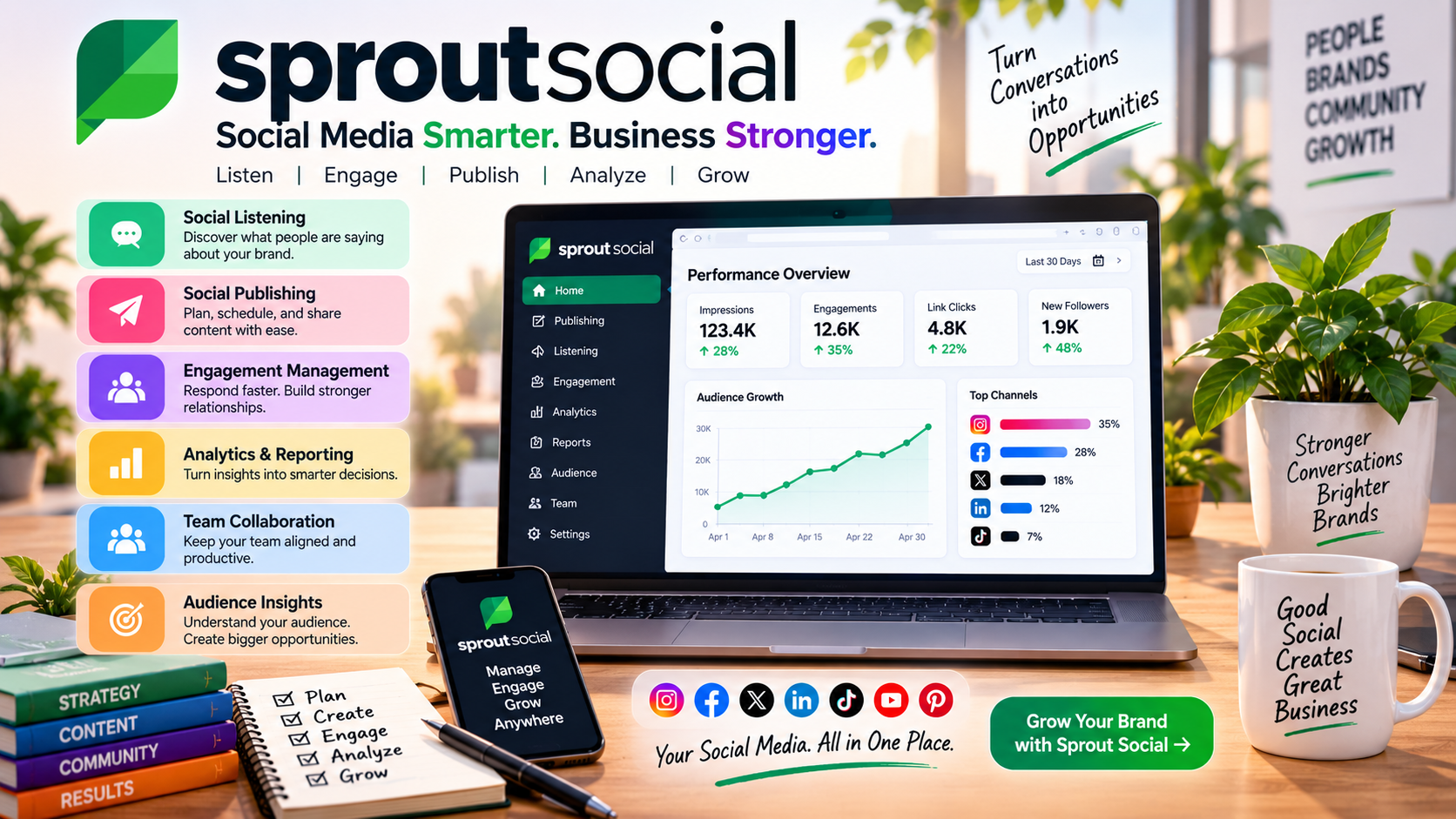
Sprout Social automates social media publishing, monitoring, analytics and optimization, customer engagement and more.
Key Features
- Social engagement
- Social publishing
- Social insights
- Social reporting
- Analytics
- Workflow optimization
Benefits
Sprout Social makes it possible to analyze and optimize customer engagement as well as publish and optimize content on social media.
Insightful analytics makes it possible for organizations to identify frequently asked questions and address their customers’ needs and/or pain points by improving content published on social media, expanding customer support and resources, and developing an improved campaign framework.
5. HubSpot
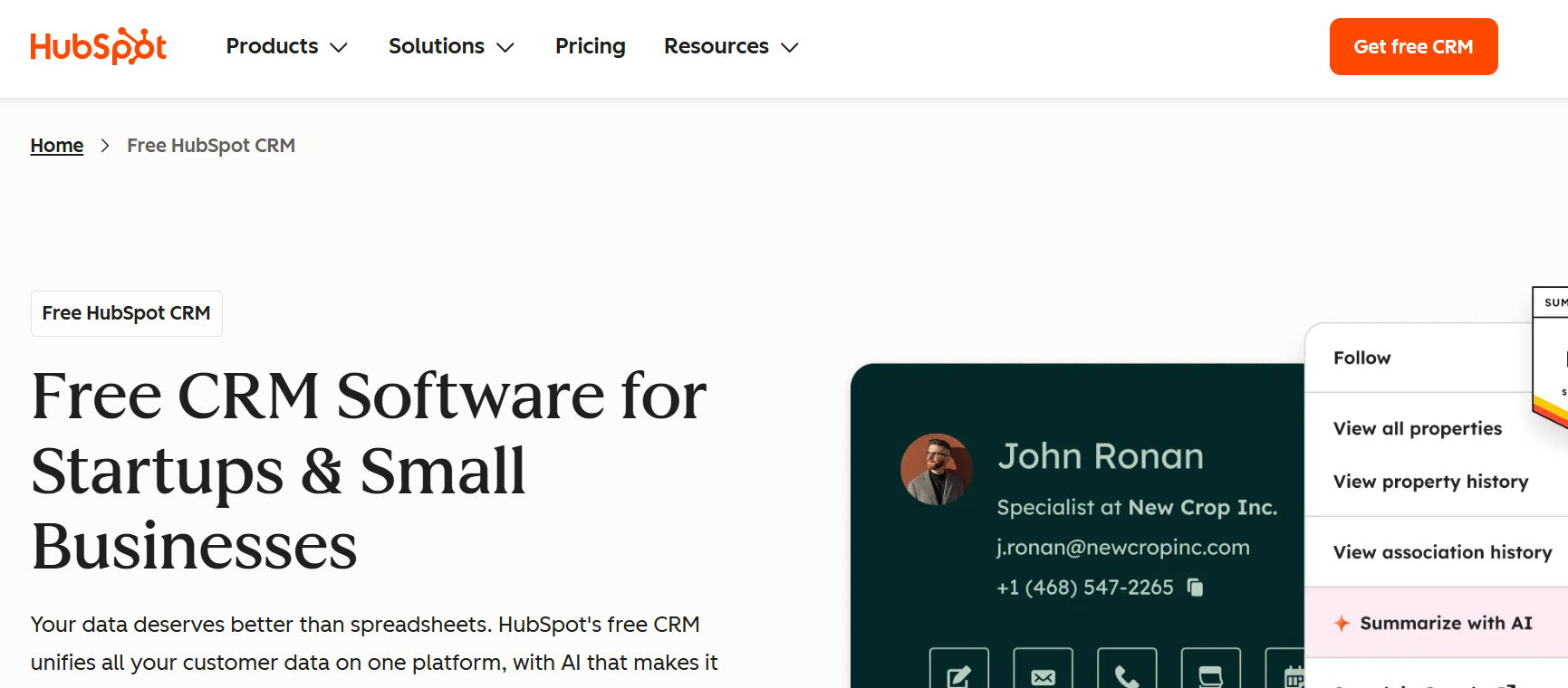
HubSpot unifies marketing automation with CRM. Its platform supports lead generation, email marketing, customer segmentation, campaign management, and personalization.
Key Features
- CRM integration
- Email marketing
- Marketing automation
- Lead management
- Campaign management
- Customer segmentation
- AI marketing workflows
Benefits
One of the main benefits that many organizations see is correlating customer and marketing data within one unified system.
For growing companies, this integration also helps marketing and sales teams align their efforts for customer journey management.
6. Canva

Canva is popular for visual marketing, and its AI technologies can assist in visual asset creation and editing.
Key Features
- AI-assisted design
- Image generation
- Image editing
- Social media graphics
- Presentation creation
- Brand design tools
- Marketing templates
Benefits
Canva is an excellent solution for small marketing teams to help create professional social graphics, advertisements, presentations, and other marketing assets with little to no design skills.
Also Read- Apple Watch Series 12 Review: Is Apple’s New Smartwatch Worth Buying?
AI Marketing Apps Comparison
| Platform | Main Focus | Notable Features | Useful For |
|---|---|---|---|
| Jasper | Content and brand messaging | Brand Voice, content workflows | Content teams |
| Surfer | SEO and content optimization | Content Editor, SEO guidance | SEO professionals |
| Albert | Paid advertising | Automation, optimized budgets and bids | Paid media teams |
| Sprout Social | Social media | Listening, publishing, analytics | Social media teams |
| HubSpot | Marketing automation | CRM, email, campaigns | Growing businesses |
| Canva | Visual marketing | AI design and editing | Small marketing teams |
Major Benefits of AI Marketing
The true value of AI-based technologies lies in linking specific features to measurable business results.
Faster Marketing Workflows
AI-based solutions reduce the time spent on certain marketing tasks, such as creating variations or formatting multiple assets for multiple marketing campaigns and channels.
AI helps automate tedious labor. This allows more time for strategy, creativity, customer research, and planning.
More Customized Customer Experiences
Not all customers want the same things.
AI allows segmentation of audiences through behavior, preference, purchase history, and interaction.
Instead of relying on demographic targeting, AI allows marketing to tailor experiences specific to audiences.
Better Data Analysis
With the abundance of business data from websites, emails, advertising, CRMs, and social media, data can be analyzed and transformed into marketing insights.
AI can help marketing identify patterns in these data sets.
From this data, retailers can leverage recommendations to sell complementary products to customers.
Greater Content Efficiency
Small marketing teams struggle to come up with quality content routinely.
AI helps marketing ideate, outline, draft, and create content variations.
While it is beneficial for businesses to publish quality over quantity, publishing hundreds of pages is no substitute for useful original content.
More Responsive Campaign Management
Digital campaign management is especially fast.
AI can help marketers manage digital campaigns by detecting changes in performance.
Campaigns can be managed automatically while still maintaining overall marketing strategy.
Building an AI Marketing Strategy
While starting campaigns solely focused on an AI system can lead to a disjointed collection of marketing systems, more effective marketing automation starts with business objectives.
1. Identify the Problem
Find labor-intensive tasks or marketing activities with a lot of data.
Examples include, but are not limited to:
- Weekly reporting
- Content research
- Social media scheduling
- Email variations
- SEO analysis
- Advertising changes
2. Choose the Right Application
Choose software based on the problem you’re trying to solve rather than based on what is trendy.
An SEO team may opt to implement an SEO solution first, while an ads team may opt to implement marketing automation first.
3. Establish a Baseline
Record any relevant metrics prior to implementing automation.
Depending on the task, this may include time to complete a task, organic traffic, conversion rate, number of quality leads, cost of advertising, and revenue.
4. Run a Small Pilot
Automate one task at a time.
For example, a business could use AI to suggest better email subject lines, and then use AI to suggest better email body copy.
5. Review the Results
See how the pilot task performed versus the original task.
Analyze both the quality of the marketing task and the efficiency with which it was completed.
6. Expand Carefully
If the pilot was successful, perform the same task for other marketing tasks.
This will help manage risks and provide more value to team members.
The Future of AI Marketing
The next iteration of marketing will involve marketing systems with more integrated AI.
Rather than using many separate tools, businesses may connect their customer data, content creation, ads, analytics, and CRM.
This may enable marketing operations where various marketing touchpoints with the customer are more integrated.
Execution can be expedited with AI, but a strong marketing strategy will always be necessary to compete.
Conclusion
AI Marketing: Supercharge Your Success shows a shift in the way businesses think about digital marketing. Rather than spending their time on repetitive tasks, marketing teams will be able to use automated tools to conduct research, create content, personalize, manage ads, digital marketing, and analyze the results of their efforts.
It’s not how many AI-based systems a business employs that matters most. It’s whether or not those systems address business problems.
The recipe for success is not the automation of tasks mindlessly. It is the masterful combination of human knowledge and quality data, informed by intelligent systems that are tested continuously.
Frequently Asked Questions
-
What is marketing with AI?
AI marketing aids the marketing process by automating/streamlining the marketing process through tasks such as content supplement, customer segmentation, personalized ads, SEO, and analytics.
-
Is AI marketing helpful to small businesses?
AI marketing applications help ease the marketing related tasks by small businesses.
-
Will AI put marketers out of a job?
AI will only help marketers by automating their more repetitive and analytical tasks. Marketers will still be needed to employ their creativity and strategic thinking to build their brand as well as understand their customers.
-
Can AI help with rankings?
No. Although some tools may provide recommendations to aid in optimizing content, no tool can guarantee rankings.
-
How can businesses implement AI?
Begin by identifying a specific, clear, and measurable problem, or multiple related problems. Once an appropriate tool is identified, the business should put in place a review system. After measuring results, and if successful, the workflow can be expanded.
-
Are there any legal and ethical concerns with publishing AI content?
The finalized business content should always be reviewed. A business should consider if the content is factually correct, original, within brand guidelines, and relevant to the intended audience.