DJI vs Autel: The Surprising Winner Revealed
+
Table of Contents
- 1 DJI vs Autel: Understanding the Brands
- 2 Popular DJI Drone Options
- 2.1 DJI Mini Series
- 2.2 DJI Air Series
- 2.3 DJI Mavic Series
- 3 Popular Autel Drone Options
- 4 DJI vs. Autel Feature Comparison
- 4.1 Key Benefits of DJI Drones
- 4.2 What Makes Autel Drones Special?
- 4.3 DJI vs Autel: Which One Has the Better Camera?
- 4.4 DJI vs. Autel: Flight and Safety
- 4.5 DJI vs. Autel: The USA Regulatory Factor
- 4.6 The Surprising Winner
- 5 Conclusion
Finding the right camera drone can be a challenge when two companies dominate the competition. The DJI vs. Autel debate is popular among American photographers, content creators, and professional pilots. Both companies create drones with impressive cameras, intelligent flight systems, and safety features.
The market has changed in the past few years. Autel’s consumer options have diminished, while DJI’s have expanded. In 2025, Autel discontinued its EVO Nano+ and EVO Lite+ consumer models, leaving the EVO II Pro V3 as its only consumer-facing Prosumer option.
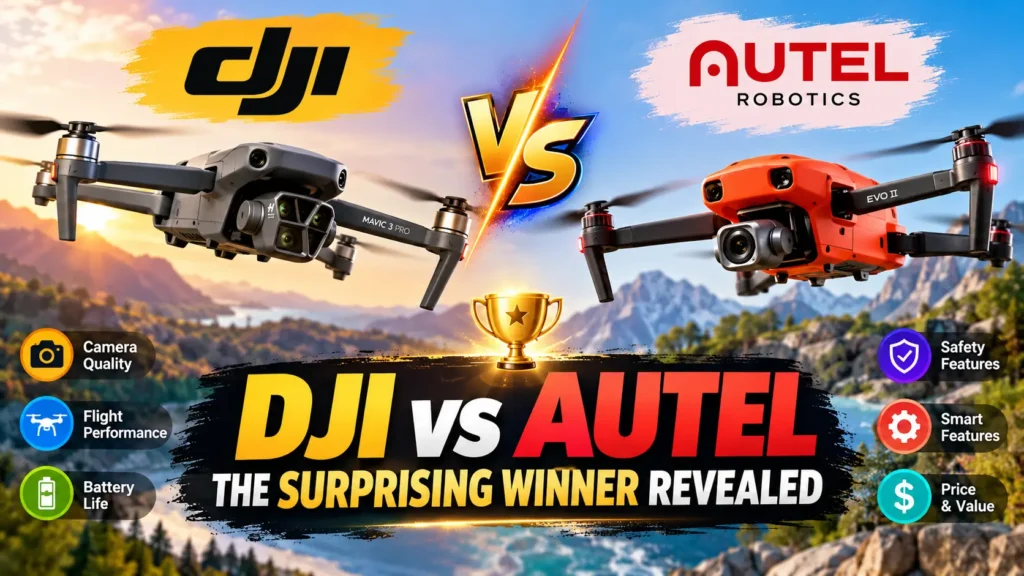
DJI vs Autel: Who should the American consumer pick? It depends on the individual, but for the average user, DJI is the better option.
DJI vs Autel: Understanding the Brands
DJI is the largest and most well-known drone manufacturer in the world. Their product line caters to the first-time flyer, the travel weary, and all the way up to the enterprise user.
DJI drones appeal to the average user because of the straightforward flight systems, top-quality camera systems, intelligent features, and obstacle sensing systems.
Autel Robotics has traditionally been a strong alternative to DJI. Their drones have manual controls and fewer software restrictions, making them attractive to pilots who want a more advanced system.
Situations have changed, and Autel has fewer consumer options, making head-to-head comparisons more difficult than they were a few years back.
Also Read: Best Drones Under $500 in 2026: Ultimate USA Picks
Popular DJI Drone Options
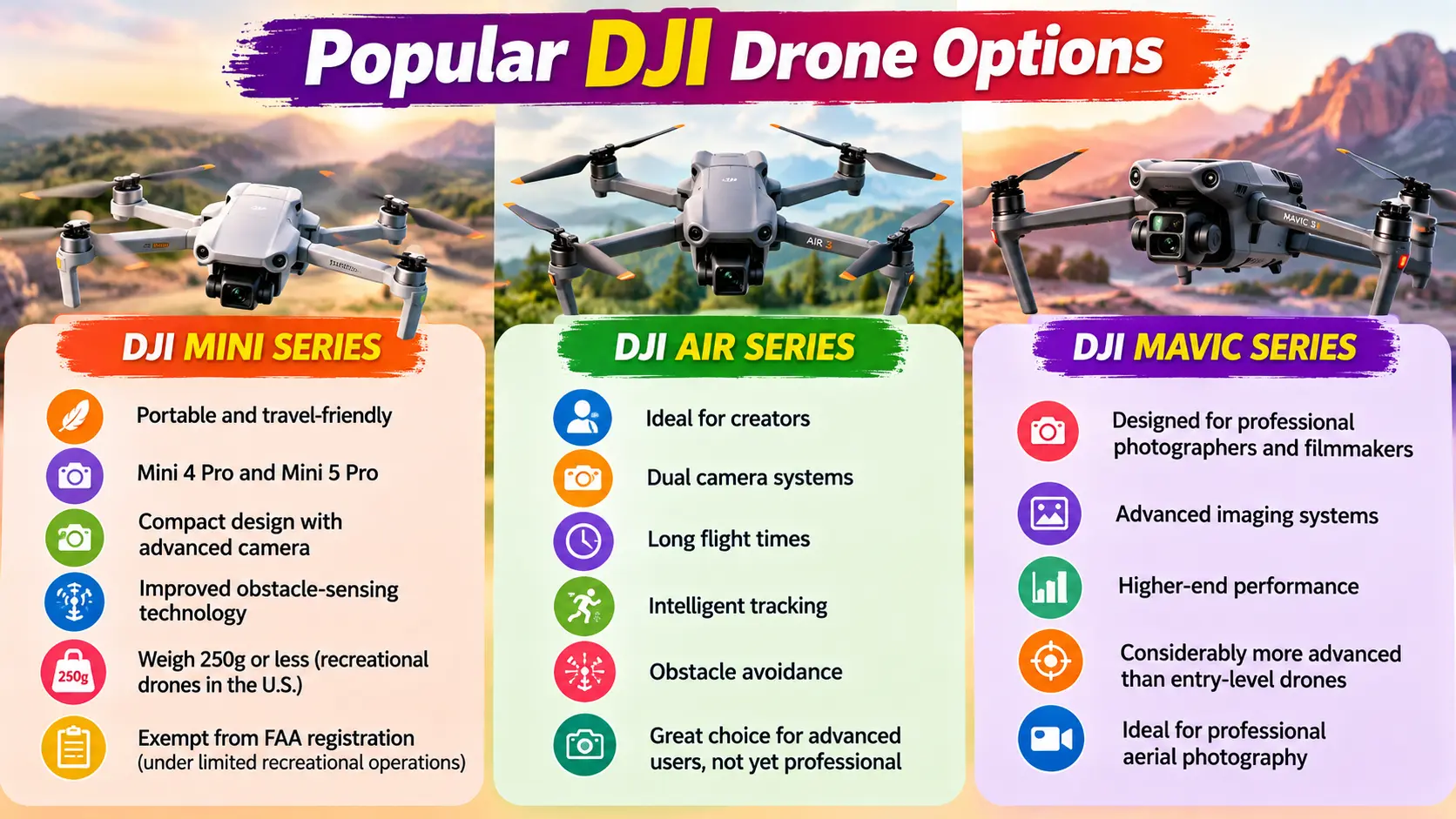
DJI covers the American market with a variety of options.
DJI Mini Series
The Mini series focuses on portability and travel. The Mini 4 Pro and Mini 5 Pro combine compact designs with more advanced camera and obstacle-sensing technologies.
A major advantage of these models is their weight. In the U.S., drones that weigh 250g or less are considered to be recreational drones and are exempt from FAA drone registration when flown under the Exception for Limited Recreational Operations. Drones flown under Part 107 have different regulations.
DJI Air Series
The DJI Air series is targeted towards creators who are not ready to jump into a full-fledged professional drone.
Features can include dual camera systems, long flight times, intelligent tracking, and obstacle avoidance.
DJI Mavic Series
Drones in the Mavic series target the professional photographer and filmmaker market with more advanced imaging systems.
For professional aerial photography, the Mavic series is considerably more advanced than entry-level drones.
Popular Autel Drone Options
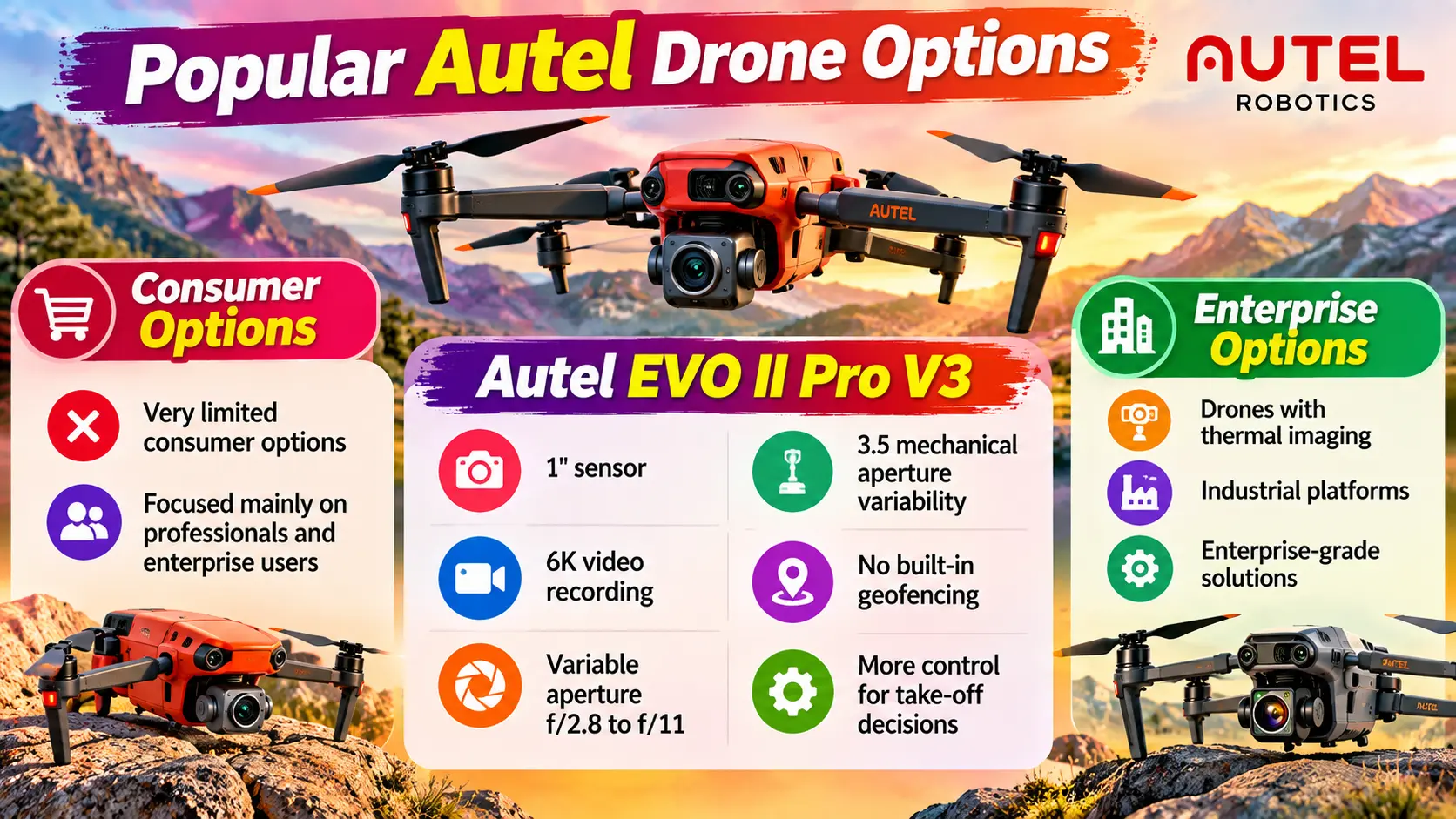
Autel currently has very limited consumer options.
Autel EVO II Pro V3
The Autel EVO II Pro V3 has a 1″ sensor and captures video at 6K. Its 3.5 mechanical aperture variability is unusually wide, going from f/2.8 to f/11. This provides a better sense of control with regard to photographic exposure and depth of field.
It is also worth noting that Autel does not have built-in geofencing like DJI. This provides more control to the consumer to make decisions regarding take-off, but at the same time, provides less accountability for understanding airspace rules (and certain laws) regarding drone flight.
They also offer enterprise products, including drones with thermal imaging and industrial platforms.
DJI vs. Autel Feature Comparison
| Feature | DJI | Autel |
|---|---|---|
| Consumer lineup | Broad | Limited |
| Beginner options | Excellent | Limited |
| Professional options | Extensive | Strong in selected categories |
| Camera quality | Excellent | Excellent |
| Obstacle avoidance | Advanced on higher models | Advanced on EVO II Pro V3 |
| Intelligent flight features | Extensive | Good |
| Geofencing | Yes on many models | No built-in geofencing |
| Variable aperture | Model dependent | EVO II Pro V3 |
| Accessories | Very broad ecosystem | Smaller ecosystem |
| App ecosystem | Mature and polished | Capable |
| Best for | Most consumers and creators | Specific professional users |
Key Benefits of DJI Drones
DJI enjoys an advantage with variety. Buyers can select a lightweight Mini, a versatile Air model, or a high-end Mavic without leaving the DJI ecosystem.
Those new to the hobby can take advantage of features like automated flight modes, subject tracking, return-to-home, and obstacle sensing. Experienced users can still take advantage of features like manual camera settings, manual flight modes, advanced transmission features, and advanced flight planning and waypoint features.
The broader ecosystem of accessories is valuable as well. From batteries and filters to cases and controllers, you can find almost everything you need to accessorize your drone.
For the American consumer, this makes DJI the convenient all-around choice.
What Makes Autel Drones Special?
Autel has made choices that clearly differentiate from DJI.
For example, the EVO II Pro V3 sports a mechanical variable aperture, which gives photographers the ability to more creatively control their depth of field. The absence of built-in geofencing is important to experienced pilots who don’t want to be restricted to the rules of standard flight zones.
The Enterprise sector is an important market for Autel as well.
In the end, Autel has the right hardware and software philosophy to cater to the needs of the clients that favor Autel.
DJI vs Autel: Which One Has the Better Camera?
DJI vs Autel: Camera performance is highly dependent on the specific models being discussed.
The EVO II Pro V3 still holds value for photographers with its 1-inch sensor and mechanical variable aperture, which provides better control over changing lighting conditions.
But compared to DJI, the selection is not as diverse and advanced. For example, some models have large sensors, while others offer telephoto lenses and advanced cameras and stabilization for video, giving DJI a wider range of camera offerings.
Therefore, no universal camera winner exists. For example, a professional photographer who values control over aperture may prefer Autel over DJI. Alternatively, a content creator who seeks a fully integrated camera-drone ecosystem may prefer DJI over Autel.
DJI vs. Autel: Flight and Safety
Fortunately, obstacle detection and flight assistance have both improved dramatically in modern drones.
DJI’s flight-assistance suite is perhaps the most advanced of any drone manufacturer. Features like ActiveTrack help users avoid obstacles and safely return the drone to them.
Autel’s EVO II Pro V3 is also a worthy competitor, as it offers 360-degree obstacle avoidance.
But let’s not kid ourselves, obstacle avoidance does not make a drone crash-proof. Pilots are always responsible for their safe flight and maintaining compliance with the FAA.
DJI vs. Autel: The USA Regulatory Factor
DJI vs. Autel: American consumers should also consider the changing regulatory environment.
The FCC added DJI and Autel to its Covered List in December 2025, affecting the authorization of new equipment. Existing, previously authorized equipment was not automatically banned from ownership and/or use.
Due to the dynamic nature of the regulatory environment, potential drone buyers should check the most up-to-date FCC and FAA information prior to their purchase, especially if they are flying for work or a government-related entity.
The Surprising Winner
The majority of American consumers would agree that DJI is the overall winner.
Although this is not because all of DJI’s drones are better than all of Autel’s drones, it is because DJI offers a broad product portfolio and has options for consumers of all skill levels, from beginners to professionals.
Autel’s offerings are still strong for experienced users. Geofencing-free and variable-aperture designs of the EVO II Pro V3 may appeal to users who prioritize those features.
Conclusion
Autel’s EVO II Pro V3 offers freedom from geofencing and a variable aperture lens, but other drones in the market may offer the same, or better, features. The decision ultimately relies on what you prioritize.
While Autel’s drones lose the competitive balance to DJI, DJI still boasts stronger ecosystems. However, Autel’s drones still have strong technology, especially in the EVO II Pro V3 and enterprise drones. User choices aren’t as plentiful as with DJI. Autel drones are good, especially for specific needs like variable aperture photography.
DJI offers easier, more automatic drones, which makes it a stronger competitor against Autel. Autel drones can suit users better for other specific needs, like variable aperture photography.
Overall, DJI offers easier drones for beginners and a stronger ecosystem.
DJI drones tend to be easier, better choices for beginners.
FAQs
1. Is DJI better than Autel?
For most consumers, yes. DJI offers a broader product range, mature software, extensive accessories, and strong automated flight features. Autel can be better for specific needs such as variable-aperture photography.
2. Which brand has better camera quality?
No brand wins every camera comparison. Camera sensor size is equally important, as is the quality and size of the lenses, video resolution and stabilization, the DR of the sensor, and aperture control.
3. Do DJI drones require FAA registration?
It depends on how the drone is used. Part 107 drones require FAA registration. Recreational drones, 250g or less, do not.
4. Does Autel have geofencing?
Autel has traditionally taken a different approach to DJI. Pilots are responsible for airspace restrictions.
5. Which drone brand should USA buyers choose?
DJI is a better choice for the average customer because of selection and integration with its broader product line. Autel is a better choice if its special features meet the pilots needs.