Blockchain Technology Guide: Unlocking the Future of Digital Innovation
+
Table of Contents
- 1 What is Blockchain Technology?
- 2 Key Features of Blockchain Technology
- 2.1 1. Decentralization
- 2.2 2. High-Level Security
- 2.3 3. Transparency
- 2.4 4. Immutability
- 2.5 5. Smart Contracts
- 2.6 6. Faster Transactions
- 3 Benefits of Blockchain Technology
- 3.1 1. Improved Data Protection
- 3.2 2. Reduced Operational Costs
- 3.3 3. Better Trust Between Users
- 3.4 4. Enhanced Business Efficiency
- 3.5 5. Global Accessibility
- 3.6 Blockchain Technology Solutions
- 3.7 Blockchain Technology Applications
- 3.8 Matrix comparison between blockchain and traditional databases
- 3.9 Main four disadvantages of blockchain technology:
- 3.9.1 1. Scalability Issues
- 3.9.2 2. High Energy Consumption
- 3.9.3 3. Regulation Issues
- 3.9.4 4. Technical Complexity
- 3.10 Future of Blockchain Technology
- 4 Conclusion
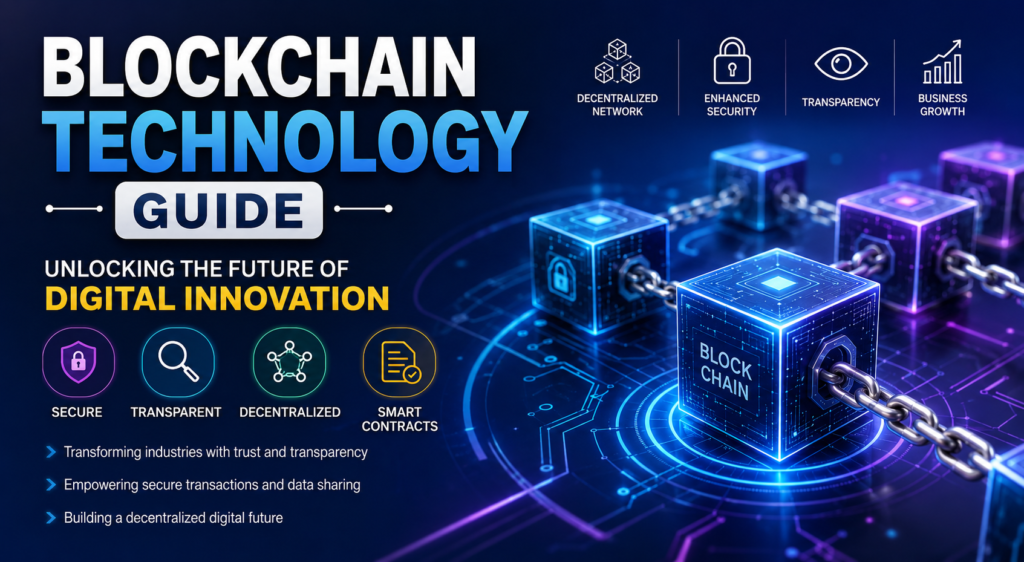
Payment, storage, communication, and business are all undergoing digital transformations. Notably, blockchain is one of the most disruptive technologies among recent digital transformations. This Blockchain Technology Guide introduces blockchain, its functionality, its prominent features, benefits, and the role it will play in the upcoming digitally-driven world.
Initially, blockchain was a technological advancement of cryptocurrency. Now, the potential uses of blockchain are far beyond digital currency. There is a growing demand for blockchain-based systems in sectors such as finance, healthcare, supply chain, gaming, cybersecurity, and real estate, due to the increased security, transparency, and efficiency.
Blockchain is the digital version of a record-keeping system, only this system is secure, decentralized, and transparent. Unlike traditional record-keeping systems, which are centralized, in blockchain, all system participants have the ability to store and verify data.
What is Blockchain Technology?
At its essence, blockchain is a digital ledger that stores information in a collection of records that are linked via a chain. Furthermore, blockchain is decentralized and distributed among a network of users.
The recorded data in a blockchain system is almost impossible to tamper with. This means that, unlike centralized systems, data stored in a blockchain is secure and verifiable.
This Blockchain Technology Guide is for beginners, and its goal is to convey to its audience that beyond cryptocurrency, blockchain is a peace-of-mind system that enhances security and eliminates intermediaries.
How Does Blockchain Technology Work?
To ensure secure and reliable transactions, blockchain technology combines several advanced components, including cryptography, a peer-to-peer network, and a consensus protocol.
Here’s how blockchain functions step by step:
- A transaction is initiated by a user.
- The transaction is communicated to all network participants.
- The transaction is validated by the computers that comprise the network.
- Once validated, the transaction is stored in a block.
- This block is permanently linked to the existing blockchain.
Every block that is added to the chain contains enclosed, sealed, and time-stamped information about the previous block. This high level of security and reliability is one of the distinguishing characteristics of blockchain.
Key Features of Blockchain Technology
1. Decentralization
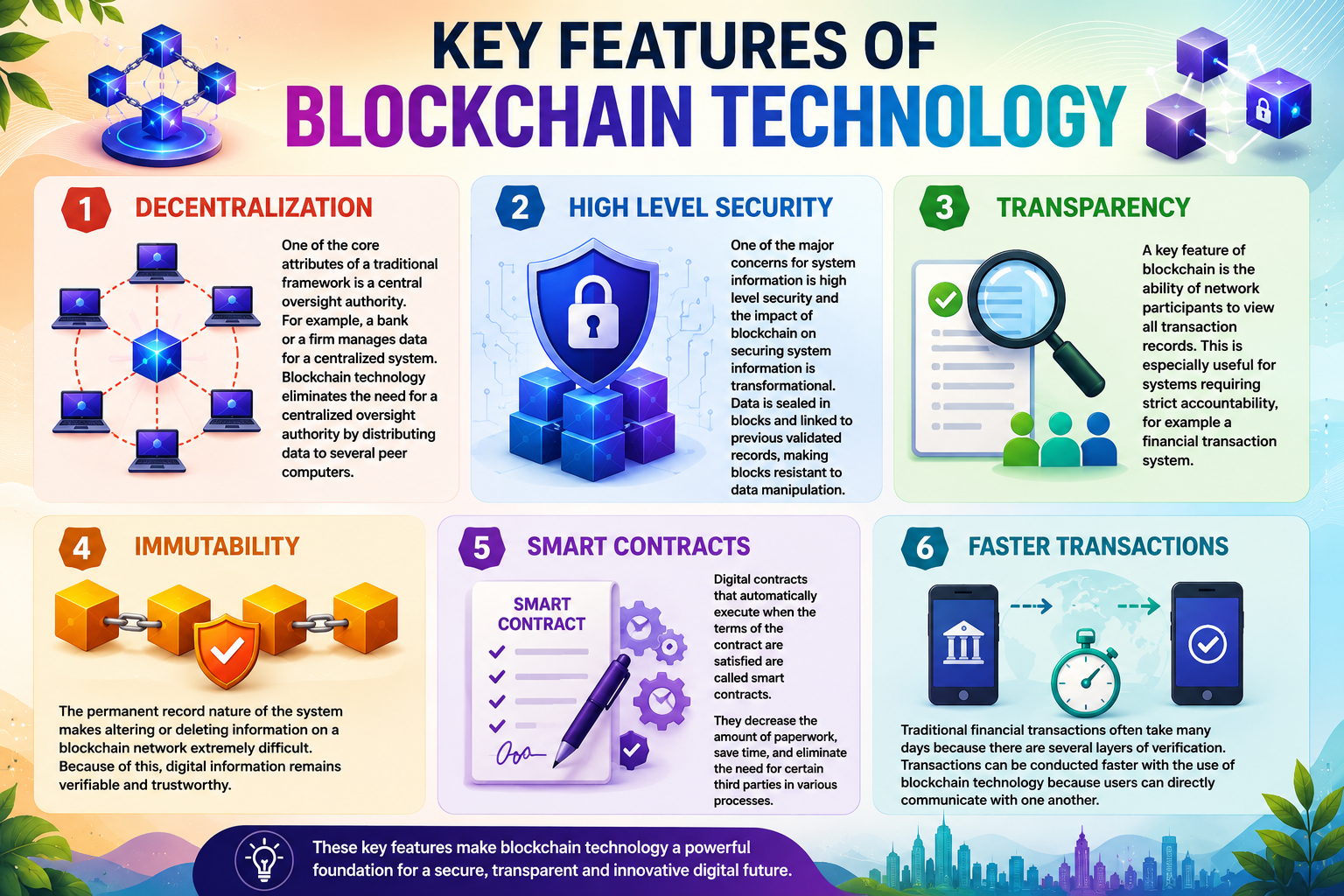
One of the core attributes of a traditional framework is a central oversight authority. For example, a bank or a firm manages data for a centralized system. Blockchain technology eliminates the need for a centralized oversight authority by distributing data to several peer computers.
2. High-Level Security
One of the major concerns for system information is high-level security, and the impact of blockchain on securing system information is transformational. Data is sealed in blocks and linked to previously validated records, making blocks resistant to data manipulation.
3. Transparency
A key feature of blockchain is the ability of network participants to view all transaction records. This is especially useful for systems requiring strict accountability, for example, a financial transaction system.
4. Immutability
The permanent-record nature of the system makes altering or deleting information on a blockchain network extremely difficult. Because of this, digital information remains verifiable and trustworthy.
5. Smart Contracts
Digital contracts that automatically execute when the terms of the contract are satisfied are called smart contracts.
They decrease the amount of paperwork, save time, and eliminate the need for certain third parties in various processes.
6. Faster Transactions
Traditional financial transactions often take many days because there are several layers of verification.
Transactions can be conducted faster with the use of blockchain technology because users can directly communicate with one another.
Benefits of Blockchain Technology
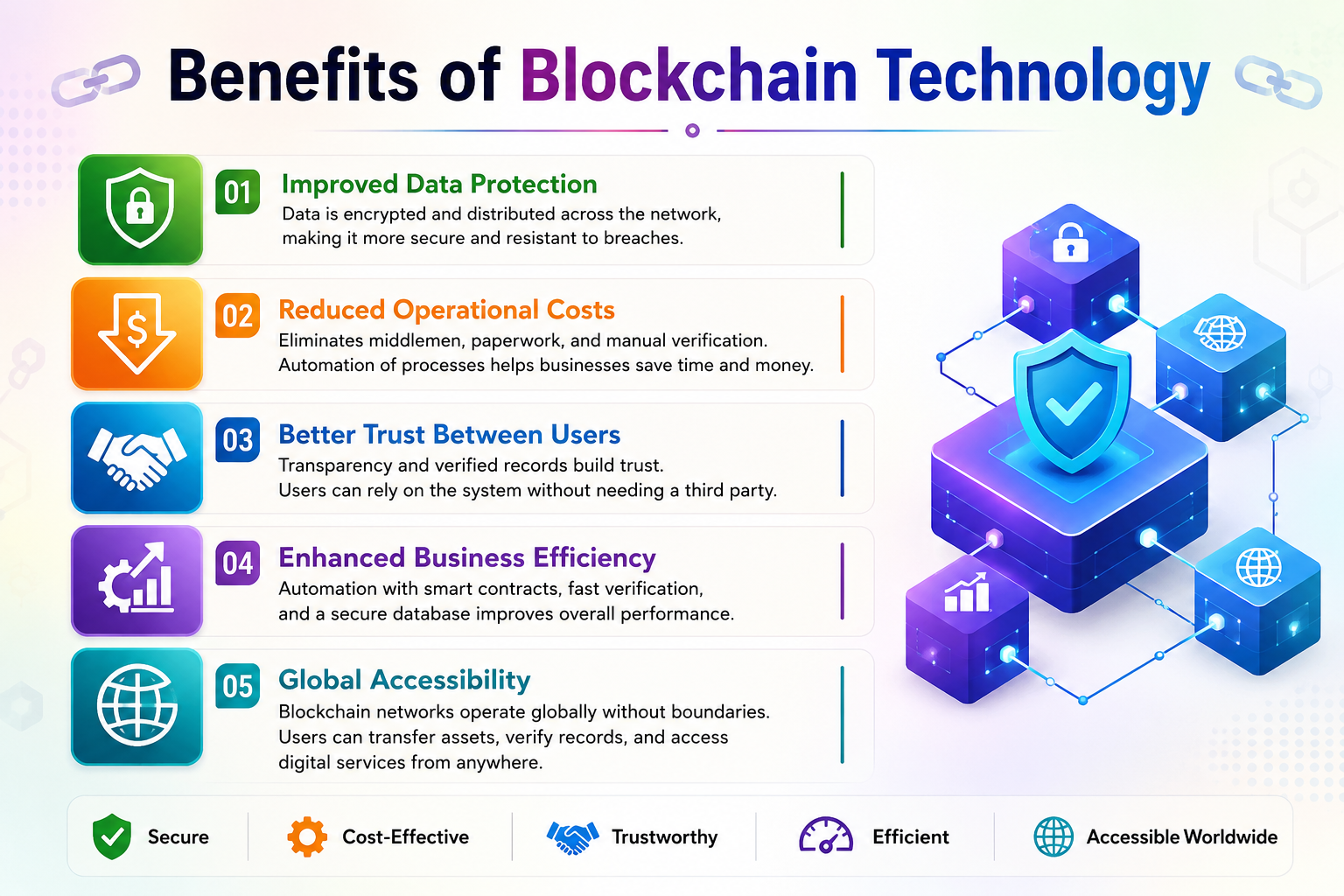
1. Improved Data Protection
One of the main advantages of blockchain technology highlighted in this Blockchain Technology Guide is the added security of data. Because data is encrypted and then distributed, it is much easier for companies to secure sensitive data.
Blockchain security is especially beneficial to the data-sensitive industries, such as healthcare and banking.
2. Reduced Operational Costs
The reduction of the need for middlemen, paperwork, and manual verification is another benefit of using blockchain technology.
Companies are able to fully automate certain processes, which also helps save money.
3. Better Trust Between Users
Trust stems from the transparency of verified records.
Because the system verifies the information, users do not necessarily need to rely on a third party.
4. Enhanced Business Efficiency
With the automation of blockchain-based applications, companies are able to complete tasks in a timely manner.
Smart contracts, rapid verification, and a secure database greatly enhance the overall business performance.
5. Global Accessibility
Unlike conventional limitations, blockchain networks can function on a global scale.
Users are able to verify records, transfer assets, and utilize digital services from any location.
Blockchain Technology Solutions
Blockchain technology is the digital solution for the improvement of many industries.
This document compares the main industries applying blockchain technology with their corresponding advantages. It includes a matrix for comparison of blockchain technology and traditional databases, and describes the four main disadvantages of blockchain technology along with its promising future.
Blockchain Technology Applications
| Industry | Blockchain Application | Main Advantage |
|---|---|---|
| Finance | Digital payments and transactions | Faster and more secure transfers |
| Healthcare | Patient data management | Better privacy and accuracy |
| Supply Chain | Product tracking | Improved transparency |
| Real Estate | Digital property records | Reduced fraud risks |
| Gaming | Digital ownership and digital assets | Secure virtual economy |
| Education | Certificate verification | Prevents fake records |
| Cybersecurity | Data protection systems | Stronger digital security |
Matrix comparison between blockchain and traditional databases
| Feature | Blockchain Technology | Traditional System |
|---|---|---|
| Control System | Decentralized | Central Authority |
| Security | Advanced encryption | Standard security |
| Transparency | High | Low |
| Data Changes | Almost impossible to modify | Easy to change |
| Verification | Network-based | Authority-based |
| Reliability | Highly distributed | Centralized |
Also Read- 10 Powerful Fintech Trends 2026 That Will Transform the Future
Main four disadvantages of blockchain technology:
1. Scalability Issues
Transactions can become slow for some blockchain networks. Faster processing is one of the main improvements under development.
2. High Energy Consumption
Some networks can become expensive to run based on their high energy requirements. Energy consumption is being optimized on newer networks.
3. Regulation Issues
Because the technology is still developing, the law has yet to catch up with it. Increased regulation is expected. Safe adoption of the technology may increase with clear regulations.
4. Technical Complexity
Specialized knowledge for the development and management of blockchain systems is a requirement for their implementations.
Future of Blockchain Technology
More industries will embrace blockchain technology and its potential.
This Blockchain Technology Guide assesses the potential of blockchain as an infrastructure for future digital systems, such as AI, digital identity systems, automated enterprises, and advanced financial services.
As businesses continue to facilitate blockchain innovations, customers will benefit from secure, transparent, and efficient digital services.
Blockchain will play a fundamental role in the evolution of the digital economy.
Conclusion
The scope of blockchain technology has gone beyond cryptocurrency. It is a groundbreaking technology that is facilitating the security and transparency of automated decentralized transactions across industries.
This Blockchain Technology Guide provides a comprehensive view of how blockchain works, its key characteristics and advantages, and its various applications. With the technology’s potential to transform the future and secure digital information and business enterprises, the possibilities are endless.
There are barriers to entry; however, the sustained innovations in the field will render blockchain more ubiquitous. Organizations and individuals who adopt blockchain today will be better positioned to leverage digital innovations in the future.
Frequently Asked Questions (FAQs)
1. What is blockchain technology in simple words?
Blockchain technology is a secure way of information storage that is decentralized.
2. Why is blockchain important?
Blockchain is a secure and reliable way to store information that provides a transparent and trustworthy digital system.
3. Is blockchain only used for cryptocurrency?
No, blockchain was initially developed for cryptocurrency, but it is used in so many other domains, such as healthcare, finance, supply chain management, gaming, education, etc.
4. Is blockchain technology secure?
Yes, blockchain technology is secure and employs a decentralized network that makes changing information virtually impossible.
5. What is the future of blockchain technology?
Faster, smarter, and more accurate digital services. Secure and trusted transactions and transfers. Automated and efficient processes. Globally accepted across industries.