
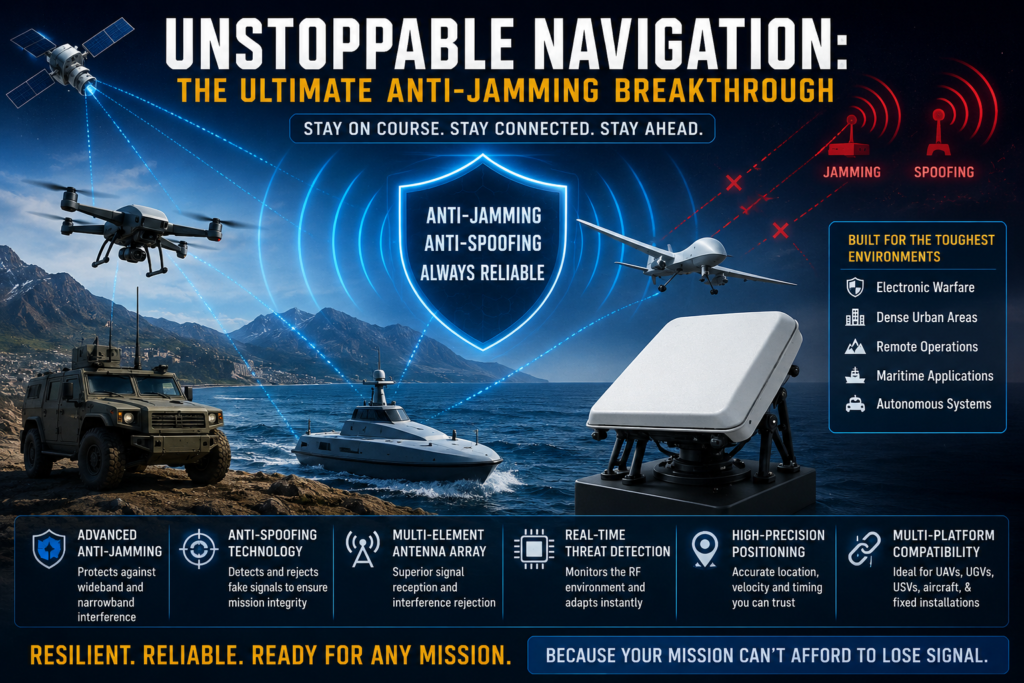
Unstoppable Navigation: The Ultimate Anti-Jamming Breakthrough
+
Table of Contents
- 1 What is Unstoppable Navigation?
- 1.1 Why Anti-Jamming Technology is Necessary
- 1.2 Greater susceptibility to electronic and cyber threats
- 1.3 Unstoppable Navigation Key Features
- 1.3.1 1. Anti-Jamming
- 1.3.2 2. Anti-Spoofing
- 1.3.3 3. Navigation Antennas with Multiple Elements
- 1.3.4 4. Threat Detection
- 1.3.5 5. Effortless Navigation
- 1.3.6 6. Integration Flexibility
- 1.3.7 7. Signal Processing
- 1.4 Unstoppable Navigation Features Comparison Table
- 1.5 Advantages of Unstoppable Navigation
- 1.5.1 Improved Mission Success
- 1.5.2 Improvements to Safety
- 1.5.3 Improved Resistance to Electronic Warfare
- 1.5.4 Enhanced Autonomous Function
- 1.5.5 Less Downtime
- 1.5.6 Long-Term Cost Benefits
- 1.6 Applications Across Industries
- 1.6.1 Defense and Military Operations
- 1.6.2 Coordination on the battlefield
- 1.6.3 Unmanned Aerial Vehicles (UAVs)
- 1.6.4 Maritime Operations
- 1.6.5 Aviation
- 1.6.6 Emergency Services
- 1.7 Emerging Technologies Driving Innovation
- 1.7.1 Artificial Intelligence
- 1.7.2 Machine Learning Algorithms
- 1.7.3 Advanced Antenna Design
- 1.7.4 Multi-Sensor Integration
- 1.8 Challenges and Considerations
- 1.8.1 Cost
- 1.8.2 Integration Complexity
- 1.8.3 Training Requirements
- 1.9 The Future of Unstoppable Navigation
- 2 Conclusion
Our world is becoming more connected and more technology-reliant. This creates a need for reliable navigation for things like military operations, transportation, and autonomous systems. Global Navigation Satellite Systems (GNSS) gives us the tools we need for these systems, but their signals can be easily interfered with and spoofed. This gives a lot of troubles to systems that rely on accurate navigation.
Unstoppable Navigation is a new solution to this problem. The technology of modern systems of GNSS can be manipulated to stay accurate to the system, but these methods lack integrity in contested electromagnetic environments. As navigation systems are becoming more advanced, anti-jamming innovations are essential to keep missions critical and on time.
This article reviews the idea of Unstoppable Navigation and discusses some of its features and benefits, and what the future of anti-jamming technology looks like.
What is Unstoppable Navigation?
Unstoppable Navigation systems are advanced navigation systems that are designed to work reliably with interfering signals. These systems are made up of hardware and software that have the capability to detect, and if needed, eliminate threats to GNSS signals.
Legacy navigation systems may have a hard time with modern Electronic Warfare operations, but systems with modern anti-jamming capabilities are more reliable. Because of this, advanced operations can be conducted with a variety of systems and/or platforms.
This concept is very crucial to advanced defense systems, autonomous transportation systems, and systems that require precise navigation.
Why Anti-Jamming Technology is Necessary
Global Navigation Satellite System (GNSS) jamming occurs when malicious signals overwhelm legitimate satellite signals. This makes navigation either unavailable or incorrect. Dangerous spoofing attacks convey misleading information by transmitting false signals to be received.
Deprived of protection, navigation systems can suffer from:
- Missing positional data
- Failed operations
- Endangered lives
- Outages
- Delays
Greater susceptibility to electronic and cyber threats
Unstoppable Navigation provides resilient navigation systems, which function despite compromising situations.
Unstoppable Navigation Key Features
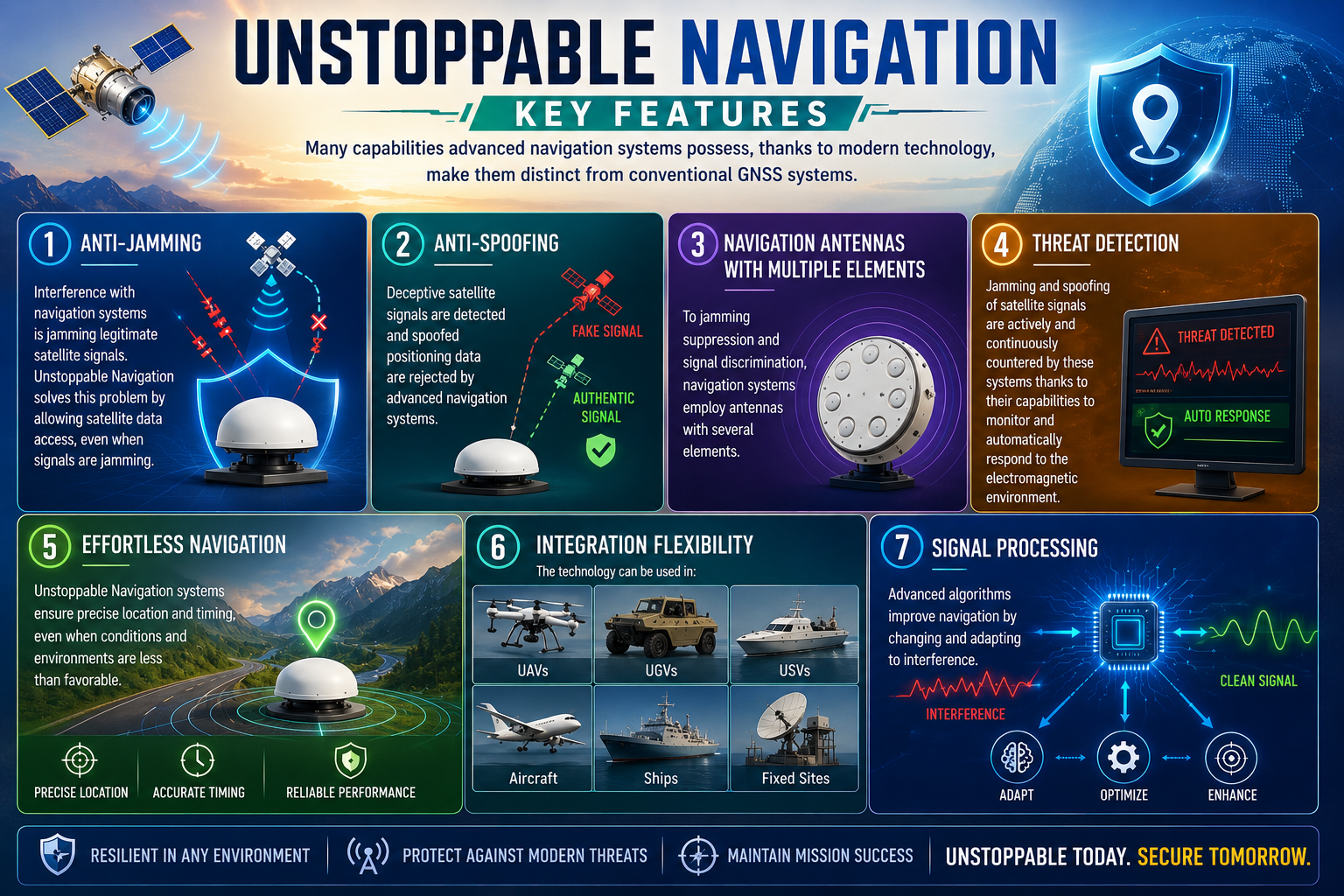
Many capabilities advanced navigation systems possess, thanks to modern technology, make them distinct from conventional GNSS systems.
1. Anti-Jamming
Interference with navigation systems is jamming legitimate satellite signals. Unstoppable Navigation solves this problem by allowing satellite data access, even when signals are jamming.
2. Anti-Spoofing
Deceptive satellite signals are detected, and spoofed positioning data are rejected by advanced navigation systems.
3. Navigation Antennas with Multiple Elements
To jamming suppression and signal discrimination, navigation systems employ antennas with several elements.
4. Threat Detection
Jamming and spoofing of satellite signals are actively and continuously countered by these systems thanks to their capabilities to monitor and automatically respond to the electromagnetic environment.
5. Effortless Navigation
Unstoppable Navigation systems ensure precise location and timing, even when conditions and environments are less than favorable.
6. Integration Flexibility
The technology can be used in:
- UAVs
- UGVs
- USVs
- Aircraft
- Ships
- Fixed sites
7. Signal Processing
Advanced algorithms improve navigation by changing and adapting to interference.
Unstoppable Navigation Features Comparison Table
| Feature | Standard GNSS System | Unstoppable Navigation System |
|---|---|---|
| Basic Positioning | Yes | Yes |
| Anti-Jamming Protection | Limited | Advanced |
| Anti-Spoofing Capability | Rare | Integrated |
| Multi-Element Antennas | No | Yes |
| Threat Detection | Minimal | Real-Time |
| Mission Reliability | Moderate | High |
| Electromagnetic Resilience | Low | Excellent |
| Autonomous Vehicle Support | Basic | Advanced |
| Military Applications | Limited | Extensive |
This comparison illustrates that Unstoppable Navigation is the most favorable solution for critical operations.
Advantages of Unstoppable Navigation
Improved Mission Success
Unstoppable navigation enhances the success of a mission. By continuously providing the position data, it increases the success of the operation of a drone, vessel, or military platform.
Improvements to Safety
Along with mission success, Unstoppable Navigation improves operational safety. It reduces the potential for a collision or a navigation error that could result in an operational mishap.
Improved Resistance to Electronic Warfare
Increasingly modern warfare relies on electronic warfare. During such conflicts, protection from enemy jamming is essential. Anti-jamming systems are crucial to maintain uninterrupted operations.
Enhanced Autonomous Function
Self-operating systems are reliant on the precision of uninterrupted navigation. Self-driving systems are more confident of the continuous performance of GNSS.
Less Downtime
There is the potential for high costs from interruptions in navigation. Unstoppable Navigation enables continuous operation and increased efficiency.
Long-Term Cost Benefits
Advanced systems for anti-jamming require an initial investment. However, the cumulative savings from reduced mission failures, loss of equipment, and operational inefficiencies outweigh the cost.
Applications Across Industries
Unstoppable Navigation will find applications in all industries due to the flexibility of anti-jamming navigation technology.
Defense and Military Operations
Precise navigation is critical for every phase of military operations, including:
Intelligence and reconnaissance
Coordination on the battlefield
Guiding weapons systems, including autonomous systems.
In all of these operations, Unstoppable Navigation provides assurance of dependable performance even under electronic assault.
Unmanned Aerial Vehicles (UAVs)
Drones are becoming more common for use in many environments for the purposes of surveillance and cargo transport, as well as mapping and assessing the integrity of infrastructure. Anti-jamming helps ensure that navigation won’t be interrupted, even during critical missions.
Maritime Operations
Ships and autonomous surface vessels rely on precision navigation to ensure safe travel and the ability to plan efficient routes. If crowded waters or contested areas are the target, advanced anti-jamming solutions increase reliability.
Aviation
Precision navigation is the baseline for safe and efficient operations of both commercial and military aircraft. Current anti-jamming solutions bolster protection from signal disruptions.
Emergency Services
Unstoppable Navigation restores critical services to search and rescue, disaster response, and law enforcement when operating in the most difficult environments.
Also Read- Revolutionary Nathu La Server: India’s Powerful Leap Toward Tech Independence
Emerging Technologies Driving Innovation
Numerous technologies are on the horizon that may improve the future of navigation resilience.
Artificial Intelligence
Faster detection of interference of navigation systems is possible through the use of AI-based threat detection.
Machine Learning Algorithms
Threats to navigation systems may be countered through the application of machine learning to ensure continuous operational improvement.
Advanced Antenna Design
New designs of antennas with the ability to reject interference are being developed.
Multi-Sensor Integration
Greater resilience in navigation systems is achieved through the combination of GNSS with other inertial systems, RADAR, and visual positioning systems.
Unstoppable Navigation relies on the cited innovations.
Challenges and Considerations
Always on the forefront of new technology are users and the threats posed by other nations. Anti-jamming systems are no exception. These technologies do surface some new considerations.
Cost
Investment will be greater due to the advanced state of anti-jamming technologies.
Integration Complexity
New navigation systems may require modification to existing platforms for integration.
Training Requirements
Advanced navigation systems increase the need for understanding how to operate and maintain them.
Handling mission-critical operations presents obstacles for any system. However, Unstoppable Navigation systems prove most helpful considering these constraints.
The Future of Unstoppable Navigation
Every country and organization today relies on some version of Global Navigation Satellite Systems (GNSS). Because of this, Unstoppable Navigation systems will need to continually enhance their offerings. Much investment is being made to technology that helps protect infrastructure and levers resilient operations, such as:
- artificial intelligence that bolsters signal protection
- antennas that are smaller and lighter
- better anti-spoofing
- superior multi-constellation GNSS systems
- autonomous navigation systems with resilience
Unstoppable Navigation will be proven reliable across many more industries because of these offerings.
Conclusion
Because of the advances in Unstoppable Navigation, organizations are able to stay ahead of the challenges posed by evolving electronic threats. From a cost/benefit perspective, the advantages of Unstoppable Navigation far outweigh any potential constraints. Reliability of navigation today is a necessity. Unstoppable Navigation will deliver solutions for military, commercial, and autonomous use.
The combination of real-time threat assessment, multi-element antenna arrays, and signal processing that adapts to the situation while providing enhanced electromagnetic resilience offers components that will fundamentally change navigation systems. Unstoppable Navigation will be the foundation of the technology that offers secure, accurate, and continuous navigation.
FAQs
-
What is Unstoppable Navigation?
Unstoppable Navigation is advanced navigation systems that offer protection against the jamming and spoofing of GNSS, while providing accurate positioning.
-
What is anti-jamming?
Anti-jamming is the use of specialized, signal processing antennas that can jamming, and other unwanted signals.
-
Which sectors benefit from anti-jamming navigation the most?
Enhanced navigation resilience benefits defense, aviation, maritime transport, autonomous vehicles, and drones, along with emergency services.
-
What is GNSS spoofing?
GNSS spoofing is the act of sending fake satellite signals to confuse receivers and tamper with positioning.
-
Will anti-jamming systems improve drone performance?
Absolutely. Drones are able to navigate precisely even when a high level of electromagnetic interference is present due to anti-jamming systems.
-
Are anti-jamming antennas only for military use?
No. Anti-jamming solutions are utilized in commercial markets and by manufacturers of autonomous vehicles, maritime operators, and emergency service providers.