Traditional SEO vs GEO: The Evolution of Search Optimization
+
Table of Contents
- 1 What is Traditional SEO?
- 2 What is GEO?
- 3 Traditional SEO vs. GEO: Major Comparison Points
- 3.1 Features of Traditional SEO
- 3.1.1 1. Keyword Optimization
- 3.1.2 2. Link Building
- 3.1.3 3. Technical Optimization
- 3.1.4 4. Content Promotion
- 3.1.5 5. Trackable Metrics
- 3.2 Elements of GEO
- 3.2.1 1. Conversational Tone
- 3.2.2 2. Signals of Trust
- 3.2.3 3. Clarity
- 3.2.4 4. Expert Content
- 3.2.5 5. Context
- 3.3 Traditional SEO Advantages
- 3.3.1 Higher Traffic
- 3.3.2 Brand Recognition
- 3.3.3 Cumulative Results
- 3.3.4 Increased Conversions
- 3.3.5 Competitive Edge
- 3.4 GEO Benefits
- 3.4.1 Better AI Visibility
- 3.4.2 Greater Brand Recognition
- 3.4.3 First-to-Market Defense
- 3.4.4 Enhanced User Experience
- 3.4.5 Trust and Authority
- 3.5 Drawbacks of Traditional SEO
- 3.5.1 Intense Competition
- 3.5.2 Frequent Changes
- 3.5.3 Delayed Outcomes
- 3.5.4 Reliance on Search Engines
- 3.6 Drawbacks of GEO
- 3.6.1 Measuring AI Visibility
- 3.6.2 Instability
- 3.6.3 Less Website Engagement
- 3.6.4 Cite Uncertainty
- 3.6.5 Create High-Value Content
- 3.6.6 Show Authority
- 3.6.7 Use Organization
- 3.6.8 Gain Recognition
- 3.6.9 Update Content
- 3.7 The Future of Search Optimization
- 4 Final Thoughts
Digital marketing evolves rapidly. Search engine optimization (SEO) used to be what drove customers, but now businesses have to grapple with Generative Engine Optimization (GEO). Artificial Intelligence (AI) search engines are now commonplace. Digital marketers are doing a Traditional SEO vs GEO analysis to see which method is more effective for visibility.
Traditional SEO vs GEO is an important concept to consider because of the changing nature of search. Gone are the days of users clicking through multiple webpages. Now, users are getting direct answers from AI. This has forced businesses, marketers, and content creators to take a different approach to optimization.
This article examines the Traditional SEO vs GEO concepts and the ways they diverge in terms of features, advantages, and obstacles.
What is Traditional SEO?
Traditional Search Engine Optimization focuses on improving a website’s visibility within search engine results pages (SERPs) by making a website more likely to receive visits for specific searches.
Every aspect of the digital marketing world has been impacted by SEO. It encompasses:
- Keyword optimization
- Backlinks
- Website performance
- Content
- Responsiveness
- User Experience (UX)
Searchers are likely to visit a website that follows the practices of SEO.
What is GEO?
Generative Engine Optimization (GEO) is a newly developed concept for enhancing visibility in AI-generated elements. The purpose of GEO is to ensure that certain bits of information are referenced, cited, or suggested by AI-driven search tools, instead of concentrating on ranking engine-generated web pages.
GEO aims to fulfill the enormous pending task of developing information for businesses that AI models are willing to use and trust in the process of generating output, especially now that AI assistants and advanced search tools are already in place.
The Traditional SEO vs. GEO controversy is all about the shift from the ranking of web pages down to actually becoming a component of AI-generated answers.
Traditional SEO vs. GEO: Major Comparison Points
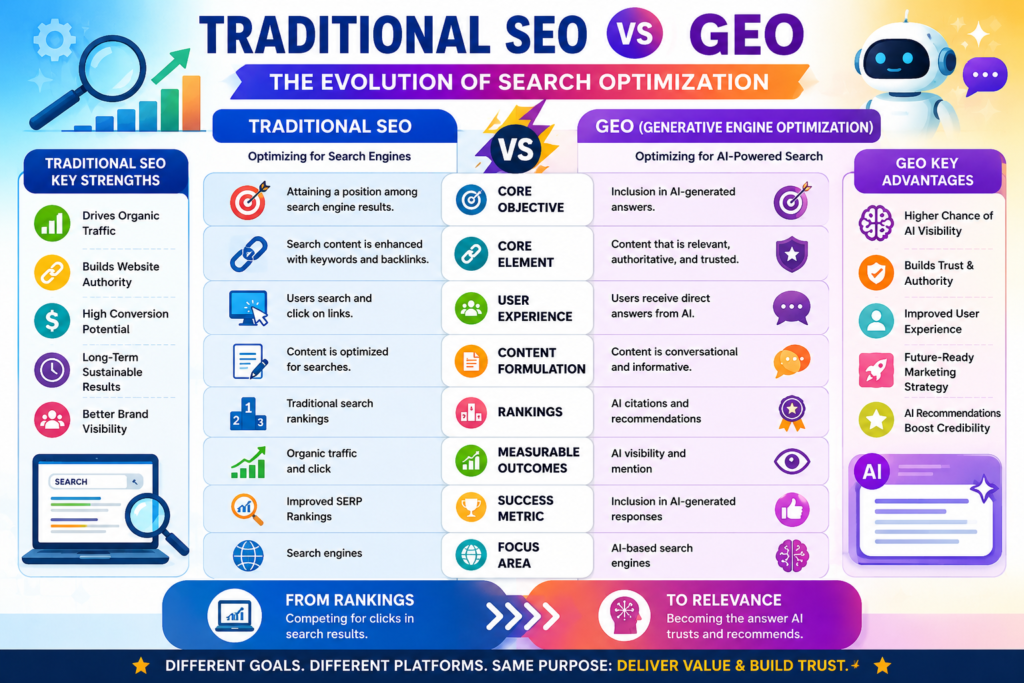
| Factor | Traditional SEO | GEO (Generative Engine Optimization) |
|---|---|---|
| Core Objective | Attaining a position among search engine results | Inclusion in AI-generated answers |
| Core Element | Search content is enhanced with keywords and backlinks | Content that is relevant, authoritative, and trusted |
| User Experience | Users search and click on links | Users receive direct answers from AI |
| Content Formulation | Content is optimized for searches | Content is conversational and informative |
| Rankings | Traditional search rankings | AI citations and recommendations |
| Measurable Outcomes | Organic traffic and clicks | AI visibility and mentions |
| Success Metric | Improved SERP rankings | Inclusion in AI-generated responses |
| Focus Area | Search engines | AI-based search engines |
Features of Traditional SEO
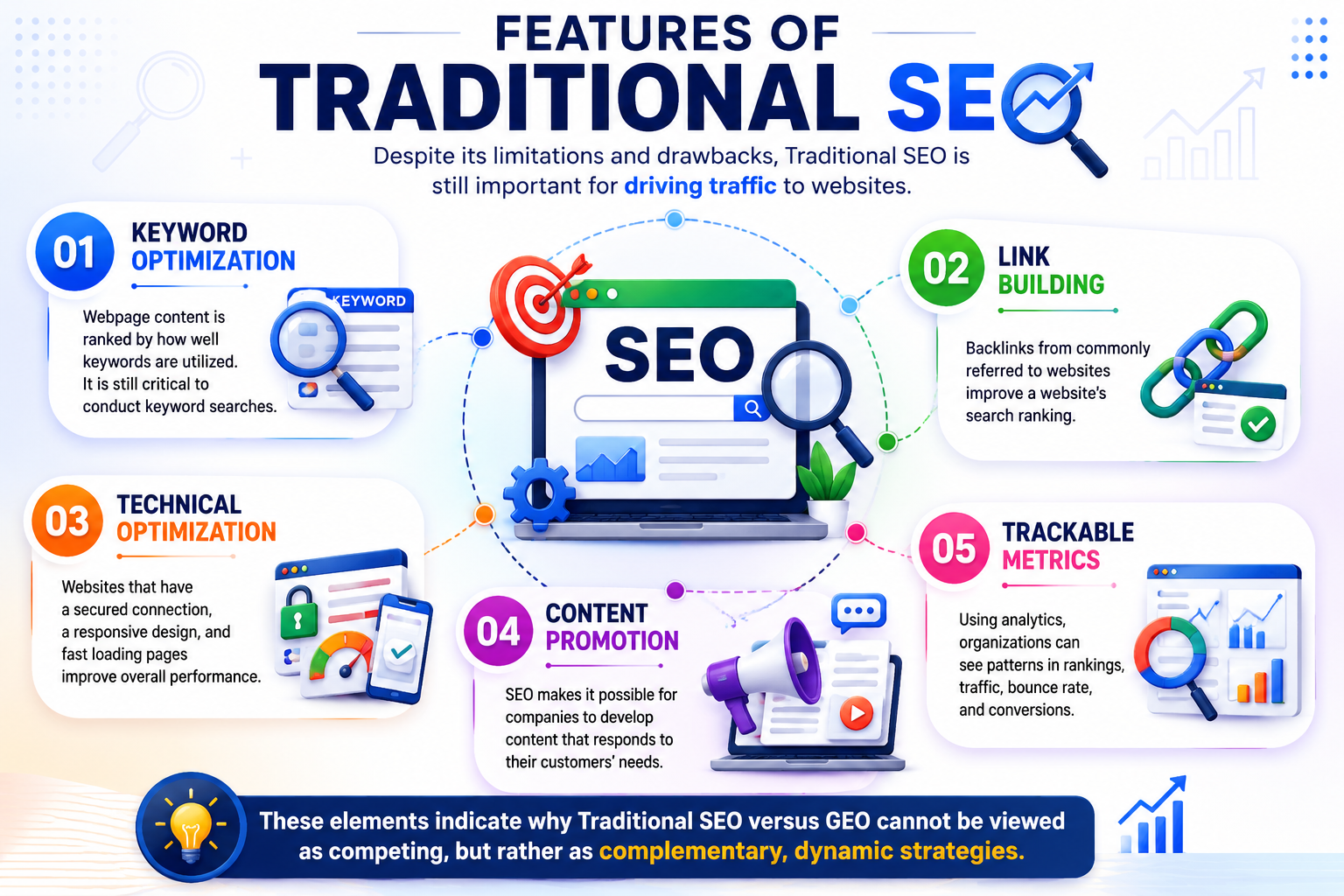
Despite its limitations and drawbacks, Traditional SEO is still important for driving traffic to websites.
1. Keyword Optimization
Webpage content is ranked by how well keywords are utilized. It is still critical to conduct keyword searches.
2. Link Building
Backlinks from commonly referred to websites improve a website’s search ranking.
3. Technical Optimization
Websites that have a secured connection, a responsive design, and fast loading pages improve overall performance.
4. Content Promotion
SEO makes it possible for companies to develop content that responds to their customers’ needs.
5. Trackable Metrics
Using analytics, organizations can see patterns in rankings, traffic, bounce rate, and conversions.
These elements indicate why Traditional SEO versus GEO cannot be viewed as competing, but rather as complementary, dynamic strategies.
Elements of GEO
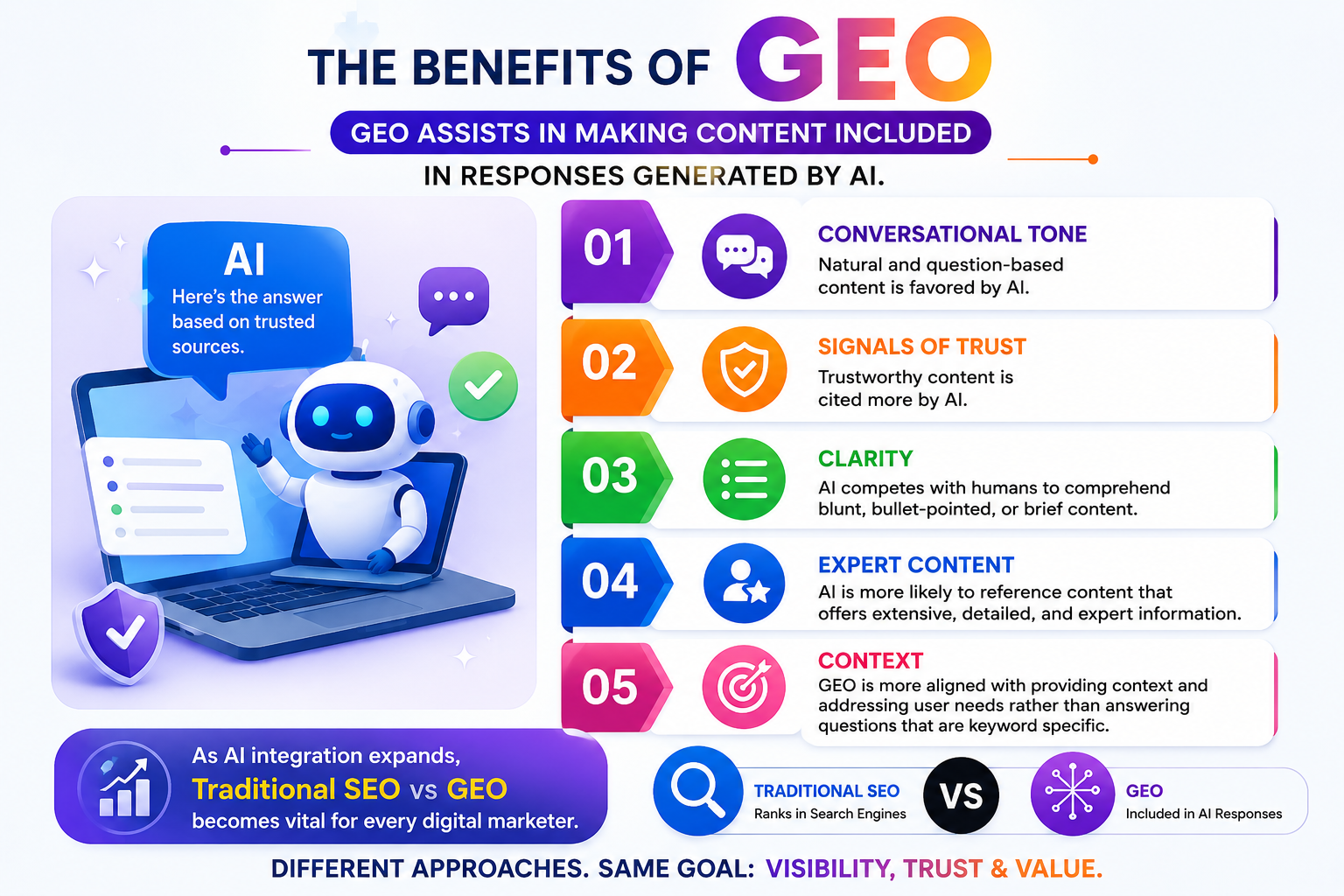
GEO assists in making content included in responses generated by AI.
1. Conversational Tone
Natural and question-based content is favored by AI.
2. Signals of Trust
Trustworthy content is cited more by AI.
3. Clarity
AI competes with humans to comprehend blunt, bullet-pointed, or brief content.
4. Expert Content
AI is more likely to reference content that offers extensive, detailed, and expert information.
5. Context
GEO is more aligned with providing context and addressing user needs rather than answering questions that are keyword specific.
As AI integration expands, Traditional SEO vs GEO becomes vital for every digital marketer.
Traditional SEO Advantages
There are many benefits that are exclusive to Traditional SEO.
Higher Traffic
There are no paid ads when a company is top in rankings.
Brand Recognition
A company’s appearance in the top returns increases awareness.
Cumulative Results
Content that is optimized and ranked can result in increased visitor rates in the long run.
Increased Conversions
Search engine visitors are more likely to make a purchase.
Competitive Edge
Firms that are apt at positioning and signaling are on better footing.
Despite contemporary AI innovations, Traditional SEO vs GEO shows how Traditional SEO is critical to the growth of business.
GEO Benefits
GEO has advantages that correspond to the AI age.
Better AI Visibility
Having AI-optimized content cited in AI responses.
Greater Brand Recognition
GEO earns citation, authority, and trust.
First-to-Market Defense
GEO is a safeguard for businesses.
Enhanced User Experience
Users appreciate and prefer direct answers.
Trust and Authority
AI references those who are trustworthy.
For equilibrium of both visibility and authority, businesses need to combine Traditional SEO and GEO.
Drawbacks of Traditional SEO
Traditional SEO is limited despite a good ROI.
Intense Competition
Keyword competition can be extreme.
Frequent Changes
SEO can be interrupted by sudden changes to search engines.
Delayed Outcomes
Potential benefits can be delayed for months.
Reliance on Search Engines
Changes in policies can impact traffic to the site.
Traditional SEO vs GEO centers on the issues associated with Traditional SEO.
Drawbacks of GEO
GEO is a fairly new and developing channel, and has challenges of its own.
Measuring AI Visibility
While measuring website traffic is easy, obtaining AI visibility metrics is more complex.
Instability
AI’s content referencing and assessment criteria are in flux.
Less Website Engagement
When users get answers directly from AI, they may not click through.
Cite Uncertainty
AI may use different models to reference content.
For this reason, Traditional SEO Vs GEO demonstrates that to achieve maximum impact, both must be employed.
Create High-Value Content
Content must be lengthy, accurate, and helpful to the search engines and AI.
Show Authority
Industries are shown to have such a level of industy-specific expertise when they provide their own data and research.
Use Organization
Both AI and humans appreciate the use of headings, tables, lists, and bullet points.
Gain Recognition
Good content leads to backlinks, mentions, and citations and results in better search visibility.
Update Content
Both SEO and AI use the timeliness and accuracy of the content.
There is a way for traditional SEO and GEO that both can be employed successfully.
Also Read- The Rise of Zero-Click Search: Opportunities and Risks for Businesses
The Future of Search Optimization
What is seen from AI Search capabilities is likely to expand into the future. Search engines will be able to summarize and answer in a more fluid and conversational way with their AI.
The way websites are designed now will remain. AI systems will pull a web of high-quality content and traditional searches and AI systems will be employed to the highest level by businesses.
What we are currently witnessing with the systems of traditional SEO and GEO is an improvement and advancement of search systems, and not a replacement of the current systems.
Final Thoughts
Within the Traditional SEO and GEO debate, we can see how innovations have impacted the online marketing industry. Traditional SEO combines ranking, visibility, and traffic, while GEO aims for inclusion in AI-generated responses.
GEO and SEO have different uses, but using them together will help brands grow, since search technology is always changing.
Traditional SEO vs GEO should not be considered incompatible techniques, but rather as complementary pieces of a wider toolbox. Used collaboratively, they lead to maximized online presence, recognition, and overall stability and growth in the digital realm.
FAQs
1. What does GEO represent?
GEO, or Generative Engine Optimization, is a method of increasing presence in AI created response systems.
2. Is GEO the new SEO?
No. GEO is not the new SEO. GEO adds to basic SEO with an AI-centered search methodology.
3. Why is comparing Traditional SEO vs GEO important?
Analyzing the difference between Traditional SEO and GEO lets companies understand the importance of modifying content to correspond with search method alterations.
4. What is superior: SEO or GEO?
Both methods work to augment a business. SEO generates business and GEO increases presence in the AI realm. They should be utilized in tandem.
5. Will AI make websites less popular?
It is possible. Though the content is created to answer a question or to provide information, people will still be drawn to it.
6. What is the future of Traditional SEO vs GEO?
A combination of the two will achieve the best visibility across search methods and AI.