AI Automation: The Game-Changing Business Revolution
+
Table of Contents
- 1 What is AI Automation?
- 2 Key Features of AI Automation
- 2.1 1. Machine Learning
- 2.2 2. Natural Language Processing (NLP)
- 2.3 3. Predictive Analytics
- 2.4 4. Intelligent Decision Making
- 2.5 5. Workflow Automation
- 2.6 6. Real-Time Data Processing
- 2.7 7. Continuous Improvement
- 3 Automation Features and Benefits
- 3.1 Benefits of AI Automation to Businesses
- 3.1.1 Cost Reduction
- 3.1.2 Accelerated Decision Making
- 3.1.3 More Automation is Possible as You Scale
- 3.1.4 Automation Improves Employee Satisfaction
- 3.2 Where AI Automation is Currently Being Used
- 3.2.1 Customer Support
- 3.2.2 Marketing Automations
- 3.2.3 Automated HR Functions
- 3.2.4 Finance and Automation
- 3.3 Areas Manufacturing is Benefiting from Automation
- 3.3.1 Supply Chain Management
- 3.3.2 AI Automation Difficulties
- 3.3.3 High Costs
- 3.3.4 The Necessity of High-Quality Data
- 3.4 The Advancement of AI Automation
- 4 Summary
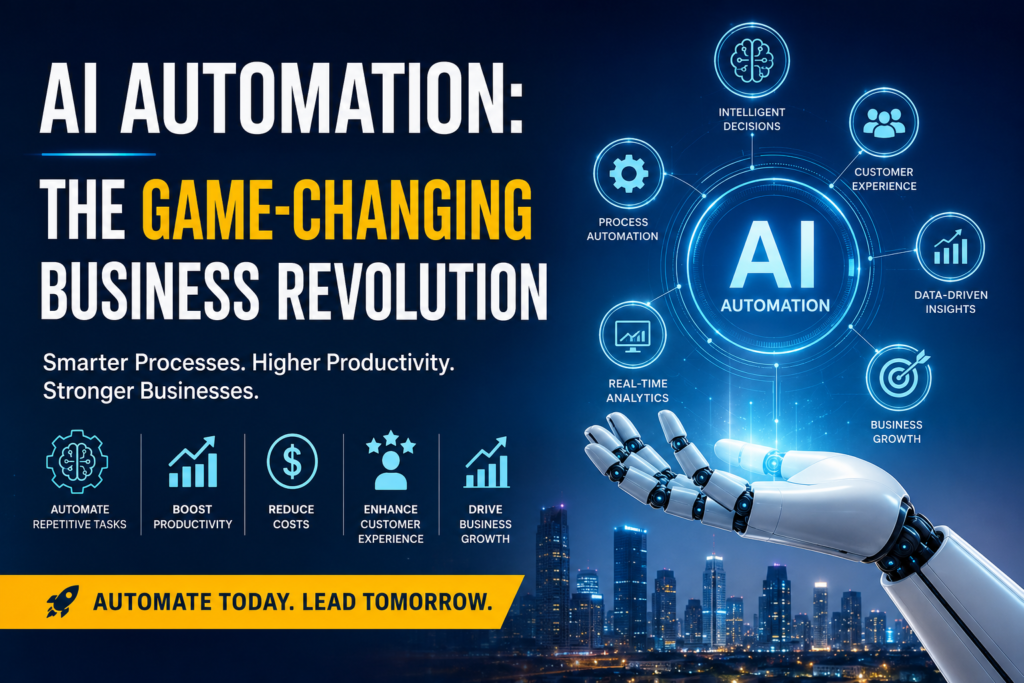
Artificial Intelligence (AI) is no longer a concept of the future; it has become part of the present. AI is changing the way we do business globally, and the advancement of AI automation is one of the most groundbreaking aspects of this. Automated AI systems are advantageous for companies because they optimize processes and systems, are cost-effective, and provide a better product or service to the customer.
AI automation can make business decisions and perform tasks that used to be repetitive for staff. AI automation is changing how businesses are run. In the era of digital business, companies that are the most up to date with the latest technology are the most successful and have a competitive edge over others that are using manual or traditional business processes.
This article will evaluate the phenomenon of AI automation, its features, perks, and examples of its use, and will explain its dramatic impact on the business world.
What is AI Automation?
AI Automation is the application of smart technologies to complete business processes automatically with little to no human involvement. Traditional automation is rules-based. Contrary to that, AI automation is intelligent. It has the capability to self-learn and make judgments.
AI automation can also perform tasks that are complex or that are traditionally performed by humans. Examples of AI automation are systems that:
- Use chatbots to respond to customer queries
- run automated AI advertising
- process invoices
- Do predictive maintenance for manufacturing
- manage inventory for smart businesses
- perform analysis and reporting on data
AI automation transforms the business data that is generated for use and does so with little manual tasking.
Key Features of AI Automation
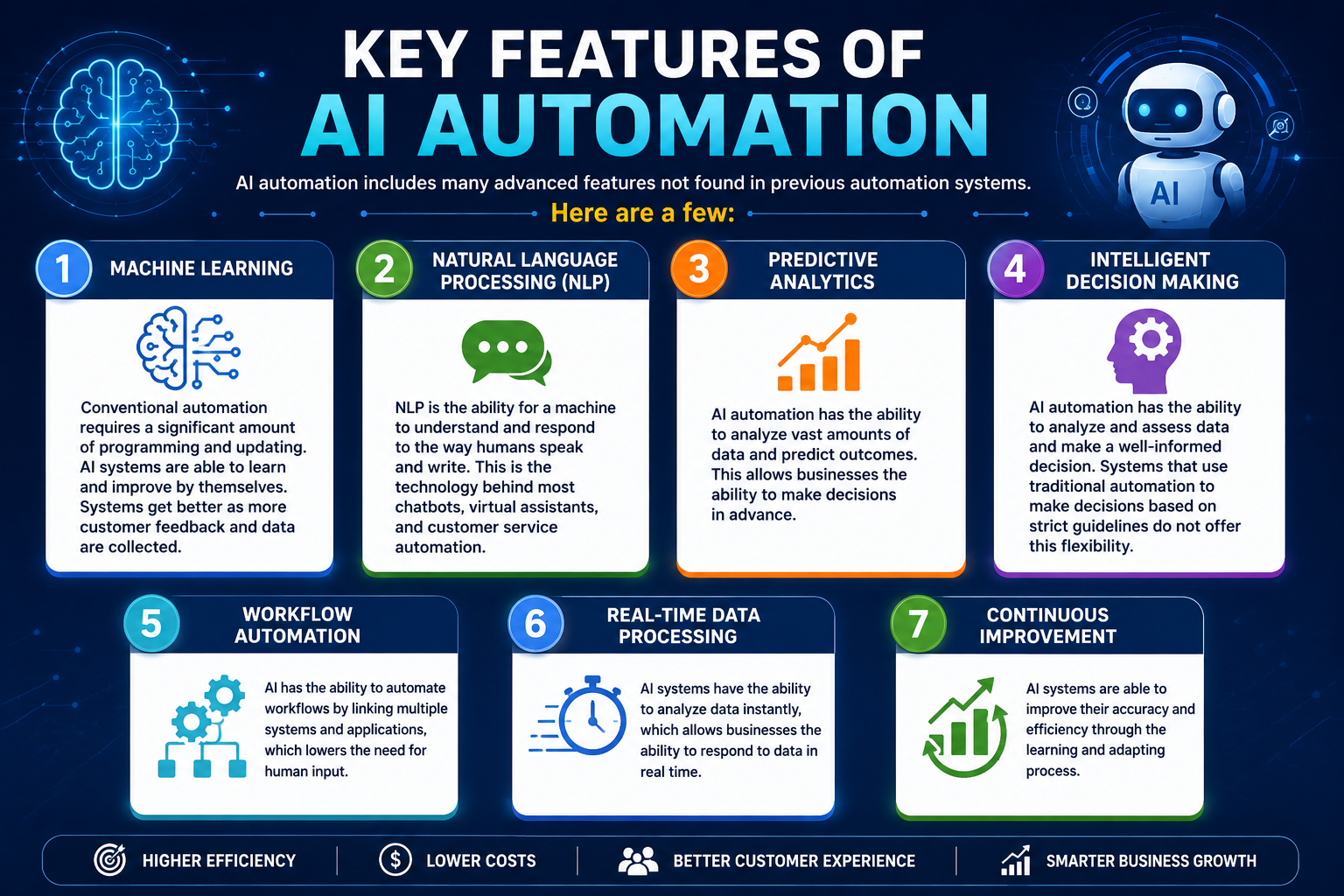
AI automation includes many advanced features not found in previous automation systems. Here are a few:
1. Machine Learning
Conventional automation requires a significant amount of programming and updating. AI systems are able to learn and improve by themselves. Systems get better as more customer feedback and data are collected.
2. Natural Language Processing (NLP)
NLP is the ability for a machine to understand and respond to the way humans speak and write. This is the technology behind most chatbots, virtual assistants, and customer service automation.
3. Predictive Analytics
AI automation has the ability to analyze vast amounts of data and predict outcomes. This allows businesses the ability to make decisions in advance.
4. Intelligent Decision Making
AI automation has the ability to analyze and assess data and make a well-informed decision. Systems that use traditional automation to make decisions based on strict guidelines do not offer this flexibility.
5. Workflow Automation
AI has the ability to automate workflows by linking multiple systems and applications, which lowers the need for human input.
6. Real-Time Data Processing
AI systems have the ability to analyze data instantly, which allows businesses the ability to respond to data in real time.
7. Continuous Improvement
AI systems are able to improve their accuracy and efficiency through the learning and adapting process.
Automation Features and Benefits
| Feature | Description | Business Benefit |
|---|---|---|
| Machine Learning | Learns from data and improves over time | Increased efficiency and accuracy |
| Natural Language Processing (NLP) | Understands human language | Better customer support |
| Predictive Analytics | Forecasts trends and outcomes | Smarter decision-making |
| Workflow Automation | Automates business processes | Reduced operational costs |
| Real-Time Processing | Analyzes data instantly | Faster response times |
| Intelligent Decision-Making | Evaluates complex scenarios | Improved business performance |
| Continuous Learning | Adapts and improves automatically | Long-term optimization |
Benefits of AI Automation to Businesses
Greater business productivity is one of the major benefits of AI automation. The reason for this is that employees are no longer required to perform repetitive menial tasks and are therefore able to focus on tasks that drive the business strategy and growth.
Automated systems are able to perform functions such as data entry processes significantly faster than an employee, who would be burdened by the task of entering large volumes of repetitive data.
Cost Reduction
Implementing AI automation means a reduction in the cost of employment and the ongoing costs associated with implementing and maintaining systems for business operations. AI systems require no downtime, overtime, or the need to expand employee numbers.
Most businesses that choose to automate processes experience great benefits and cost savings stemming from the automation of scheduling tasks and systems such as customer support and accounting.
Accelerated Decision Making
Automation is quickly processing data and offering insight through AI in the background. In turn, business leaders can base approaches on fast and accurate information. This is an edge on the competition since the market is constantly changing.
More Automation is Possible as You Scale
Workload can be a challenge with a growing business. AI Automation makes it easier to manage that growth with fewer needs for staff and costs. Automated systems will sustain performance even among more transactions.
Automation Improves Employee Satisfaction
With the automation of the more mundane and repetitive tasks, employees can work on the more meaningful and the strategic and creative work. This type of work is also more fulfilling, increasing engagement.
Where AI Automation is Currently Being Used
Customer Support
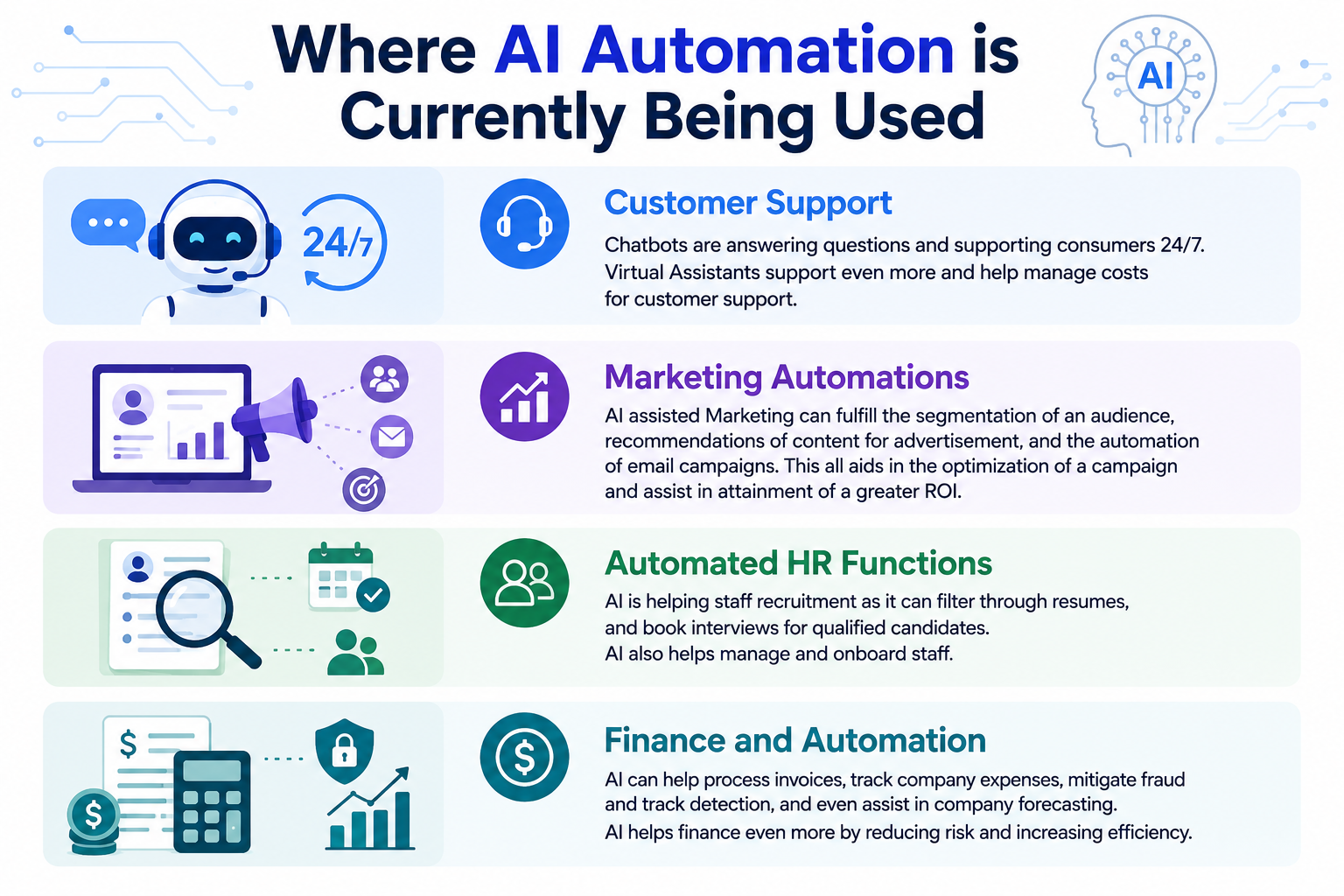
Chatbots are answering questions and supporting consumers 24/7. Virtual Assistants support even more and help manage costs for customer support.
Marketing Automations
AI-assisted marketing can fulfill the segmentation of an audience, recommendations of content for advertisement, and the automation of email campaigns. This all aids in the optimization of a campaign and assists in attainment of a greater ROI.
Automated HR Functions
AI is helping staff recruitment as it can filter through resumes, and book interviews for qualified candidates.
AI also helps manage and onboard staff.
Finance and Automation
AI can help process invoices, track company expenses, mitigate fraud and track detection, and even assist in company forecasting.
AI helps finance even more by reducing risk and increasing efficiency.
Areas Manufacturing is Benefiting from Automation
AI is being used by manufacturers for maintenance that is more predictive, and optimizing quality and control of manufacturing processes.
AI is also helping reduce downtime and improving quality of products.
Supply Chain Management
Automation helps balance the optimization of inventory and logistics while managing less or no waste, helping fulfill demand better.
AI Automation Difficulties
Implementing AI automation has issues businesses need to resist and reflect on despite its extensive advantages.
High Costs
Integration of AI Automation requires significant spending in infrastructure, software, and employee training.
The Necessity of High-Quality Data
- Low-quality or insufficient data leads to poor results for AI.
- Adaptation of the Workforce
- Employees will need training to use the systems.
- Security and Privacy
AI automation requires businesses to incorporate and account for security and protection of data compliance.
Though this has many challenges, the long-term advantages typically outweigh the initial problems.
Also Read- Elite Robot Dog Defends Against Drone Threats: The Future of Mobile Airspace Security
The Advancement of AI Automation
The future of AI automation is incredibly bright. The rapid advancement of machine learning, generative AI, robotics, and cloud computing are making automation even more powerful and pervasive.
The coming years are likely to see wide-scale business adoption of:
- Self-operating business processes
- AI-based decision-making
- An unprecedented level of automation
- Sophisticated virtual assistants
- Smart document processing
- Proactive engagement with customers
The firms that will gain the greatest competitive advantage from these business process innovations and technologies will be the firms that make the earliest and most extensive use of these systems.
Summary
AI automation is a revolutionary technology for business. Automation and self-operating systems greatly enhance business capabilities to reduce costs, refine the quality of service and enhance the quality of business decisions. AI automation is applicable in almost all business functions. The first investment has a long payback period. This is an investment in the future for both business and its customers.
Technology will become further integrated in the world. Along with that, AI automation will further integrate into business. Using AI solutions now will help your company be ready to adapt and react to the digital economy in the future.
Frequently Asked Questions
1. What is AI automation?
AI automation uses AI to do tasks or make decisions with no human involvement.
2. What makes AI automation different from standard automation?
Routine automation uses a set of rules, unlike AI automation that can learn and adjust with data to make decisions.
3. What are the advantages of using AI automation?
Some advantages include the ability to take on more tasks, less cost, increased precision, improved customer experience, and the ability to make decisions quickly.
4. Where is AI automation used?
Healthcare, finance, retail, manufacturing, logistics, marketing, and customer service are some of the industries that use AI automation.
5. Is AI Automation good for small businesses?
Yes. Many AI tools and solutions that are cloud based can provide small businesses with automation and are inexpensive.