AI Jobs in the USA: Powerful Careers Shaping the Future
+
Table of Contents
- 1 Why Are AI Jobs in the USA Growing?
- 2 Top AI Jobs in the USA
- 2.1 1. AI Engineer
- 2.2 2. Machine Learning Engineer
- 2.3 3. Data Scientist
- 2.4 4. AI Research Scientist
- 2.5 5. AI Product Manager
- 2.6 6. AI Security Specialist
- 2.7 7. AI Consultant
- 3 Top AI Jobs in the USA
- 3.1 Degrees and Courses
- 3.2 Remote Work and AI Jobs in the USA
- 3.3 Are AI Jobs Replacing Other Jobs?
- 3.4 Who is Attracted to Careers in AI?
- 3.5 Who Should Consider an AI Career?
- 3.6 Future Outlook
- 4 Final Thoughts
- 4.1 FAQs
- 4.1.1 1. What are the most in-demand AI jobs in the USA?
- 4.1.2 2. How much can AI professionals earn in the USA?
- 4.1.3 3. Is a degree necessary for AI Jobs in the USA?
- 4.1.4 4. What type of skills will help me land a job in AI?
- 4.1.5 5. Where can I find AI jobs outside of Silicon Valley?
- 4.1.6 6. Is it possible to find work in AI in the USA with no experience?
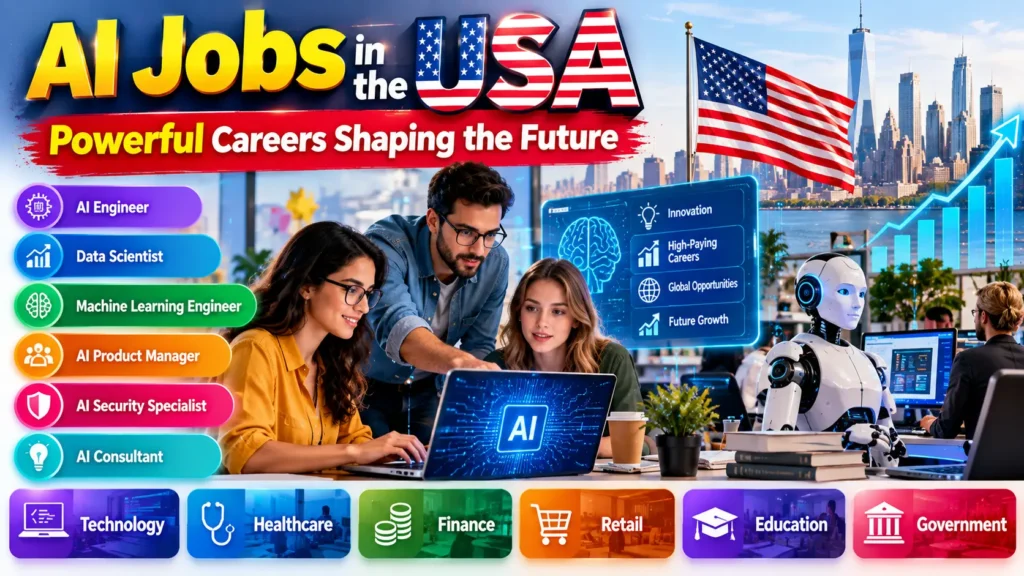
A new era in technology led by artificial intelligence has revolutionized nearly every aspect of the business and economic industry in the U.S. From designing and manufacturing products to analyzing data and making business decisions, countless AI Jobs in the USA have been created to integrate and utilize artificial intelligence in business.
Although many associate artificial intelligence with jobs in engineering, there is an equal dispersal of related career opportunities in other fields such as law, medicine, finance, and business.
The United States Department of Labor forecasts that employment in various science, technology, engineering, and mathematics (STEM) related professions will increase by 14% to 30% by the year 2030.
Why Are AI Jobs in the USA Growing?
AI has spread pervasively throughout the U.S. workforce. From law to finance to engineering, nearly every profession employs artificial intelligence in some form. In the U.S. labor market, artificial intelligence has changed nearly every aspect of business from designing and manufacturing products to selling and servicing those products.
According to a study conducted by Lightcast for the 2026 edition of the Stanford Artificial Intelligence Index, in 2023, 2.5% of all jobs in the U.S. required knowledge and skills in artificial intelligence. This figure represented a 55% increase over the previous year. While a growing number of companies are looking to hire AI specialists, other companies are integrating artificial intelligence into the work of their employees.
This will expand occupational opportunities in two areas: jobs in AI and related fields, as well as non-AI jobs requiring a complementary knowledge of AI technologies.
Also Read: Jasper vs. Copy.ai: Powerful AI Battle
Top AI Jobs in the USA
1. AI Engineer
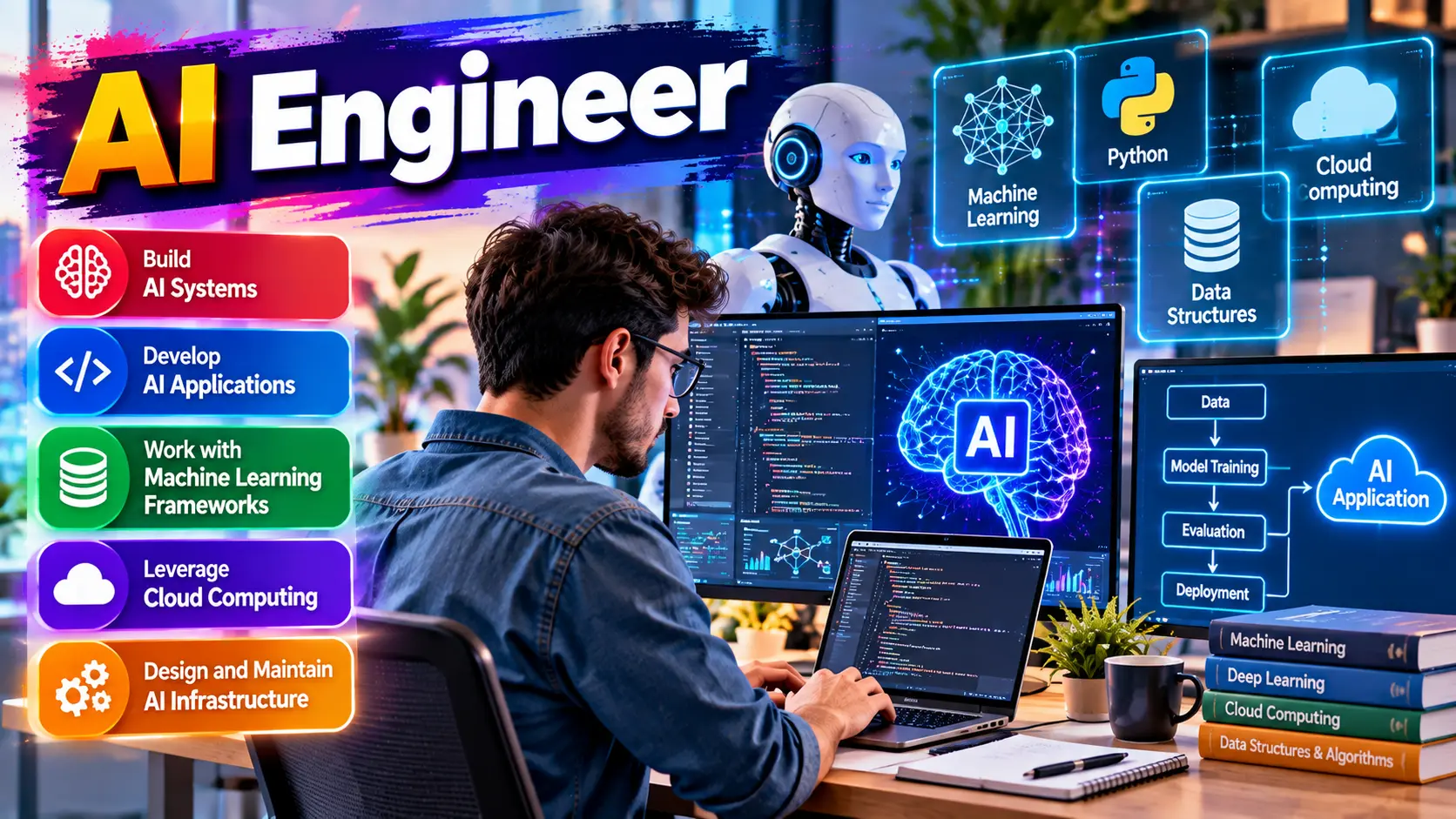
AI engineers create and implement artificial intelligence. They employ their software development skills to build AI systems, leverage their understanding of data to build AI applications, and build production systems to build AI infrastructure.
They utilize their skills in different machine learning frameworks, programming, and cloud computing, and are experts in data structures and algorithms.
The demand for AI engineers is expected to surge across different industries, including banking, health care, retail, manufacturing, and technology.
2. Machine Learning Engineer

Much like AI engineers, machine learning engineers construct systems and applications that learn and improve through experience and algorithms.
They create and improve various models through the practice of data science and machine learning. They employ statistics and programming to gain and integrate business insights into systems.
A bachelor’s degree in a field related to technology, engineering, mathematics, or science is a common pathway to a career in this field.
3. Data Scientist

Data science employs techniques from computer science, statistics, mathematics, and information systems to synthesize, study, and extrapolate business information from large volumes of structured and unstructured data.
Data science is one of the fastest-growing professions, and according to the BLS, it will grow 33.5% between 2024 and 2034.
A degree in a quantitative field (mathematics, statistics, or computer science) combined with a field related to business is a common entry point.
4. AI Research Scientist
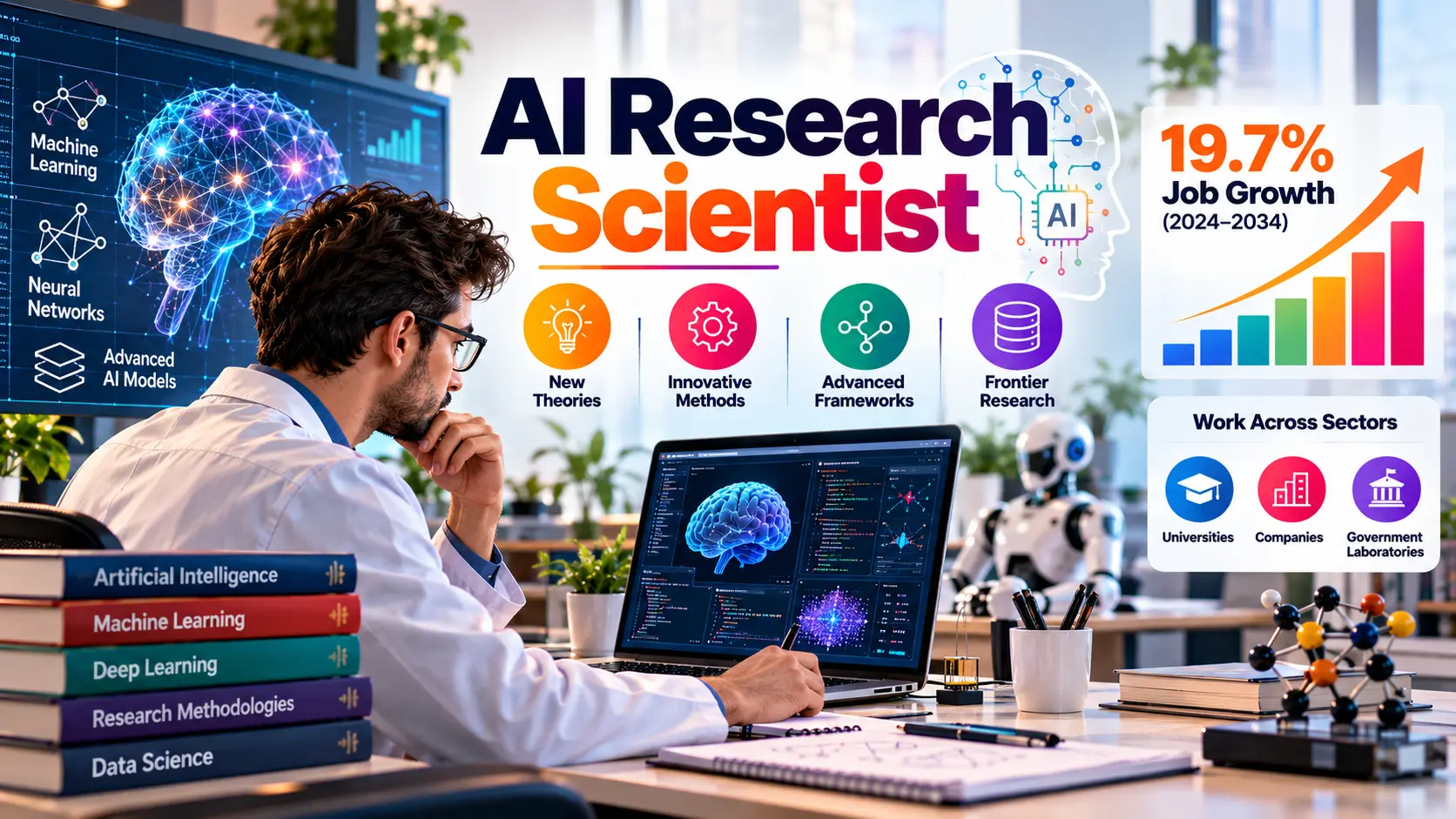
A concentration in artificial intelligence and machine learning is typically pursued by computer and information research scientists. These researchers explore the frontiers of computing and develop new theories, methods, and frameworks.
The BLS expects computer and information research scientist employment to grow by 19.7% between 2024 and 2034.
Research scientists work in both the public and private sectors, including universities and companies, and government laboratories.
5. AI Product Manager

A product manager works to create a product that serves an identified customer need. An important part of the role is setting product performance goals and determining product capabilities and features.
This career provides an opportunity for product managers, business strategists, and UX specialists to incorporate AI into their careers.
6. AI Security Specialist

As companies adopt more AI systems, the security of AI systems, applications, and data becomes important.
The BLS predicts employment of Information Security Analysts will increase by 28.5% between 2024 and 2034.
AI and Cybersecurity represent two rapidly growing career fields.
7. AI Consultant
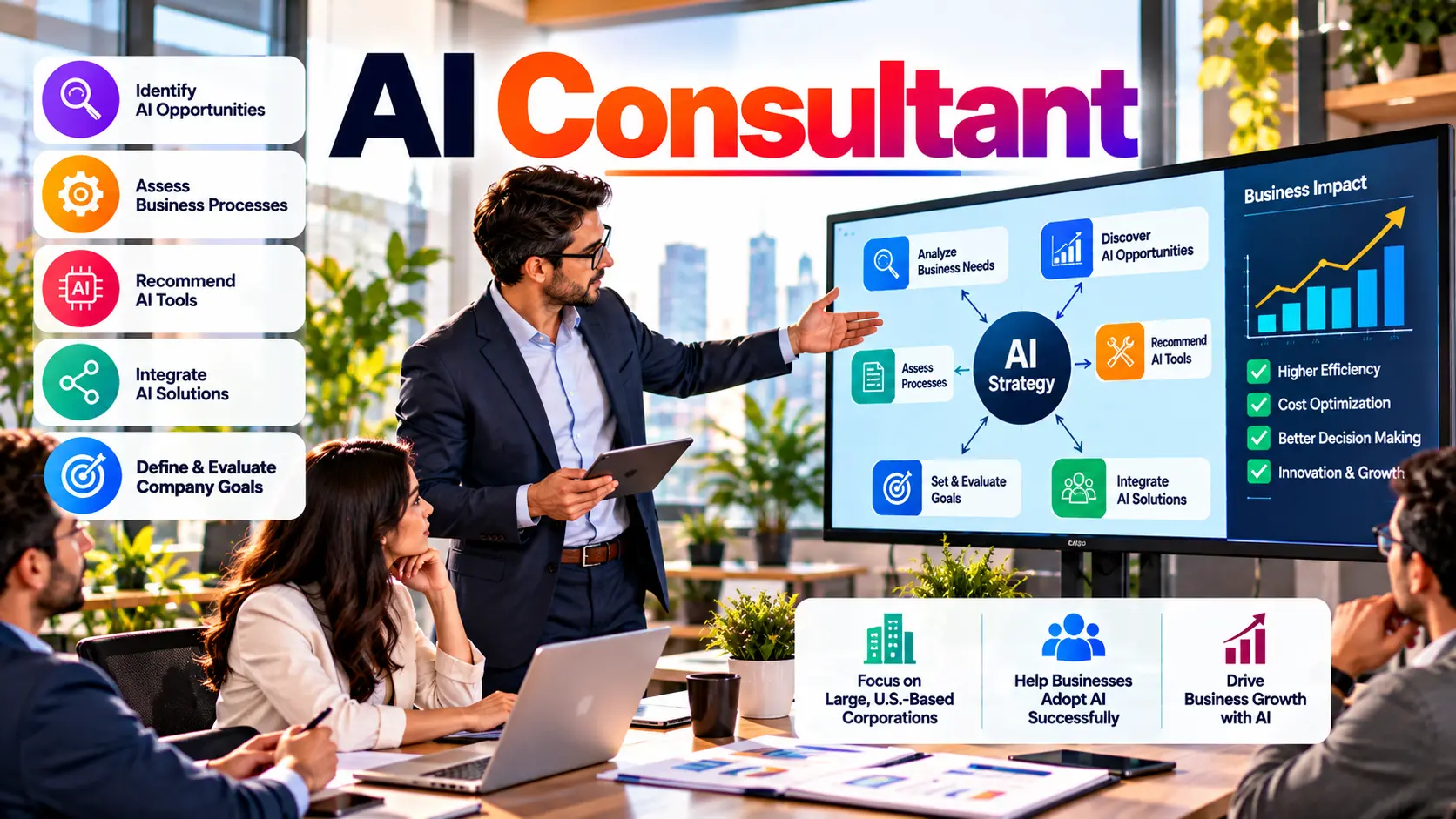
AI consultants assist in identifying AI opportunities within a company. Sometimes this involves assessing company processes to suggest AI tools, helping to integrate AI within a company, and defining and evaluating company goals.
This work is most applicable to large, U.S.-based corporations.
Top AI Jobs in the USA
| AI Job | Typical Responsibilities | Key Skills | Common Industries |
|---|---|---|---|
| AI Engineer | Develop and deploy AI applications and systems | Python, Machine Learning, APIs, Cloud Computing | Technology, Finance, Healthcare |
| Machine Learning Engineer | Build, train, and maintain machine learning models | Python, ML Frameworks, Statistics, MLOps | Technology, Automotive, Finance |
| Data Scientist | Analyze data and build predictive models | Python, SQL, Statistics, Machine Learning | Healthcare, Finance, Retail |
| AI Research Scientist | Research new AI methods, algorithms, and models | Mathematics, Deep Learning, Research | Technology, Universities, Research |
| AI Product Manager | Manage AI products and connect technical work with business goals | Product Management, AI Literacy, Strategy | Technology, SaaS, Business |
| AI Security Specialist | Protect AI systems, models, data, and infrastructure | Cybersecurity, AI Security, Cloud Security | Finance, Government, Technology |
| AI Consultant | Help businesses identify and implement practical AI solutions | AI Strategy, Business Analysis, Communication | Consulting, Technology, Enterprise |
| Generative AI Engineer | Develop applications using generative AI and large language models | LLMs, APIs, Python, Prompt Engineering | Technology, Marketing, Software |
| AI Data Engineer | Build data pipelines and infrastructure supporting AI systems | SQL, Python, Data Engineering, Cloud | Technology, Finance, Healthcare |
| MLOps Engineer | Deploy, monitor, and maintain machine learning systems | MLOps, Cloud, DevOps, Machine Learning | Technology, SaaS, Enterprise |
Degrees and Courses
A bachelor’s degree in a STEM field is often the minimum education requirement for jobs in artificial intelligence. However, some employees may acquire skills related to artificial intelligence through other means, including informal training or education in technology, and be hired in related artificial intelligence or machine learning roles.
Often, research-related positions in artificial intelligence will require a PhD; however, this may not be the case for business-related or software-development positions.
Remote Work and AI Jobs in the USA
Remote and hybrid opportunities are an important consideration for U.S. job seekers. AI-related work can sometimes be performed remotely because many responsibilities involve software development, data analysis, research, or cloud-based systems.
It’s important for job seekers to keep in mind that even if a position is related to artificial intelligence, it doesn’t always follow that the position will be remote. Each job listing should be researched independently.
Also Read: Best Photo Editing Software: Powerful Tools for Stunning Photos
Are AI Jobs Replacing Other Jobs?
“Artificial Intelligence and related technologies will probably affect many occupations, and some occupations will see an increase in employment while others will see a decrease. It is difficult to determine exactly which occupations will be affected and how they will be affected.”
According to the Bureau of Labor Statistics, artificial intelligence and related technologies will likely increase employment for data scientists and other similar professionals while reducing employment for some occupations in administrative and support services and in the field of sales and office work.
The BLS has stated that the industries and occupations with the highest AI exposure may not necessarily be the ones with the greatest job automation.
The message for workers is to consider how a given occupation may be transformed with the help of AI and what skills will be necessary to fulfill that occupation.
Who is Attracted to Careers in AI?
Many people are attracted to AI Jobs in the USA. With the unemployment rate in the U.S. remaining steady at 3.5% in February 2023, individuals switching careers can gain new skills that increase their employability.
People with degrees in computer science and related fields can work in related fields in engineering and research. People in data analysis can work in machine learning. People in software engineering can work in AI development. People in business and marketing can work in AI-related fields.
There is a high demand for people who have the ability to integrate and interpret AI in the context of business and industry. People do not need to become leading researchers in the field of AI to work in related fields.
Who Should Consider an AI Career?
The fields of AI, computer science, and related disciplines are expected to see rapid growth and employment in the coming years. For example, the employment of software developers is projected to increase by 15.8%, and the employment of data scientists is projected to increase by 33.5% in the same time period.
Future Outlook
During the same time period, the employment of workers in other computer and related occupations is projected to increase by about 280,000 each year. These figures show that there is a growing emphasis on AI and other related occupations.
Final Thoughts
AI Jobs in the USA are expanding across technology and increasingly intersecting with business, finance, healthcare, cybersecurity, marketing, and other fields.
The strongest career strategy is not necessarily to chase every new AI job title. Instead, candidates can build a combination of technical or professional expertise, AI literacy, communication skills, and practical experience.
For students and early-career professionals, learning programming, data analysis, statistics, and AI fundamentals can create a useful foundation. For experienced workers, adding AI capabilities to an existing profession may provide another path into the evolving U.S. labor market.
AI is changing the skills employers need, but the opportunities are broader than any single job title. Understanding where AI is being adopted—and developing skills that help organizations use it effectively—can help U.S. workers prepare for the changing world of work.
FAQs
1. What are the most in-demand AI jobs in the USA?
Some prominent AI-related careers include AI engineer, machine learning engineer, data scientist, AI research scientist, AI product manager, AI consultant, and AI security specialist. Demand varies by industry, location, experience level, and employer.
2. How much can AI professionals earn in the USA?
AI-related salaries vary significantly depending on the occupation, experience, location, education, and company. Technical positions such as software engineering, data science, and research can offer competitive compensation, particularly in major U.S. technology and business markets.
3. Is a degree necessary for AI Jobs in the USA?
Not always. More experience and real-world projects can often make up for lacking a degree.
4. What type of skills will help me land a job in AI?
The technical skills and knowledge required for AI jobs span across numerous domains including software development, data, and other technology. Communication and interpersonal skills, along with domain expertise (knowledge of the industry, problem or situation) are strongly recommended and required for almost any job in the industry.
5. Where can I find AI jobs outside of Silicon Valley?
There are AI positions throughout the country, like in finance, law, medicine and other service industries.
6. Is it possible to find work in AI in the USA with no experience?
It is possible to find work in the industry with little to no experience, especially at the entry-level. You can gain the needed experience and skills to work in an AI-related role through education and training. Working in a related field, like data or software, is a great way to gain the needed skills and experience for roles in the industry.